



October 8, 2026
|
5 min read


Published: July 14, 2026
Blazingly fast way to build, track and deploy your models!
Most enterprise AI platforms make pricing difficult to estimate before talking to sales. Runlayer is no exception. The platform focuses on enterprise agent governance, Shadow AI discovery, and managed MCP infrastructure, but it doesn't publish pricing anywhere on its site. That makes it hard for engineering leaders to estimate cost or compare vendors during the early stages of evaluation, which is usually exactly when you want a number.
This guide breaks down what's publicly known about Runlayer pricing, what factors move the quote up or down, what's actually included, and how it compares with alternatives that publish their pricing.
No. Runlayer does not publish pricing or plan tiers. Every deal goes through a custom quote after you contact sales, and there's no self-serve signup, no "starts at" number, and no publicly advertised free trial.
The quote you'd get likely depends on:
That's a reasonable set of levers for enterprise governance software, but it also means you can't sanity-check a number until you're already in a sales cycle.
Since there's no rate card, the honest way to estimate cost is to look at what the platform actually governs and assume pricing scales with it.
Enterprise deployment
Number of users
Agent governance scale
Enterprise security
Support
Any of these can move a quote meaningfully. A single platform team piloting the MCP gateway on a small agent footprint is a different deal from a company rolling out identity-scoped governance to every employee.
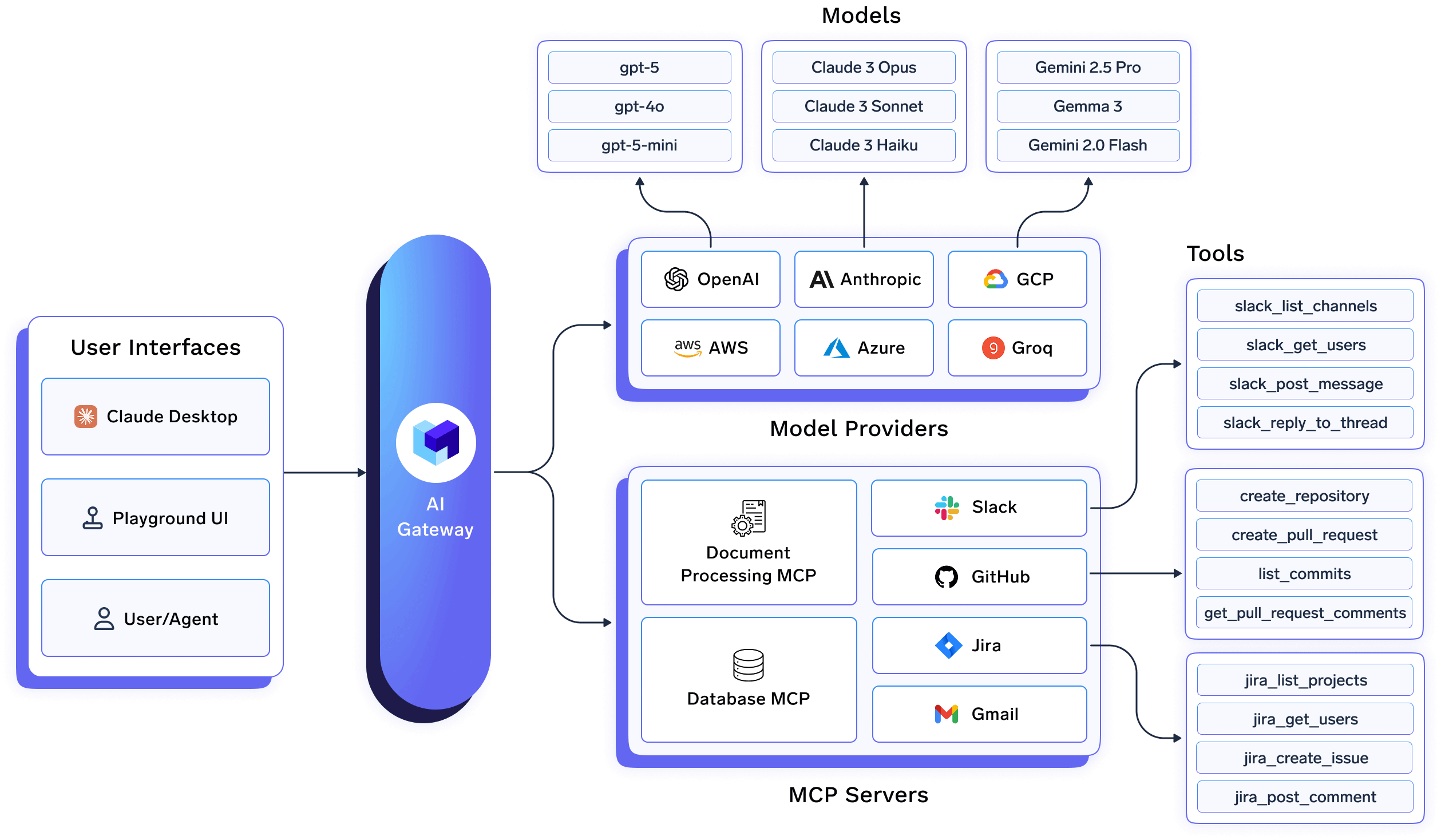
TrueFoundry approaches the same problem Runlayer solves, controlling which tools and MCP servers agents can reach, as a published product rather than a custom enterprise deal. The MCP Gateway applies role-based access control to every registered MCP server, supports virtual MCP servers for teams composing multiple tools behind one governed endpoint, and logs every tool call with metrics visible in the same dashboard as LLM traffic.
Where Runlayer wraps identity, budgets, and OAuth grants around agent access without a dedicated AI Gateway alongside it, TrueFoundry pairs the same category of governance (RBAC, quotas, audit logs) with an AI Gateway that routes and governs the underlying model traffic in the same control plane. That matters if your evaluation includes LLM cost and routing, not just MCP access.
A platform team evaluating Runlayer for MCP governance can register up to 25 MCP servers and get RBAC, virtual MCP servers, and tool-call metrics on the $499/month Pro plan, and see the exact tool-call and request limits before signing anything. Full breakdown at truefoundry.com/pricing.
Good fit if:
Consider alternatives if:
Is Runlayer expensive?
There's no public number to confirm this either way. Runlayer is positioned as enterprise governance software, backed by $11M in seed funding and a $30M Series A, which typically funds enterprise sales motion rather than a low-cost self-serve product. Expect an enterprise-scale quote rather than a low monthly fee.
Does Runlayer have public pricing?
No. Runlayer doesn't list plans, tiers, or a starting price anywhere on its site. Every deal runs through a demo request and a custom quote.
Is there a free tier?
No. There's no publicly advertised free tier or free trial. The only path to see the product is booking a demo.
How do I estimate the total cost?
Use the cost drivers in this guide as a checklist when you talk to sales: organization size, number of users, number of agents and MCP servers under governance, compliance requirements, and support tier. Ask for a quote broken out by these dimensions rather than a single bundled number, so you can see what's driving the price.
How does it compare to alternatives like TrueFoundry?
TrueFoundry publishes four pricing tiers starting at $0/month and covers AI Gateway and MCP Gateway governance in one platform. Runlayer has stronger Shadow AI discovery specifically, but requires a sales conversation for any number at all. See the comparison table above for a full breakdown.
Runlayer's pricing opacity isn't unusual for enterprise AI governance software, and its Shadow AI discovery is a genuine strength if that's your primary concern. But if you'd rather see real numbers before a sales call, and want AI Gateway and MCP Gateway governance from the same platform, check TrueFoundry's published pricing or book a demo to compare the two directly.
TrueFoundry AI Gateway delivers ~3–4 ms latency, handles 350+ RPS on 1 vCPU, scales horizontally with ease, and is production-ready, while LiteLLM suffers from high latency, struggles beyond moderate RPS, lacks built-in scaling, and is best for light or prototype workloads.






The latest news, articles, and resources sent to your inbox


.webp)
.png)
.png)
.png)
.png)
.png)
.png)
.png)
.png)
.png)


