September 15, 2026
|
5 min read


Published: September 15, 2026
Blazingly fast way to build, track and deploy your models!
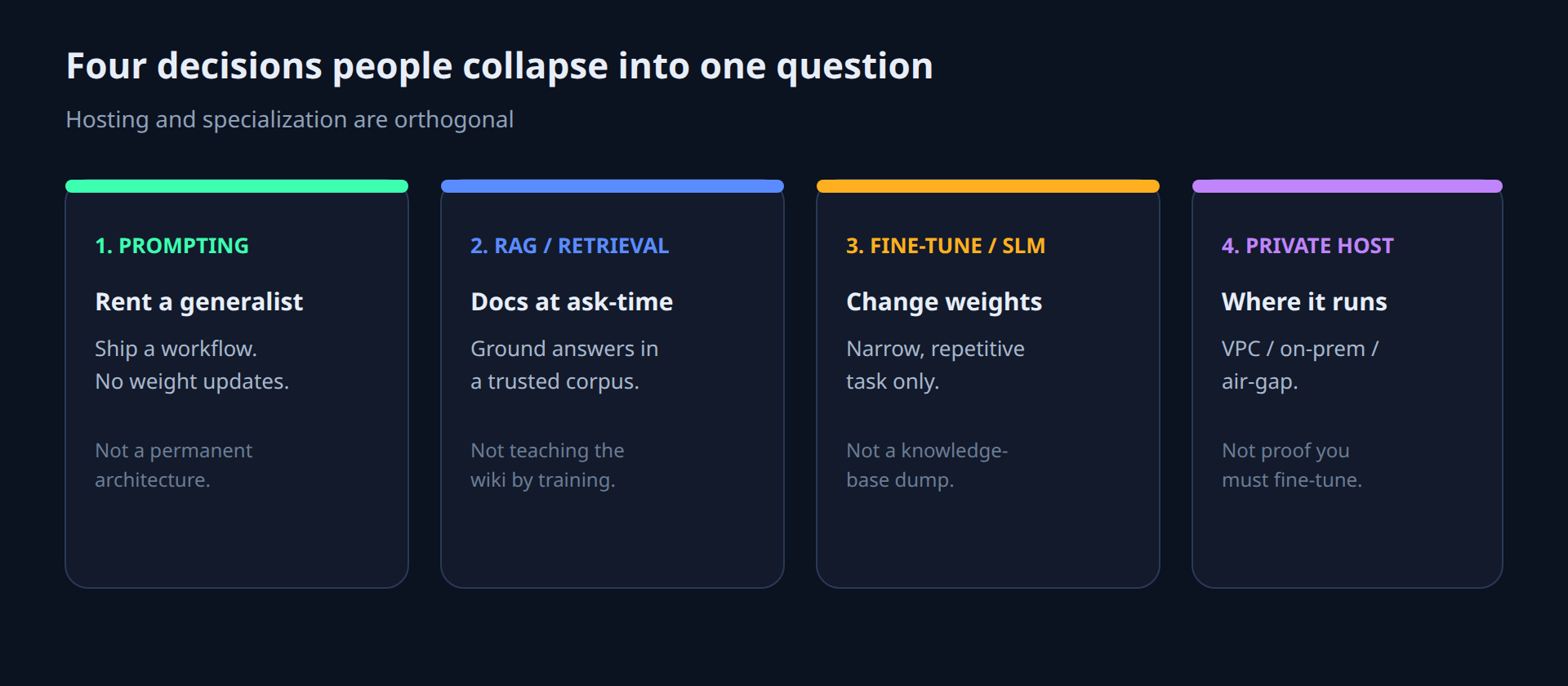
Teams often ask "SLM or LLM?" as if that answers the product. It doesn't. Four different decisions get mashed together:
You can prompt a private LLM. You can fine-tune and still call a public API for the open-ended parts. Hosting and specialization are orthogonal. Mixing them up is how regulated teams stall for a quarter on GPUs when the real blocker was a missing doc index.
For how teams keep model choice and spend under control once traffic is live, see what an LLM gateway is (https://www.truefoundry.com/blog/llm-gateway). The gateway question comes after you know which track you are on.
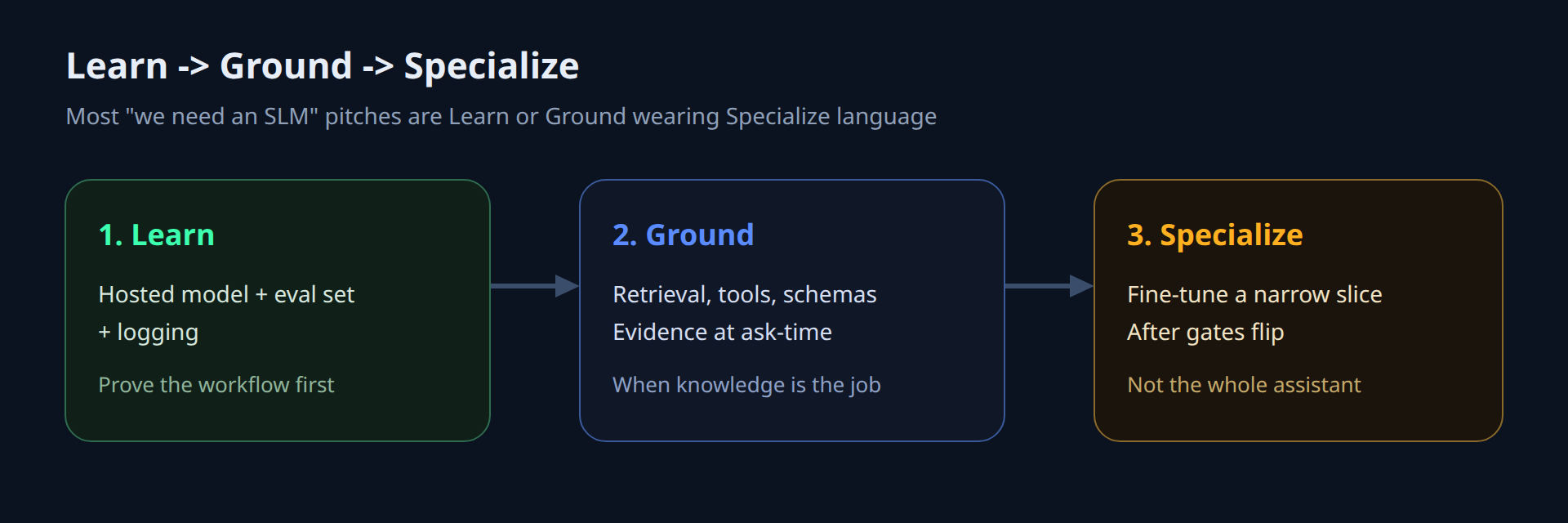
Once you separate those four decisions, the roadmap collapses into three tracks:
Most "we need an SLM" pitches are really Learn or Ground problems wearing Specialize language.
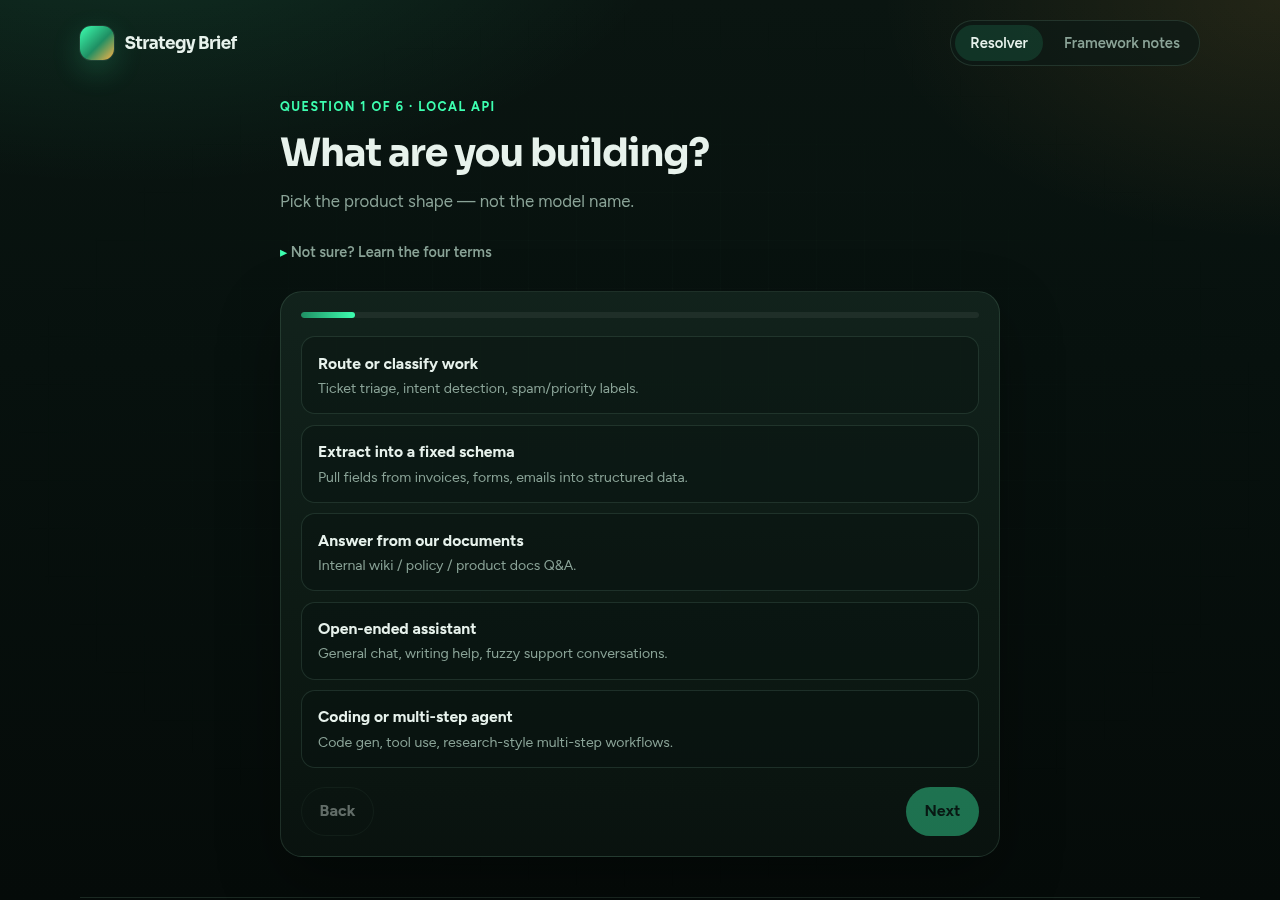
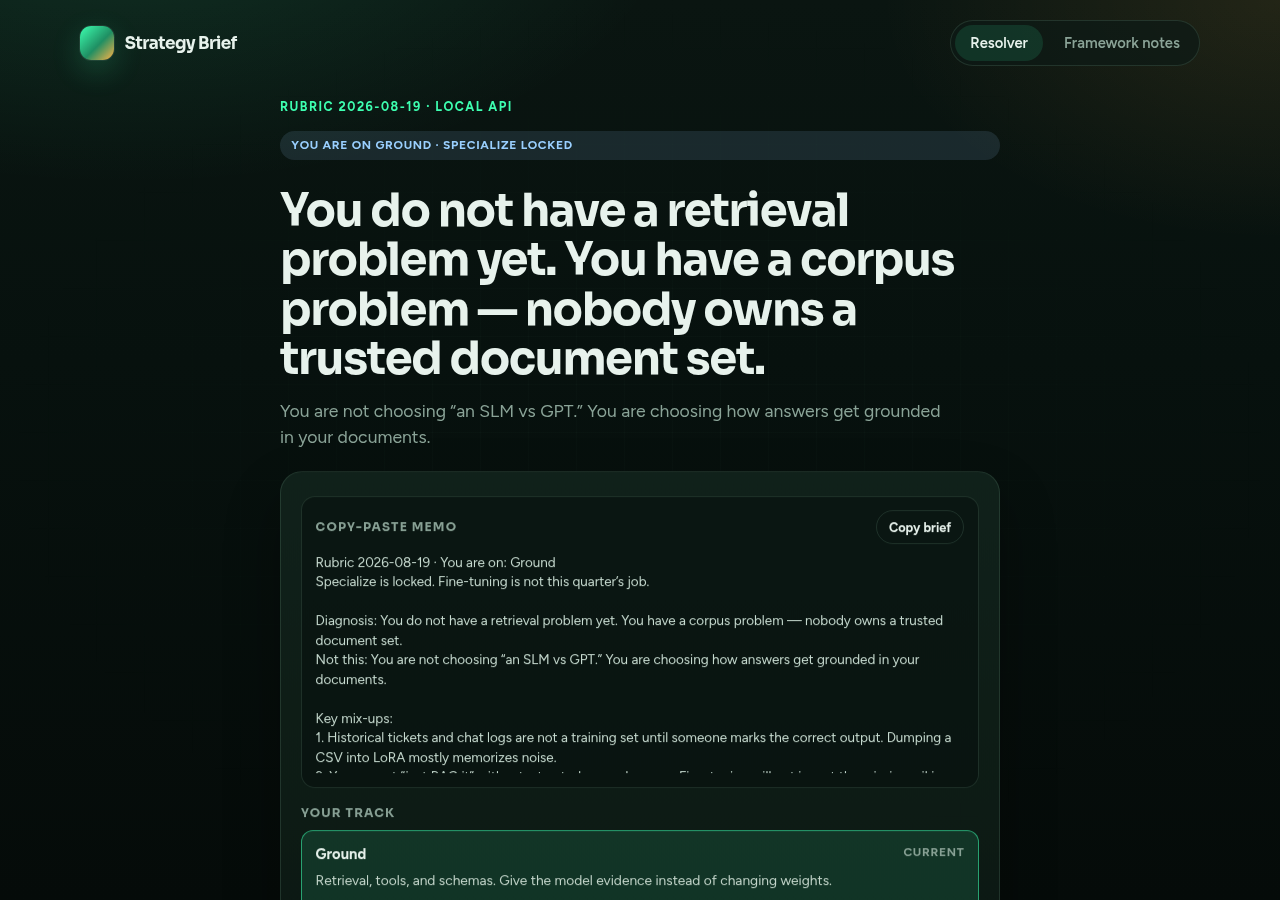
We built a small fine-tuning vs prompting resolver (https://benchmark-accelerators.ml.tfy-eo.truefoundry.cloud/fine-tuning-vs-slm) around that framing. Answer a handful of product questions and it returns a diagnosis, locked vs current tracks, and a copy-paste memo. Same rubric every time, so PM, eng, and security argue from one sheet.
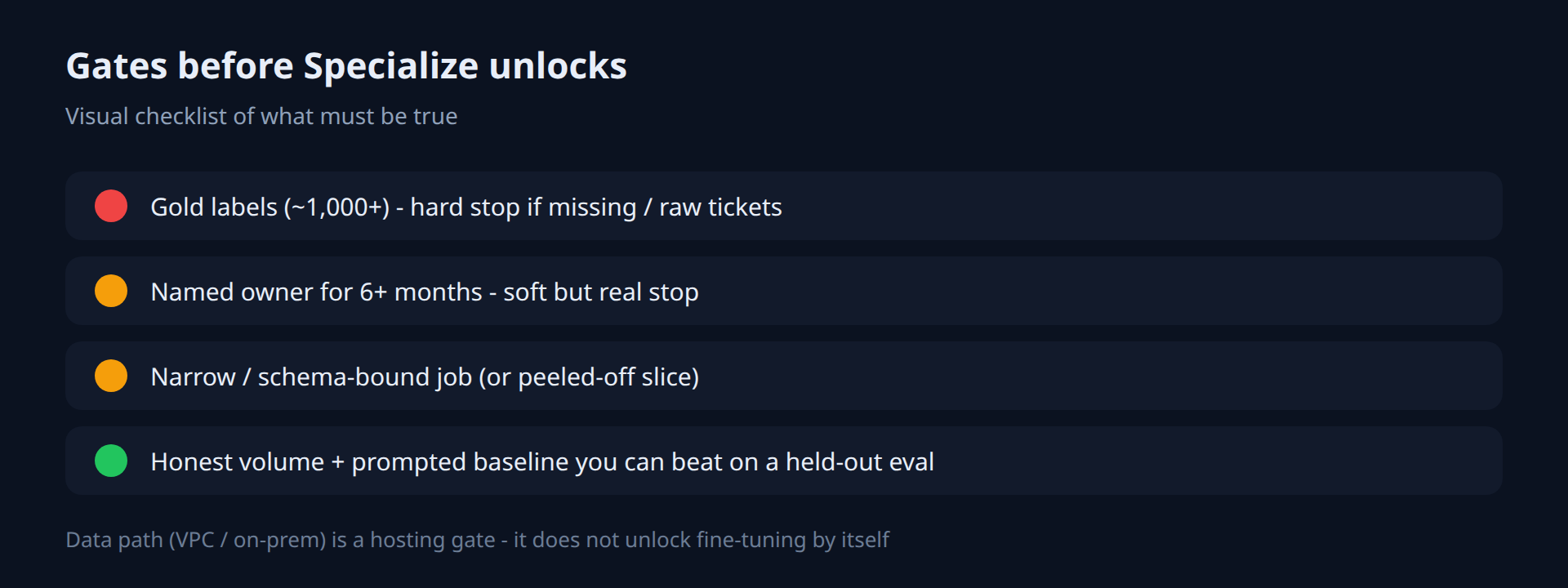
Developer enthusiasm matters. Vendor demos matter less. Neither replaces gates.
Is this ticket triage, field extraction, docs Q&A, open chat, or a multi-step agent?
Closed or schema-bound work can specialize later. Open-ended assistants and coding agents almost never should be fine-tuned first. If you can peel off a narrow sub-task (classify, then draft), specialize only that slice.
Internal / low risk can start on a public API with normal vendor review. Customer PII needs a privacy review. Regulated data (PHI, finance residency, air-gap) forces VPC or on-prem.
That decision is hosting. It does not unlock fine-tuning by itself. For spend and latency once volume grows, LLM cost optimization (https://www.truefoundry.com/blog/llm-cost-optimization) is the parallel conversation, not a substitute for labels.
Historical tickets and chat logs are not a training set until someone marks the correct output. Dumping a CSV into LoRA mostly memorizes noise.
If someone says "we have some examples," ask whether those are gold or raw. Raw counts as none.
Fine-tuning without an owner is a frozen prompt you cannot safely update when data or the base model shifts. Evals, drift, and redeploys need a name on the hook. "Maybe later" is Learn, not Specialize.
Pilots rarely pay back GPU plus MLOps. Hundreds of requests per day may still favor APIs. High steady volume is when unit cost and latency start to justify a specialist, and only after the other gates pass.
Ask eng for the eval set, logging plan, and whether a prompted baseline already exists. Ask security about vendor allowlists, prompt logging, and what happens if a future feature starts sending PII. Skip this and the fine-tune becomes a compliance surprise after the first demo lands.
Someone wants the model to "know our wiki." That is retrieval. Fine-tuning will not invent missing pages or stay fresh when docs change. If nobody owns a corpus, you do not have a RAG problem yet. You have a corpus problem. Ground first.
This is one of the few places Specialize earns a seat. Keep a prompted baseline on the same eval. Run one narrow LoRA experiment. Only then argue managed private endpoint vs self-host. Classification and extraction are the common wins, not "replace the whole assistant."
Teams try to fine-tune personality into a small model and wonder why quality collapses on edge cases. Keep the open-ended agent on a general model. If there is a closed step before drafting (intent, route, extract), peel that off and specialize only the peel.
The spreadsheet has thousands of rows. Nobody marked correct. Treat it as no labels until review exists. Specialize stays locked for a reason.
Privacy can force VPC or on-prem hosting. It does not force weight updates. Many regulated teams should prompt a private LLM (Learn) or retrieve over a private index (Ground) long before they train.
Spend pressure is real. Training without a held-out scoreboard is how you ship a specialist that loses to the prompted baseline you never measured. Fix the harness first. For routing routine work to cheaper models while you Learn, an LLM router (https://www.truefoundry.com/blog/what-is-llm-router) is often the cheaper lever than a fine-tune.
When the debate starts, force three sentences:
Then list the hard gates with severity. No labels is a hard stop. No owner is a soft but real stop. "Some labels" is a sequence issue: enough to measure, not enough to train. Data path is a hosting gate, not a specialize unlock.
We use that structure in the strategy resolver (https://benchmark-accelerators.ml.tfy-eo.truefoundry.cloud/fine-tuning-vs-slm). The output is a short memo PMs can paste into a PRD or Slack thread, with rubric version on top so arguments stay pinned to the same rules.
Choosing the track is half the job. Once traffic is live, the same issues show up for any LLM workload.
Model selection stays a settings preference. Fine-tunes ship without a baseline. Spend and quality stay invisible until someone complains.
Teams that stay ahead usually put a control layer in front of model traffic. An AI gateway sits between apps and providers. It sets defaults, gates who can call frontier models, attributes cost by team, and keeps inference in the right network boundary. For the mechanics, see LLM gateway (https://www.truefoundry.com/blog/llm-gateway) and multi-model routing (https://www.truefoundry.com/blog/multi-model-routing).
TrueFoundry's AI Gateway (https://www.truefoundry.com/ai-gateway) is one option built for that job: one OpenAI-compatible API across 1,000+ models, with quotas, RBAC, cost tracking, and routing policies. You can run it in your VPC, on-prem, air-gapped, or hybrid, so the data path decision from earlier stays enforceable. When Specialize finally unlocks, TrueFoundry's training and fine-tuning (https://www.truefoundry.com/training-fine-tuning) path covers the narrow LoRA work without bolting on a separate MLOps stack first.
If model governance, private hosting, or a clean path from prompted baseline to specialist are still open after you pick a track, it's worth a look.
Fine-tuning vs prompting is a budgeting and sequencing decision, not a brand preference. Most teams should Learn or Ground this quarter. Specialize is earned: narrow job, gold labels, named owner, honest volume, and a prompted baseline you can beat.
Map the job before you name a model. Separate hosting from fine-tuning. Count reviewed examples, not ticket dumps. Give finance and security a track and a gate list, not a vibes vote.
We learned most of this after watching "let's fine-tune" projects absorb a quarter and still fail an eval the prompted model already passed. The model catalog will keep growing. The gates will not get simpler. Getting the strategy side right early saves a lot of awkward roadmap resets later.
TrueFoundry AI Gateway delivers ~3–4 ms latency, handles 350+ RPS on 1 vCPU, scales horizontally with ease, and is production-ready, while LiteLLM suffers from high latency, struggles beyond moderate RPS, lacks built-in scaling, and is best for light or prototype workloads.




When the job is narrow and repetitive, you have ~1,000+ clean labeled examples, a named owner for evals and redeploys, enough volume that unit cost or latency hurts, and a prompted baseline you can beat on a held-out set. If any of those are missing, keep prompting (and add RAG if the job is knowledge).
Fine-tuning changes model weights for a specialist behavior. RAG retrieves trusted docs at ask-time so answers stay grounded and fresh. Private hosting is where inference runs. You can combine them in any order; picking VPC hosting does not mean you must fine-tune.
Usually one of: no held-out eval, labels that were raw tickets, an open-ended job that should not have been specialized, or no owner to keep the specialist from drifting. Specialize without a scoreboard is guessing.
Route traffic through an AI gateway. Set default models. Gate premium access. Expose per-team spend. TrueFoundry's AI Gateway gives engineering leads usage and cost visibility across 1,000+ LLMs behind one OpenAI-compatible API, so model choices do not pile into billing surprises while you are still proving the product.
Yes. TrueFoundry runs in your VPC, on-prem, air-gapped, or hybrid, so prompts and responses never leave your domain even as you route across many providers.



The latest news, articles, and resources sent to your inbox
.webp)
.webp)
.webp)
.webp)