


احصل على وصول فوري إلى بيئة TrueFoundry مباشرة. انشر النماذج، ووجّه حركة مرور LLM، واستكشف المنصة بالكامل — بيئة الاختبار الخاصة بك جاهزة في ثوانٍ، ولا يلزم وجود بطاقة ائتمان.


Synthetic Data: Definition, Benefits And Use Cases

Building an AI model often requires enough good-quality data to train and test the model. However, compiling or evaluating real-world data can be difficult. It may be expensive to collect, difficult to access because of privacy rules, or limited because the relevant event happens rarely, to provide enough examples.
Synthetic data addresses some of these data availability issues. Synthetic data generation can produce data that reflects real-world patterns, characteristics, or relationships without relying entirely on real-world records.
H2: What is synthetic data?
Synthetic data is artificially generated data designed to reproduce selected characteristics, patterns, or relationships found in real-world data. It can be generated using statistical models, simulations, rules, or machine learning models trained on real-world data.
Examples of synthetic data include artificial financial transactions, simulated sensor readings, generated images, synthetic customer records, synthetic medical data, or simulated driving scenarios.
For example, an automotive company could generate data representing different road, traffic, and driving conditions to test a driver-assistance system. A financial institution could create artificial transaction data to test a fraud detection model without exposing real customer records.
H2: Why is synthetic data used?
Organizations use synthetic data to support AI development, reduce some data-collection costs, and limit direct exposure to sensitive real-world records when access to real data is restricted or difficult.
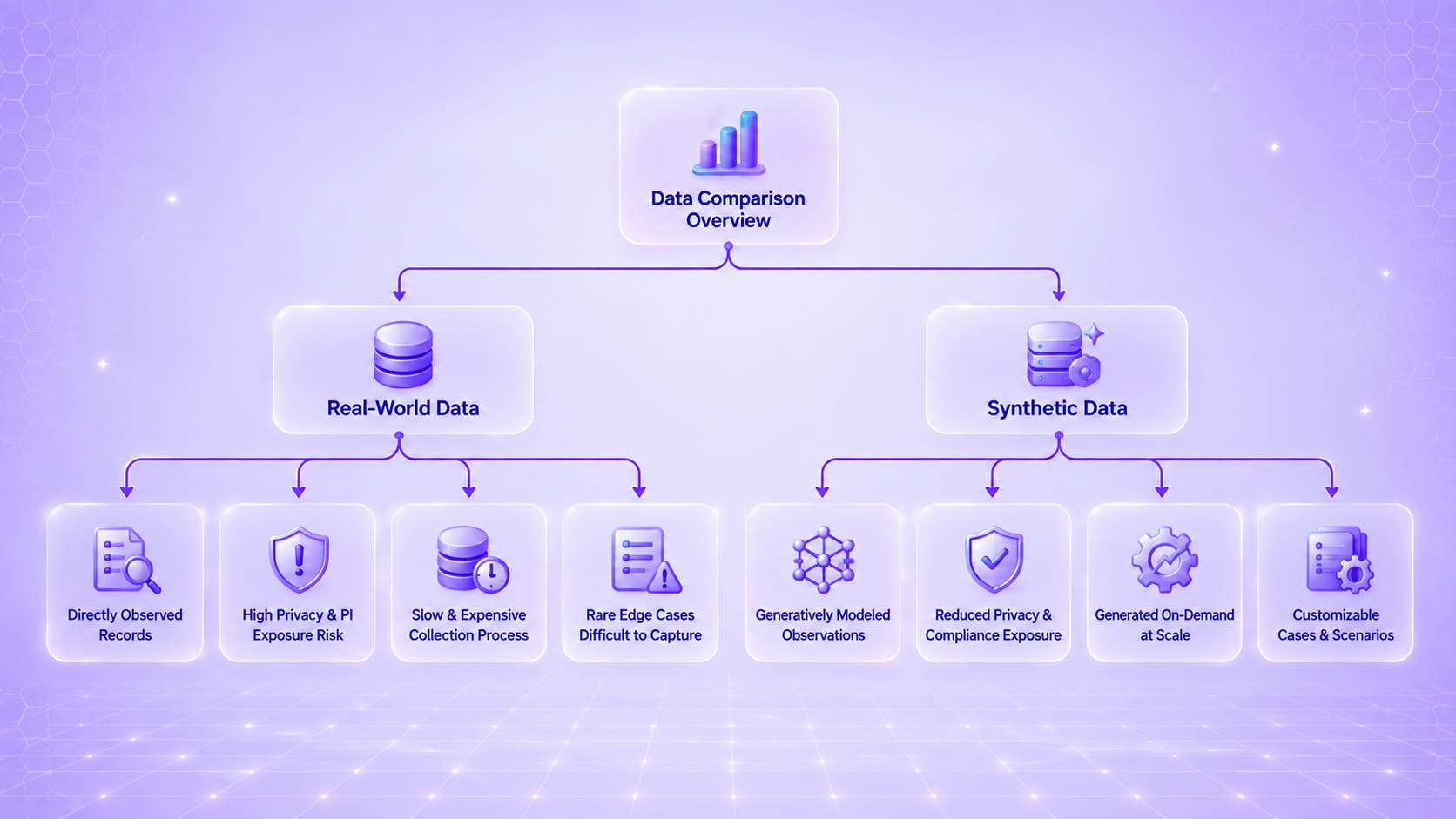
Alt text
Synthetic data generation showing real-world patterns transformed into artificially generated records
Caption
Synthetic data is generated to reproduce selected patterns or characteristics of real-world data.
H3: Filling gaps in training and testing data
Machine learning models require large and varied datasets to handle different situations. Collecting enough real-world data can take a long time when the events don't happen frequently.
Synthetic data can provide data by generating instances of relevant scenarios. For example, a team developing a fraud detection model can create more examples of unusual transaction patterns when real cases are limited to cover the data needed for development and testing. Synthetic data can also be used to test edge cases that are difficult or costly to reproduce in the real world.
H3: Privacy regulations and data access challenges
Real-world datasets can contain names, financial details, medical records, location information, or other sensitive attributes. These data may be subject to privacy requirements, access controls, and internal data-governance policies. Synthetic data reduce the need to expose real records during certain development and testing activities. But it should not automatically be treated as anonymous or risk-free. A generation method that memorizes and reproduces real records, or reproduces sensitive patterns from the source data, can create privacy risk.
Privacy testing should be a part of the synthetic-data workflow, particularly when the source data contains highly sensitive information.
H3: Access to data means access to opportunities
Limited access to relevant data can delay model deployment and testing. A development team may have a model ready to test but lack enough examples, while an organization may have useful data that cannot easily be shared between teams.
Synthetic datasets can provide developers and researchers with data for prototyping and testing when access to real-world data is denied or delayed. This allows teams to prototype and test workflows before data is accessible.
H2: What are the types of synthetic data?
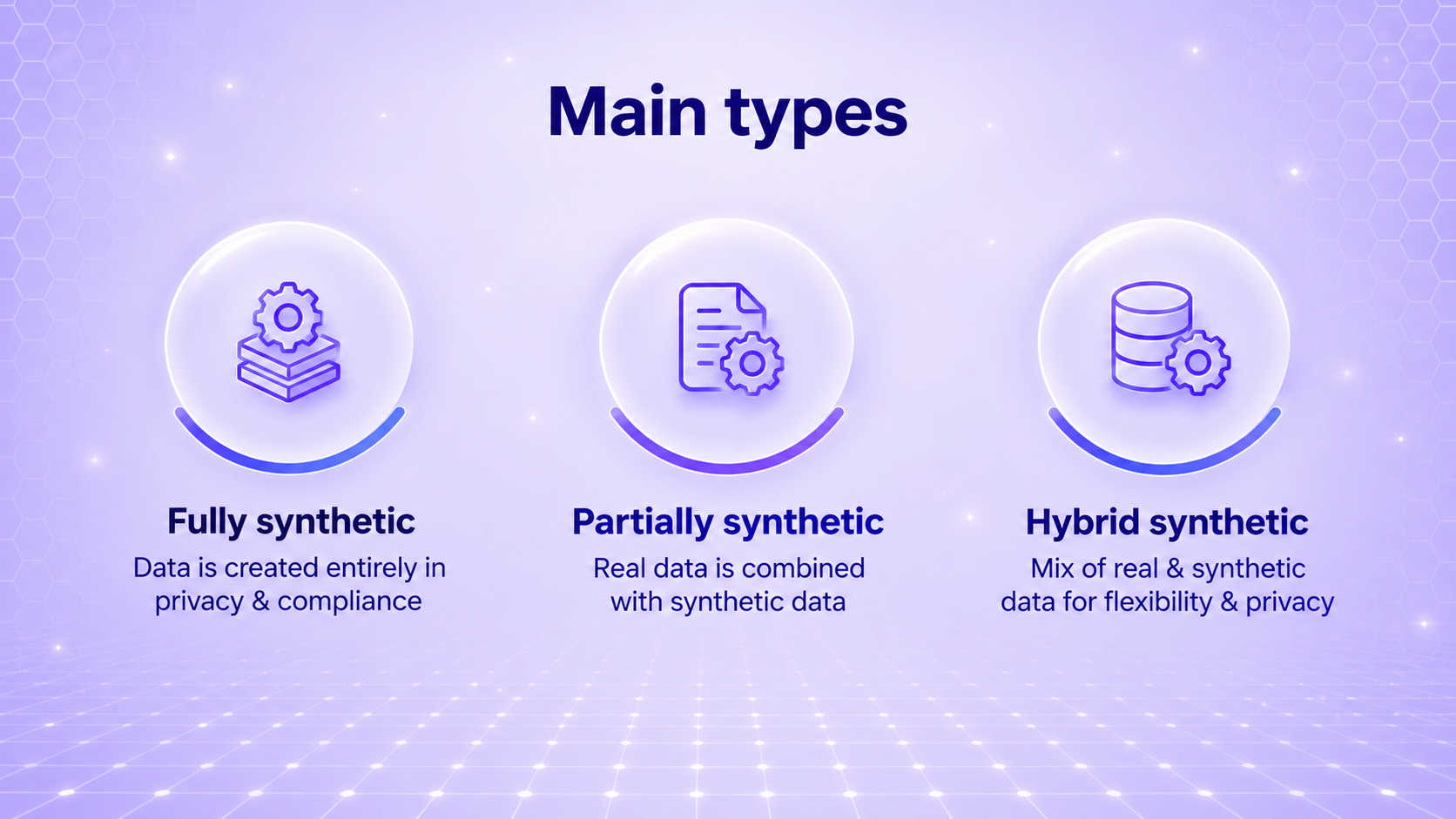
Alt text: Types of synthetic data include fully synthetic, partially synthetic, and hybrid synthetic
Synthetic data can be classified into three categories based on how real and generated data are used.
H3: Fully synthetic data
Fully synthetic data consists of generated records rather than records created by replacing specific values in an existing dataset.
For example, a bank could create an artificial dataset containing account activity, transaction amounts, payment times, and other attributes that follow realistic patterns observed in real transaction data without representing actual customers.
H3: Partially synthetic data
Partially synthetic data is created with real data, where selected values are replaced with generated ones.
This approach can be useful when the structure and information in most of the original dataset need to be retained while selected fields contain sensitive information. The generated values can reduce direct exposure to sensitive fields while retaining parts of the original dataset's structure.
H3: Hybrid data
Hybrid datasets combine real and synthetically generated data. A hybrid dataset retains data from original datasets while adding generated examples to represent scenarios that may be underrepresented or have data imbalance in the original data.
Hybrid datasets don't replace real data fully. They add synthetic variations to original datasets to make AI models accurate, safe, and balanced.
H2: How is synthetic data generated?
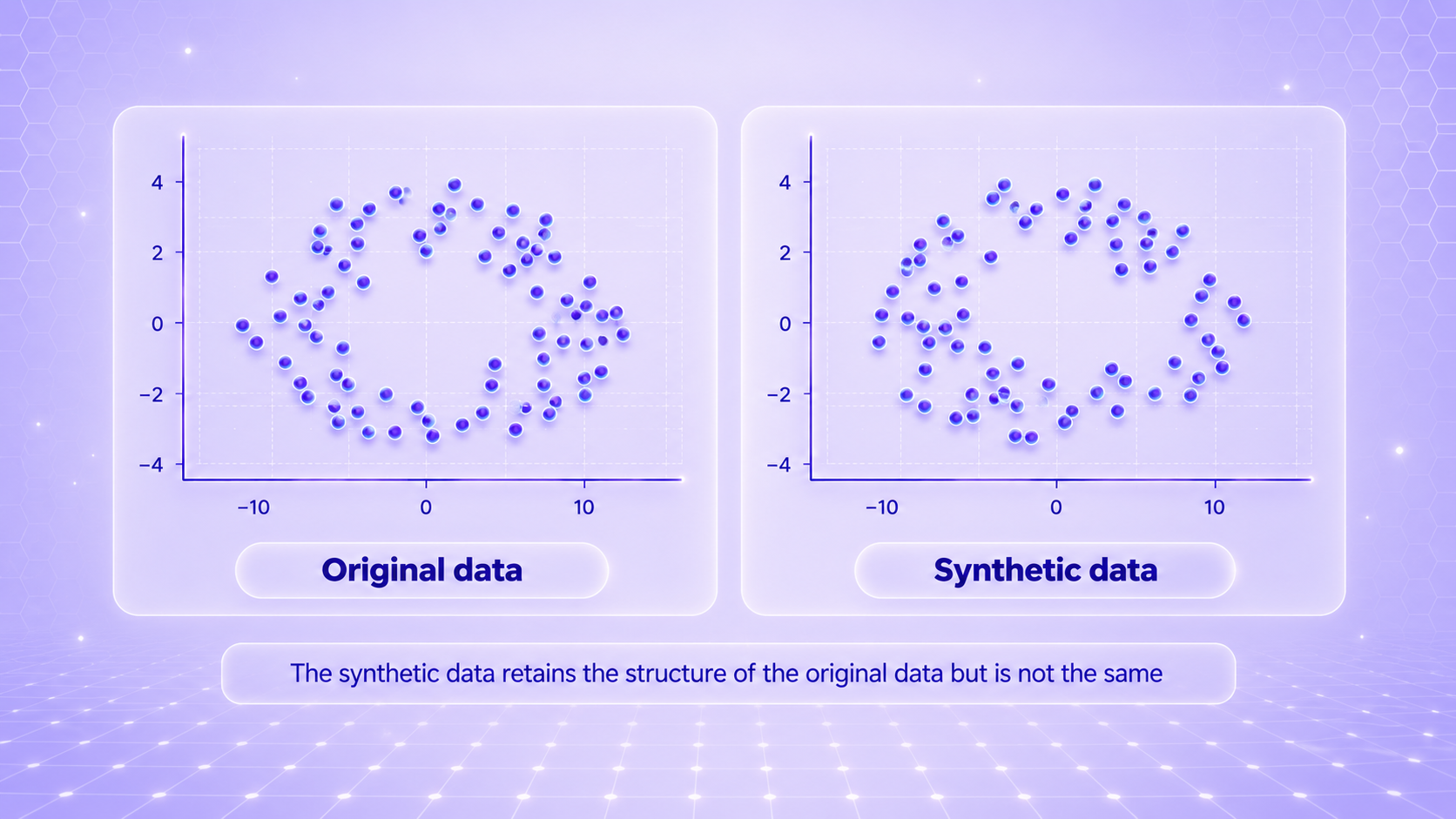
Alt text: Synthetic data generation
There is no single method for generating synthetic data. The method depends on the data type, use cases, and the characteristics the synthetic data needs to reproduce.
H3: Statistical methods
Statistical methods use distributions and relationships observed in existing datasets to generate new observations.
A statistical model can estimate the distribution of values and relationships between variables and then produce new records that follow similar patterns. This approach is often useful for structured or tabular data, such as customer information, financial transactions, and business records.
H3: Generative Adversarial Networks (GANs)
GANs use two neural networks: a generator and a discriminator.
The generator produces synthetic examples, while the discriminator tries to distinguish synthetic examples from real ones. During training, the generator uses the feedback from the discriminator to learn and improve.
GANs have been used to generate synthetic images and can also be applied to other data types.
H3: Transformer models
Transformer models learn patterns in sequential data and can generate new sequences based on those learned patterns.
For synthetic-data applications, transformers can generate text, conversations, code, and other natural language-based data. For example, a transformer-based model could generate synthetic customer-support conversations for chatbot testing, without the need to use real customer chats for every test.
H3: Variational Autoencoders (VAEs)
VAEs generate synthetic data by encoding data into a lower-dimensional latent representation (compressed area where data live) and then use that representation to create new examples.
This allows VAEs to generate new examples that resemble the original dataset. VAEs have been applied to images, tabular datasets, and other data types.
H3: Agent-based modeling
Agent-based modeling simulates the behavior of individual entities, known as agents, and the ways they interact with one another.
Rather than generating isolated records, agent-based models simulate an entire interconnected ecosystem. For example, researchers can simulate vehicles moving through a road network, customers responding to market conditions, or machines interacting within a manufacturing process.
Agent-based modeling is useful when the relationships between entities are an important part of the system being modeled.
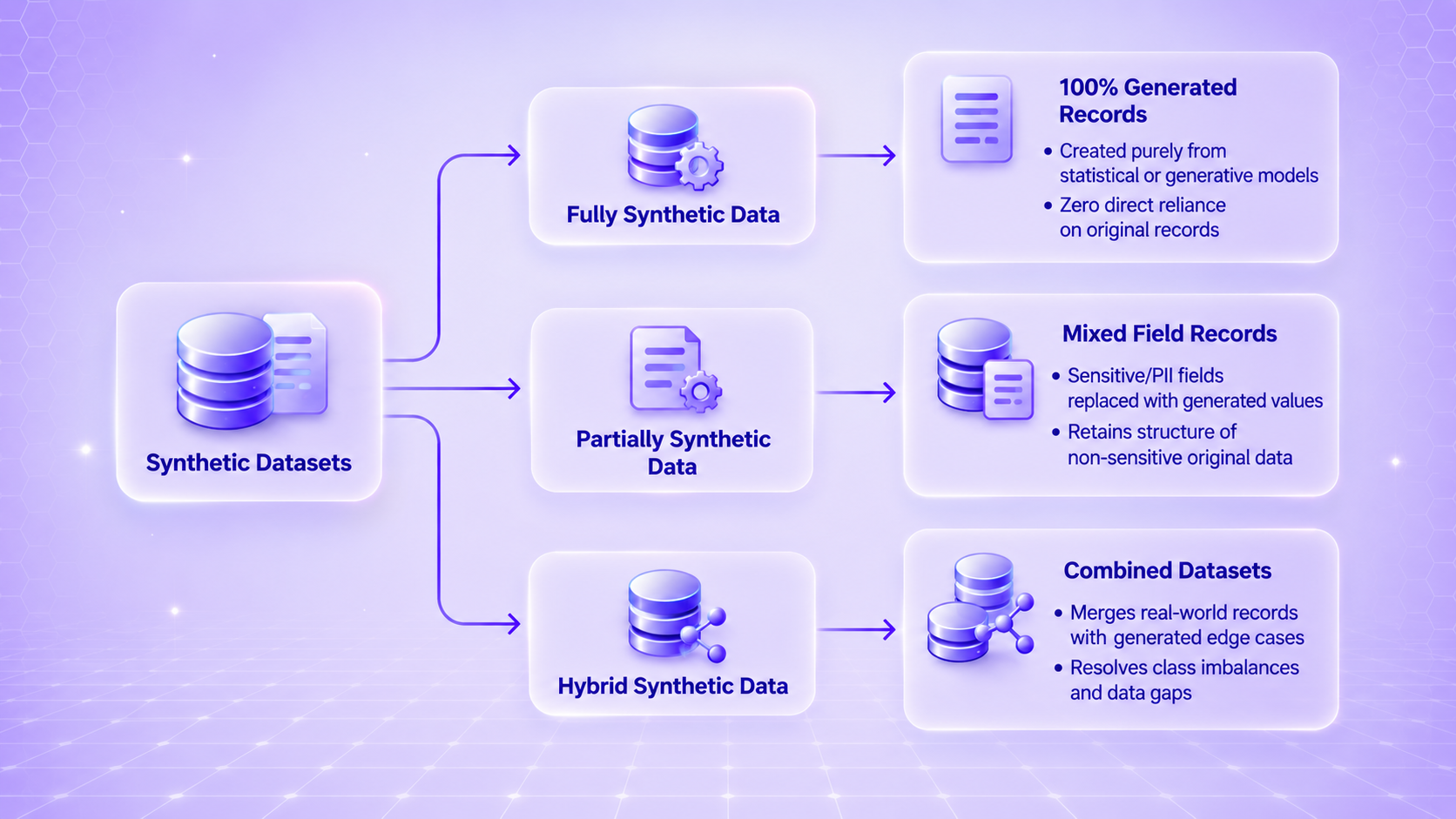
Alt Text: Diagram showing fully synthetic, partially synthetic, and hybrid synthetic data classification
Caption: The three primary approaches to structuring synthetic datasets based on real-data reliance.
H2: What are the use cases of synthetic data?
Synthetic data is useful across industries where real-world data is expensive, sensitive, difficult to collect, or too limited for a particular application.
- Automotive: Automotive companies can use synthetic data and simulation to represent traffic, road conditions, driver behavior, and unusual situations to train and test autonomous driving and driver-assistance systems. Simulation helps create situations where physically testing can be difficult or dangerous.
- Finance: Financial institutions can generate artificial transaction data for fraud detection, risk modeling, software testing, and research. These datasets can provide transaction patterns for testing fraud-detection systems without relying on real customer transactions.
- Healthcare: Synthetic patient records can be used in medical research, software development, testing, and AI training. They can provide data for development and testing without relying on identifiable patient records.
- Manufacturing: Manufacturers can use simulation and synthetic data to model equipment behavior, production conditions, defects, and machine failures. These scenarios can be used to develop predictive maintenance models, evaluate quality control, and test industrial systems under different conditions.
H2: What are the benefits of synthetic data?
When generated and validated properly, synthetic data can provide additional data for specific scenarios, reducing reliance on real-world records.
- Generate additional data for specific scenarios: Synthetic data can generate additional records without needing to collect every new record from real-world sources or individuals. Specific scenarios can also be generated on demand.
- Reduced exposure to sensitive data: Synthetic datasets can reduce direct exposure to sensitive information during development and testing by providing artificially generated records for certain workflows. However, privacy depends on the generation method and should be evaluated for the specific dataset and use case.
- Enhancing dataset diversity: Synthetically generated data increases the representation of underserved groups or rare scenarios. This can help address gaps in the original data, but synthetic data alone does not remove existing biases.
- More control over test data: Developers can generate test records or scenarios for specific conditions rather than waiting for those situations to occur naturally.
- Cost efficiency compared to real-world data collection: In some cases, generating synthetic data may cost less than collecting, labeling, storing, and maintaining large real-world datasets, particularly for testing and simulation.
H2: What are the challenges of synthetic data?
Synthetic data can be useful, but generating more data doesn't automatically make a dataset more suitable for its intended application. The generated output must be evaluated to ensure it accurately represents the real-world problem.
H3: Quality control and fidelity to real-world distributions
A synthetic dataset can look realistic while missing important relationships found in the real-world data.
For example, synthetic financial transactions might have realistic amounts and timestamps but fail to reproduce the relationship between spending behavior, account history, and fraud risk.
Synthetic datasets should be evaluated against relevant real-world characteristics of the real-world data and tested for the purpose they will support.
H3: Model collapse and loss of data diversity
Synthetic data can become problematic when generated data is repeatedly used as the basis for generating or training data.
Repeated generation can increase errors, reduce the diversity of samples, and cause the resulting dataset to diverge from the original dataset. Retaining real data in training and validation can help detect and reduce distributional drift.
H3: Technical complexity of generation pipelines
Generating synthetic data suitable for a specific task requires more than selecting a generation model.
The process may involve preparing source data, choosing a generation technique, setting quality requirements, evaluating privacy, validating the output, and monitoring the pipeline. The complexity increases when the data is large, sensitive, or highly specialized.
H3: Stakeholder trust and adoption barriers
Teams may be cautious about using synthetic data that doesn't come directly from real-world observations.
The concern is whether the data preserves the characteristics and relationships required for the planned task. Clear validation methods, documentation, and comparisons with real data can make synthetic datasets suitable for the task.
H3: Ethical and regulatory considerations
Using synthetic data does not remove the need for data governance, ethical review, or regulatory assessment.
Organizations still need to consider where the source data came from, how the synthetic data was generated, whether sensitive information could be reproduced, and whether the resulting dataset is appropriate for its intended use.
H2: Synthetic data in the world of AI
Knowing what synthetic data is only the beginning. The value of synthetic data depends on how well the data represents the features required for the task. Its usefulness depends on the problem being addressed, whether the generated data is reliable enough for the task, and how well it fits into the organization's existing data and AI workflows.
As synthetic data becomes more common in AI development, teams will need to look beyond the volume of data they can generate and pay closer attention to its quality, privacy, and real-world usefulness.
H2: FAQs
H3: Can ChatGPT generate synthetic data?
Yes. ChatGPT can generate synthetic examples, including customer records, survey responses, transactions, conversations, and other structured or unstructured data. However, the output should be reviewed and validated before it is used for model training, testing, research, or other important applications.
H3: What is an example of synthetic data?
Artificial bank transactions created to resemble real spending patterns are one example of synthetic data. Other examples include simulated patient records, generated customer support conversations, and simulated driving scenarios used to test AI systems.
H3: What is synthetic data vs real data?
Real data comes from actual people, events, systems, or observations. Synthetic data is generated artificially to reproduce useful patterns found in real-world information. Real data provides direct observations, while synthetic data represents generated observations based on a statistical model, simulation, rules, or other generation process.
H3: How do companies get access to synthetic data?
Companies can get synthetic data in several ways. They can download existing datasets from public repositories, purchase datasets from specialized providers, use cloud or data platforms that offer synthetic-data capabilities, or generate datasets internally from real data using statistical models, simulations, or generative AI. The best approach depends on the required data type, volume, realism, privacy requirements, and intended use. Before using a dataset, teams should evaluate its quality, representativeness, privacy risks, licensing, and fitness for the specific task.
H3: Where can you find synthetic data?
You can find synthetic data through public datasets, synthetic-data platforms, cloud providers, research repositories, and datasets generated within your organization. Public repositories such as Kaggle, Hugging Face, and government or academic data portals may provide ready-to-use synthetic datasets. Organizations can also generate synthetic data from their own source data using statistical models, simulations, or generative AI tools when an existing dataset does not meet their requirements. The right source depends on the data type, quality requirements, privacy considerations, and intended use.
Govern, Deploy and Trace AI in Your Own Infrastructure


- © 2022 ENSEMBLE Technologies



اشترك في نشرتنا الإخبارية
أحدث الأخبار والمقالات والموارد تصلك مباشرة إلى بريدك الوارد


