September 22, 2026
|
5 min read


احصل على وصول فوري إلى بيئة TrueFoundry مباشرة. انشر النماذج، ووجّه حركة مرور LLM، واستكشف المنصة بالكامل — بيئة الاختبار الخاصة بك جاهزة في ثوانٍ، ولا يلزم وجود بطاقة ائتمان.


Published: September 22, 2026
Blazingly fast way to build, track and deploy your models!
A prompt becomes operationally meaningful when its messages, variables, model configuration, guardrails, schema, ownership, and release identity travel together.
The phrase “prompt management” can sound like storing strings. In a production application, the executable unit is larger: ordered messages, input variables, model choice, generation parameters, guardrails, structured-output schema, caching and logging settings, and metadata. A change to any of those can alter behavior even when the visible instruction remains unchanged.
TrueFoundry’s Prompt Registry models this unit as a versioned artifact inside a Repository. A saved version has a fully qualified name that applications can reference. Each edit and save produces a new version, and the UI exposes history and diffs. Repository access controls who can view, edit, or use the prompt.
This gives teams a stable identity for the instruction package actually invoked. It does not, by itself, establish that a version is good, safe, or approved for production. Those are release claims that need evaluation and organizational policy.
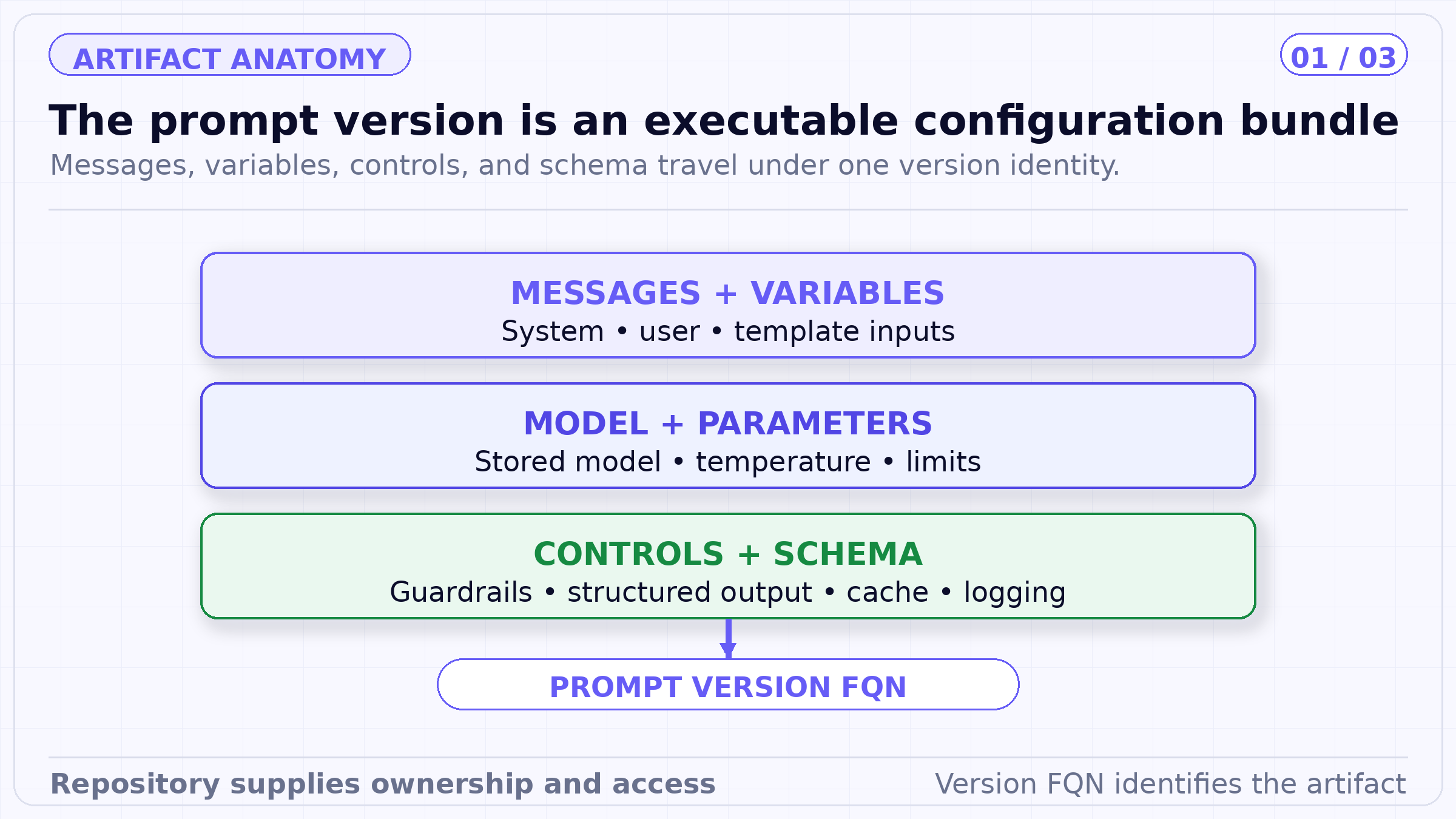
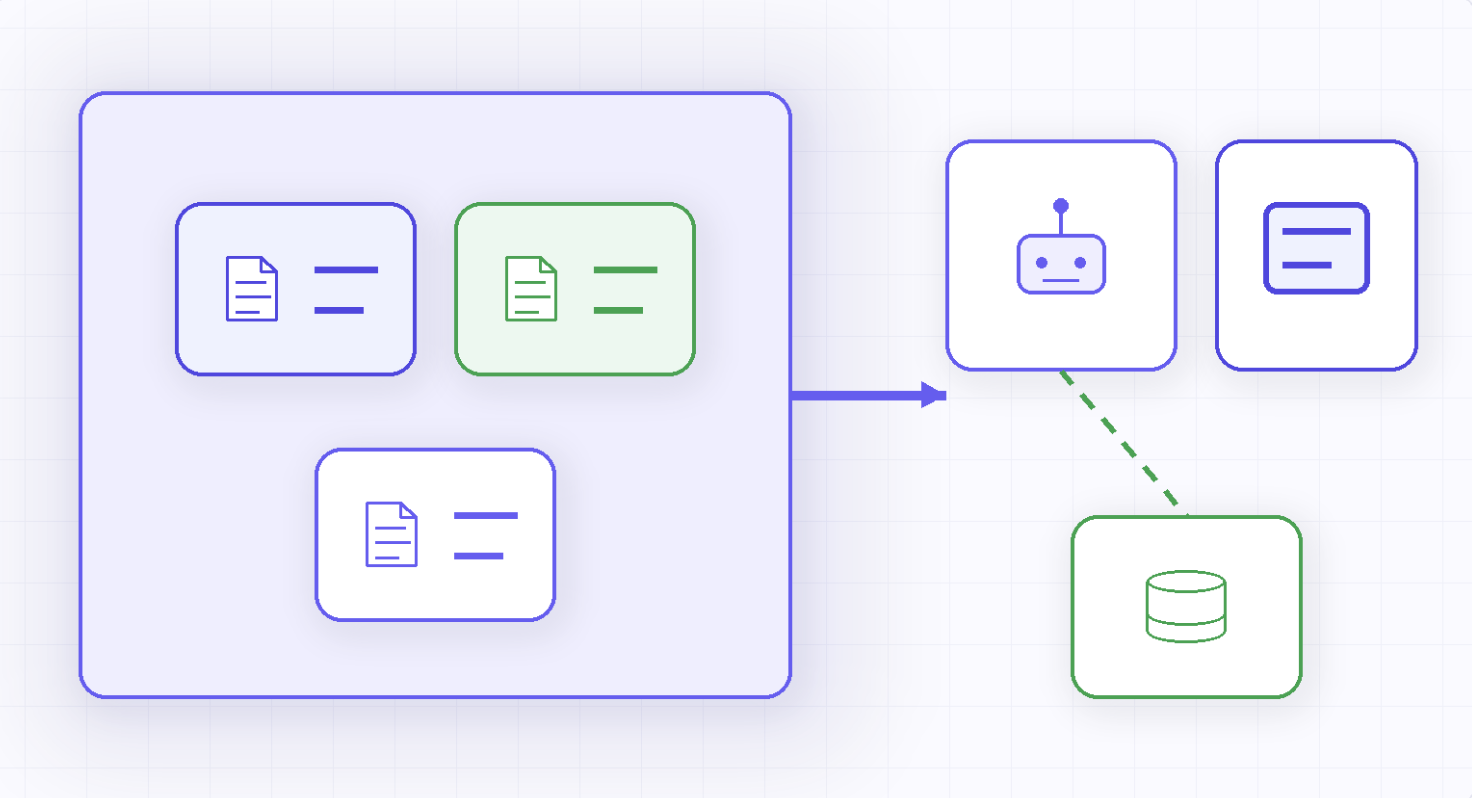
The registry object is deliberately wider than the visible prompt text. Any attached control or schema that changes behavior belongs in the release identity and review surface.
Prompt permissions inherit from the parent Repository rather than being configured independently on each prompt. That simplifies administration and encourages teams to group related artifacts under one ownership boundary. It also means repository design matters. A broad shared repository can unintentionally make sensitive instructions or use rights available to more people than intended.
Separate repositories when ownership, data classification, deployment environment, or change authority differs. Record who authored a version, why it changed, and which applications consume it. A commit message is useful context, but it is not an approval or an evaluation result.
An application can call a saved prompt through AI Gateway by providing the prompt version FQN and runtime variables. The gateway renders the prompt and executes the model request. Alternatively, the TrueFoundry SDK can fetch the version and render it client-side before the application sends the request.
Both paths should preserve the resolved version identity in request metadata and traces. Otherwise a production incident may reveal the final messages but not the artifact that produced them. Pin a numbered version for controlled releases. Treat an unpinned “latest” convention in application code as an implicit deployment channel with a larger blast radius.
The current Skills documentation explicitly rejects a latest alias for skill downloads; Prompt Management documents numbered prompt versions through their FQNs. Even where an integration offers a convenient moving reference, release systems should resolve and record the concrete version before traffic runs.
TrueFoundry documents two precedence rules that deserve explicit tests. If a saved prompt has no model, the request must supply one. If both the version and request specify a model, the request model wins. Messages supplied in the request are appended to the prompt version’s messages. Those behaviors are useful, but they create a composition surface: the version alone may not describe the exact request executed.
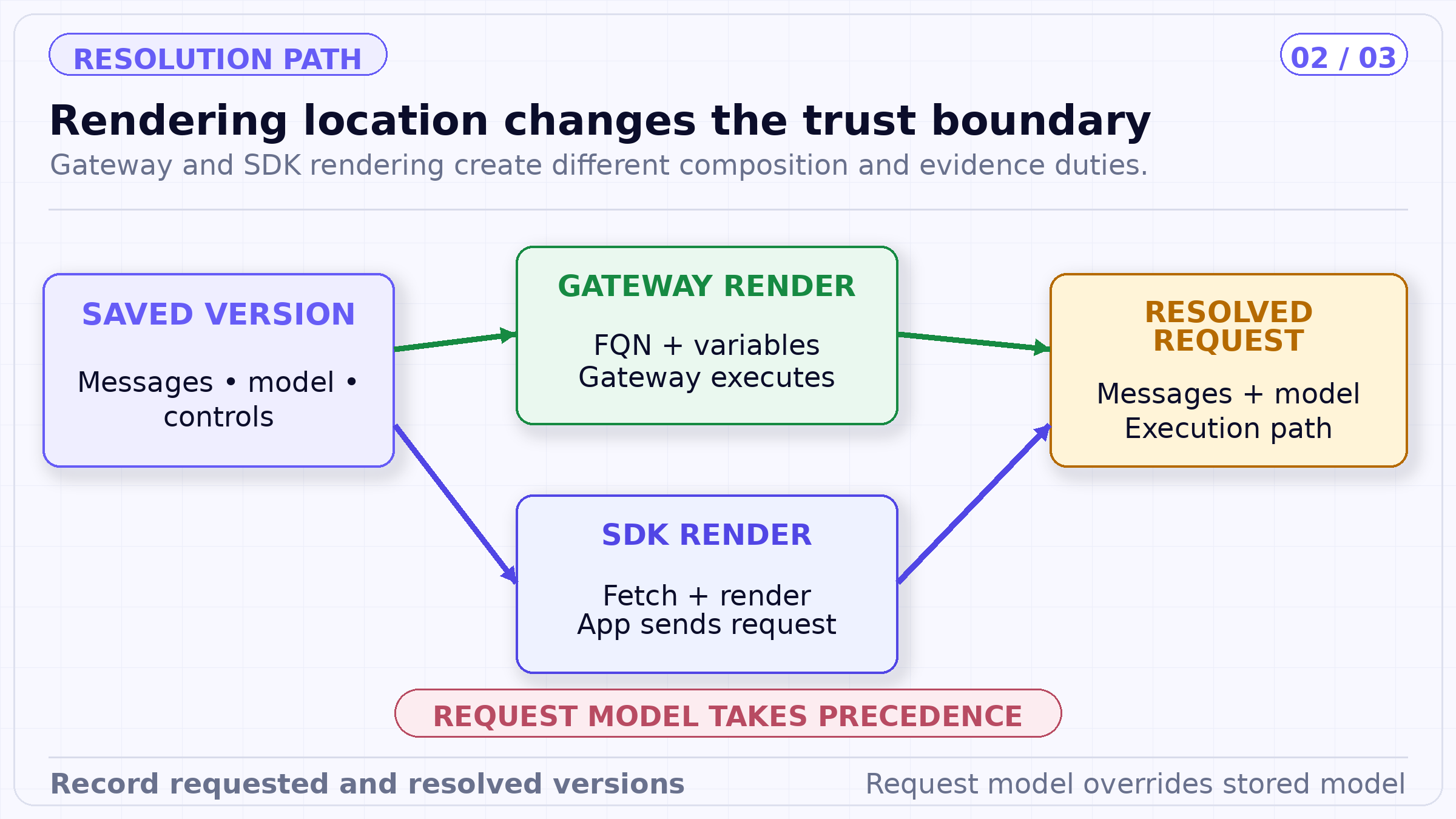
The two rendering paths converge on model execution but expose different mutation points. Telemetry should preserve the saved version, runtime variables, appended messages, and resolved model.
Template variables make a prompt reusable, but they also create input boundaries. Validate required variables, types, allowed values, length, encoding, and data classification before rendering. A variable inserted into a system-level instruction can have a different security impact from the same value placed in a user message.
Do not treat templating as prompt-injection protection. Delimit untrusted values, minimize their authority, and attach appropriate input guardrails. When structured output is required, validate the returned payload against the same schema the downstream code expects. A schema can constrain shape; it does not prove factual correctness or business authorization.
Prompt versions can include a selected model and advanced settings such as guardrails, structured output, logging, caching, and metadata. A release review should compare the complete manifest, not only the message diff. Changing a guardrail from enforce to audit or switching a virtual model target can be more consequential than editing one sentence.
Keep environment-specific concerns explicit. A production model route, logging policy, or data-retention setting may differ from development. If one prompt version must run under several environments, separate invariant prompt content from environment policy and record both resolved versions in telemetry.
Version history answers “what changed?” It does not answer “did quality improve?” A defensible release process joins each candidate version to evaluation datasets, task-level metrics, safety checks, latency and cost measurements, human review where appropriate, and a rollback decision.
Use representative cases that exercise variable boundaries, appended messages, model overrides, guardrail outcomes, and structured-output failures. Compare the candidate against the currently deployed version under the same model route and evaluation configuration. When results are stochastic, report distributions or repeated-sample summaries instead of a single lucky output.
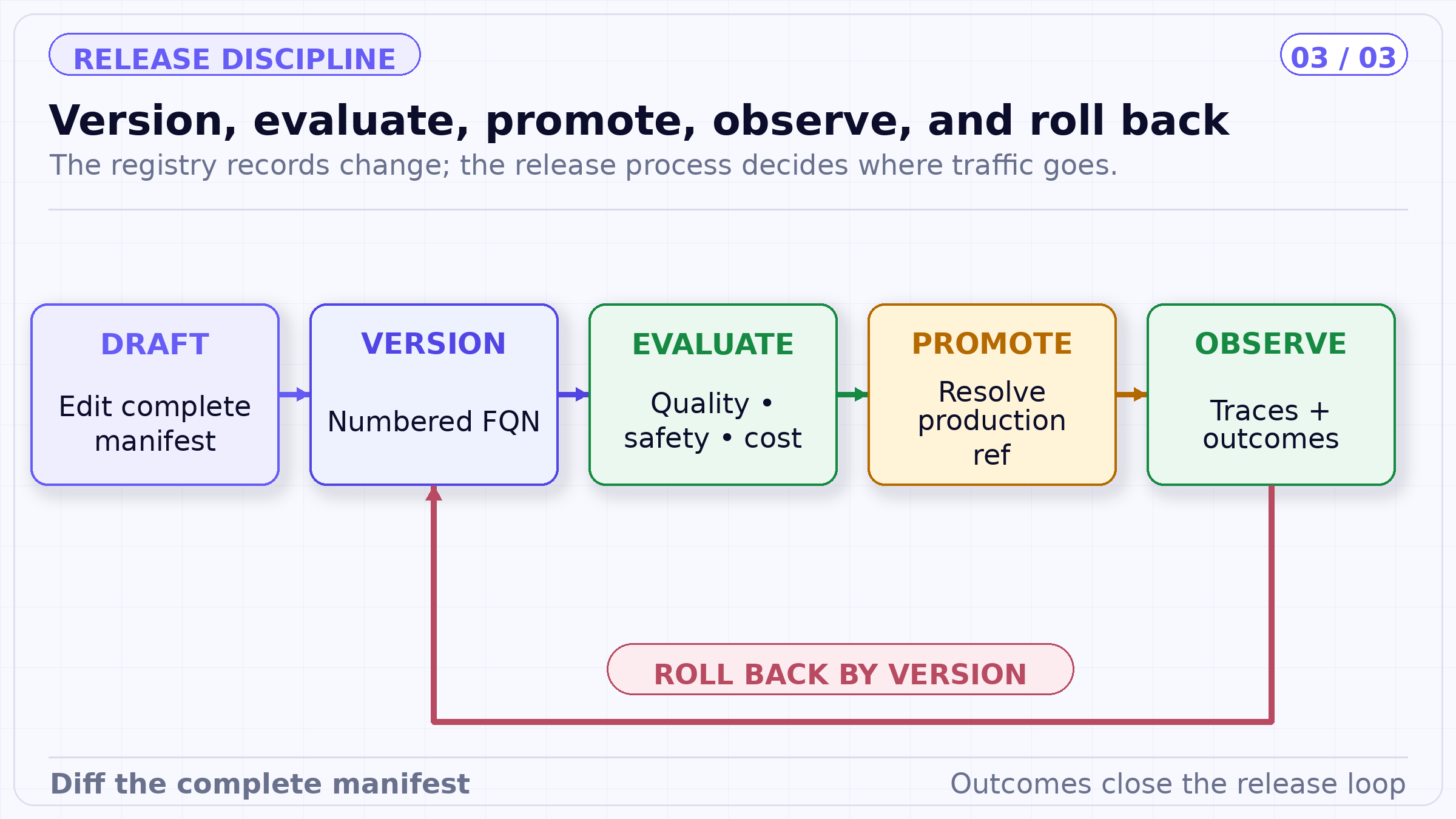
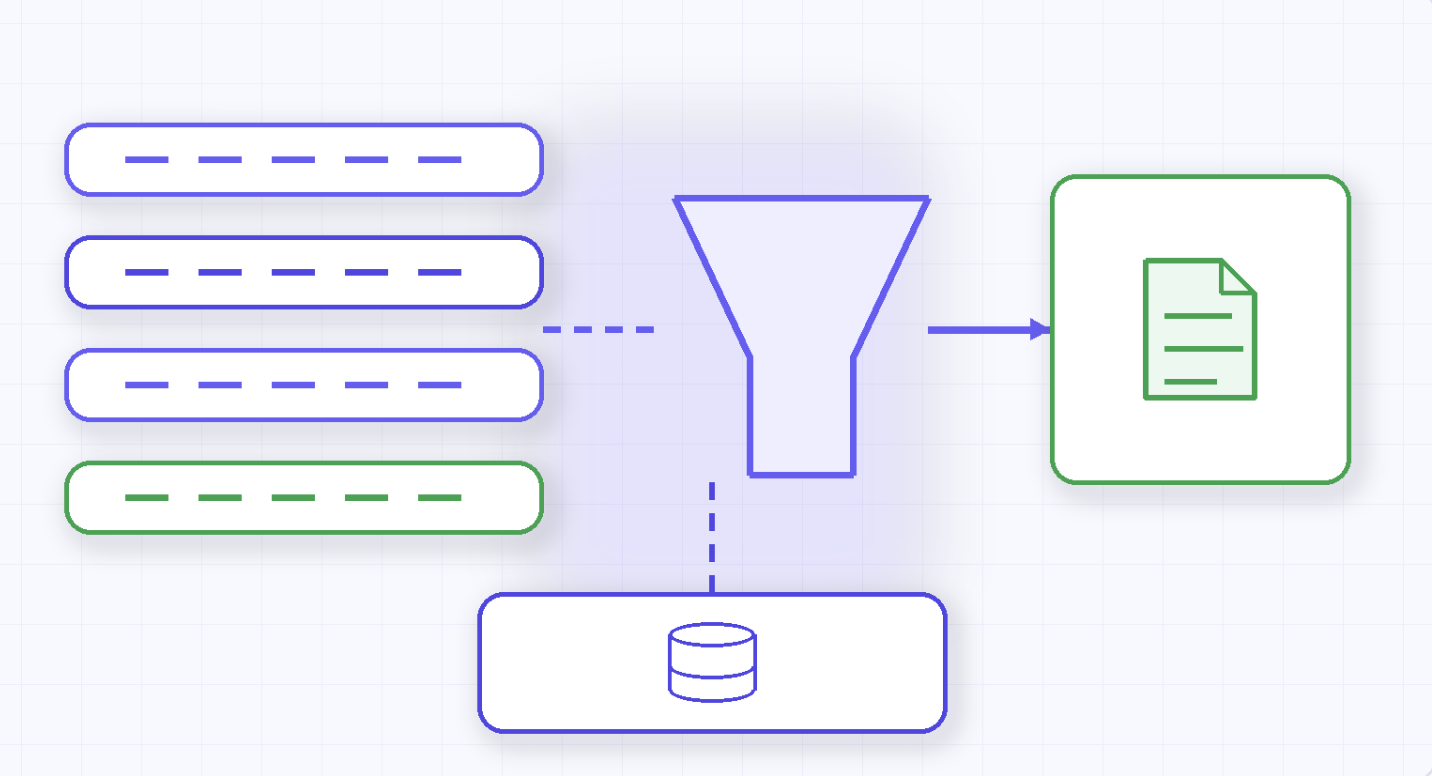
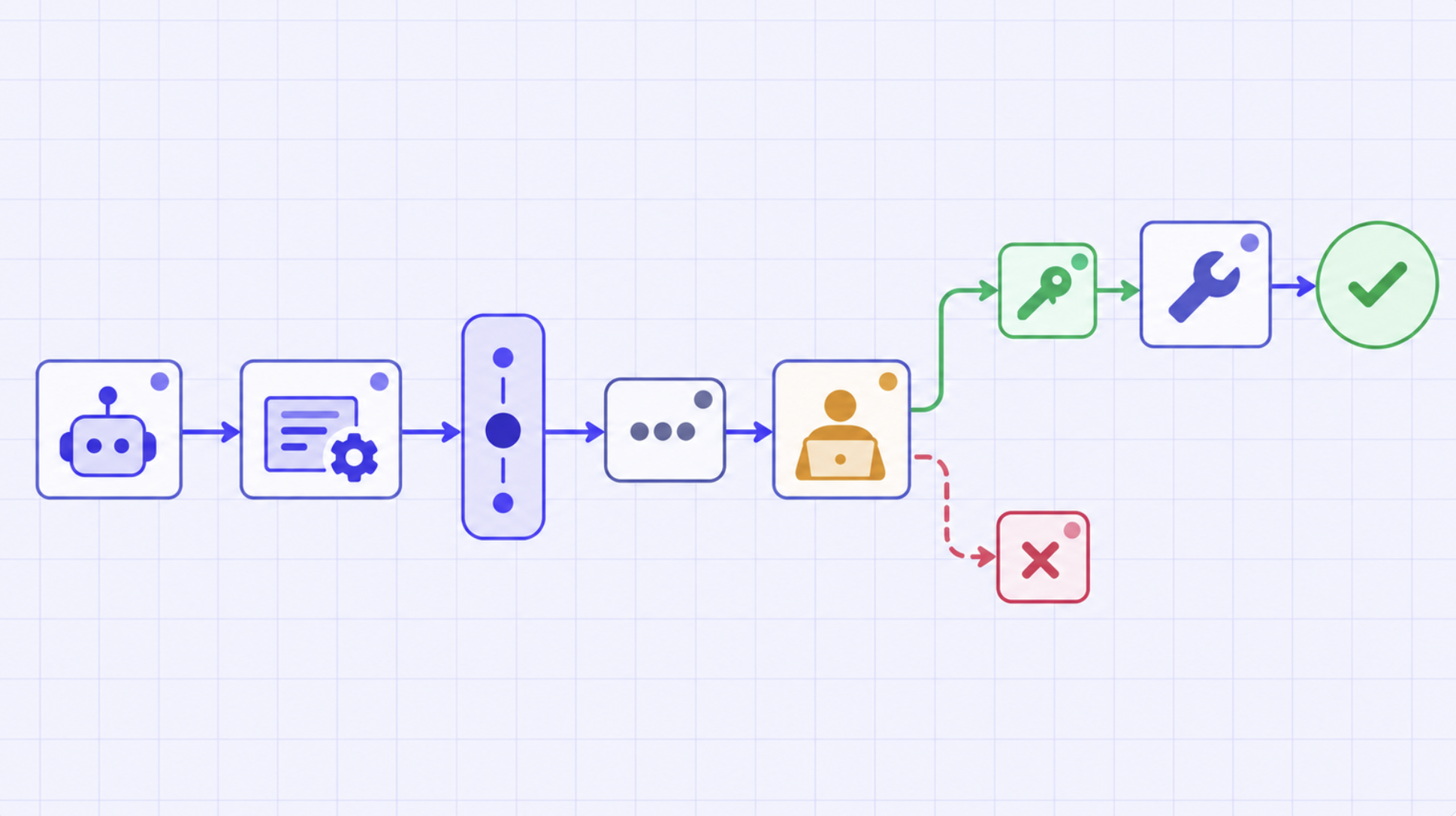
The release loop keeps versioning and evaluation separate. Promotion is a decision over evidence, while rollback restores a known-good combination of prompt, model route, and controls.
A safe rollout resolves a candidate FQN, records the evaluation result, updates a deployment reference, observes production outcomes, and retains the prior version for rollback. The runtime should log both the requested prompt reference and the resolved version. If request-time model overrides are allowed, log the resolved model target too.
Rollback means restoring the complete known-good combination—not merely copying old text into a new version. If a failure involved a model target, guardrail, schema, or application composition rule, the prompt body may be innocent.
Many applications combine a registry prompt with developer instructions, retrieved context, conversation history, tool results, and runtime messages. The registry controls only its portion. Define which layer may introduce behavioral instructions, which layers carry untrusted evidence, and which component is allowed to override model or guardrail configuration.
A useful request manifest records the prompt version FQN, application release, rendering path, variable names and digests, appended-message count, resolved model, virtual-model configuration, structured-output schema version, and guardrail-policy version. That manifest turns a distributed composition process into one inspectable execution identity without storing every sensitive value in every log.
Exact or semantic caching can serve a result without repeating model inference. That can improve cost and latency, but the cache key and invalidation policy must reflect every input that changes the answer or its authorization. A prompt-version change, model-route change, guardrail change, tenant boundary, or material variable may require a different cache entry.
Do not assume publishing a new prompt version removes responses produced by the old one. Verify how the application and gateway identify cached entries, and include the resolved prompt version in cache observability. For sensitive tasks, keep access control outside the cache hit decision or include the authenticated scope in the key so one subject cannot receive another subject’s result.
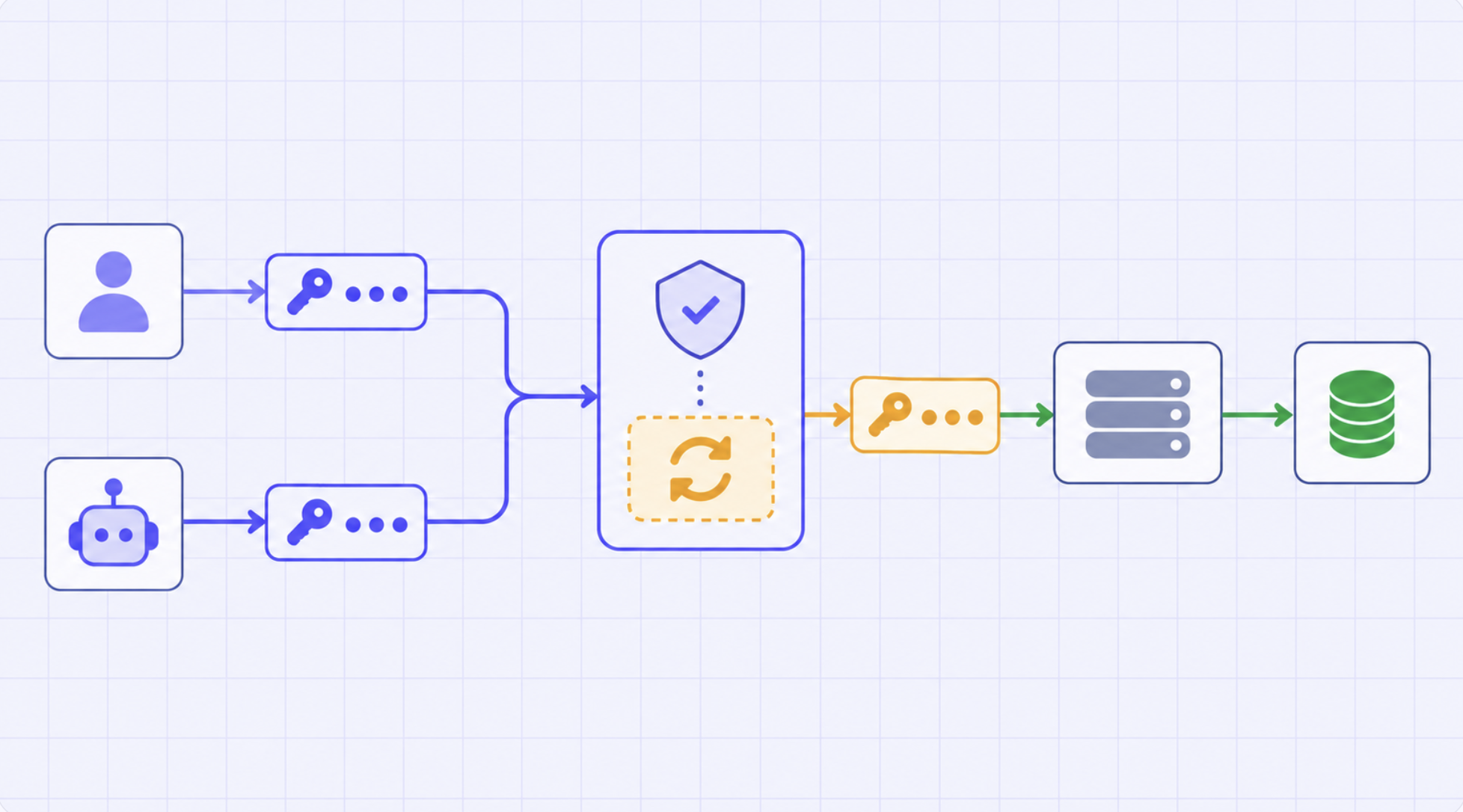
Repository edit rights answer who may create a new version. They do not necessarily answer who may approve production use or change the application’s pinned reference. Mature teams separate those roles for high-impact prompts. The deployment record should name the approver, evaluation report, intended consumers, start time, and rollback target.
Emergency edits still need traceability. A fast path can shorten review, but it should create a concrete version, preserve the diff, narrow the affected traffic, and require retrospective evaluation. Editing an unversioned string directly in production defeats the reason to have a registry.
Prompt Registry supplies artifact identity, versioning, repository access, and reusable invocation. AI Gateway supplies the request path where model routing, budgets, guardrails, logging policy, and telemetry can be applied. TrueForge can consume instructions as part of an agent runtime, but durable session behavior and tool execution remain separate from prompt versioning.
That separation prevents the registry from becoming a vague “AI control plane.” It owns a specific artifact. The gateway owns routed inference controls. The application owns business inputs and outcome validation. Evaluation systems determine whether the combination meets a release bar.
Use Prompt Registry to make model instructions identifiable, reviewable, and reproducible. Pin concrete versions, validate variables, record composition and overrides, and evaluate the full manifest before promotion.
The strongest TrueFoundry story is not that a registry makes prompts correct. It is that the platform gives teams a stable object around which they can build a disciplined release process—and enough runtime control to know which object actually reached production.
Editorial disclosure. This article reflects TrueFoundry’s engineering interpretation of the cited public materials as of September 19, 2026. Product capabilities are scoped to linked documentation. Examples and operating defaults are illustrative; they are not legal advice, an audit opinion, an independent benchmark, or a guarantee of security, safety, or compliance.
TrueFoundry AI Gateway delivers ~3–4 ms latency, handles 350+ RPS on 1 vCPU, scales horizontally with ease, and is production-ready, while LiteLLM suffers from high latency, struggles beyond moderate RPS, lacks built-in scaling, and is best for light or prototype workloads.





أحدث الأخبار والمقالات والموارد تصلك مباشرة إلى بريدك الوارد
.png)
.png)
.png)
.png)


.png)
.png)