


October 1, 2026
|
5 min read


احصل على وصول فوري إلى بيئة TrueFoundry مباشرة. انشر النماذج، ووجّه حركة مرور LLM، واستكشف المنصة بالكامل — بيئة الاختبار الخاصة بك جاهزة في ثوانٍ، ولا يلزم وجود بطاقة ائتمان.



Published: July 4, 2026
Blazingly fast way to build, track and deploy your models!
The Model Context Protocol (MCP), introduced by Anthropic in late 2024, quietly rewired how we connect AI agents to the tools and data they need. Instead of brittle, one-off integrations, MCP standardizes the “adapter” layer so agents can talk to services like Slack, Jira, or GitHub with far less custom work. That’s powerful — and messy. As companies deploy LLM-powered agents, they’re spinning up thousands of MCP servers. Without a control plane, that growth quickly becomes integration chaos: duplicate connectors, scattered credentials, and little visibility into who’s giving AI access to what.
Obot MCP Gateway (launched by Obot AI in August 2025) attempts to solve this. Think of it as both an internal App Store and an air-traffic controller: a central control plane where IT can onboard, secure, and monitor MCP servers while employees discover and connect approved tools.
While Obot offers a well-designed open-source approach, enterprises often need deeper observability, multi-cloud support, and governance — capabilities where Truefoundry's MCP Gateway and other advanced alternatives lead.
This guide explores how Obot works, where it fits, and five top alternatives to Obot MCP Gateway for enterprise-scale AI infrastructure.
Obot is an open-source control plane for MCP servers designed for enterprise governance. At its core it solves three everyday problems: discovery (how employees find the tools they’re allowed to use), access control (who’s allowed to call which MCP), and observability (who did what, when, and how often). The result is fewer “shadow” MCPs running unchecked and more consistent, auditable connections between agents and enterprise systems.
Practically, Obot bundles a service registry, a web-based catalog, RBAC and policy enforcement, credential management, and proxying. Admins can add MCP entries via a UI or GitOps, attach docs and metadata, and publish a curated catalog to employees. Users then pick a tool and get a one-time connection URL that plugs into an LLM client — no manual auth or hand-wiring required. Meanwhile, Obot enforces the policies and sits between the client and the MCP server to provide centralized logging and auditing.
Put simply: Obot gives IT teams the tooling to treat MCP servers like first-class, governed infra instead of a fast-growing set of ad-hoc connectors.
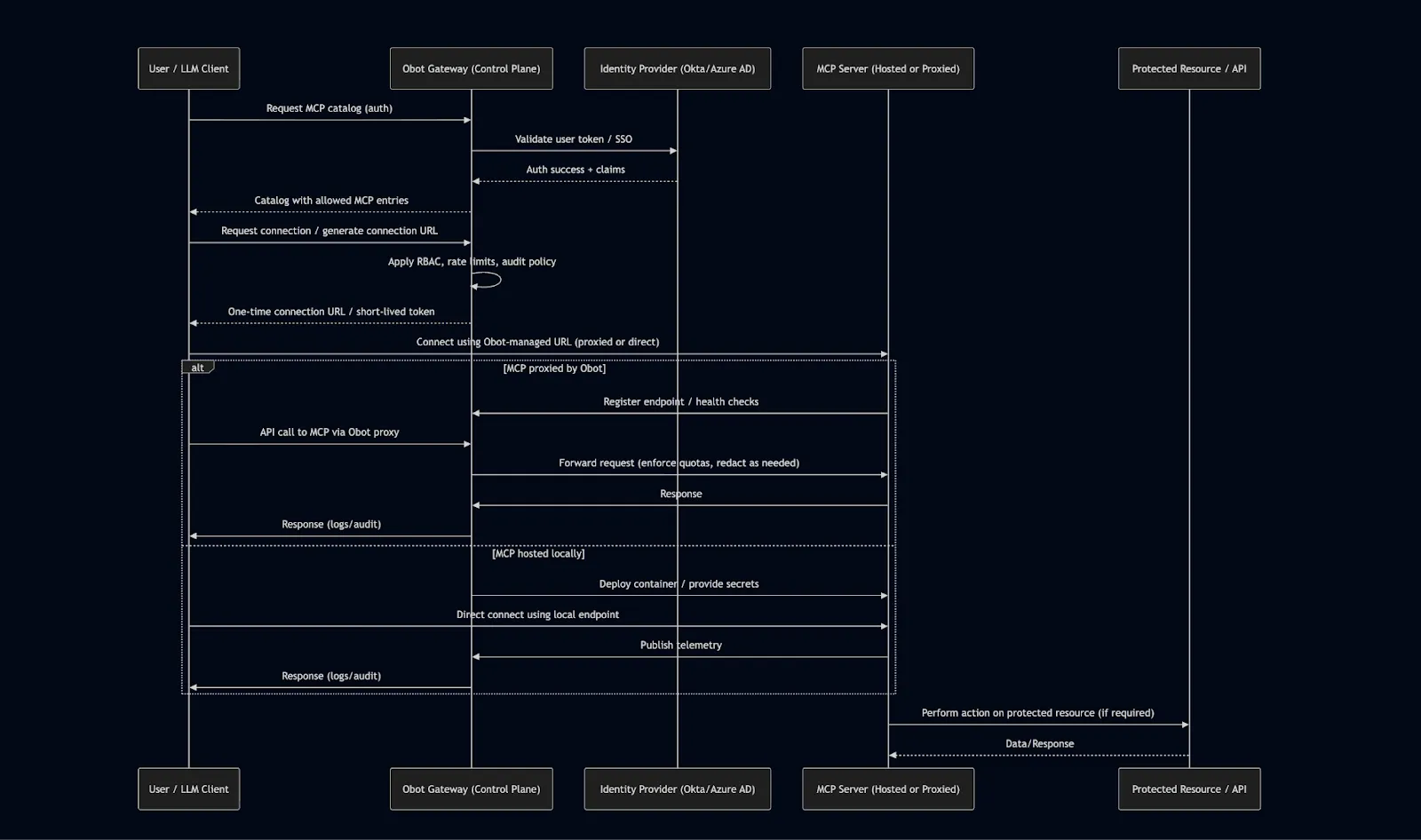
Under the hood, Obot functions as a secure proxy and control plane for all MCP traffic. The typical workflow is as follows:
Admin Setup & Integration
IT deploys the Obot Gateway (often on Kubernetes) and integrates it with identity providers like Okta, Azure AD, or Google Workspace for unified authentication.
Catalog Configuration
Obot includes common MCP connectors (Slack, GitHub, Notion, etc.) out of the box. Admins can add more through a UI or GitOps workflow, tagging each with metadata and usage docs.
Access Control & Policies
Administrators define which teams can access which MCP servers. Policies are enforced directly by Obot’s gateway.
User Discovery & Connection
Employees browse a web catalog of approved MCPs, connect via one-click URLs, and instantly authorize their AI tools to use the selected service.
Routing & Observability
Every MCP request passes through Obot’s proxy layer, providing a unified audit trail, request logs, and performance metrics for compliance and debugging.
While Obot MCP Gateway offers a strong open-source foundation for managing Model Context Protocol servers, it’s primarily designed for lightweight, internal use cases.
Enterprises operating at scale — with hundreds of agents, strict compliance needs, and multi-cloud deployments require deeper governance, observability, and performance optimization.
Key considerations include:
Security & Compliance: Some gateways (like Lasso Security) focus on advanced security controls and real-time scanning of agent calls. An enterprise handling sensitive or regulated data may prefer a gateway with built-in guardrails and threat detection.
Integration Ecosystem: Obot provides many connectors, but other vendors (e.g. TrueFoundry, Microsoft Azure Gateway) offer deeper integration with specific platforms or services. For example, if an organization is heavily invested in Azure, Microsoft’s MCP gateway (which is built into Azure services) might fit more smoothly into existing workflows.
Performance & Scalability: Gateways differ in their overhead and throughput. TrueFoundry’s MCP gateway, for instance, touts sub-3ms latency under load by handling auth and rate limits in-memory. If thousands of concurrent tool calls are expected, performance-optimized solutions may be preferred.
Deployment Model: Some teams prioritize container-native approaches. Docker’s MCP Gateway treats each MCP as a sandboxed container with strict resource limits and security boundaries. Enterprises already using Docker may find that approach familiar and easy to adopt.
Flexibility & Extensibility: Alternatives may offer plugin architectures or unique features. Lasso’s open-source gateway, for instance, lets users add custom security interceptors to filter or transform requests. Other platforms (like IBM’s Context Forge) allow composing “virtual” MCP servers from existing APIs.
Also Read: What is MCP Gateway
Key Metrics for Evaluating Gateway
| Criteria | What should you evaluate ? | Priority | TrueFoundry |
|---|---|---|---|
| Latency | Adds <10ms p95 overhead for time-to-first-token? | Must Have | ✅ Supported |
| Data Residency | Keeps logs within your region (EU/US)? | Depends on use case | ✅ Supported |
| Latency-Based Routing | Automatically reroutes based on real-time latency/failures? | Must Have | ✅ Supported |
| Key Rotation & Revocation | Rotate or revoke keys without downtime? | Must Have | ✅ Supported |
| Key Rotation & Revocation | Rotate or revoke keys without downtime? | Must Have | ✅ Supported |
| Key Rotation & Revocation | Rotate or revoke keys without downtime? | Must Have | ✅ Supported |
| Key Rotation & Revocation | Rotate or revoke keys without downtime? | Must Have | ✅ Supported |
| Key Rotation & Revocation | Rotate or revoke keys without downtime? | Must Have | ✅ Supported |
TrueFoundry MCP Gateway is an enterprise-grade solution designed to unify and govern large-scale MCP deployments. Built as part of the TrueFoundry AI Platform, it provides a single control plane that seamlessly integrates with existing AI infrastructure — including LLM management, telemetry, and compliance enforcement — enabling teams to manage both models and tools without fragmentation.
Because it’s deeply integrated into the TrueFoundry ecosystem, enterprises gain a single-pane-of-glass view of all AI activity — from LLMs to connected tools — ensuring consistent governance, compliance, and performance visibility.
In short, TrueFoundry MCP Gateway is more than just a connector — it’s a complete AI infrastructure control plane. For organizations that need scale, reliability, and compliance, TrueFoundry stands out as the most comprehensive alternative to Obot.
For enterprises evaluating the best MCP gateway for scale, compliance, and performance, TrueFoundry offers a unified control plane purpose-built for production-grade AI systems.
TrueFoundry goes beyond being a gateway — it’s a complete orchestration and governance platform for AI infrastructure.
By unifying model management, observability, and policy enforcement under one system, TrueFoundry eliminates integration sprawl and provides a single pane of glass for all AI agent activity.
Its sub-3 ms latency, deep observability, and enterprise-grade compliance make it the preferred choice for organizations building scalable, secure, and compliant AI systems.
Docker MCP Gateway is a container-native solution offered as a Docker plugin, aimed at teams already familiar with containerization workflows. It treats each MCP server as a containerized workload with strong isolation and resource caps, aggregating multiple MCP servers behind a single, secure interface. A standout feature is its Interceptor Framework — allowing custom scripts or plugins to inspect, modify, or block requests in real time.
For example:
Docker’s MCP Gateway excels at security filtering and auditability, with tight integration into Docker Desktop and Docker Swarm. The trade-off is added latency (50–200 ms typical round trip) and a container-centric model, but for teams already using Docker infrastructure, it offers familiarity and strong isolation by default.
IBM’s Context Forge is an open-source MCP gateway and registry designed for large enterprises needing federation and extensibility. It can auto-discover multiple gateways via mDNS, merge capabilities from different deployments, and even compose several MCP servers into a single endpoint.
Key highlights:
Context Forge feels like traditional IBM middleware — highly configurable, federation-friendly, and security-conscious.
However, it’s still in beta and lacks official enterprise support, making it best suited for organizations with strong DevOps capabilities that can manage a DIY setup.
Instead of offering a standalone gateway, Microsoft has integrated MCP functionality directly into its Azure ecosystem. The Azure MCP Gateway acts as a session-aware reverse proxy for Kubernetes-hosted MCP servers and connects with Azure API Management, Container Apps, and Azure Monitor.
بينما يوفر هذا تكاملاً عميقًا مع Azure وعمليات مبسطة، يمكن أن تكون الإعدادات متعددة السحابات أو المحلية أكثر تعقيدًا، كما أن خيارات التخصيص محدودة.
في جوهر الأمر، يفضل نهج مايكروسوفت الراحة والتوافق مع النظام البيئي على قابلية النقل.
بوابة Lasso Security MCP هي بوابة مفتوحة المصدر تركز على الأمان أولاً، وتهدف إلى إدارة المخاطر واكتشاف التهديدات. تعمل كوكيل ومنسق لجميع تفاعلات MCP، وتدمج الأمان والحوكمة والمراقبة في كل طلب.
تشمل عوامل التمايز الرئيسية:
بينما قد تضيف طبقة الأمان العميقة بعض العبء، فإن Lasso مثالي للصناعات الخاضعة للتنظيم أو المؤسسات التي تضع الأمان أولاً وتحتاج إلى قابلية تدقيق صارمة والتحكم في السياسات.
تمثل بوابة Obot MCP خطوة مهمة إلى الأمام في تكامل الذكاء الاصطناعي الموحد — حيث تقدم مستوى تحكم مجانيًا ومفتوح المصدر يضيف الحوكمة وقابلية التوسع وقابلية التشغيل البيني إلى عمليات نشر MCP الحديثة.
ومع ذلك، مع تسارع تبني وكلاء الذكاء الاصطناعي عبر المؤسسات، تزداد الحاجة إلى بوابات قوية وجاهزة للإنتاج بشكل بالغ الأهمية.
تركز منصات مثل Obot وTrueFoundry على التنسيق منخفض الكمون وإدارة دورة الحياة الشاملة، بينما يوسع البائعون مثل Docker وIBM وMicrosoft أنظمتهم البيئية للبنية التحتية الحالية لتلبية متطلبات أعباء عمل الذكاء الاصطناعي. وفي الوقت نفسه، تدمج بوابات الأمان أولاً مثل Lasso Security اكتشاف التهديدات وتطبيق الامتثال مباشرة ضمن طبقة الاتصال — مما يحمي تفاعلات الذكاء الاصطناعي مع الأدوات على نطاق واسع.
من خلال مقارنة هذه الأساليب بعناية، يمكن للمؤسسات اختيار بوابة MCP التي تناسب بنيتها وحوكمتها وأهداف أدائها على أفضل وجه.
على المدى الطويل، سيمكن هذا النظام البيئي المتطور المؤسسات من ربط وكلاء الذكاء الاصطناعي بالأنظمة الواقعية بثقة — مما يضمن بقاء الأمان والموثوقية والمرونة في صميم كل عملية نشر.
تشمل الخيارات الرائدة لبدائل بوابة Obot MCP ذات التحكم المتقدم TrueFoundry، وبوابة Docker MCP، وLasso Security. توفر هذه المنصات ميزات متخصصة مثل الكمون المنخفض للغاية، والعزل الأصلي للحاويات، أو الفحص الأمني المتقدم. يلبي كل بديل احتياجات مختلفة، تتراوح من المكونات الإضافية التي تركز على المطورين إلى حلول الحوكمة والمراقبة الشاملة للمؤسسات.
يجب أن تفكر في البدائل إذا كنت تحتاج إلى ميزات على مستوى الإنتاج مثل زمن استجابة أقل من 3 مللي ثانية، وسجلات تدقيق دقيقة، ودعم السحابات المتعددة. بينما تُعد Obot نقطة دخول مفيدة، إلا أنها تفتقر إلى الحوكمة المتعمقة ومعايير الامتثال للمؤسسات الضرورية للمنظمات التي تدير بيانات حساسة وبنية تحتية معقدة وموزعة للذكاء الاصطناعي.
تركز Obot بشكل أساسي على اكتشاف الخوادم الأساسي والوكالة الداخلية للإعدادات الأبسط. على النقيض من ذلك، تقدم الحلول المتقدمة مثل TrueFoundry لوحة تحكم شاملة لكل من نماذج اللغة الكبيرة (LLMs) والأدوات. يشمل ذلك مراقبة متعمقة من خلال التتبع المنظم، وإدارة التكاليف المتكاملة، والتوسع الأصلي في Kubernetes الذي لا يمكن للسجلات الأساسية أن تضاهيه.
نعم، توفر العديد من الخيارات مفتوحة المصدر مثل بوابة Lasso ومكونات إضافية متنوعة تعتمد على Docker وظائف مماثلة بتعقيد متفاوت. تتيح هذه المشاريع المجتمعية للمطورين تخصيص معترضات الأمان أو إضافة موصلات خاصة، مما يتجنب تكاليف الترخيص التجاري مع الحفاظ على المرونة في كيفية نشر وإدارة خوادم MCP الخاصة بهم.
تُعد TrueFoundry بديلاً مثاليًا لبوابة Obot MCP لأنها توفر لوحة تحكم عالية الأداء بزمن استجابة أقل من 3 مللي ثانية وتوسعًا أصليًا في Kubernetes. إنها توحد إدارة النماذج وحوكمة الأدوات في لوحة تحكم واحدة مع ضمان بقاء البيانات داخل شبكتك الافتراضية الخاصة (VPC). هذا المزيج من الأمان والسرعة والقياس عن بعد المتعمق يجعلها الخيار الأفضل للمؤسسات الكبيرة.
TrueFoundry AI Gateway delivers ~3–4 ms latency, handles 350+ RPS on 1 vCPU, scales horizontally with ease, and is production-ready, while LiteLLM suffers from high latency, struggles beyond moderate RPS, lacks built-in scaling, and is best for light or prototype workloads.





أحدث الأخبار والمقالات والموارد تصلك مباشرة إلى بريدك الوارد
.png)
.png)
.png)
.png)
.png)
.png)
.png)
.png)
.png)
.png)
.png)


