


October 1, 2026
|
5 min read


احصل على وصول فوري إلى بيئة TrueFoundry مباشرة. انشر النماذج، ووجّه حركة مرور LLM، واستكشف المنصة بالكامل — بيئة الاختبار الخاصة بك جاهزة في ثوانٍ، ولا يلزم وجود بطاقة ائتمان.



Published: July 4, 2026
Blazingly fast way to build, track and deploy your models!
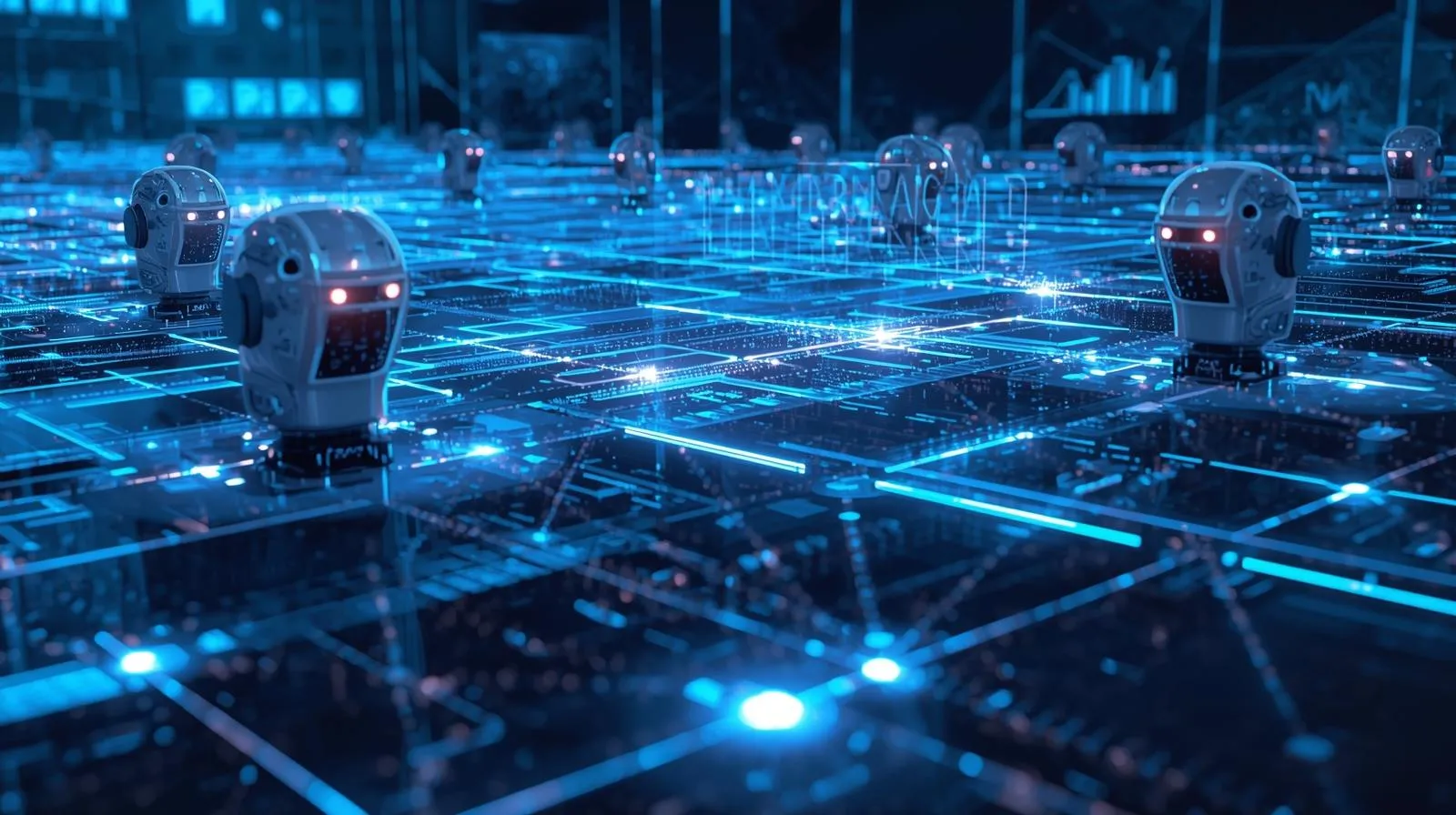
Imagine a team of intelligent agents – AI programs that can reason, communicate, and act – all working together to solve a problem. This is the essence of a multi-agent system (MAS). A MAS is essentially a computerized system composed of multiple interacting intelligent agents, collaborating as a unified whole. Each agent operates autonomously with its own goals and knowledge, yet they coordinate their actions to achieve shared objectives. The result is a digital ecosystem of AI agents engaging in a sophisticated dance of interaction and cooperation, much like a flock of birds moving in unison or a team of experts tackling different aspects of a complex task. By dividing and conquering problems that would stump any single AI, MAS can handle challenges ranging from optimizing city traffic grids to automating intricate business workflows with unprecedented efficiency.
Why do multi-agent systems matter now more than ever?
Recent advances in AI – especially large language models (LLMs) – have given rise to “agentic” AI systems, where multiple AI agents plan, reason, and use tools collaboratively. Modern MAS leverage these advances to autonomously manage tasks that once required significant human coordination. However, designing a robust multi-agent solution is not trivial. It requires careful orchestration, communication protocols, and governance to ensure these agents work together reliably (and don’t descend into chaos!). This is where platforms like TrueFoundry come into play.
TrueFoundry provides an enterprise-grade AI platform that transforms multi-agent prototypes into production-ready solutions, handling the heavy lifting of security, scalability, and infrastructure so teams can focus on building intelligent agents. In the following sections, we’ll explore what MAS are, why they’re important, their key capabilities and architectures, and how TrueFoundry’s products empower organizations to leverage multi-agent systems effectively.
In simple terms, a multi-agent system is a collection of autonomous AI “agents” that work collectively to perform tasks or solve problems. Each agent in a MAS is an independent entity with its own set of knowledge and capabilities, but the power of MAS comes from their interaction and collaboration. By communicating and coordinating with each other, the agents can achieve goals that would be difficult or impossible for a single agent or monolithic system to accomplish. In other words, the group of agents as a whole is greater than the sum of its parts.
Agents in a MAS perceive their environment, make decisions, and take actions without constant human input. Their coordination leads to emergent behaviors that solve complex problems more efficiently. For example, in a smart factory, one agent may handle inventory, another schedules machines, and a third oversees quality control working in tandem to optimize production in real time.
Modern MAS often use LLM-powered agents that can reason, plan, invoke tools or APIs, and adapt their strategies dynamically. These are not static programs they’re intelligent assistants capable of evolving with the task.
In short, a MAS functions like a collaborative AI team: each agent has autonomy and specialization, but it’s their combined intelligence that makes the system powerful, scalable, and well-suited for dynamic, multi-step workflows.
Key Capabilities of MAS
Multi-agent systems function effectively because they blend autonomy, collaboration, and adaptability:
Together, these capabilities make MAS robust, scalable, and continuously improving ideal for solving dynamic, complex problems that static or single-agent systems struggle to handle.
| Criteria | What should you evaluate ? | Priority | TrueFoundry |
|---|---|---|---|
| Latency | Adds <10ms p95 overhead for time-to-first-token? | Must Have | ✅ Supported |
| Data Residency | Keeps logs within your region (EU/US)? | Depends on use case | ✅ Supported |
| Latency-Based Routing | Automatically reroutes based on real-time latency/failures? | Must Have | ✅ Supported |
| Key Rotation & Revocation | Rotate or revoke keys without downtime? | Must Have | ✅ Supported |
| Key Rotation & Revocation | Rotate or revoke keys without downtime? | Must Have | ✅ Supported |
| Key Rotation & Revocation | Rotate or revoke keys without downtime? | Must Have | ✅ Supported |
| Key Rotation & Revocation | Rotate or revoke keys without downtime? | Must Have | ✅ Supported |
| Key Rotation & Revocation | Rotate or revoke keys without downtime? | Must Have | ✅ Supported |

Designing the architecture of a multi-agent system involves deciding how agents are organized and how they interact through the system’s infrastructure. Broadly, MAS can be structured in different architectural models, chiefly distinguished by how centralized or distributed the control and knowledge is:
Most real-world systems adopt a multi agent architecture that falls somewhere on a spectrum between fully centralized and fully decentralized. Hybrid architectures are common – for instance, a hierarchical setup where some agents act as regional leaders coordinating sub-agents (a mix of centralization at local levels with decentralization globally). Another example is a blackboard architecture, where agents communicate indirectly by reading/writing to a common data space (the “blackboard”) – centralized data but decentralized decision-making.
No matter the architecture, a critical component is the middleware or communication framework that connects agents. Agent actions are typically mediated via an appropriate middleware, which provides the abstraction for messaging, resource sharing, and coordination. This middleware ensures that agents can discover each other, exchange messages in a standardized way, and perhaps register for particular events or services. It’s analogous to an operating system for the multi-agent network, handling the low-level details so the agents can focus on high-level reasoning.
TrueFoundry’s platform is designed to provide this kind of robust infrastructure for MAS, making it easier to implement any architecture. For example, TrueFoundry offers an AI Gateway that acts as a powerful orchestration layer for agent-based applications. The AI Gateway provides a centralized protocol endpoint for agents’ workflows – managing shared context, routing tool usage, and orchestrating multi-step reasoning across agents. This means that when your agents need to call external tools or maintain a collective memory, the gateway ensures it happens in a controlled, visible manner. All agent interactions through TrueFoundry’s gateway come with enterprise-grade observability and control, preventing the chaos that could arise in a free-for-all agent communication scenario.
In addition, TrueFoundry embraces standards to simplify agent integration. One such standard is the Model Context Protocol (MCP) – essentially a uniform interface for agents to access external data/tools. In advanced enterprise deployments, this enables multi agent MCP architectures, where multiple agents share tool access, coordinate execution, and operate under unified governance policies. Think of MCP servers as the “USB-C of AI,” providing standardized ports through which agents can connect to enterprise systems (CRMs, databases, APIs) without custom integration code. TrueFoundry’s platform makes deploying and managing these MCP servers straightforward, so every agent has plug-and-play access to the tools it needs. The benefit is akin to using a universal adapter – agents call tools through a common protocol, and developers don’t have to rewire the system every time a new data source is added.
TrueFoundry’s architecture also includes an MCP & Agents Registry, which is essentially a catalog of all available tools and agents, complete with schema validation and access controls. This registry ensures that each agent knows what “skills” or APIs are at its disposal and how to invoke them properly. Coupled with TrueFoundry’s Prompt Lifecycle Management, developers can version and test the “prompts” or instructions that drive agent behaviors, ensuring consistent and auditable actions across the agent team.
Finally, TrueFoundry is designed to be framework-agnostic. Whether you design your MAS using LangChain, LangGraph, AutoGen, or any custom agent framework, TrueFoundry can deploy those agents as containerized, production-ready services. The platform handles hosting models (you can bring any LLM or ML model and serve it through TrueFoundry’s optimized backends) and ensures that agents built with different libraries can still work together under a unified control plane. In summary, TrueFoundry provides the technical backbone for multi-agent systems architecture – from communication and tool integration to scaling, security, and monitoring – so that architects of MAS can focus on the agent logic rather than reinventing infrastructure.
Beyond architecture, MAS can be categorized by how agents are socially and functionally organized. These structures define how responsibilities, communication, and authority are distributed:
Most MAS implementations blend these structures. Regardless of which you adopt, TrueFoundry’s platform provides flexible orchestration, real-time tracing, and governance primitives — ensuring agent coordination remains transparent, secure, and performant.
A single-agent system is like a Swiss Army knife — one AI trying to do it all. In contrast, a multi-agent system (MAS) resembles a toolkit: multiple specialized tools working together. This fundamental shift enables several key advantages:
ولعل الأهم من ذلك هو أن وكلاء الأنظمة متعددة الوكلاء (MAS) يتعاونون. فهم لا يكتفون بتبادل البيانات فحسب، بل يتفاوضون ويتكيفون ويضعون الاستراتيجيات معًا. وهذا يجعلهم مناسبين تمامًا للاستدلال الموزع وتخطيط المهام الديناميكي — متجاوزين بكثير ما يمكن أن تحققه إعدادات الوكيل الواحد.
بينما تُدخل الأنظمة متعددة الوكلاء (MAS) تعقيدًا في التصميم (مثل التنسيق وحل النزاعات)، تقلل TrueFoundry هذا الاحتكاك من خلال أدوات مثل تحديد إصدارات المطالبات، وتتبع حركة المرور، وتطبيق الضوابط الوقائية. والنتيجة: أنظمة ذكاء اصطناعي أكثر مرونة وقوة وجاهزية للإنتاج مبنية على تعاون الوكلاء المستقلين.
تقدم الأنظمة متعددة الوكلاء مزايا واضحة لحل المشكلات الكبيرة والديناميكية والموزعة:
باختصار، توفر الأنظمة متعددة الوكلاء (MAS) بنية معيارية ومرنة وموجهة نحو الأداء — وتقدم منصات مثل TrueFoundry الأدوات اللازمة لتشغيلها على نطاق واسع.
تقدم الأنظمة متعددة الوكلاء (MAS) بالفعل قيمة حقيقية عبر مجموعة واسعة من الصناعات:
توضح حالات الاستخدام هذه أن أنظمة الوكلاء المتعددين (MAS) ليست نظرية — بل هي عملية وقوية وضرورية بشكل متزايد في تطبيقات الذكاء الاصطناعي الواقعية. بدعم من منصات مثل TrueFoundry، يمكن للمؤسسات نشر أنظمة بيئية متطورة للوكلاء مع تضمين إمكانية المراقبة والتحكم في الوصول والحوكمة — كل ذلك مع التوسع بمرونة وتقديم أداء على مستوى المؤسسات.
تمثل أنظمة الوكلاء المتعددين (MAS) قفزة نوعية في بنية الذكاء الاصطناعي، مما يتيح ذكاءً تعاونيًا موزعًا يتفوق بكثير على أساليب الوكيل الواحد في البيئات المعقدة والديناميكية. أينما يمكن موازاة المهام، أو تقسيمها حسب الخبرة، أو معالجتها في الوقت الفعلي من المدن الذكية إلى أتمتة المؤسسات - تقدم أنظمة الوكلاء المتعددين (MAS) حلاً مرنًا وقابلاً للتطوير.
ومع ذلك، فإن بناء وصيانة أنظمة الوكلاء المتعددين (MAS) على نطاق واسع يأتي مع تحديات حقيقية: تنسيق الوكلاء، وضمان الاتصال الآمن، والحفاظ على إمكانية المراقبة، ومواءمة الأداء مع متطلبات الإنتاج. هنا تتفوق TrueFoundry. توفر منصتها البنية التحتية اللازمة لنشر أنظمة الوكلاء المتعددين وإدارتها وتوسيع نطاقها بثقة. من بوابات الذكاء الاصطناعي منخفضة الكمون وتنسيق وحدات معالجة الرسوميات (GPU) إلى مسارات التدقيق الآمنة والتحكم في الوصول، تجرد TrueFoundry العبء التشغيلي مما يتيح للفرق التركيز على النتائج، وليس على البنية التحتية.
مع استمرار تطور الذكاء الاصطناعي، سيدعم التعاون متعدد الوكلاء أنظمة بيئية ذكية — حيث لا يقوم الوكلاء بأتمتة المهام فحسب، بل يتعاونون لحلها بذكاء. بفضل المنصات الجاهزة للمؤسسات مثل TrueFoundry، تمتلك المؤسسات الآن الأدوات اللازمة لإخراج أنظمة الوكلاء المتعددين (MAS) من المختبر إلى العالم الحقيقي بمسؤولية وكفاءة وعلى نطاق واسع. مستقبل الذكاء الاصطناعي ليس فرديًا، بل جماعي. وأنظمة الوكلاء المتعددين (MAS)، المدعومة بالبنية التحتية الصحيحة، هي أساس هذا المستقبل.
TrueFoundry AI Gateway delivers ~3–4 ms latency, handles 350+ RPS on 1 vCPU, scales horizontally with ease, and is production-ready, while LiteLLM suffers from high latency, struggles beyond moderate RPS, lacks built-in scaling, and is best for light or prototype workloads.





أحدث الأخبار والمقالات والموارد تصلك مباشرة إلى بريدك الوارد
.png)
.png)
.png)
.png)
.png)
.png)
.png)
.png)
.png)
.png)
.png)


