


Obtenha acesso instantâneo a um ambiente TrueFoundry ao vivo. Implante modelos, direcione o tráfego de LLM e explore a plataforma completa — seu sandbox estará pronto em segundos, sem necessidade de cartão de crédito.


What Is Distributed Training and How Does It Work?

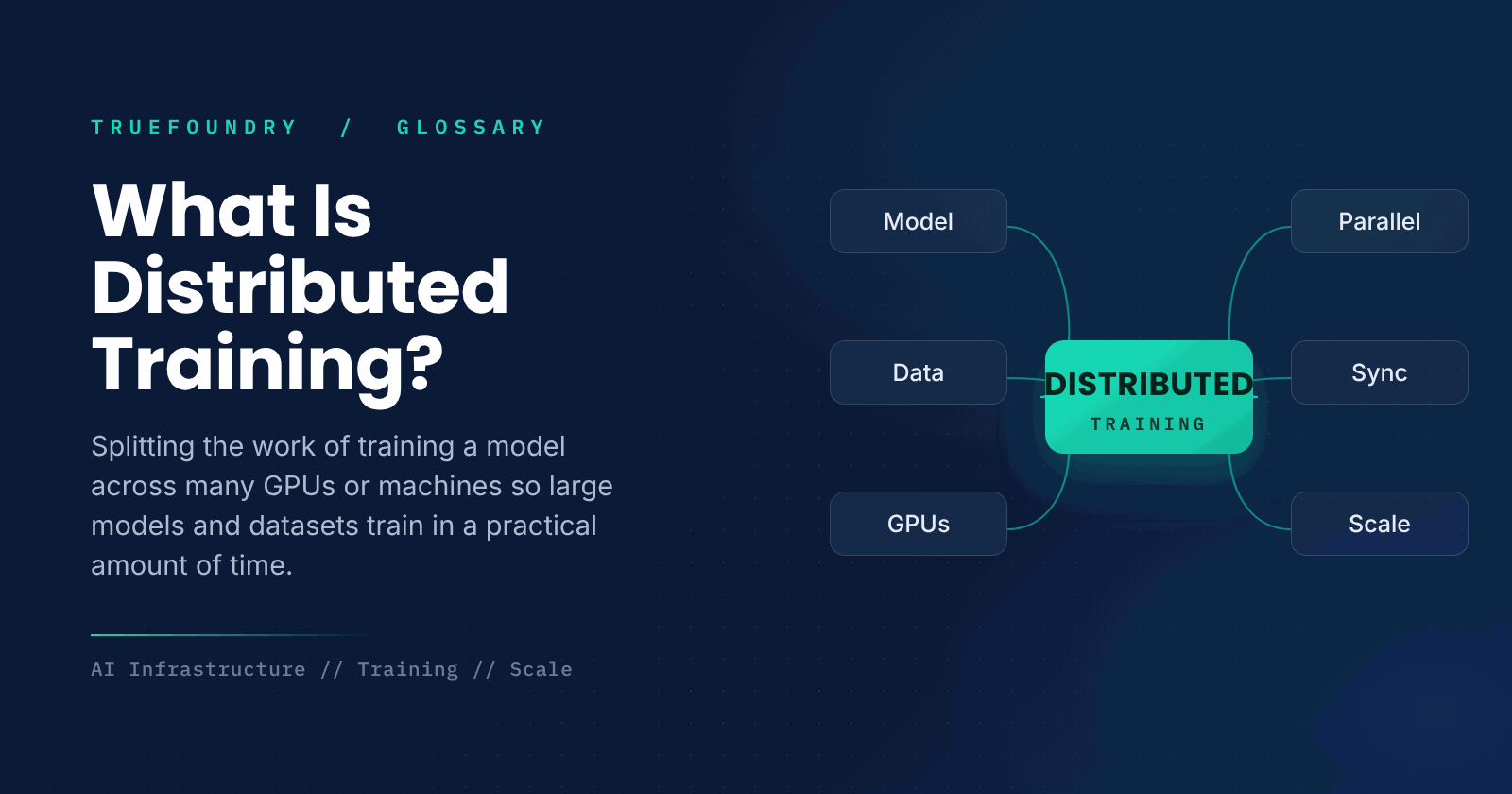
Training a modern model can involve billions of parameters and trillions of tokens. A single GPU cannot hold a large model or get through that much data in any reasonable time. Distributed training is how teams get around both limits, by spreading the work across many devices that cooperate as one.
The challenge is coordination. The devices must divide the work, stay in sync, and combine their results so that the outcome matches training on one impossibly large machine. How you split the work defines the main flavors of distributed training.
This guide explains what distributed training is, how it works, the main parallelism strategies, and the trade-offs involved.
What is distributed training?
Distributed training is the practice of training a machine learning model across multiple processors, GPUs, or machines at once. Instead of one device doing all the computation, the work is divided among many devices that run in parallel and synchronize so the final model is the same as if a single, far larger device had trained it.
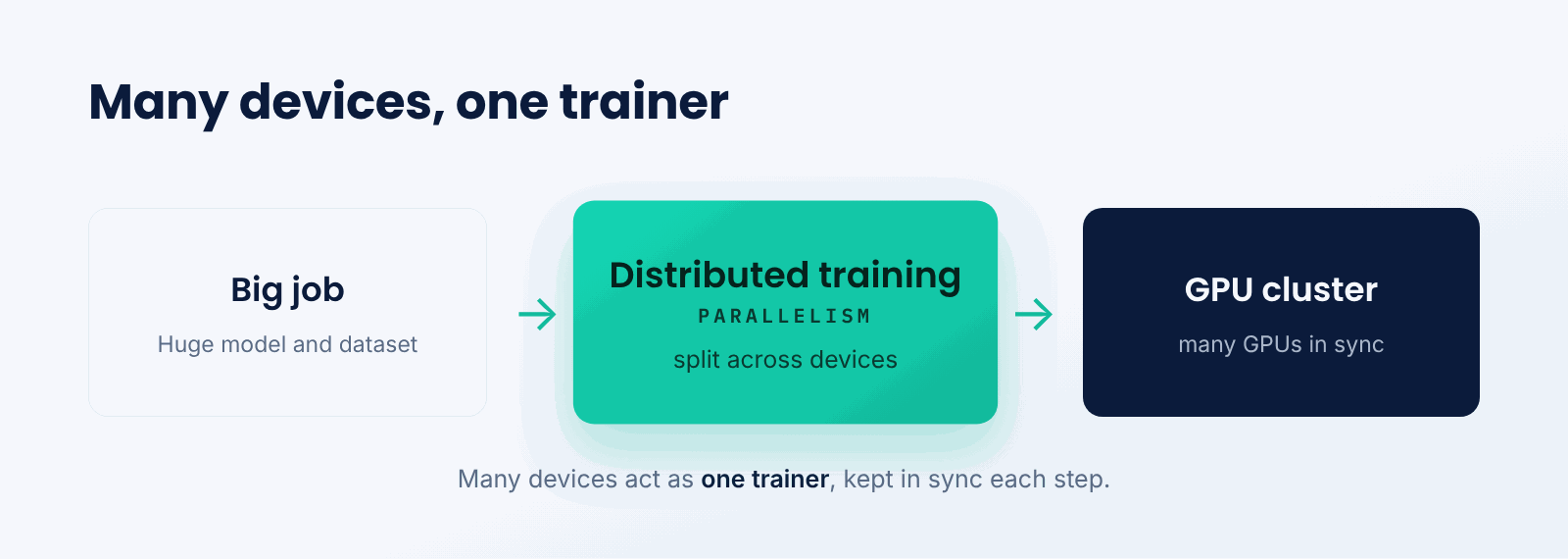
Think of a large construction project. One worker would take forever, so you bring in a crew. They split the tasks, work simultaneously, and coordinate so the pieces fit together into one building. Distributed training is that crew for a model, with synchronization taking the place of a site foreman keeping everyone aligned.
The central idea is parallelism with coordination. Many devices do parts of the work at the same time, and frequent synchronization keeps them converging on one shared model.
How does distributed training work?
Each training step, the devices compute in parallel and then reconcile their results.
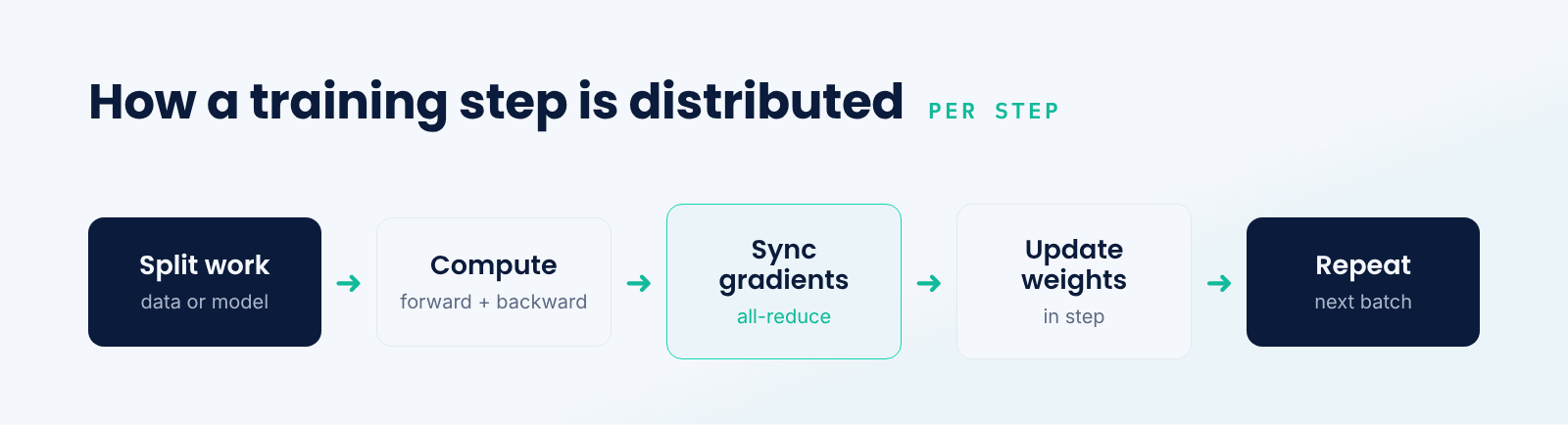
- Split the work. The model, the data, or both are divided across the available devices.
- Compute in parallel. Each device runs a forward and backward pass on its share of the batch.
- Synchronize gradients. The devices exchange and combine gradients, often with an all-reduce operation.
- Update the weights. Every device applies the same combined update so they stay identical.
- Repeat. The cycle continues on the next batch until training completes.
The synchronization step is where distributed training earns its complexity. Exchanging gradients across many devices takes fast interconnects and careful engineering, and communication can become the bottleneck if it is not managed well.
Data vs. model vs. pipeline parallelism
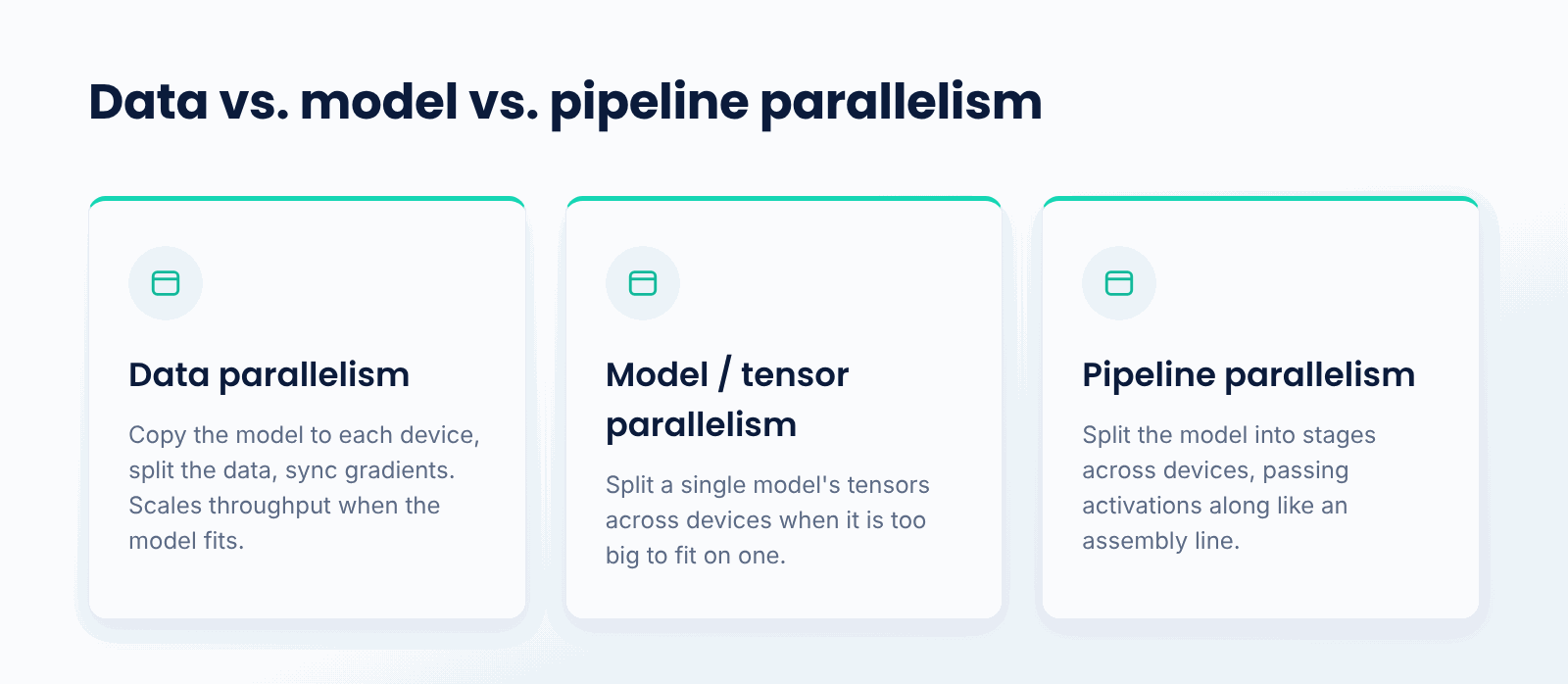
There are three main ways to split the work. Data parallelism copies the whole model to each device and gives each a different slice of the data, then syncs gradients; it scales throughput well as long as the model fits on one device. Model, or tensor, parallelism splits a single model's layers or tensors across devices for models too large to fit on one. Pipeline parallelism divides the model into sequential stages across devices, passing activations along like an assembly line.
Large-scale training usually combines these. A frontier model might use data parallelism across groups of machines, tensor parallelism within a machine, and pipeline parallelism across stages, all at once, to use thousands of GPUs efficiently.
What are the benefits of distributed training?
- Train bigger models. Model and pipeline parallelism let you train models too large for any single device.
- Train faster. Spreading data across devices cuts the wall-clock time to get through a dataset.
- Handle huge datasets. Parallelism makes it feasible to train on trillions of tokens.
- Scale with hardware. Adding more devices increases capacity without changing the method.
- Better utilization. Done well, it keeps expensive accelerators busy rather than idle.
What are the challenges?
- Communication overhead. Synchronizing gradients across devices can become the bottleneck.
- Complex setup. Combining parallelism strategies and tuning them is engineering-heavy.
- Fault tolerance. With many devices, failures are common and must be handled without losing progress.
- Cost. Large clusters of accelerators and fast interconnects are expensive to run.
When do you need distributed training?
You need it whenever a model or dataset outgrows a single device. Training large language models, running on very large datasets, or needing to cut training time from weeks to days all push you toward distributing the work.
For small models and modest datasets that fit comfortably on one GPU, a single device is simpler and cheaper. The complexity of distribution only pays off once scale makes it necessary.
Best practices for distributed training
- Start with data parallelism, the simplest strategy, before reaching for model or pipeline splits.
- Use fast interconnects so gradient synchronization does not dominate the step time.
- Overlap communication with computation to hide synchronization cost where possible.
- Checkpoint frequently so a failed device does not cost you the whole run.
- Use mature frameworks and libraries rather than building distribution logic from scratch.
- Monitor device utilization to catch stragglers and communication bottlenecks early.
Conclusion
Distributed training spreads the work of training a model across many devices so large models and datasets become feasible to train in practical time. By splitting data, the model, or both, and synchronizing each step, many devices act as one trainer. The art is in choosing and combining parallelism strategies and keeping communication from becoming the bottleneck.
TrueFoundry helps teams run training and fine-tuning jobs on their own GPU infrastructure, managing clusters, scheduling, and utilization so distributed workloads run efficiently. As models and datasets keep growing, distributed training is how teams keep training times and costs under control.
Govern, Deploy and Trace AI in Your Own Infrastructure
Frequently Asked Questions
What is distributed training in simple terms?
This refers to training a model using several GPUs or computers simultaneously, as opposed to one computer only. The machines divide up the task and work in parallel to produce results equivalent to training on a single large machine, just faster or bigger.
What is data parallelism?
Data parallelism involves copying the entire model to each device and assigning each device a unique portion of the data. Gradients between devices are synchronized at each step to keep them consistent. It scales throughput as long as the model fits on a single device.
What is the difference between data and model parallelism?
Data parallelism replicates the model and splits the data. Model parallelism splits a single model across multiple devices because it is too big to fit on one. Large runs often combine both, plus pipeline parallelism.
Why is synchronization important?
Because every device has to conclude each step with identical weights. Synchronizing gradients among devices lets them work together as one model; however, this introduces communication overhead that can become the bottleneck.
Do I always need distributed training?
No. When the model or dataset fits on one device, using a single GPU is easier and more economical. You need distribution only when the model or dataset exceeds the capacity of one device, or the time needed for training becomes too long.


- © 2022 ENSEMBLE Tecnologias



Assine nossa newsletter
As últimas notícias, artigos e recursos enviados para sua caixa de entrada


