


Obtenha acesso instantâneo a um ambiente TrueFoundry ao vivo. Implante modelos, direcione o tráfego de LLM e explore a plataforma completa — seu sandbox estará pronto em segundos, sem necessidade de cartão de crédito.


What Is Agent Orchestration and How Does It Work?

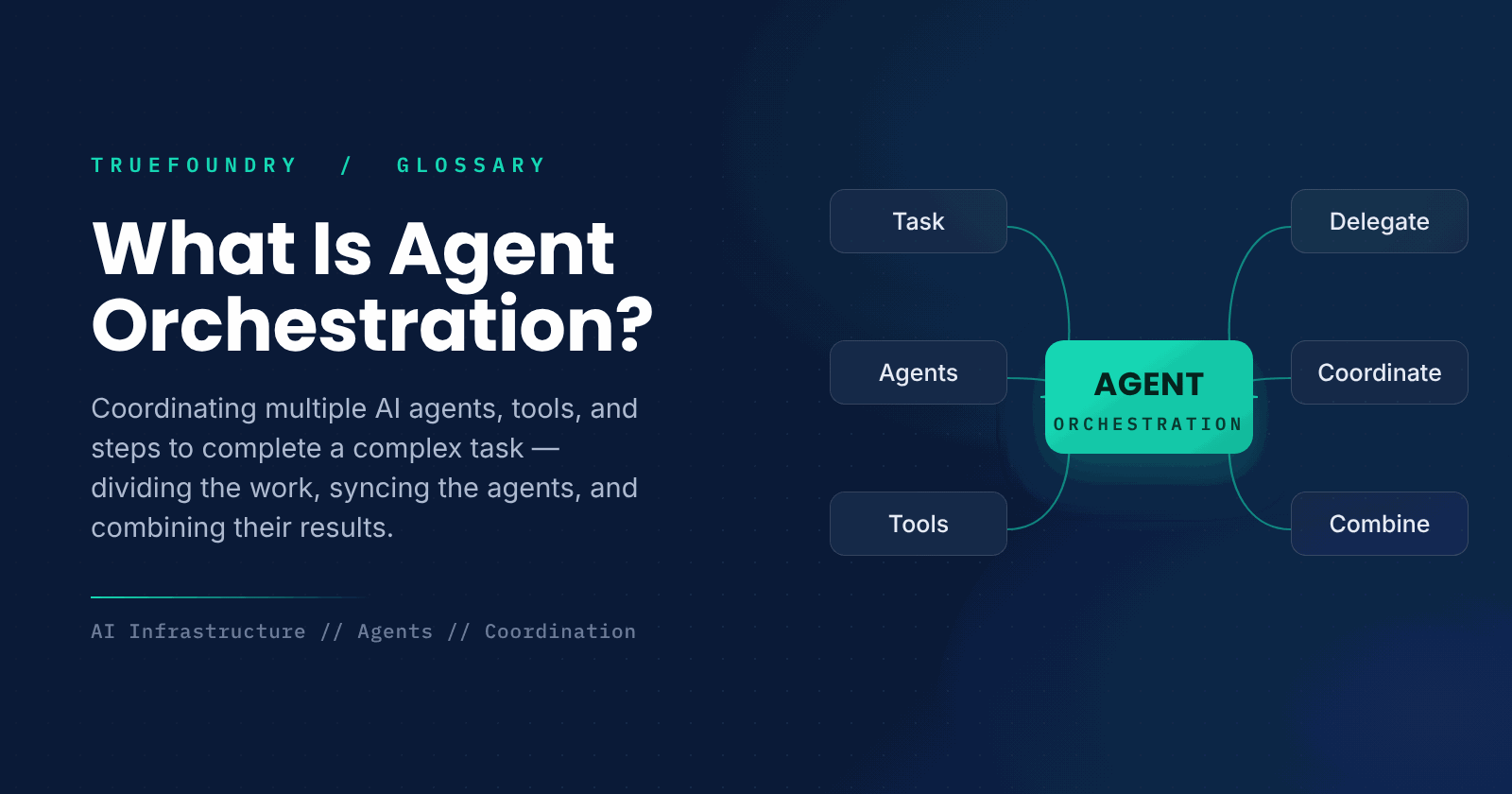
A single agent can handle a lot, but complex work often needs several, each specialized for a part of the job: one to research, one to write, one to check. The moment you have more than one agent, or a long chain of steps, something has to coordinate them. That coordination is agent orchestration.
Orchestration decides how a task is broken up, which agent or tool handles each part, how they pass information to each other, and how their outputs come together into a final result. Without it, a collection of capable agents is just chaos; with it, they become a system that can tackle work no single agent could.
This guide explains what agent orchestration is, how it works, the common patterns, and when you need it.
What is agent orchestration?
Agent orchestration is the practice of coordinating multiple AI agents, along with the tools and steps they use, so they work together toward a shared goal. An orchestrator decides how to decompose a task, assigns the pieces to the right agents or tools, manages the flow of information and state between them, and assembles their results into a coherent outcome.
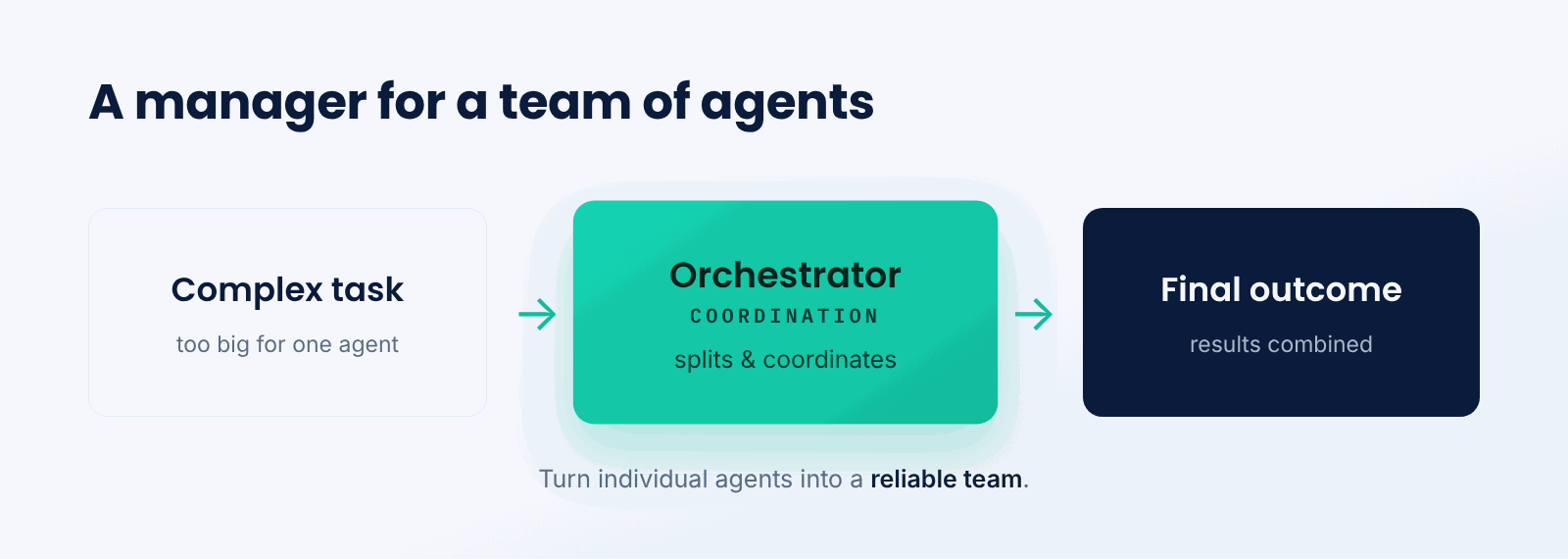
Think of a project manager leading a team of specialists. The manager breaks the project into tasks, assigns each to the right person, keeps everyone in sync, handles problems, and pulls the pieces together at the end. Agent orchestration is that manager for a team of AI agents.
The key idea is coordination. Individual agents provide capability; orchestration provides the structure that lets several of them collaborate reliably rather than working at cross purposes.
How does agent orchestration work?
An orchestrator runs the overall flow, delegating to agents and combining what they return.
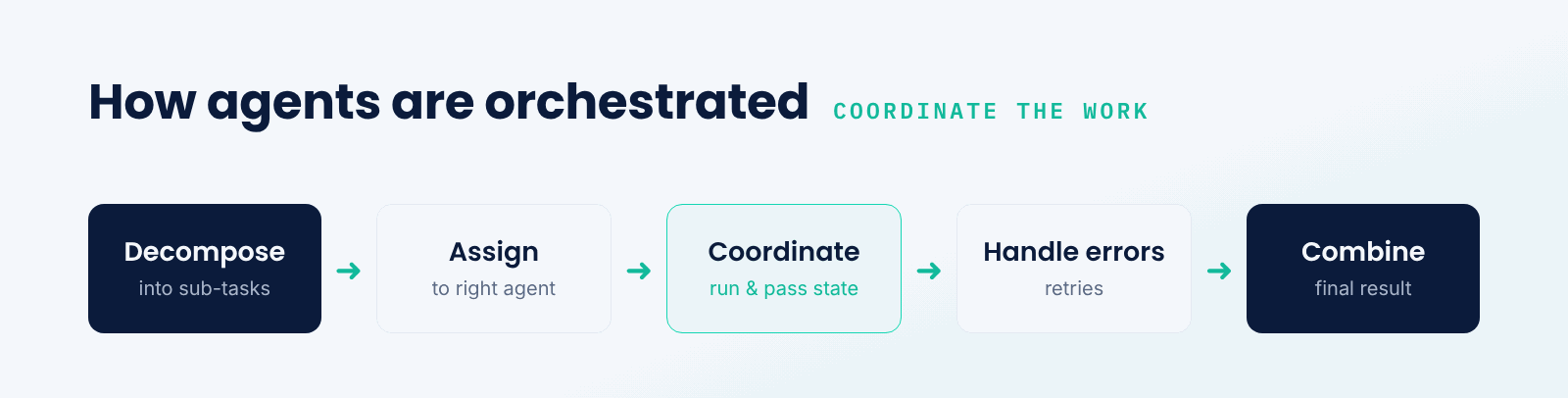
- Decompose the task. The orchestrator breaks the goal into smaller sub-tasks that agents can handle.
- Assign the work. Each sub-task is routed to the agent or tool best suited to it.
- Coordinate execution. Agents run, in sequence or parallel, passing information and state between them.
- Handle problems. The orchestrator manages errors, retries, and cases where an agent gets stuck.
- Combine the results. The outputs are assembled into a final answer or completed task.
The orchestrator also holds the shared state and keeps the overall goal in view, so individual agents can focus on their part while the system stays coherent. Managing communication and failure between agents is much of the real work.
What are the common orchestration patterns?
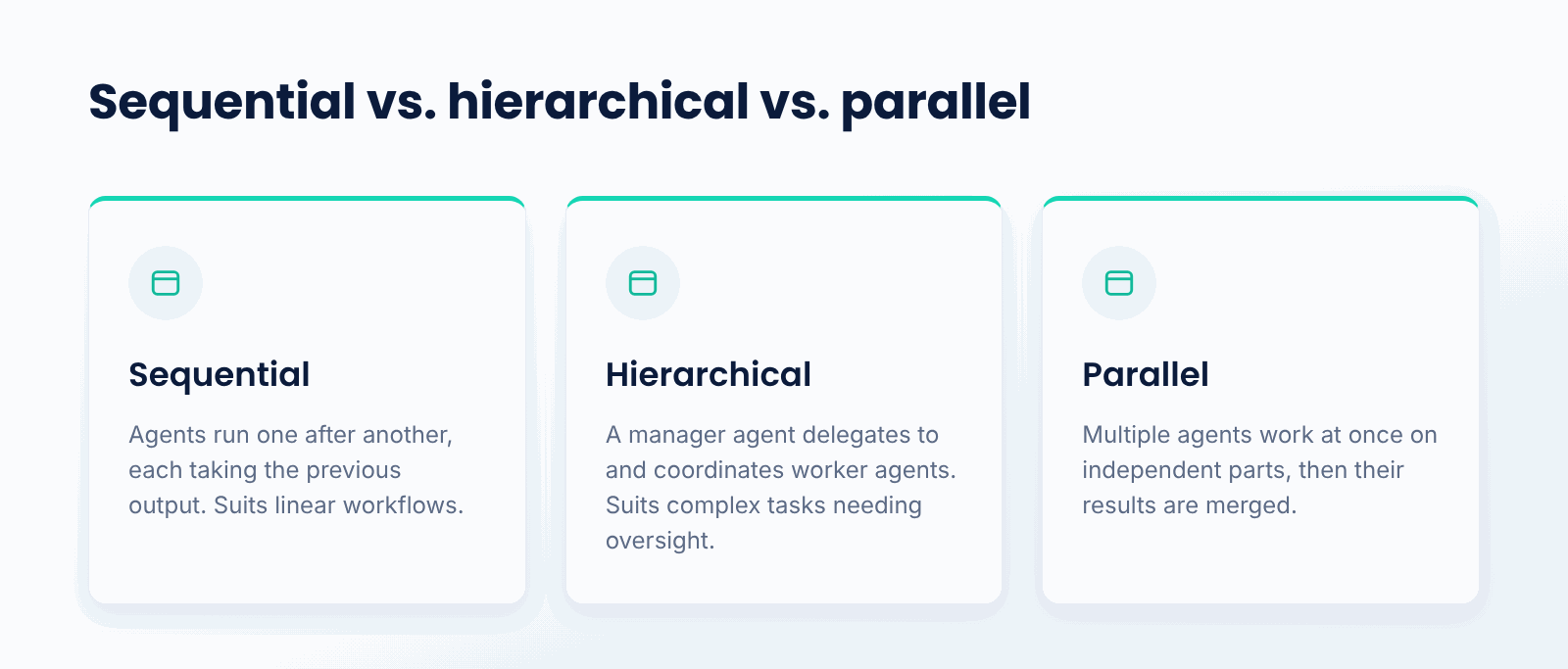
Several patterns recur. In a sequential chain, agents run one after another, each taking the previous one's output, which suits linear workflows. In a hierarchical pattern, a manager agent delegates to and coordinates worker agents, which suits complex tasks that need oversight. In a parallel pattern, multiple agents work at once on independent parts, and their results are merged, which suits tasks that split cleanly.
Real systems often mix these, with a manager agent that dispatches work both in sequence and in parallel. The right pattern depends on whether the sub-tasks are ordered, independent, or need central coordination.
Why does agent orchestration matter?
- Tackles complex tasks. It lets several specialized agents solve work no single agent could.
- Specialization. Each agent can focus on what it does best, with the orchestrator combining them.
- Reliability. Central coordination handles errors, retries, and stuck agents gracefully.
- Scalability. Parallel patterns let work spread across many agents at once.
- Coherence. Shared state and a held goal keep the system aligned rather than fragmented.
What are the challenges?
- Complexity. Coordinating many agents, state, and failures is hard to build and debug.
- Error propagation. A mistake by one agent can cascade through the others if not caught.
- Cost and latency. More agents and steps mean more model calls, more tokens, and more time.
- Observability. Understanding what went wrong across many agents requires good tracing.
When do you need agent orchestration?
You need it when a task is too complex for one agent and naturally splits into parts that different agents or tools should handle. Multi-step workflows, tasks needing specialized roles, and anything where several agents must cooperate all call for orchestration to keep them coordinated and reliable.
For a simple task a single agent can do end to end, orchestration is overhead. The need appears as tasks grow in complexity and the number of agents and steps increases.
Best practices for agent orchestration
- Give each agent a clear, bounded role rather than overlapping responsibilities.
- Choose the pattern, sequential, hierarchical, or parallel, that fits the task's structure.
- Handle errors and retries explicitly so one agent's failure does not break the whole system.
- Keep shared state and the overall goal managed centrally by the orchestrator.
- Trace and log every agent's steps so failures across the system can be debugged.
- Run orchestration behind a gateway so model calls, tools, and cost stay observable and governed.
Conclusion
Agent orchestration is the coordination of multiple AI agents and the steps they take toward a shared goal. It decomposes a task, routes work to the right agents, manages communication and failures, and combines the results, turning a set of individual agents into a reliable multi-agent system. The choice of pattern and the handling of errors and state are what make it work.
TrueFoundry helps teams build and run multi-agent systems on their own infrastructure, with the models, tools, and orchestration governed and observable through one gateway. As AI moves from single agents to coordinated teams of them, orchestration is the layer that keeps that collaboration coherent and dependable.
Govern, Deploy and Trace AI in Your Own Infrastructure


- © 2022 ENSEMBLE Tecnologias



Assine nossa newsletter
As últimas notícias, artigos e recursos enviados para sua caixa de entrada


