Webinar on Data Residency for AI Systems - What enterprises must get right? Register now

How
Scales
Multi-Model Agents with
TrueFoundry

Adopt AI builds enterprise-grade agentic AI across modern and legacy systems.
Using TrueFoundry’s AI Gateway, the platform unifies multi-provider LLM access, handling 15M+ requests and 40B+ input tokens centrally.

Want to learn more about this success

Talk to our expert
arrow1
This multi-model strategy was essential for performance and quality, but it introduced fragmentation in access, observability, cost tracking, and reliability management. By adopting TrueFoundry’s AI Gateway, Adopt AI established a single, centralized control plane for all LLM traffic. The Gateway now powers unified model access, real-time monitoring, latency-aware routing, and cost visibility across hundreds of thousands of production requests, without requiring application-level changes.
About
Adopt AI enables enterprises to build and deploy agentic workflows that integrate APIs, business processes, and enterprise content across both modern and legacy systems. Its Zero-Shot ingestion and agent infrastructure allow teams to modernize applications without disrupting existing architectures, delivering secure, production-grade agent experiences at scale.
As customers adopted increasingly complex agent workflows, Adopt AI’s platform began handling high-volume, latency-sensitive AI interactions across multiple teams and environments.

Building a Multi-Model Agentic AI Foundation with Centralized Control

As Adopt AI’s agent platform matured, several challenges emerged:

Multi-model complexity

As Adopt AI’s agent platform matured, the company made a deliberate decision to operate across multiple LLM providers. Different workflows required different trade-offs across quality, latency, availability, and cost, and no single model could serve all use cases effectively.
Learn More

Enabling Unified Tracing and Decision-Making

Without a centralized AI access layer, observability was fragmented across provider-specific dashboards. It was difficult to answer critical questions in real time:
  • Which models are being used, and by whom?
  • How many requests are flowing through the system?
Learn More

Cost and reliability risks

Token usage spikes, elevated P99 latency, and provider-side issues could directly impact agent responsiveness, but diagnosing and correcting these issues across providers was slow and manual.
Learn More

Multi-model complexity

As Adopt AI’s agent platform matured, the company made a deliberate decision to operate across multiple LLM providers. Different workflows required different trade-offs across quality, latency, availability, and cost, and no single model could serve all use cases effectively.
Learn More

Enabling Unified Tracing and Decision-Making

Without a centralized AI access layer, observability was fragmented across provider-specific dashboards. It was difficult to answer critical questions in real time:
  • Which models are being used, and by whom?
  • How many requests are flowing through the system?
Learn More

Cost and reliability risks

Token usage spikes, elevated P99 latency, and provider-side issues could directly impact agent responsiveness, but diagnosing and correcting these issues across providers was slow and manual.
Learn More
“For us, the TrueFoundry AI Gateway is about complete abstraction. Our applications never talk directly to model providers. We can switch models, manage throttling, and trace behavior centrally without changing code. That separation is critical as we scale agentic workflows across customers.”
 — Rahul Bhattacharya, Co-Founder & CTO, Adopt AI

Solution: TrueFoundry AI Gateway as the Central Control Plane

Adopt AI standardized all LLM interactions through TrueFoundry’s AI Gateway, treating it as a strict abstraction layer between applications and model providers. Applications no longer interact directly with individual LLM vendors; instead, all requests flow through a single gateway that enforces routing, tracing, and provider selection centrally

Unified access across providers

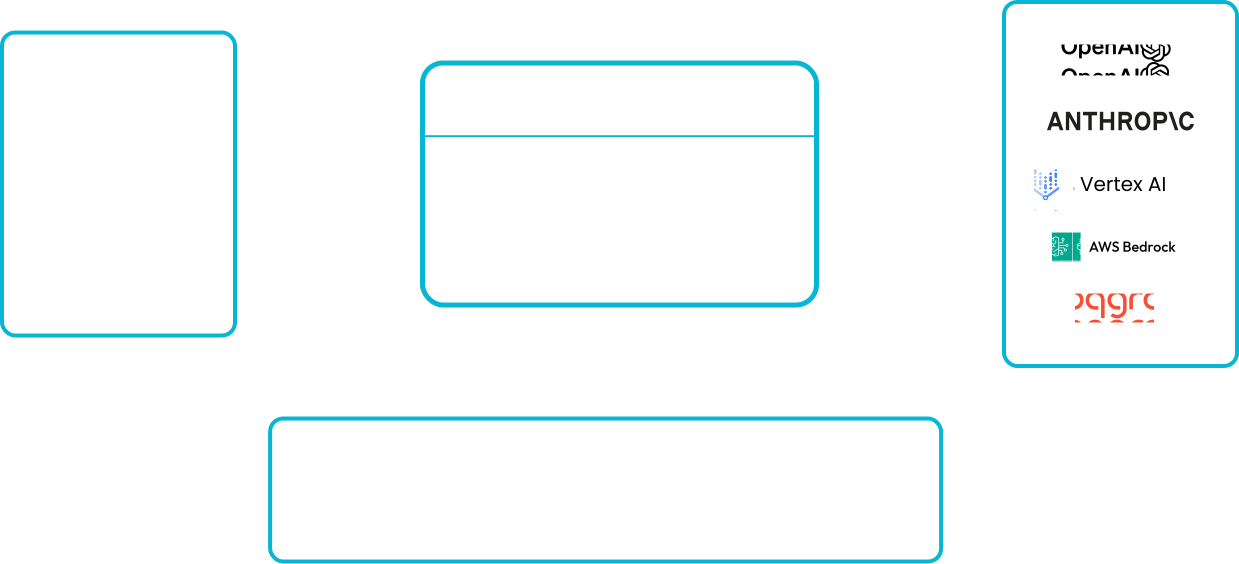
The Gateway provides a consistent interface to models from OpenAI, Anthropic, Google Vertex, AWS Bedrock, and Groq. Teams can onboard new models or retire existing ones centrally, without touching application code.
Learn More

Centralized observability

All requests flow through the Gateway, enabling real-time visibility into:
  • Total requests: 15M+ over the last 90 days
  • Token usage: ~40B input tokens and ~2.2B output tokens
  • Latency metrics: including P50, P90, and P99
Learn More

Cost and reliability risks

Token usage spikes, elevated P99 latency, and provider-side issues could directly impact agent responsiveness, but diagnosing and correcting these issues across providers was slow and manual.
Learn More

Multi-model complexity

As Adopt AI’s agent platform matured, the company made a deliberate decision to operate across multiple LLM providers. Different workflows required different trade-offs across quality, latency, availability, and cost, and no single model could serve all use cases effectively.
Learn More

Enabling Unified Tracing and Decision-Making

Without a centralized AI access layer, observability was fragmented across provider-specific dashboards. It was difficult to answer critical questions in real time:
  • Which models are being used, and by whom?
  • How many requests are flowing through the system?
Learn More

Cost and reliability risks

Token usage spikes, elevated P99 latency, and provider-side issues could directly impact agent responsiveness, but diagnosing and correcting these issues across providers was slow and manual.
Learn More

Why It Matters for Agentic AI

Agentic systems are only as reliable as the infrastructure controlling their interactions with models. For Adopt AI, the AI Gateway became the foundation that allowed:

  • Multi-model flexibility without chaos
  • High-volume agent traffic without blind spots
  • Cost and latency optimization without slowing innovation

By centralizing LLM interactions at the Gateway layer, Adopt AI preserved flexibility without sacrificing control. The platform now supports rapid experimentation across models, predictable operational behavior under load, and a clear path to scaling agentic workflows, all while keeping complexity out of application code.

GenAI infra- simple, faster, cheaper

Trusted by 10+ Fortune 500s