
We’re sharing complimentary access to the full Gartner Hype Cycle for AI Governance 2026. Get your copy →

For one of the largest healthcare enterprises in the US, digital engagement is mission-critical. Managing over 500 million calls annually across pharmacy, retail, and insurance lines, the organization faced a massive engineering hurdle. They needed to modernize their voice systems from simple menus to intelligent agents capable of handling complex patient intents. While they successfully built an agentic IVR system, the operational complexity of scaling it revealed a gap between innovation and infrastructure. By partnering with TrueFoundry to build a unifiedInternal AI Platform, the enterprise automated their infrastructure, successfully arbitrated workloads between cloud and on-premise, and accelerated their AI roadmap from months to weeks.
This Fortune 50 Healthcare Enterprise operates at the intersection of retail pharmacy, health insurance, and medical services. Their digital vision is centered on accessibility. Ensuring that every patient interaction is handled with precision and empathy, whether it happens in one of their 9,000 stores or via a digital channel.
The organization's journey began with a distinct engineering challenge: modernizing their Interactive Voice Response (IVR) system. They needed to move beyond rigid "press 1 for pharmacy" menus to a fully agentic system capable of understanding natural language.
To manage the tension between latency, cost, and accuracy at this scale, the engineering team designed a sophisticated 3-Stage Routing Architecture.
Running this system for millions of users required deep optimization beyond standard model inference:
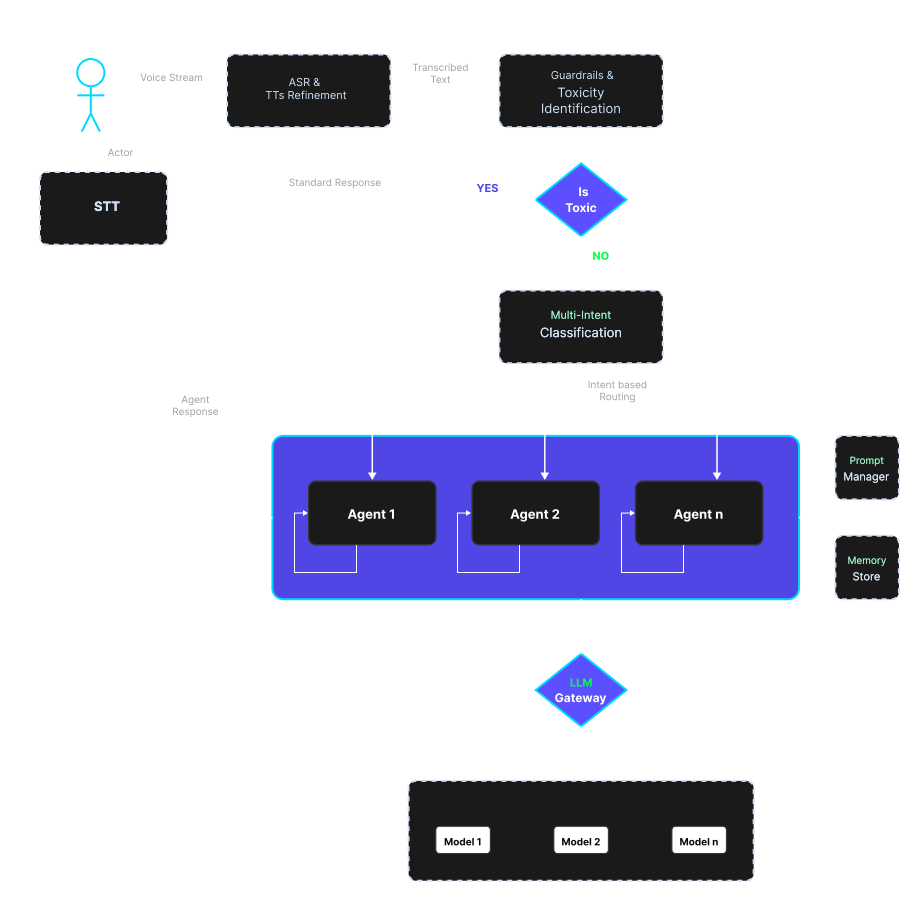
Latency Reduction
The team implemented global instantiation of agent graphs. Instead of re-creating the agent context for every call, the service maintains active agent graphs that can be reused across sessions. Additionally, prompts are cached for 30 minutes to minimize latency when fetching from the management service.
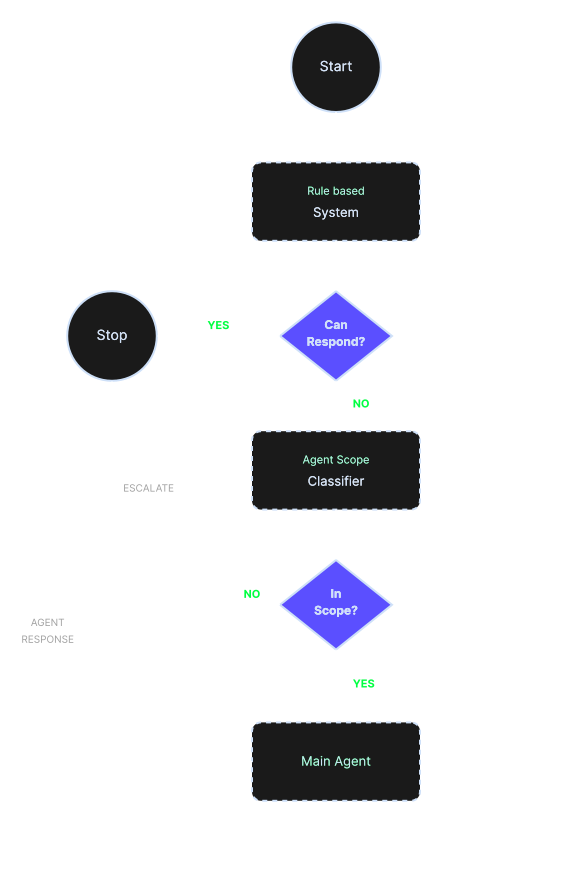
3-Stage Decision Flow
To preserve expensive GPU compute for complex reasoning, the system uses a tiered approach:
Safety First
Guardrails are not just an afterthought. They are applied via prompts at the gateway level, ensuring every agent has a fallback mechanism for toxicity or out-of-scope topics before any logic is executed.
While the IVR architecture was sound, the operational burden of running it was immense. The team faced a "Day 2" reality: managing active-passive reliability across geographically isolated clusters, configuring GPU resources, and handling the disparity between cloud development and on-premise production.
Realizing that manual infrastructure management would stall their roadmap, they utilized TrueFoundry to build a unified Internal AI Platform to serve not just IVR, but all future use cases.
1. From "Cloud-First" to "Best-Infrastructure"
The primary friction point was the divergence between environments. Developers preferred the agility of the cloud, but economic mandates required heavy inference to run on-premise. TrueFoundry provided the abstraction layer that bridged this gap.
2. The AI Gateway: The Central Control Plane
With the system processing over 9 million LLM requests per month, the team needed a robust traffic controller. TrueFoundry's AI Gateway became the central nervous system for their inference stack.
3. Economic Efficiency via Autopilot
To manage the sheer scale of compute required, the platform leverages TrueFoundry’s Autopilot capabilities. Instead of statically provisioning GPUs for peak call volumes, Autopilot automatically scales resources based on real-time traffic demand and orchestrates the use of spot instances for non-critical workloads. This dynamic resource management turned a potential cost center into an optimized asset.
The transition from a standalone IVR project to a comprehensive platform strategy has future-proofed the organization’s AI roadmap.
By codifying the lessons from their massive IVR deployment into a unified platform built on TrueFoundry, this Fortune 50 Healthcare Enterprise has solved the most complex problem in enterprise AI. Day 2 Operations. They have democratized access to state-of-the-art infrastructure for their developers while maintaining the rigorous control required in healthcare. The result is a system that is not only powerful enough to understand half a billion patient voices but efficient enough to do so sustainably.




The latest news, articles, and resources sent to your inbox


