.webp)
July 28, 2026
|
5 min read


Published: July 28, 2026
Blazingly fast way to build, track and deploy your models!
Role-based access control works well when access decisions depend on a user’s role. Challenges appear when permissions also depend on the requested data, environment, time, location, or previous actions inside the current session.
ABAC evaluates a richer set of attributes during every access request. It considers the subject, resource, action, and context before allowing or denying access. This makes it useful when traditional access control methods cannot handle dynamic enterprise requirements.
This guide explains what is ABAC, how it works, how it compares with RBAC, and where each model fits. It also explains how TrueFoundry uses attribute-based access control to govern AI agents, model calls, and MCP tool access at scale.
Attribute-based access control is an access control model that evaluates attributes before granting or denying access. These attributes can describe the user, resource, action, environment, device, session, risk score, or business context attached to the request.
The ABAC meaning is easier to understand by comparing it with the RBAC model. RBAC asks whether the user belongs to an approved role. ABAC access control asks whether a combination of attributes satisfies the policy.
For example, a policy may allow access only when the user belongs to Finance, has the correct security clearance, requests read access, and connects from an approved IP address during business hours. If one condition fails, access can be denied.
This makes ABAC useful for complex business requirements. Modern organizations often need smart access restrictions across sensitive data, business processes, enterprise resource planning systems, patient records, and AI workflows that cannot be governed by roles alone.
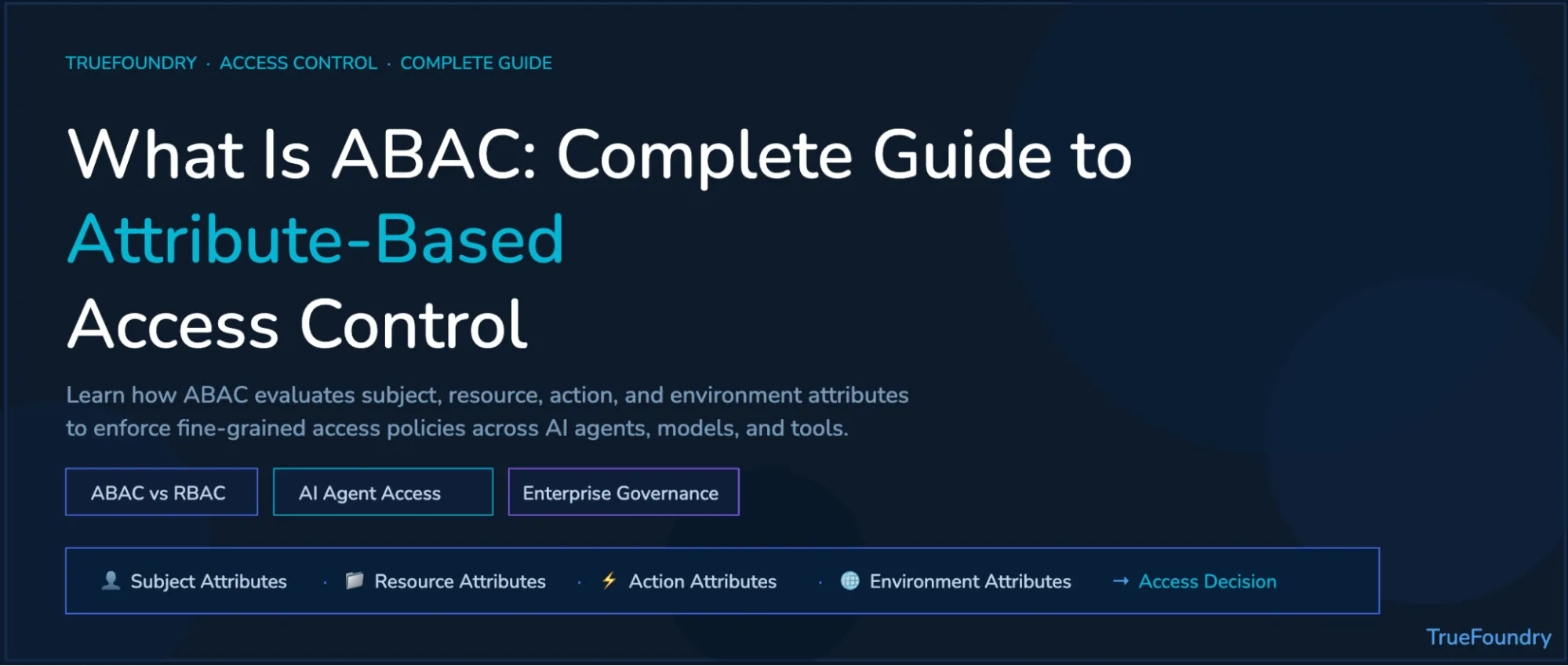
Attribute-based access control uses four major attribute categories for authorization. These categories are subject attributes, resource attributes, action attributes, and environment attributes. Together, they create a rich set of attributes for contextual access decisions.
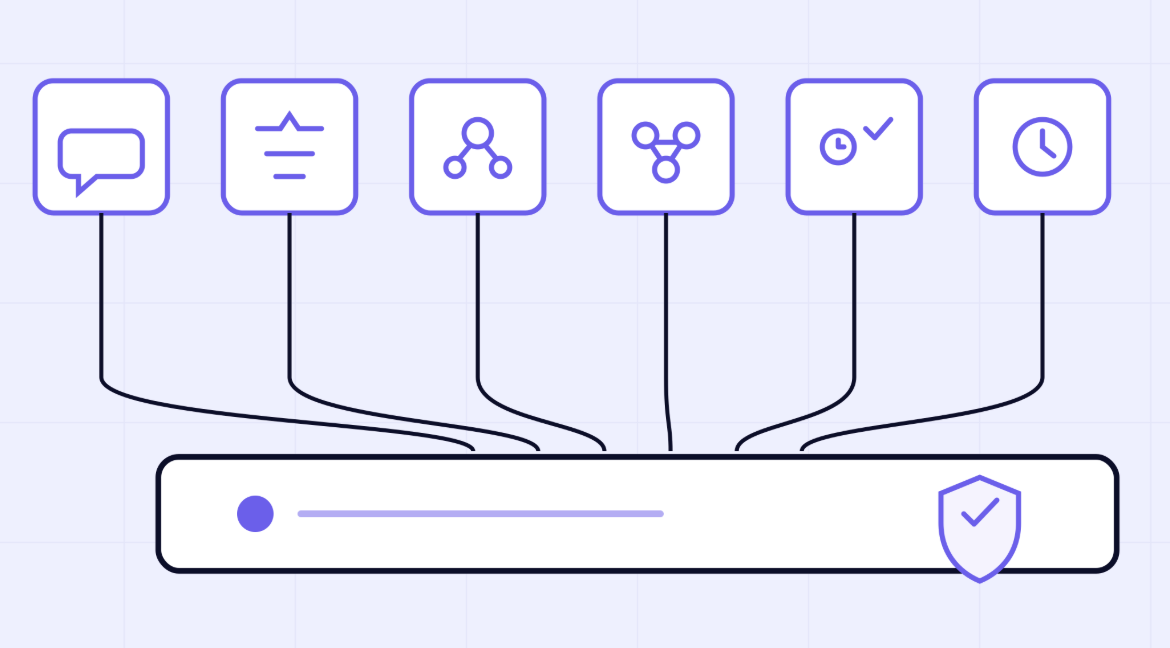
TrueFoundry applies attribute-based access control at the gateway layer across every AI agent, model, and tool connection your teams run—evalutaing subject, resource, action, and environment.
Subject attributes describe the entity requesting access. These may include department, job function, region, user profile, business unit, authentication status, security clearance, or the attributes of the subject making the request.
In AI systems, subject attributes can also include agent identity, application identity, and the authenticated user behind the agent. This helps enterprises avoid treating all AI agents as generic service accounts with broad access rights.
Resource attributes describe the asset being accessed. Examples include resource owner, data classification, model tier, tool category, environment, sensitivity level, data security label, and production or staging status.
These attributes help protect sensitive data and improve data protection. For example, a healthcare policy may allow support agents to read internal patient records while blocking write access to billing systems and clinical record updates.
Action attributes define the requested operation. Common examples include read, write, delete, invoke, summarize, generate, execute, export, approve, or modify. These actions can be allowed or denied independently of user roles.
This matters for AI agents because the same tool can support safe and risky actions. An agent may summarize a CRM record safely, yet the same agent may need stronger authorization before updating customer data.
Environment attributes describe the conditions surrounding the request. These may include time of day, location, IP address, device posture, risk score, session behavior, authentication method, and environmental conditions.
Environment conditions make access policies more adaptive. A request from a trusted office device during business hours may pass. The same request from an unmanaged device during unusual hours may require denial or step-up verification.
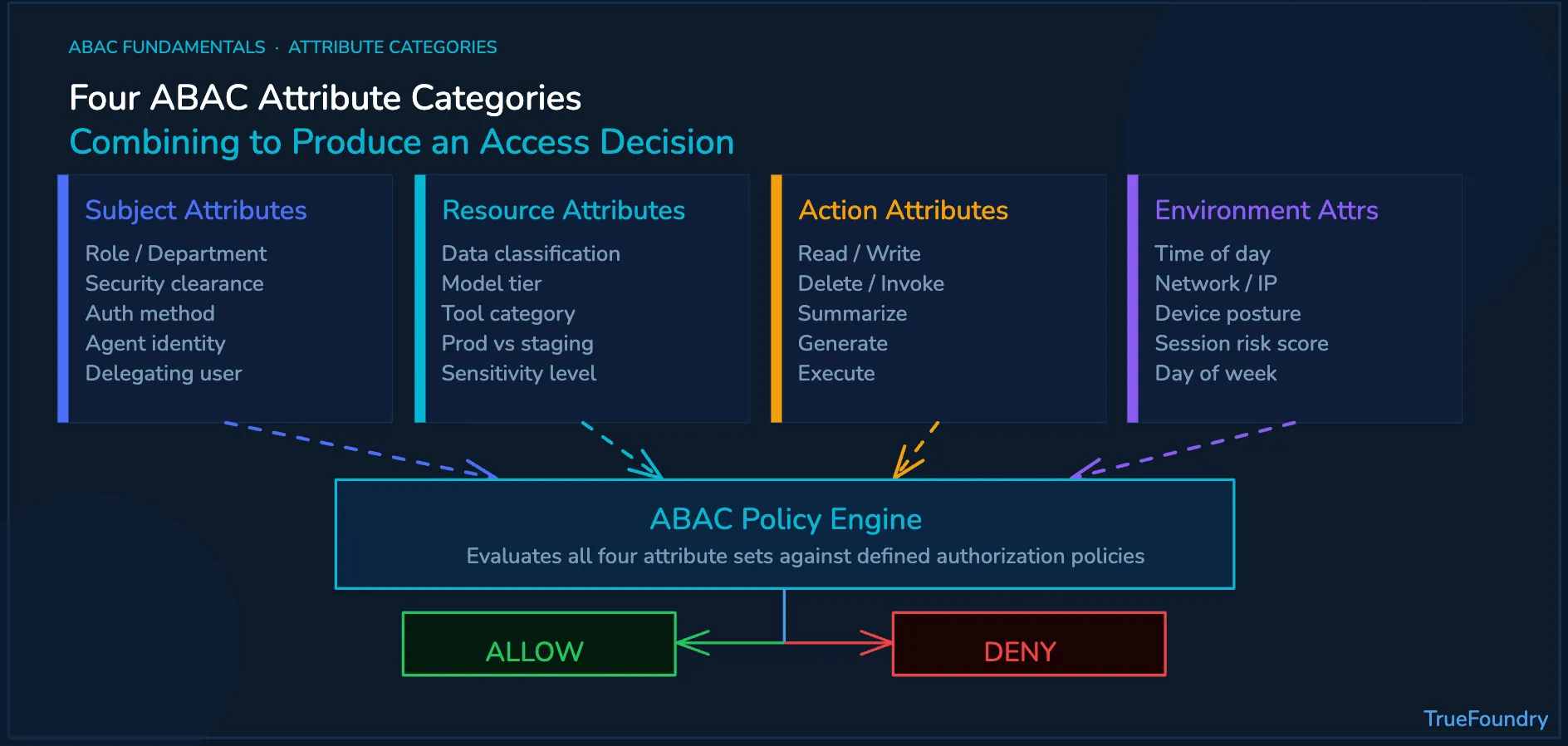
Attribute-based access control is a policy-driven security approach. It collects attributes, evaluates them against ABAC policies, and enforces the final decision before the user or system reaches the protected resource.
The process usually starts at the policy administration point. System administrators define rules that describe which attribute combinations are allowed. These rules may be expressed through a policy language such as Extensible Access Control Markup Language.
A policy engine evaluates the request in real time. It may check identity information from a Lightweight Directory Access Protocol directory, device signals, resource metadata, session context, and security policies before deciding.
The policy enforcement point applies the outcome before the protected resource is reached. In enterprise AI systems, an AI Gateway is a useful enforcement layer because model calls and tool actions can be governed before execution.
Enterprises should treat ABAC as a governance model, not only a policy syntax. The goal is to create rules that are understandable, enforceable, auditable, and manageable as the number of users, agents, tools, and business units grows.
These best practices also apply beyond AI. Web platforms may use attributes for parts of the site, types of cookies, end users, consent states, and device context. Enterprise systems use the same logic for data security and access management.
RBAC and attribute-based access control both help organizations control access. The difference is how each system decides whether access should be allowed. RBAC uses roles, while ABAC evaluates a wider set of attributes at request time.
RBAC is simpler to manage when permissions map cleanly to roles. For example, a finance manager may need access to specific financial applications. Attribute-based controls become stronger when access depends on data sensitivity, location, device, action, or session context.
Some enterprises use an ARBAC hybrid approach when role administration and attribute checks both matter. This allows teams to retain simple user roles while adding finer controls for sensitive resources, tools, models, and workflows.
Compared with discretionary access control, attribute-based models give central security teams stronger policy consistency. Compared with static access control policies, they also create a more adaptive user experience for dynamic work across applications, tools, and teams.
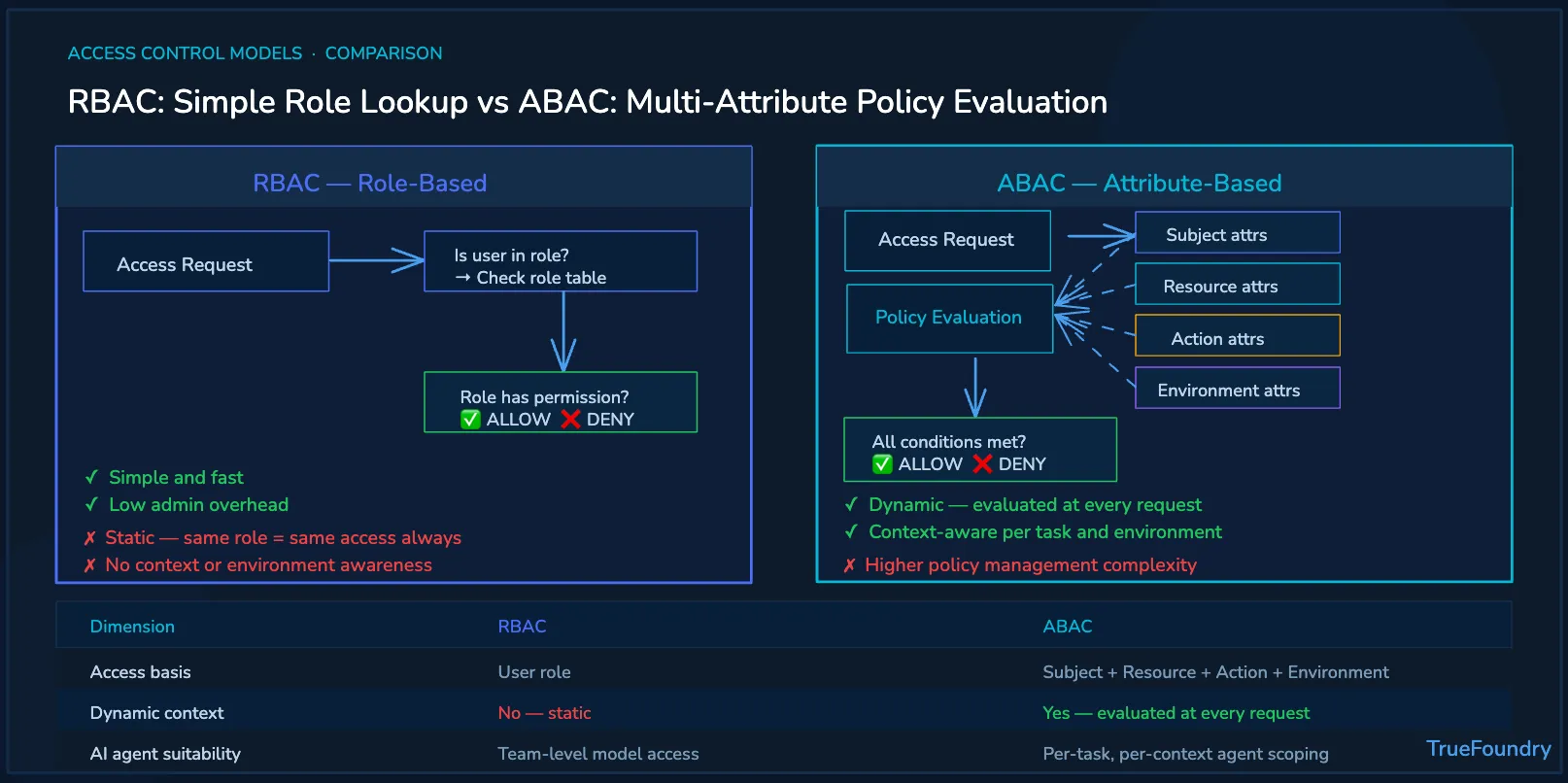
Human employees usually follow defined roles inside the organization. AI agents act based on tasks, prompts, tools, and context. That difference makes static roles insufficient for many agentic AI use cases.
For example, a customer-support AI agent may read CRM records during a service workflow. The same agent should not modify sensitive billing records unless the requester, action, resource, and context satisfy the approved policy.
Without ABAC, organizations usually face two weak options. They either over-permit AI agents and increase security risks, or they restrict agents so heavily that many useful workflows require manual exceptions and operational delays.
Attribute-based controls let teams match access to the task. A workflow can approve read-only customer access for one situation, deny write access in another, and apply stronger checks when sensitive data or high-risk tools are involved.
This becomes important as AI agents connect with the Model Context Protocol. Tools can reach internal systems, documents, databases, and ticketing platforms. The MCP Gateway layer becomes relevant when those tool calls need contextual authorization.
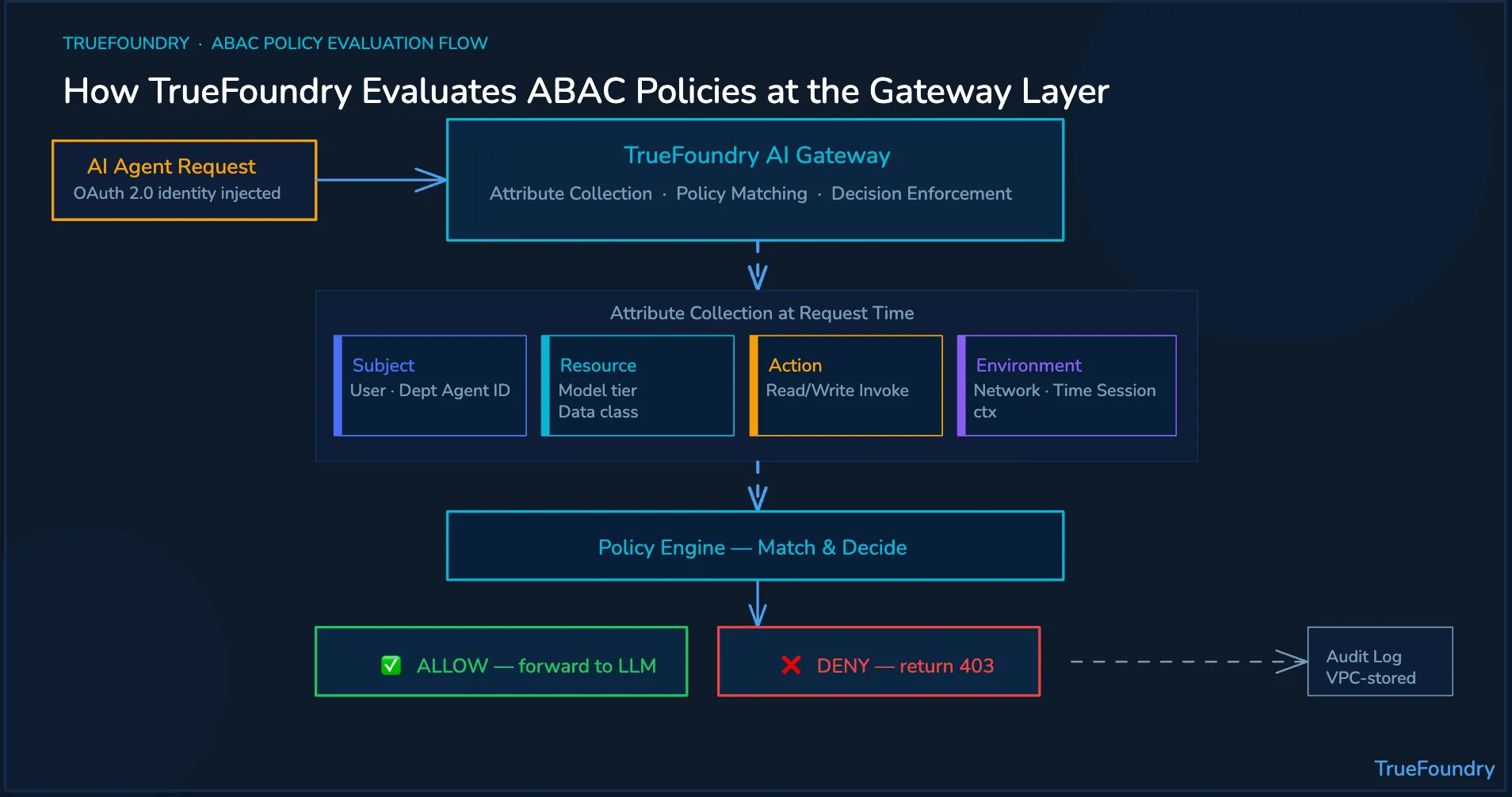
TrueFoundry applies attribute-based access control concepts to production AI governance. It helps enterprises manage access to models, tools, and AI agents through contextual policies enforced at the gateway layer.
Subject attributes can come from enterprise identity providers. TrueFoundry can use OAuth 2.0 identity injection so every agent action is tied to the requester’s identity and organizational attributes. This avoids relying only on shared service accounts.
Resource and action attributes can be enforced at the model and tool layer. TrueFoundry’s MCP Gateway can apply per-model and per-tool policies, including read-only or read-write access to specific enterprise tools.
Environment attributes can be evaluated through workflow-level controls. The Agent Gateway helps teams govern session context, runtime behavior, cost thresholds, workflow state, and approved execution boundaries for agentic AI systems.
The LLM Gateway governs model access, routing, provider abstraction, rate limits, and cost visibility. Together, these controls help enterprises enforce policy before model calls, MCP tool actions, or agent workflows execute.
Policy decisions are logged with relevant attributes, matched policies, and decision results. These audit logs can remain inside the customer’s VPC, which helps teams support SOC 2, HIPAA, and internal compliance review processes.
ABAC helps enterprises make access decisions based on context. TrueFoundry helps enforce those decisions before AI agents call models, access MCP tools, or act on enterprise systems.
Book a demo to see how TrueFoundry applies identity-aware ABAC policies across models, tools, agents, budgets, and audit logs.
TrueFoundry AI Gateway delivers ~3–4 ms latency, handles 350+ RPS on 1 vCPU, scales horizontally with ease, and is production-ready, while LiteLLM suffers from high latency, struggles beyond moderate RPS, lacks built-in scaling, and is best for light or prototype workloads.


The purpose of ABAC is to make access decisions more contextual than role-based rules. It evaluates a rich set of attributes, including user profile, resource sensitivity, action type, security clearance, IP address, and time of day. This helps modern organizations enforce granular access control across sensitive data, AI tools, and business processes.
ABAC stands for attribute-based access control. The ABAC meaning is simple: access is granted or denied after evaluating attributes of the subject, resource, action, and environment. Instead of relying only on a role, ABAC access control checks context such as job function, data classification, device posture, and environmental conditions per request.
ABAC is used when access requirements depend on more than user roles. Enterprises use it to protect patient records, enterprise resource planning data, parts of the site, or AI tools with smart access restrictions. It supports data security, separation of duties, regulatory compliance, and real-time policy enforcement across large organizations.
An ABAC model evaluates four attribute groups before approving an access request. Subject attributes describe the requester. Resource attributes describe the protected asset. Action attributes describe the attempted operation. Environment attributes describe context such as IP address, time of day, device state, and risk signals. A policy engine uses these inputs together.
An example of attribute-based access control is a support agent accessing customer records. The policy may allow read access when the requester belongs to Support, the data is internal, the action is read-only, and the request comes from an approved network. If billing data is modified, access can be denied.
An ABAC pattern is the repeatable structure used to evaluate attributes during access management. It collects subject, resource, action, and environment attributes, checks them through access control policies, and applies the final decision through a policy enforcement point. This pattern supports granular access control without creating endless roles for end users.
Yes, organizations can use RBAC and ABAC in the same system. The RBAC model can group users by role, while ABAC adds contextual checks for sensitive data, business units, action type, and environment conditions. This hybrid approach balances simplicity, flexibility, user experience, and policy administration across large organizations and security operations.
The ABAC process starts when a subject submits an access request. The system gathers attributes from a policy information point, compares them with ABAC policies, receives a decision from the policy decision point, and enforces it through the policy enforcement point. The decision is then logged for policy management and audits.
An ABAC policy is a conditional rule that defines when access should be allowed or denied. It may evaluate department, job function, security clearance, resource sensitivity, requested action, IP address, and time of day. Strong policy administration keeps rules understandable, testable, and aligned with business requirements and data protection goals.



The latest news, articles, and resources sent to your inbox
.webp)
.png)
.webp)
.webp)
.webp)

.webp)