


What is supervised learning and how does it work?

Machine learning is often used to make predictions, but those predictions need something to learn from. If you want a model to recognize defective products, estimate future demand, or classify images, you need examples that show what the expected outcome looks like.
That's where supervised learning comes in. It is one of the main approaches used to train machine learning models for prediction and classification tasks.
In this article, we'll explain what supervised learning is, how models learn from labeled data, the main task types and algorithms, and how supervised learning is used in real-world applications.
What is supervised learning?
Supervised learning is a type of machine learning in which a model learns the relationship between inputs and known outputs, or labels, from labeled training data.
Take spam detection as an example. You can give a model thousands of emails that have already been marked as “spam” or “not spam.” By studying those examples, the model learns which patterns are commonly associated with spam and can use them when it sees a new email.
The same principle works for very different problems. A model can learn to predict house prices, flag potentially fraudulent transactions, identify defective products, or classify images.
How does supervised learning work?
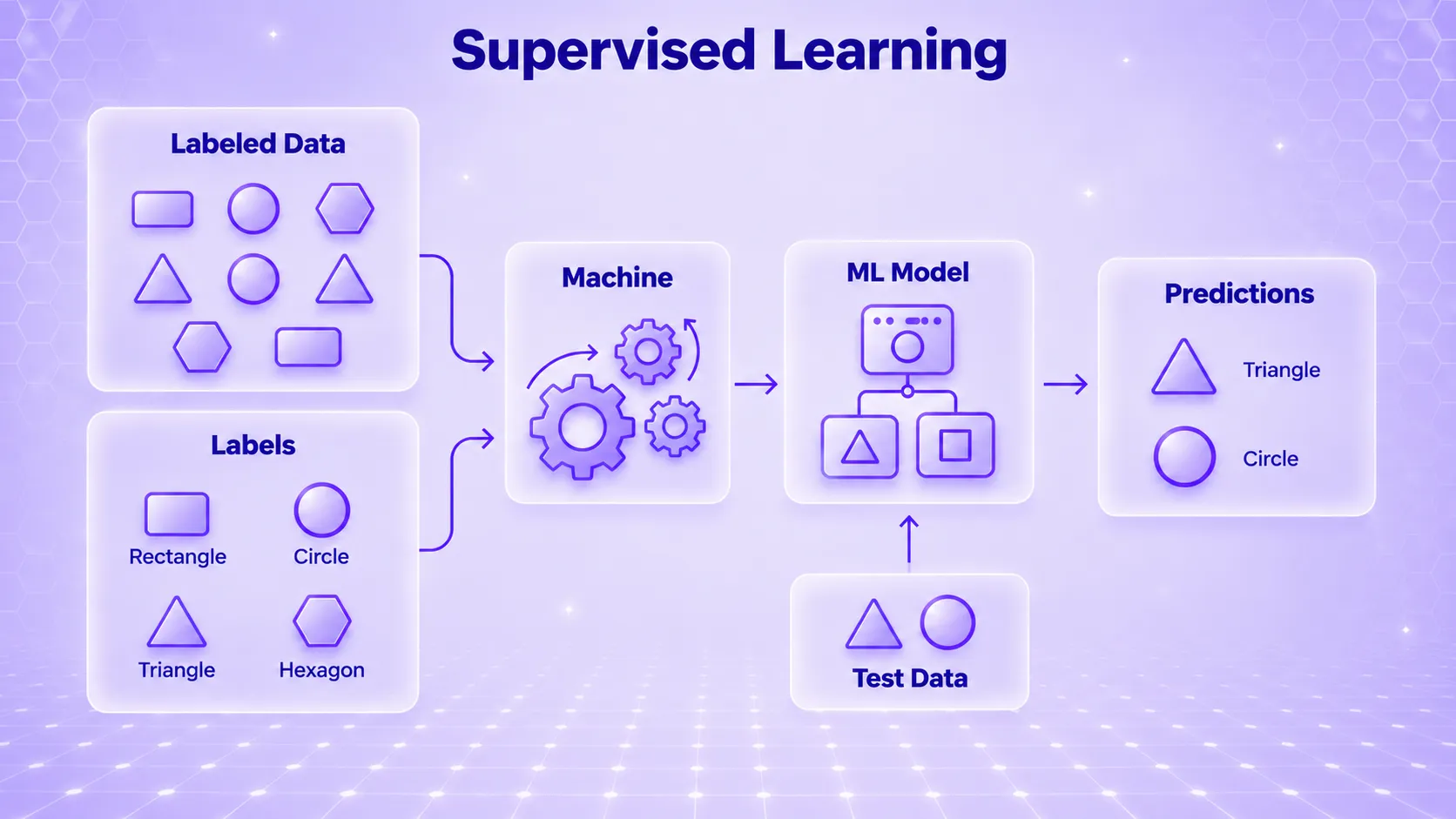
The process is easier to understand if you think of it as learning with an answer key. The model isn't given a rule for every possible situation. Instead, it sees enough labeled examples to learn the relationship between the input and the expected output.
In practice, a supervised learning workflow usually looks like this:
- Collect the data:
Gather examples that represent the problem you want to solve.
- Label the data:
Add the correct outcome to each example. An email, for instance, could be labeled “spam” or “not spam.”
- Train the model:
Feed the labeled dataset into a machine learning algorithm. During training, the model compares its predictions with the known labels and adjusts its parameters to reduce prediction error.
- Evaluate the model:
Measure its performance on labeled data it did not use for training, using metrics appropriate to the task.
- Deploy and monitor:
If the results are good enough, the model can be used with real-world data and monitored over time.
The labeled training dataset is what makes supervised learning different from several other machine learning approaches. Each example tells the model what the input looks like and what output it should associate with that input.
Consider fraud detection. The training data might include transaction amount, location, time, device information, and other features. Each transaction would also have a known outcome, such as “fraud” or “legitimate.”
The model's goal isn't to memorize those transactions. It needs to learn patterns that still work when a completely new transaction comes along.
What are the benefits of supervised learning?
Supervised learning is particularly useful when you have historical data and a clear outcome you want a model to predict.
Supports different kinds of predictions:
Supervised models can predict categories as well as numerical values. That covers problems ranging from spam detection and image classification to sales and demand forecasting.
Provides straightforward evaluation: You can compare the model's predictions with the actual answers in your test data. Depending on the problem, you might use metrics such as accuracy, precision, recall, or mean squared error.
Applies to a broad range of applications: The same basic approach is used across finance, healthcare, retail, manufacturing, cybersecurity, marketing, and many other areas.
Supports automation at scale: Once a model has been properly trained and evaluated, it can process large amounts of new data without requiring someone to manually make every prediction.
What are the types of supervised learning?
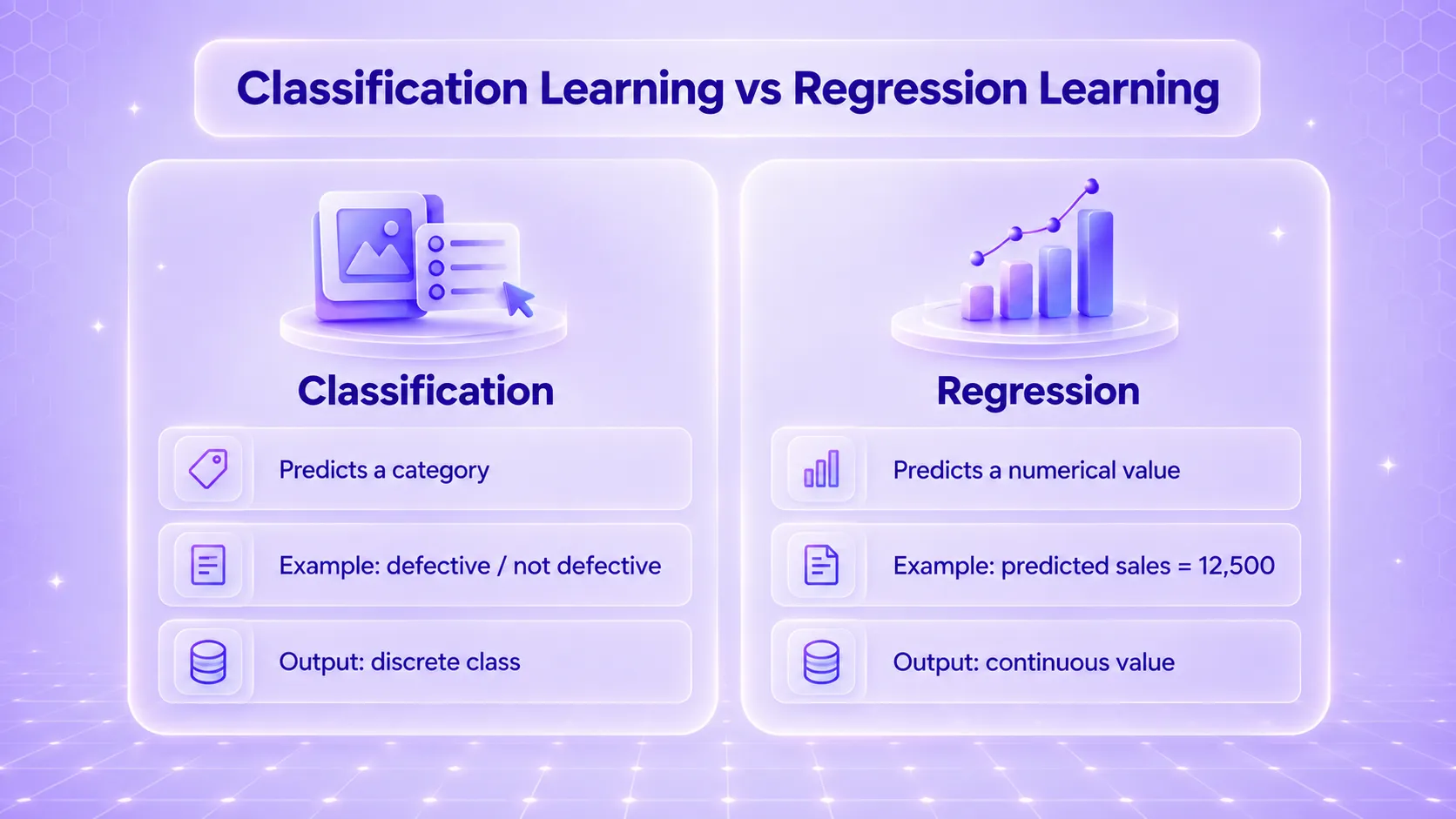
Supervised learning problems generally fall into two main task types: classification and regression. Ensemble learning is different: it is not a third prediction task, but an approach that combines multiple models and can be used for either classification or regression.
Classification
For example, an email might be classified as spam or legitimate. A fraud detection system could classify a transaction as suspicious or normal, while an image model could identify whether a picture contains a cat, dog, or another object.
Classification can be binary, where there are two possible classes, or multiclass, where there are several.
Regression
Regression is used when the model needs to predict a continuous numerical value.
A retailer might use regression to estimate future sales. A property platform could use it to estimate the price of a home based on factors such as location, size, and other characteristics.
The key difference is simple: classification predicts a category, while regression predicts a value.
Ensemble learning
Ensemble learning is not a separate supervised learning task like classification or regression. Instead, it is an approach that combines predictions from multiple models and can be used for both classification and regression.
Random forest is a common example. It combines many decision trees and uses their predictions to arrive at an overall result. Ensemble methods can be used for both classification and regression.
Which algorithms are used in supervised learning?
Different supervised learning algorithms are suited to different kinds of problems. Your choice will depend on what you're trying to predict, the data you have, how much of it you have, and whether you prioritize factors such as accuracy, speed, or ease of interpretation.
Naive Bayes: A probabilistic classification method based on Bayes' theorem. It makes the simplifying assumption that input features are conditionally independent given the class and is commonly used for tasks such as spam detection and text classification.
Linear regression: Predicts a numerical value by finding a linear relationship between input variables and an output. For example, it can estimate sales based on advertising spend, pricing, or other factors.
Nonlinear regression: Models relationships between inputs and a continuous output using a nonlinear function. It can capture relationships that cannot be represented adequately by a simple linear model but may require more careful model selection and tuning and can be more prone to overfitting.
Logistic regression: Despite its name, this is primarily a classification algorithm. It estimates the probability of an outcome and uses that probability to assign data to a class, such as predicting whether a customer will cancel a subscription.
Polynomial regression: An extension of linear regression that can model curved relationships between variables. It is useful when a straight-line model doesn't fit the data, although a model that is too complex can overfit the training data.
Support Vector Machine (SVM): A supervised learning method commonly used for classification and also adaptable to regression. For classification, it finds a decision boundary that maximizes the separation between classes, while kernel functions can help model nonlinear relationships.
k-nearest neighbor (KNN): Makes predictions based on the training examples closest to a new data point. For classification, it can use the most common class among nearby examples; for regression, it can use their values to estimate a numerical output.
Decision tree: Makes predictions by repeatedly splitting data based on feature values. Decision trees can be used for both classification and regression and are also the building blocks of ensemble methods such as random forests.
Supervised learning versus other Learning methods
One of the easiest ways to distinguish machine learning approaches is to ask: Where does the model get its learning signal from?
Supervised vs. unsupervised learning
Supervised learning learns from examples with known labels. Unsupervised learning works with unlabeled data and identifies structures or patterns, such as groups of similar data points.
Supervised vs. semi-supervised learning
Supervised learning relies on labeled training examples, while semi-supervised learning combines a smaller labeled dataset with a larger amount of unlabeled data. This can be useful when accurate labeling is expensive or time-consuming.
Supervised vs. self-supervised learning
Supervised learning uses externally provided labels. Self-supervised learning instead derives learning signals from the data itself and is commonly used to learn representations from large unlabeled datasets.
Supervised vs. reinforcement learning
Supervised learning trains against known target outputs. Reinforcement learning instead learns from rewards generated through interaction, making it suitable for problems involving sequences of actions and decisions.
Where is supervised learning used in the real world?
Many everyday Artificial Intelligence (AI) systems rely on historical examples with known outcomes to automate decision-making.
Email spam detection and content moderation: Models can learn from previously labeled emails, comments, messages, or posts to identify unwanted or inappropriate content.
Fraud detection and risk scoring: Financial models can learn from historical transactions marked as fraudulent or legitimate and use those patterns to flag new transactions.
Medical diagnosis support and triage prediction: Models can analyze labeled clinical or imaging data to help classify cases or estimate risk. These systems require careful testing and human oversight.
Demand forecasting: Regression models can use historical sales, demand, pricing, seasonality, and other factors to forecast future demand.
Recommendation and ranking: Models can learn from previous user interactions to estimate which products, content, or search results are likely to be relevant.
Computer vision: Labeled images can be used to train systems for defect detection, OCR, image classification, and other visual tasks.
Natural language processing: Supervised models can classify sentiment, identify user intent, or extract information such as names, locations, and organizations from text.
What are the challenges of supervised learning?
Supervised learning can produce useful predictions, but its performance depends heavily on the quality of its labeled data and how well the model can match real-world conditions.
Labeling cost and effort: Creating accurate labels can be expensive and time-consuming, particularly when annotation requires domain experts. Teams can prioritize high-value examples, improve annotation workflows, and, where appropriate, use techniques such as semi-supervised learning to reduce labeling requirements.
Data bias and representation: If training data contains biases or does not adequately represent the population the model will be used in, predictions can reproduce or amplify those biases. Teams can evaluate dataset coverage, measure performance across relevant groups, and improve data collection where gaps appear.
Privacy and compliance: Labeled datasets may contain personal or confidential information. Data minimization, access controls, appropriate de-identification, retention policies, and governance processes can help teams manage these risks.
Interpretability and explainability: Some models are difficult to interpret, which can be a problem when users or regulators need to understand a prediction. Teams can choose more interpretable models where appropriate and use explanation techniques alongside model and data documentation.
Data quality and drift: Incorrect labels, noisy inputs, adversarial inputs, or changes in production data can reduce model performance. Data validation, representative evaluation datasets, drift monitoring, and periodic reevaluation can help teams detect and respond to these issues.
Production monitoring: Strong offline results do not guarantee that a model will continue to perform well after deployment. Teams should monitor prediction quality, input distributions, latency, errors, and other relevant metrics and establish thresholds for investigation, retraining, or rollback.
Conclusion
A supervised learning system is only as useful as its performance on new, real-world data. Choosing an appropriate algorithm matters, but data quality, representative evaluation, and ongoing monitoring are equally important once the model moves into production.
Teams should therefore evaluate supervised learning as a complete lifecycle, from preparing reliable training data to measuring and monitoring how the deployed model performs as real-world conditions change.

Govern, Deploy and Trace AI in Your Own Infrastructure
Frequently Asked Questions
Is ChatGPT supervised or unsupervised?
No single term describes ChatGPT. Large language models undergo multi-stage training combining unsupervised/self-supervised pretraining on vast text corpora with supervised fine-tuning (SFT) and reinforcement learning from human feedback (RLHF). While supervised learning is used during post-training, describing ChatGPT as purely a supervised model is an oversimplification.
Is supervised learning AI or ML?
Supervised learning is a specific machine learning (ML) approach, while machine learning is a branch of artificial intelligence (AI). Therefore, supervised learning is a subfield of ML, which sits under the broader umbrella of AI.
What is the best supervised learning model?
There is no single "best" model. The optimal choice depends on your data size and type, prediction targets, latency constraints, compute budget, and interpretability requirements. For example, decision trees excel at structured data, while neural networks are commonly used for computer vision and natural language processing.
What are the disadvantages of supervised learning?
Supervised learning requires high-quality labeled data, which can be expensive and time-consuming to collect. Furthermore, models can inherit human labeling biases and suffer performance degradation when production data drifts away from original training distributions.
Is CNN supervised or unsupervised?
A convolutional neural network (CNN) is an architecture, not a learning paradigm. When trained on labeled image pairs (e.g., photos tagged with object classes), it functions as a supervised learning system. However, CNNs can also be used in self-supervised or unsupervised feature extraction setups.


- © 2022 ENSEMBLE Technologies



Subscribe to our newsletter
The latest news, articles, and resources sent to your inbox


