


What Is SIEM And How Does It Work?

Organizations face security threats across their IT environments every day, such as login attempts, firewall blocks, file downloads, or changes in user permissions. It may look harmless on its own. However, the problem is determining which events may indicate suspicious activity or an attack.
Security Information and Event Management (SIEM) solutions manage this by collecting security data from organization-wide applications, devices, and users. It then analyzes and consolidates the data in real time.
Using advanced detection algorithms, correlation rules, and logic, SIEM connects disparate data and identifies potential threats. Alerts will be sent to security analysts for further investigation.
What is SIEM?
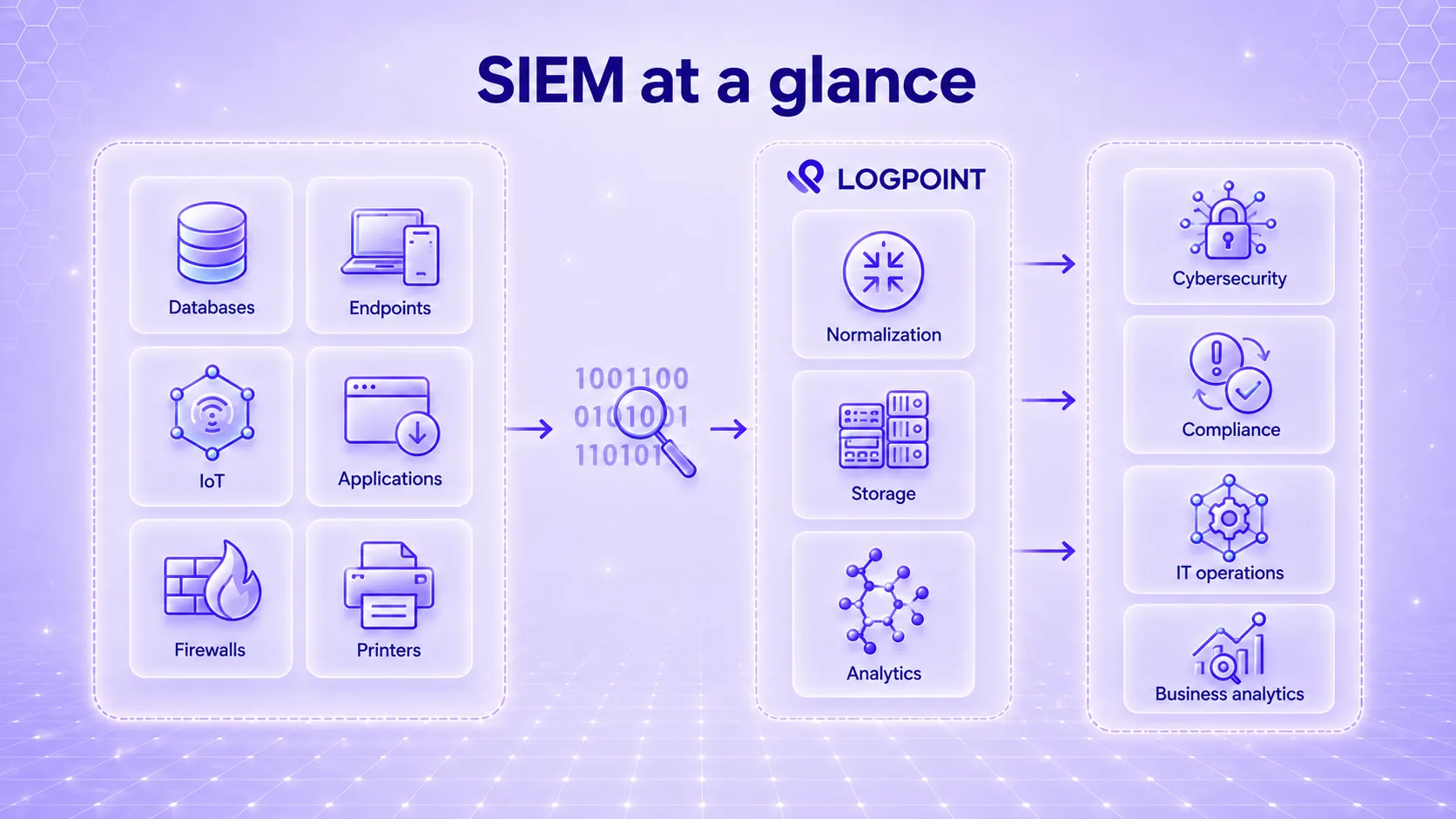
SIEM stands for Security Information and Event Management. It is a security platform that collects and analyzes logs and security event data from an organization's IT environment, including servers, applications, endpoints, networks, cloud services, and identity systems.
SIEM gives security teams a consolidated view of security-related activity and helps security operations center (SOC) analysts monitor, investigate, and respond to potential threats. It correlates events from other sources to identify patterns that may involve suspicious activity and generate data for investigation.
Early SIEM platforms converged security information management (SIM) with security event management (SEM). SIM focused on collecting and managing security logs while SEM focused on monitoring and analyzing security events. Modern SIEM platforms may also include security analytics, behavioral analysis, and AI or machine learning capabilities.
SIEM is primarily used to monitor security, detect suspicious activity, and investigate incidents. It can also support compliance activities by maintaining activity records across the IT environment.
How does SIEM work?
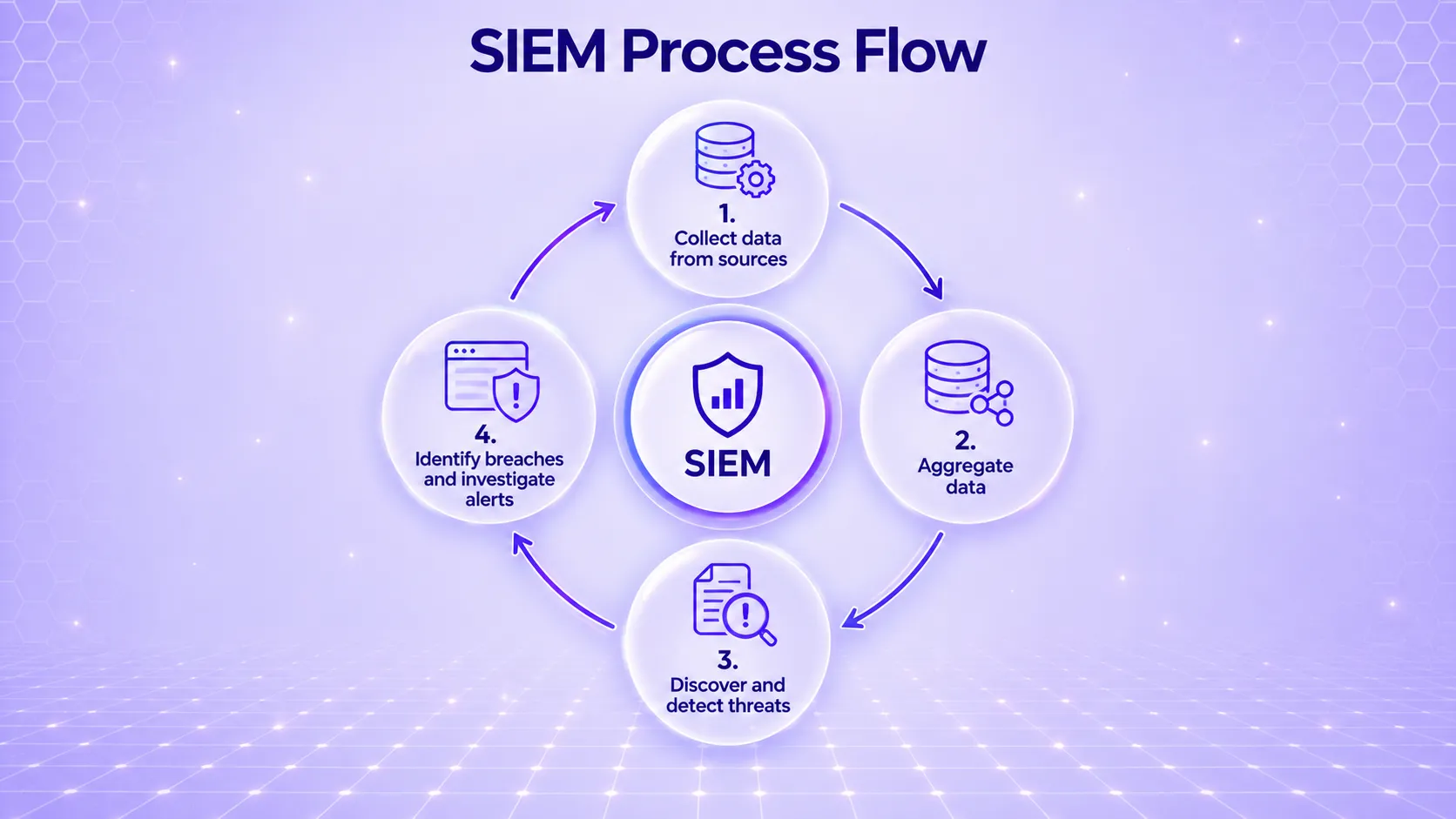
A SIEM processes data through four core activities, including collecting security data, analyzing events, generating alerts, and investigating.
Log management
The process starts with ingesting security data into the SIEM. Logs come from firewalls, servers, databases, applications, endpoint devices, cloud platforms, identity providers, and other security tools.
Because different systems record events in different formats, the data usually needs to be normalized before it can be analyzed consistently.
Normalized data can be indexed and searched, allowing analysts to investigate activity across multiple systems and search historical events.
Event correlation and analytics
A single security event may not provide the whole context.
For example, an employee account may have failed a login attempt. That's not necessarily suspicious. If the same account has dozens of failed attempts, a successful login from an unusual location, and an attempt to access a restricted database, these events provide more context for investigation.
SIEM platforms use correlation rules, analytics, behavioral detection, and other techniques to connect related events, allowing security teams to investigate patterns rather than evaluating individual log entries.
Incident monitoring and security alerts
When a SIEM detects activity that matches a rule or looks suspicious, it generates an alert for analysts to review.
The alert may include information about the affected user, device, application, source IP address, timestamps, and related events. Analysts can use this context to determine whether the alert represents a genuine security concern, a false positive, or activity that requires investigation.
A high volume of low-priority or false positive alerts can increase the workload for the security operations team. SIEM platforms can prioritize alerts and provide data to help analysts investigate activity that requires attention.
Incident investigation
When alerts confirm the need for further investigation, analysts search for related events across the SIEM to reconstruct security events. They check for authentication activity, network connections, file activity, and changes to user privileges.
The SIEM helps analysts build a timeline by connecting events from different systems. This helps determine the systems and accounts involved, identify activity that occurred, and assess the scope of an incident. These findings can be used to determine whether further actions are required.
What are the benefits of SIEM?
SIEM centralizes security data from multiple systems, giving analysts a comprehensive view of organizations’ security-related activity and helping them spot threats.
- Centralized Visibility: Security data from endpoints, applications, networks, cloud services, and identity systems can be accessed through a central platform, allowing analysts to examine activity across multiple systems without switching between different data sources.
- Cross-System Event Correlation: Correlating events across multiple systems can reveal suspicious patterns that may be difficult to spot in individual logs. Detecting security-related activity earlier can give security analysts more time to investigate and decide on a response.
- Centralized Investigation Workflow: Analysts can search security data, investigate alerts, and manage detection rules within the SIEM. Converging these activities reduces the need to switch between different tools when searching for events and investigating alerts.
- Regulatory Compliance Support: Centralized logging, data retention, monitoring, and reporting can provide records organizations may need as evidence during security audits and compliance reviews.
- Faster Investigation and Forensics: When historical event data is retained, analysts can trace activity across systems, build an incident timeline, and investigate activities before and after a suspicious event.
What are the common use cases of SIEM?
SIEM use cases vary depending on an organization's environment, available data sources, and detection strategy. Common use cases include:
- Insider Threat Detection: Unusual access patterns, changes in privilege, large data transfers, or activity that deviates from a user's normal behavior can indicate potential insider threats.
- Advanced Persistent Threat (APT) Detection: APTs involve multiple systems and attack stages over a long period. SIEM helps identify activity associated with multiple stages of an APT by investigating events across users, endpoints, networks, and applications.
- Phishing and Malware Detection: SIEM can integrate email, endpoint, identity, and network events to investigate whether a reported phishing message or suspicious file has resulted in unauthorized activity.
- Cloud Security Monitoring: Cloud environments generate large amounts of activity data. SIEM can centralize events from cloud infrastructure, applications, identities, and services to help teams monitor that activity.
- Endpoint Monitoring: Endpoint events such as unusual processes, authentication changes, software installations, and security alerts can be analyzed alongside activity from other systems to investigate suspicious behavior.
- Detecting Lateral Movement: After compromising one system, an attacker may attempt to access other accounts or machines. Authentication and network activity across multiple systems can be analyzed for patterns that may expose this movement.
- DDoS Detection: SIEM can analyze network and security events such as sudden traffic spikes and unusual connection patterns to identify activity that may indicate a distributed denial-of-service attack.
- Third-Party and Supply Chain Risk Monitoring: SIEM can monitor activity involving vendors, external accounts, and connected services, making unusual third-party access easier to investigate.
What is the role of AI and Machine Learning in SIEM?
Some SIEM platforms use AI and machine learning to analyze security data, identify anomalous activity, prioritize alerts, and support investigation.
Traditional detection often relies on predefined rules. For example, a rule might generate an alert when an account has an unusually high number of failed login attempts.
Machine learning can identify patterns that deviate from a user's or system's normal pattern. For example, an account that normally accesses a limited set of internal applications during working hours. If the account suddenly logs in from a new location, accesses several unfamiliar systems, and transfers an unusually large amount of data, behavioral analytics flags the activity for investigation.
AI -based features can also summarize alerts, help prioritize investigations, extract relevant information, and support selected response workflows. The quality of these capabilities depends on the underlying data, detection methods used, model performance, and context provided to the system.
What is the difference between SIEM and SOC?
A SIEM is a technology platform, while a Security Operations Center (SOC) is the function responsible for monitoring, investigating, and responding to security threats.
The SIEM collects security events that analysts can use during monitoring and investigation. SOC analysts then review those alerts, investigate suspicious activity, assess its impact, and determine whether a response is needed.
A SOC may also use other technologies, such as endpoint detection and response (EDR), network detection and response (NDR), threat intelligence platforms, vulnerability management tools, and security orchestration and automation tools.
How does TrueFoundry integrate with SIEM?
AI and MCP workflows can generate a large amount of security data, including user access, tool calls, and request and response activity. Bringing this data into a SIEM enables security teams to monitor these interactions alongside other security events in the IT environment.
TrueFoundry MCP Gateway maintains an MCP server registry with role-based access control (RBAC) at the tool level. It applies pre-execution guardrails to evaluate tool calls before they run. It also records details such as user identity, tool name, request payload, response, and latency.
The gateway can export this invocation data through OpenTelemetry (OTel) to a SIEM. Security teams can then use their existing monitoring and investigation workflows to track AI and MCP access, identify unusual activity, and maintain an audit trail of AI interactions.
SIEM in practice
SIEM combines security data from multiple systems to detect, analyze, alert, and investigate security-related events. SIEM’s effectiveness depends on available data, detection methods and rules, and the team’s capabilities.
To monitor AI and MCP activity through existing SIEM workflows, sign up for TrueFoundry MCP Gateway.

Govern, Deploy and Trace AI in Your Own Infrastructure
Frequently Asked Questions
What is SIEM vs SOC?
A SIEM is a technology platform that collects and analyzes security data, while a SOC is the security function responsible for monitoring, investigating, and responding to security events. A SOC can use SIEM as one of its core security monitoring tools.
What is an example of a SIEM tool?
Examples include Microsoft Sentinel, Splunk Enterprise Security, IBM QRadar, Google Security Operations, and Elastic Security. Selecting the right SIEM tool depends on factors such as data sources, integrations, detection capabilities, scalability, deployment requirements, and cost.
What is replacing SIEM?
SIEM is not being replaced by a single technology. Security platforms may combine SIEM capabilities with XDR (extended detection and response), security orchestration and automation, threat intelligence, and AI-driven analytics. These technologies can be used together rather than as direct replacements.
What are the three types of SIEM?
There are three common types of SIEM deployment models, including on-premises, cloud-based, and hybrid. On-premises SIEM can be installed on the organization’s own physical servers and hardware. Cloud-based SIEM runs on a third-party infrastructure. Hybrid SIEM uses both local infrastructure and cloud resources.


- © 2022 ENSEMBLE Technologies



Subscribe to our newsletter
The latest news, articles, and resources sent to your inbox


