


What is enterprise AI and why is it important?

Businesses are shifting AI from individual productivity tools into core operations, making enterprise artificial intelligence part of everyday business workflows. As companies begin to rely on artificial intelligence, they need ways to deploy and manage AI across different teams and functions. Enterprise AI manages this need by offering security, scalability, and governance.
Enterprise AI supports many aspects of business operations, from automating repetitive tasks to integrating with existing software systems and assisting employees. The focus is not simply on using AI but on integrating it into business processes in ways that support security and scalability.
This article explains what enterprise AI is, its benefits and use cases, how organizations can implement it, and the risks associated with using AI as part of digital transformation.
What is enterprise AI?
Enterprise AI is the application of artificial intelligence within an organization to automate processes, analyze data, support decisions, and build AI-powered products or services.
Enterprise AI can include traditional machine learning models, predictive AI, generative AI systems that create content, and AI agents that perform multi-step tasks using business data and tools.
What makes enterprise AI different from consumer AI is the environment in which it is deployed and used. Enterprise systems often need to work with private enterprise data, existing business applications, internal policies, access controls, and regulatory requirements.
For example, a company could deploy an AI assistant that answers employee questions using internal documentation and connected business systems. The system may use retrieval-augmented generation (RAG) to retrieve relevant information and provide it as context to a large language model (LLM), while access controls determine which documents each employee can access.
Why is enterprise AI important?
AI is moving beyond individual productivity tools and becoming part of how organizations operate. Enterprise AI can help organizations improve performance, make decisions, and access information.
The strategic business value comes from connecting AI capabilities to measurable business outcomes. Organizations can use AI to reduce customer support time, detect unusual transactions, forecast demand, and turn complex business data into actionable insights.
As generative AI and foundation models become easier to deploy, businesses can move beyond isolated experiments and integrate AI into repeatable workflows across different teams and functions.
What are the benefits of enterprise AI?
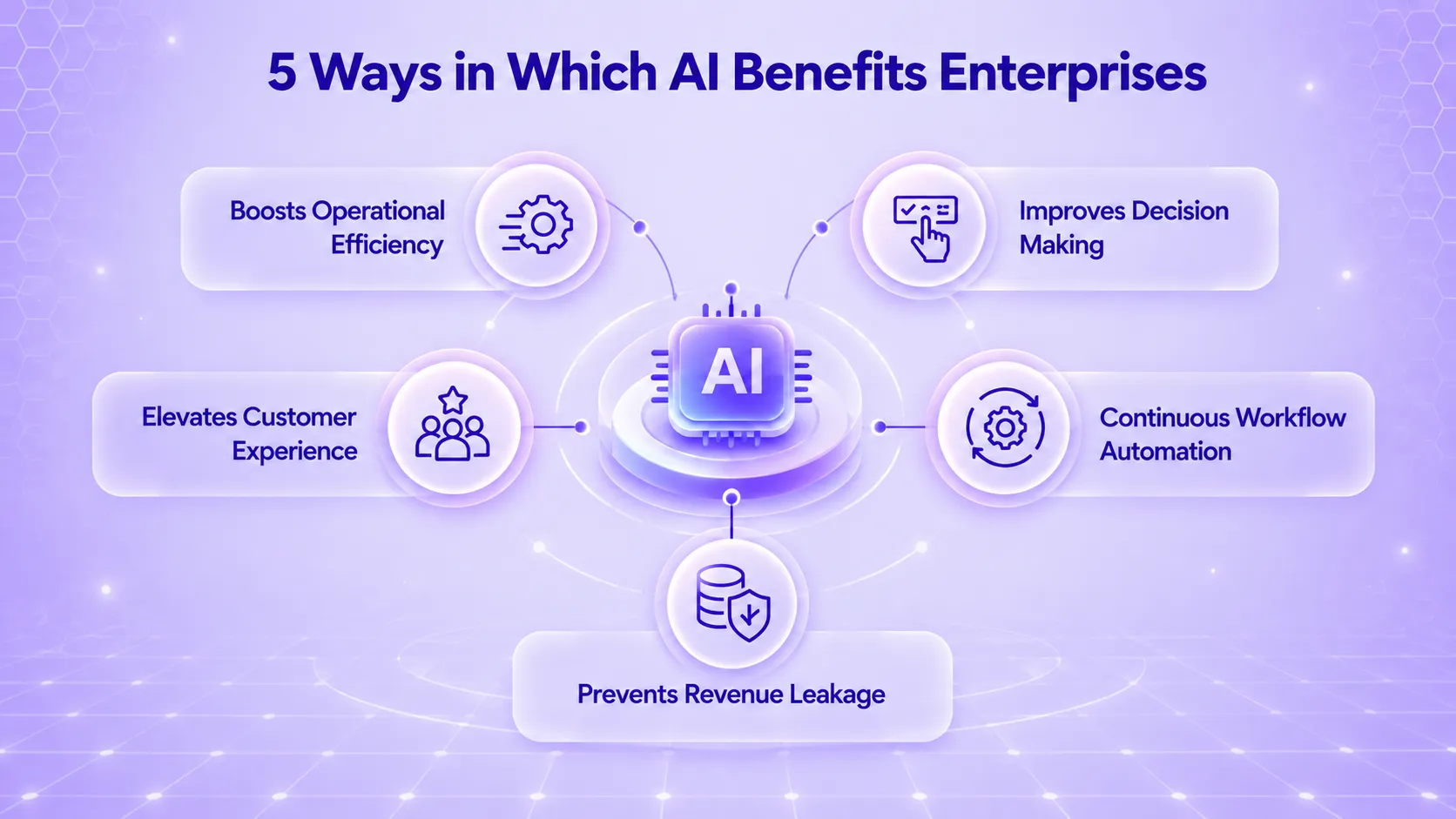
Enterprise AI can help organizations improve efficiency, decision-making, customer experience, and innovation.
- Automating tasks and optimizing operations: AI can handle repetitive tasks such as document processing, classification, summarization, and routine customer requests. AI agents can also execute several multi-step workflows by using tools and interacting with connected systems.
- Reducing costs and increasing efficiency: Automating routine tasks reduces labor and operational effort, potentially reducing costs, improving overall performance, and helping boost productivity.
- Enhancing decision-making with predictive analytics: Machine learning models can identify patterns in historical data and help businesses forecast demand, identify potential risks, predict likely outcomes, and improve resource allocation.
- Driving innovation and gaining a competitive edge: Organizations can use AI to develop new products, personalize services, and automate repetitive manual tasks that would be difficult to manage at scale.
- Improving customer experience: AI-powered assistants can provide faster support, recommend relevant products based on customer preferences, and personalize interactions across customer channels.
- Real-time monitoring and issue detection: AI systems can analyze incoming data in real time to identify unusual behavior, operational problems, or potential security incidents.
How can you implement enterprise AI?
Implementing enterprise AI is usually an ongoing process rather than a single technology deployment, and successful AI adoption requires alignment across data, technology, people, and governance.
Assessing AI readiness and building a data strategy
Start by understanding the data available to the organization and how it is stored, accessed, governed, and maintained.
Poor-quality, fragmented, or inaccessible data can limit the value of an AI system. Teams should identify the data sources needed for the AI use case, establish ownership, and determine how sensitive information will be protected.
Defining business objectives and use case prioritization
Not every process needs AI. Start with problems where AI can provide a measurable improvement.
For example, reducing customer support resolution time or detecting fraudulent transactions may provide a clearer business outcome than deploying AI simply because the technology is available.
Selecting the right tools, platforms, and partners
The technology stack depends on the use case and the new technologies an organization needs to integrate with its existing infrastructure. An organization may need machine learning platforms, LLMs, data platforms, vector databases, APIs, cloud infrastructure, model-serving systems, and AI observability.
The choice between managed services and self-hosted infrastructure also depends on requirements for control, cost, security, latency, and scale.
Piloting, scaling, and measuring ROI
Start with a controlled pilot rather than immediately deploying AI across the organization.
Measure both technical performance and business outcomes. Depending on the application, these could include accuracy, response quality, latency, cost per request, employee productivity, customer satisfaction, or revenue impact. For applications that use AI agents, teams may also need visibility into tool calls, intermediate steps, latency, and cost. AI agent observability helps teams investigate how these workflows behave in production.
Once a system demonstrates consistent value, it can be scaled to additional teams or workflows while evaluation and continuous improvement help maintain performance over time.
Building internal AI skills and cross-functional teams
Enterprise AI involves more than data scientists. Successful deployments can require engineers, developers, security teams, domain experts, product managers, legal teams, and business stakeholders.
Cross-functional teams can help ensure that AI systems are technically sound while also meeting business, security, and governance requirements, defining when human intervention is required.
What are the common business use cases for enterprise AI?
Enterprise AI can be applied across major business units and functions, including customer service, finance, marketing, supply chain, and human resources.
- Customer service and support: AI assistants can answer common questions, summarize customer interactions, classify support tickets, and help human agents find relevant information.
- Research and development: AI can help teams analyze technical documents, identify patterns in research data, generate summaries, and support faster experimentation.
- Supply chain and asset management: Businesses can use AI to forecast demand, optimize inventory, predict equipment failures, and identify potential disruptions.
- Sales, marketing, and revenue operations: AI can help analyze customer behavior, segment audiences, personalize campaigns, score leads, support customer relationship management, and forecast sales.
- Human resources and talent management: Enterprise AI can support tasks such as employee knowledge search, recruitment workflows, onboarding, and workforce analysis. HR applications require careful consideration of fairness, privacy, and access controls.
- Finance and risk management: Financial teams and financial services organizations can use AI for forecasting, document processing, anomaly detection, financial fraud analysis, and risk assessment.
- Cybersecurity and fraud detection: Machine learning models can analyze large volumes of activity to identify suspicious patterns, including fraudulent transactions. AI can also help security teams investigate alerts and prioritize potential threats.
What tools and technologies are used in enterprise AI?
Enterprise AI is built from multiple artificial intelligence technologies rather than a single platform.
- AI agents and agentic AI: Systems that can reason through tasks, use tools, retrieve information, and perform actions across connected applications.
- Chatbots and virtual assistants: AI interfaces that answer questions and support customer or employee interactions.
- Cloud platforms: Provide computing, storage, networking, and managed AI services required to develop and run AI workloads.
- Data platforms: Store and process the structured and unstructured data used by AI applications.
- Generative AI: Produces content such as text, code, images, audio, and other outputs.
- Large language models (LLMs): Models trained on large volumes of text that can perform tasks such as generation, classification, and summarization.
- Machine learning: Uses models that learn patterns from data to make predictions or classifications.
- Natural language processing (NLP): Enables systems to process and understand human language.
- Predictive analytics: Uses historical and current data with predictive models to estimate future outcomes or identify likely events.
- Retrieval-augmented generation (RAG): Combines information retrieval with generative AI so that an LLM can use external or private information when producing an answer.
These components often work together in an enterprise AI system. For example, an enterprise AI assistant could use a large language model (LLM) with RAG to retrieve information from internal data platforms, call business APIs through tools, and run on cloud infrastructure.
What are the risks of enterprise AI?
Enterprise AI introduces technical, operational, security, and organizational risks that need to be addressed throughout development and deployment.
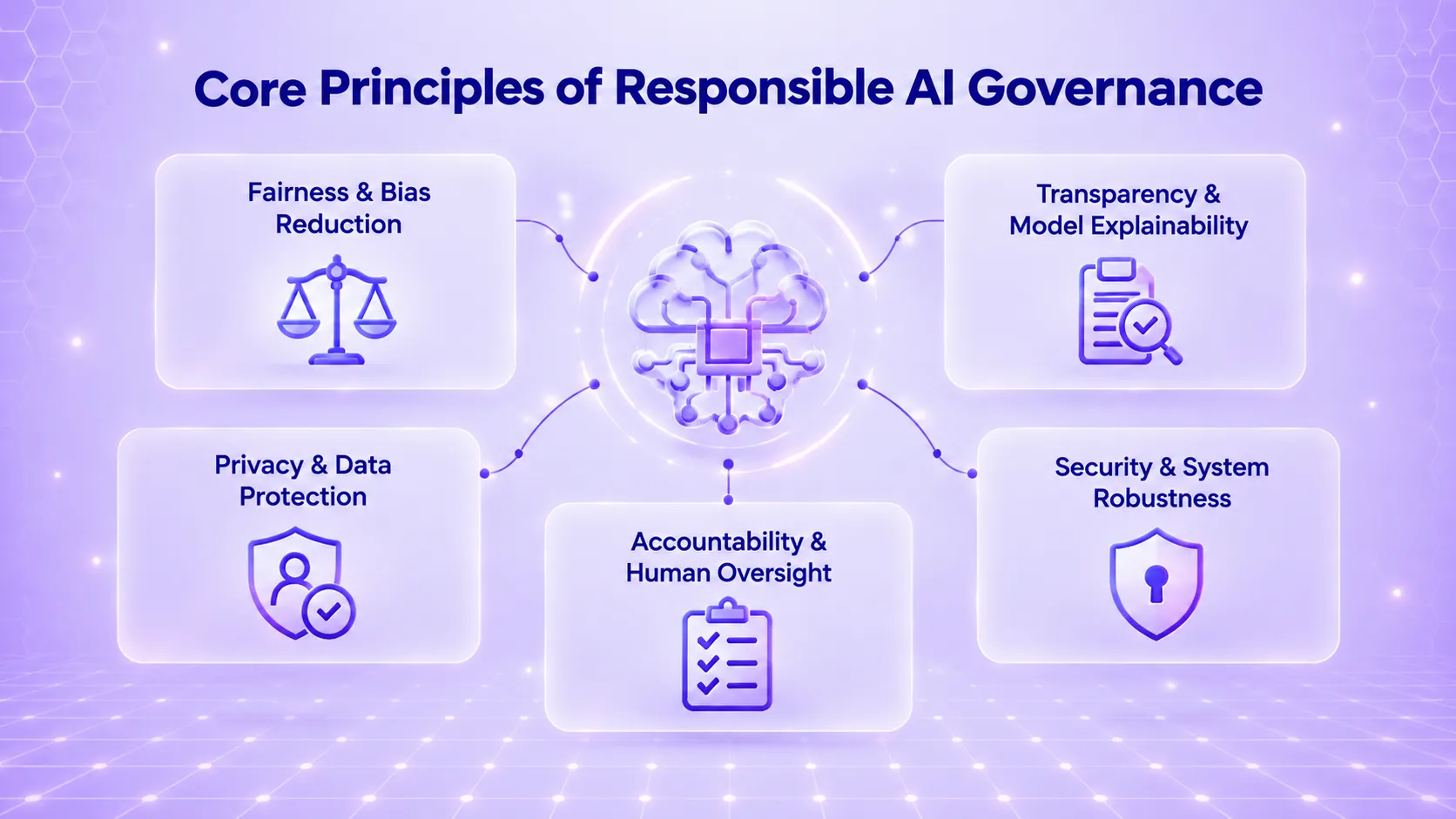
- Data quality, data privacy, and security concerns: AI systems may produce unreliable results when trained or grounded on poor-quality data. Private or sensitive information also needs appropriate access controls and protection. Data quality checks, access controls, and data governance can help reduce these risks.
- Responsible AI, ethics, and bias mitigation: Models can reproduce biases present in their training or input data. Organizations need processes for testing, evaluating, and addressing potentially harmful outputs, including regular evaluation for bias and other safety issues.
- Change management and organizational adoption: Employees may not immediately trust or understand AI-powered systems. Clear processes, training, and human oversight can help teams adopt new workflows.
- Content safety and intellectual property issues: Generative AI can produce inappropriate, inaccurate, or potentially infringing content. Organizations need policies and technical controls that define how AI-generated content can be reviewed and used.
- Integration with legacy systems: Existing enterprise applications may not have modern APIs or data interfaces, making integration more complex. Organizations can use integration layers, APIs, or controlled migration strategies.
- Cost and complexity of scaling AI: Running models at enterprise scale can require significant compute, storage, networking, monitoring, and engineering resources. Larger workloads can also make inference costs and latency important considerations. Businesses can manage these costs by monitoring resources, optimizing model selection, and scaling infrastructure according to demand.
This is why enterprise AI needs governance and operational controls alongside the models themselves.
Enterprise AI in practice
Enterprise AI is practical when AI capabilities are connected to drive measurable business outcomes and integrated into the company’s existing workflows. The key to successful deployments is not just choosing the right model, but also depends on reliable data, security, infrastructure, evaluation, and governance.
As organizations move from AI experiments to production applications, the underlying infrastructure becomes increasingly important. Model deployment, observability, data access, evaluation, and governance all help determine whether an AI system can operate reliably at scale.

Govern, Deploy and Trace AI in Your Own Infrastructure
Frequently Asked Questions
What is an example of enterprise AI?
An internal AI assistant that answers employee questions using company policies and documentation is one example of enterprise AI. Other examples include AI-powered fraud detection, predictive maintenance, and demand forecasting.
What does enterprise AI do?
Enterprise AI uses artificial intelligence to automate tasks, analyze data, support decision-making, improve customer experiences, and build AI-powered products or services. It can operate across functions such as customer support, finance, marketing, cybersecurity, supply chain, and human resources.
What is the difference between AI and enterprise AI?
AI is a broader technology used to perform tasks that typically require human intelligence, such as prediction, classification, language processing, and content generation. Enterprise AI refers to applying those capabilities within organizations, where factors such as private data, security, governance, existing systems, scalability, and business outcomes become important.
What are the best enterprise AI tools?
There is no single enterprise AI tool that is best for every organization. The right choice depends on the use case, data requirements, deployment model, and operational requirements. Common options include LLM platforms, AI agent frameworks, data platforms, model-serving infrastructure, and AI observability tools.
What are the different types of enterprise AI?
Enterprise AI can be categorized by the problems it solves rather than by a single fixed set of types. Common categories include predictive AI, generative AI, conversational AI, computer vision, AI agents, and recommendation or decision systems. Organizations may use several of these approaches within the same AI strategy.


- © 2022 ENSEMBLE Technologies



Subscribe to our newsletter
The latest news, articles, and resources sent to your inbox


