


What Is Unsupervised Learning and Why Does It Matter?

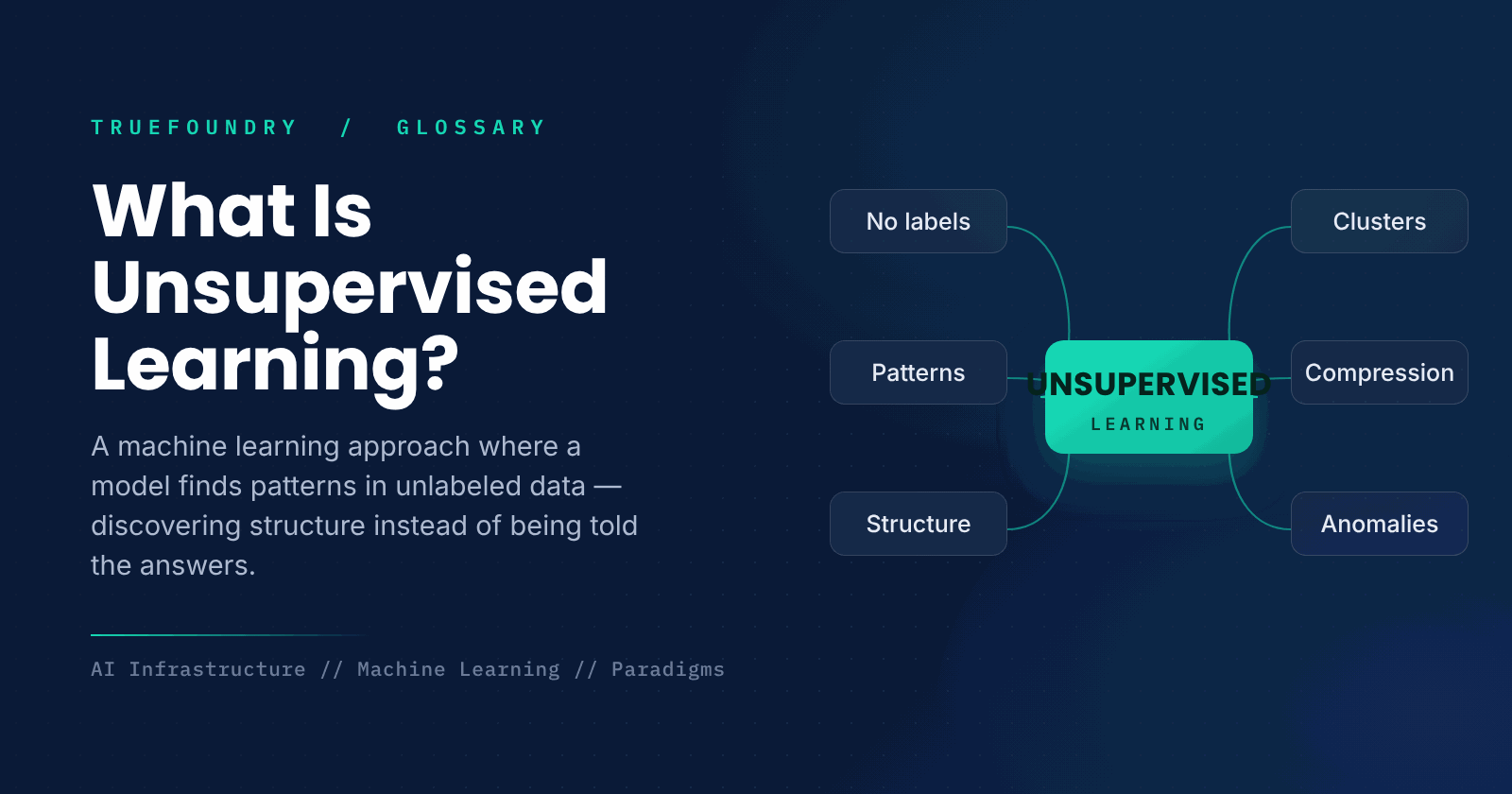
Most data in the world comes without labels. Nobody has gone through and tagged every customer, document, or image with the answer you happen to care about. Unsupervised learning is the branch of machine learning built for exactly this situation: finding useful structure in data when no one has told the model what to look for.
Rather than learning a mapping from inputs to known answers, an unsupervised model studies the data itself and surfaces patterns, which groups of examples resemble each other, which features carry the most information, and how the data is organized. These discoveries can be valuable on their own or feed into other systems.
This guide explains what unsupervised learning is, what it is used for, how it compares to supervised learning, and when to reach for it.
What is unsupervised learning?
Unsupervised learning is a type of machine learning in which a model is trained on data without labeled outputs. The goal is not to predict a known answer but to find inherent structure, such as natural groupings, patterns, or a compact representation of the data. The model learns from the data's own organization rather than from supervision.
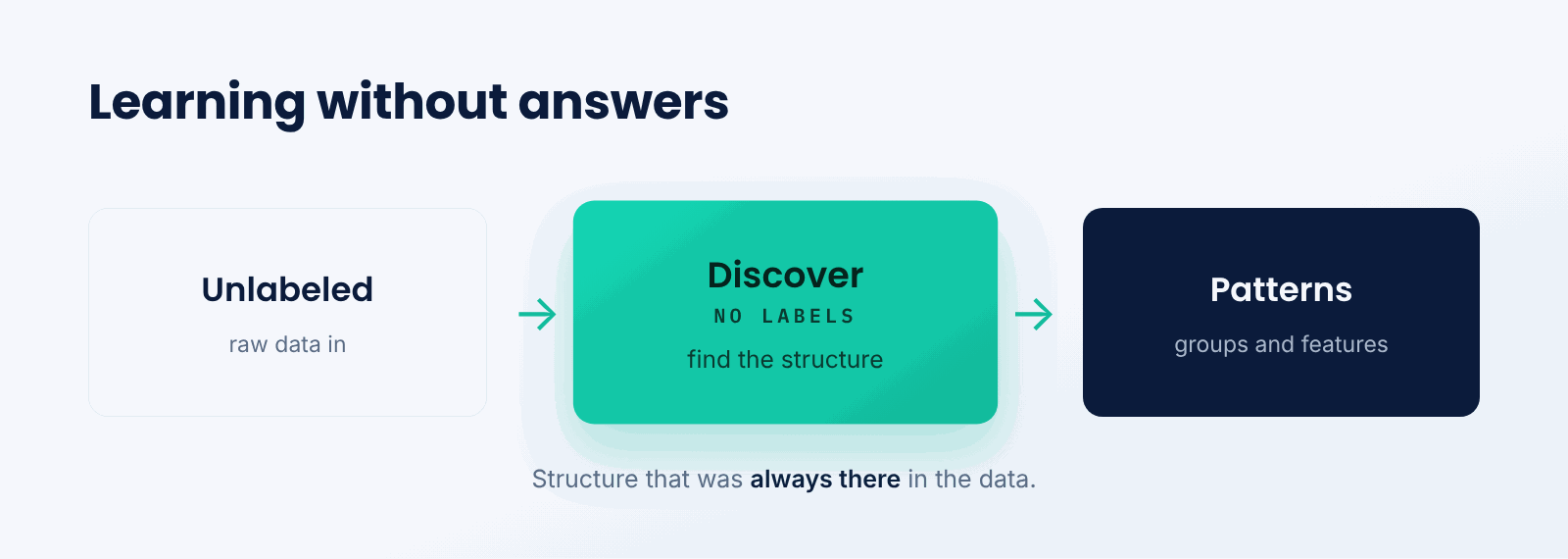
Think of it like sorting a pile of unlabeled photos. Without being told the categories, you might naturally group them by who appears, where they were taken, or their colors. You are discovering structure that was always present in the data. Unsupervised learning does the same, finding groupings and patterns without predefined labels.
The key idea is learning without answers. Because the model is not given target outputs, it must rely entirely on the relationships within the data, which makes it powerful for exploration and for working with the vast amounts of unlabeled data that exist.
What is unsupervised learning used for?
Several common tasks fall under unsupervised learning, each surfacing a different kind of structure.
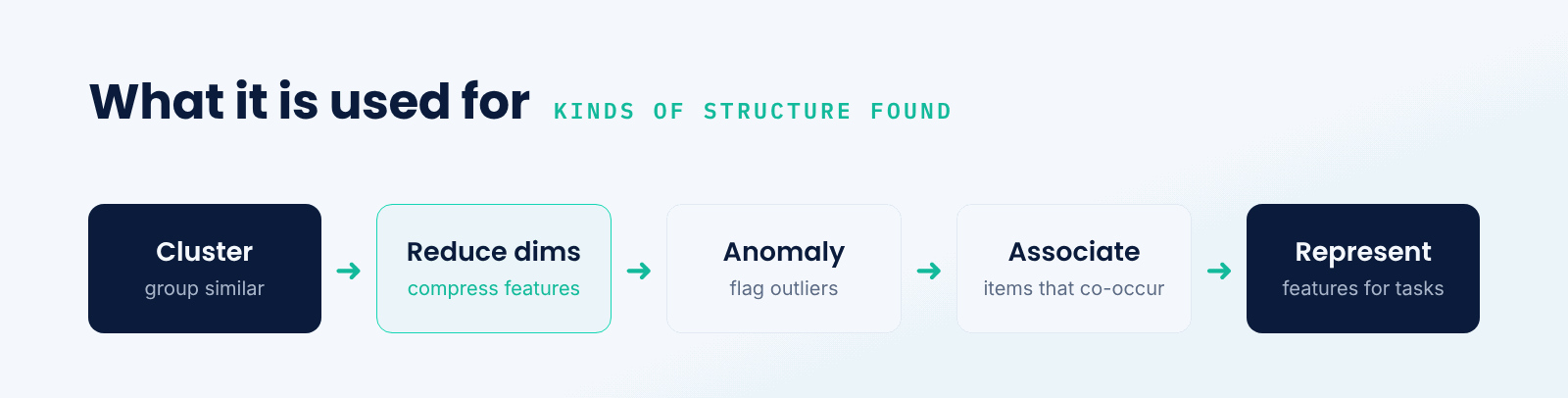
- Clustering. Group similar examples together, such as segmenting customers.
- Dimensionality reduction. Compress data into fewer features while keeping its structure.
- Anomaly detection. Flag examples that do not fit the learned patterns.
- Association. Find items that tend to occur together, as in market-basket analysis.
- Representation learning. Learn useful features that help other downstream tasks.
These tasks turn raw, unlabeled data into something actionable: segments you can target, compressed features that are easier to work with, or outliers worth investigating. Often the output of unsupervised learning becomes the input to a later supervised step.
Unsupervised vs. supervised learning
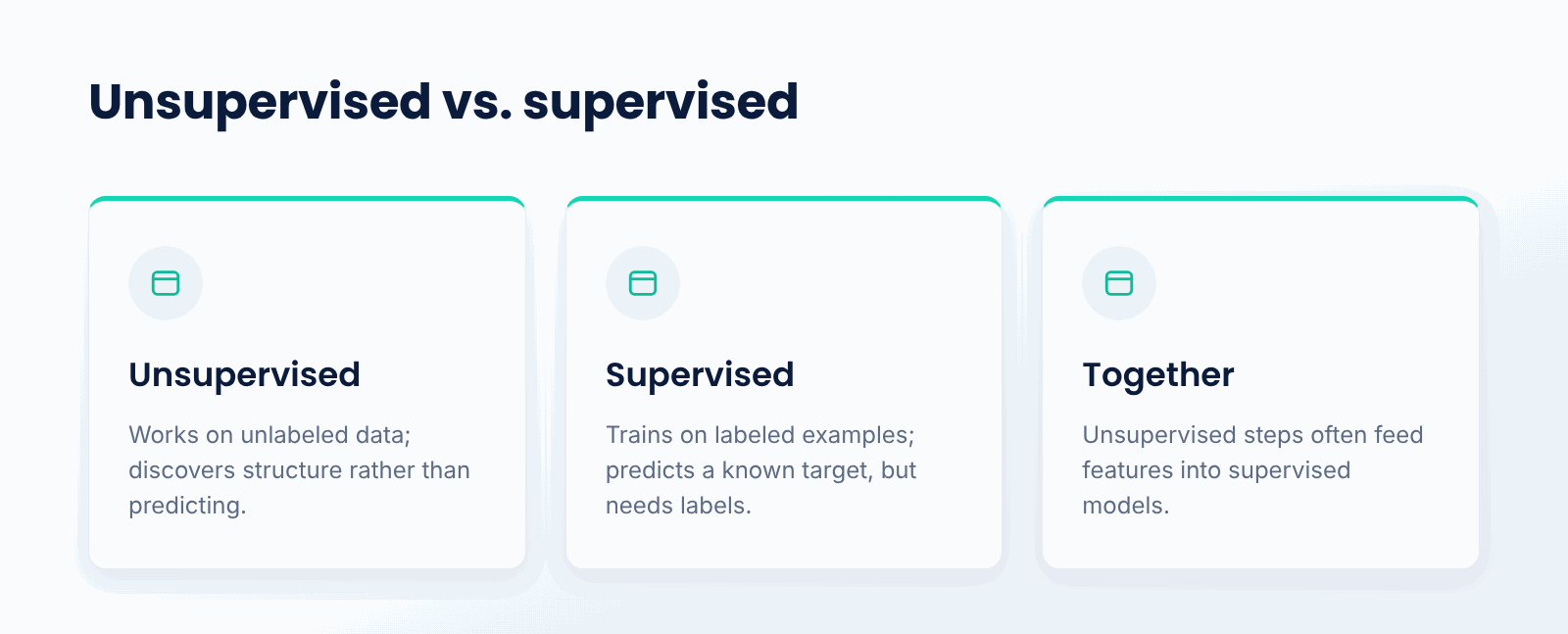
Supervised learning trains on labeled examples, learning to map inputs to known outputs so it can predict labels for new data. It needs labeled data, which can be costly to produce. Unsupervised learning works on unlabeled data and discovers structure rather than predicting a known target, so it trades the clarity of a defined goal for the ability to work without labels.
The two are complementary. Supervised learning excels when you have labels and a clear prediction task; unsupervised learning excels when you have lots of data but no labels, or when you want to explore and understand the data. Many systems use both, with unsupervised steps feeding supervised ones.
Why does unsupervised learning matter?
- Abundant data. It works with the vast amounts of unlabeled data that exist.
- No labeling cost. It avoids the expense of annotating examples.
- Discovery. It surfaces patterns and segments you did not know to look for.
- Preprocessing. It produces features and representations for other models.
- Anomaly detection. It flags unusual cases without needing labeled examples of them.
What are the tradeoffs?
- No ground truth. Without labels, results are harder to validate.
- Interpretation. Discovered structure may not match what you care about.
- Evaluation. Measuring quality is less clear-cut than with labeled tasks.
- Tuning. Choices like the number of clusters can strongly shape the outcome.
When should you use unsupervised learning?
Reach for it when you have unlabeled data and want to explore its structure, segment it, compress it, or find anomalies. It is also the right choice when labels are too expensive or impractical to obtain, and when the goal is understanding the data rather than predicting a specific target.
If you have labeled data and a clear prediction task, supervised learning is usually more direct. But even then, an unsupervised step can help by revealing structure, reducing dimensionality, or generating features that improve the supervised model.
Key points about unsupervised learning
- It finds structure in unlabeled data.
- Clustering and dimensionality reduction are core tasks.
- It is valuable when labels are scarce or costly.
- Its results can be harder to validate without ground truth.
- It often feeds features or segments into supervised models.
- Choose it for exploration, segmentation, and anomaly detection.
Conclusion
Unsupervised learning finds patterns in data that has no labels, discovering structure like clusters, compressed representations, and anomalies rather than predicting a known answer. It is invaluable for the abundant unlabeled data in the world and for exploring and understanding data, often feeding its results into supervised steps. Its main caveat is that results are harder to validate without ground truth.
TrueFoundry helps teams build, train, and serve machine learning models of all kinds on their own infrastructure, including the unsupervised steps that turn raw data into useful features and segments. Understanding unsupervised learning is key to making the most of unlabeled data.

Govern, Deploy and Trace AI in Your Own Infrastructure
Frequently Asked Questions
What is unsupervised learning in simple terms?
It is machine learning based on unlabeled data. Unlike the case where the model is trained on the correct answers, in unsupervised learning the model comes up with structure on its own, for instance clustering similar instances or reducing the dimensionality of data.
How is unsupervised learning different from supervised learning?
The supervised learning process involves labeled inputs that help predict the correct output, while unsupervised learning does not involve any labels. It simply helps find patterns and structure within the data, exploring rather than predicting a known target.
What is clustering?
Clustering is a fundamental unsupervised learning technique where the algorithm forms clusters of data points based on their similarity and not on pre-existing categories. It may involve grouping consumers according to their behaviors or documents according to their topics, with the groupings emerging from the data rather than being specified in advance.
When should I use unsupervised learning?
In situations where there is unlabeled data and it is necessary to explore it, segment it, reduce its dimensions, or look for anomalies, and where labeling the data is too expensive. It is also useful as a preprocessing step that produces features for a later supervised model.
How do you evaluate an unsupervised model?
It is more difficult than with labeled tasks since there is no ground truth here. You have to use indicators such as the correspondence between the structure and the data, the usefulness of the results downstream, and domain knowledge about whether the found patterns are meaningful.


- © 2022 ENSEMBLE Technologies



Subscribe to our newsletter
The latest news, articles, and resources sent to your inbox


