


What Is Transfer Learning and Why Does It Matter?

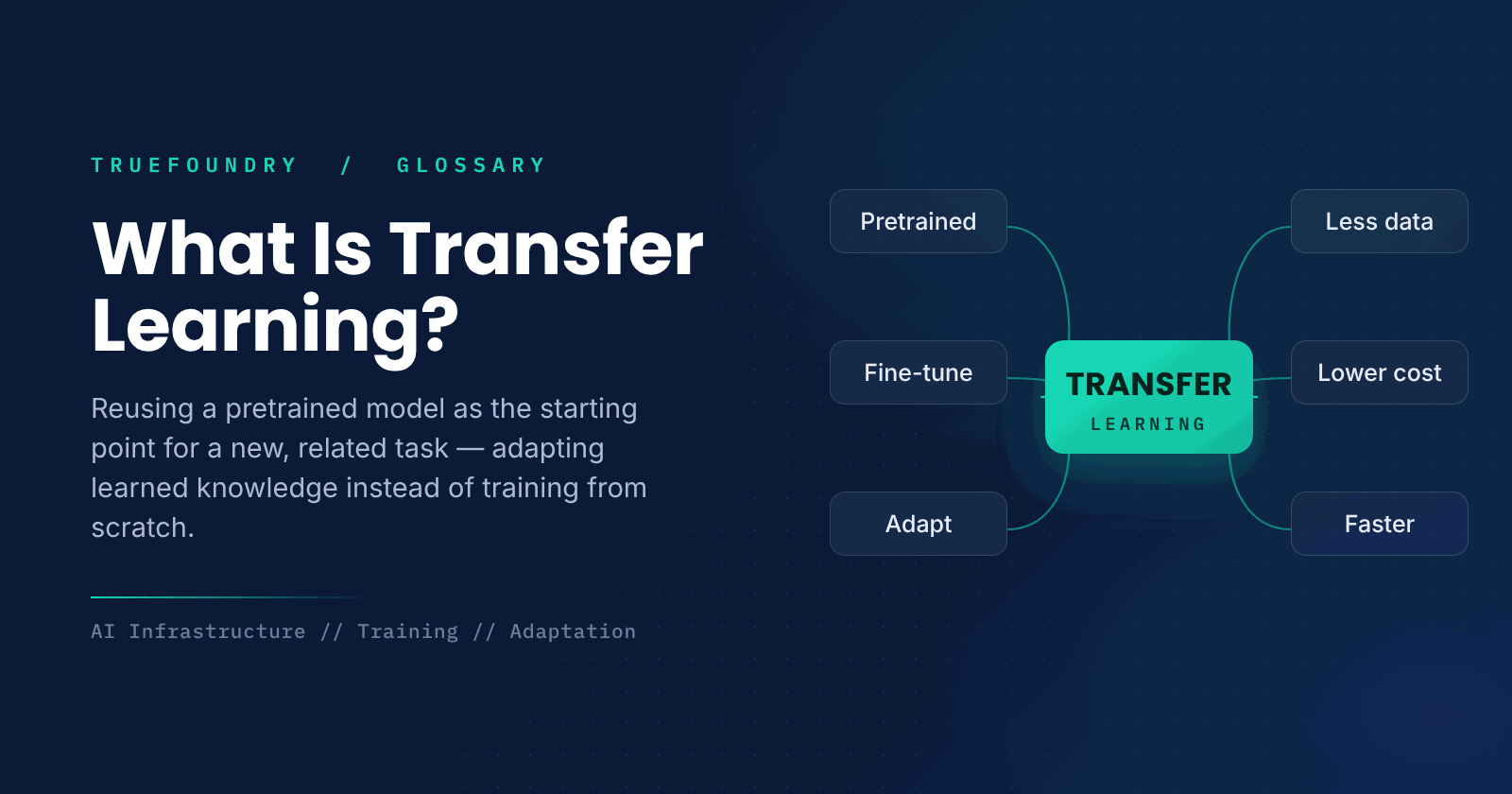
Training a capable model from scratch takes enormous amounts of data and compute, which most teams and most tasks cannot justify. Transfer learning sidesteps that by starting from a model that has already learned general patterns, then adapting it to a specific task. It is one of the most practical ideas in modern machine learning.
The intuition is that much of what a model learns is reusable. A model trained on a huge corpus of text learns grammar, facts, and reasoning patterns that are useful far beyond its original objective. Transfer learning takes that general knowledge and redirects it toward a new task, saving the cost of relearning the basics.
This guide explains what transfer learning is, how it is applied, how it compares to training from scratch, and when it is the right approach.
What is transfer learning?
Transfer learning is a technique where knowledge gained while solving one task is reused to help solve a different but related task. In practice, it means starting with a model pretrained on a large, general dataset and adapting it, rather than initializing a new model with random weights and training it entirely on the target task.
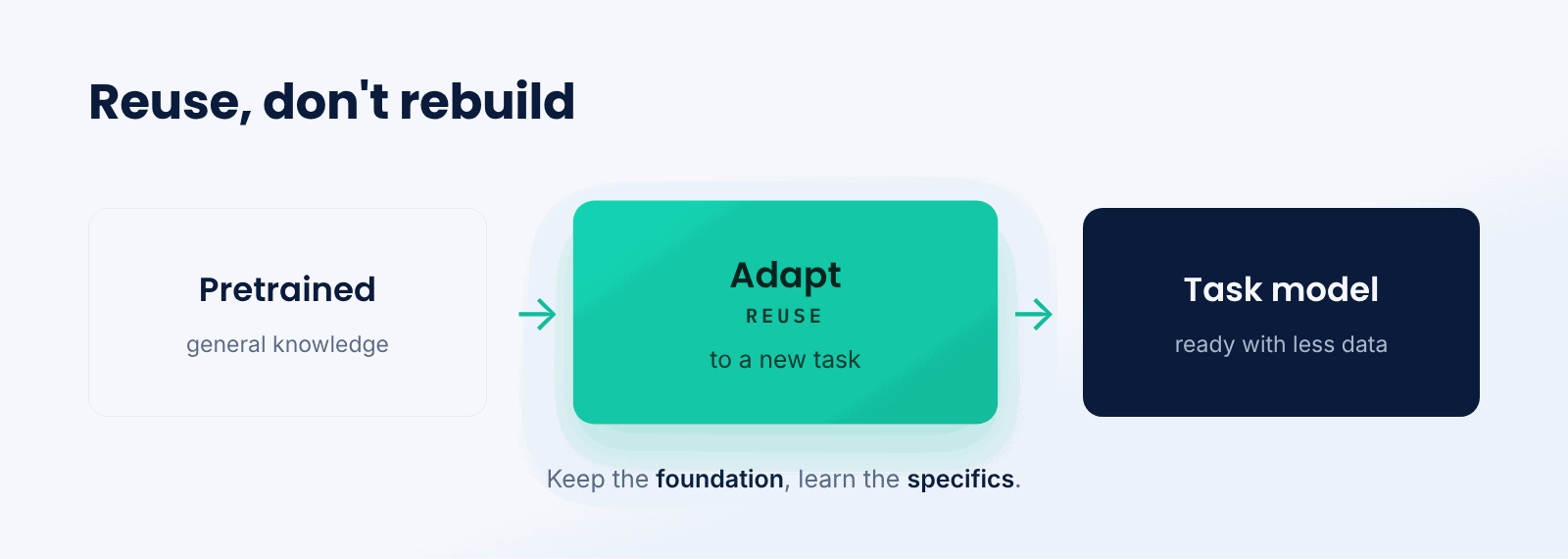
Think of it like hiring an experienced professional instead of training someone from nothing. A new hire who already understands the field needs only to learn the specifics of your organization, not the fundamentals of the job. A pretrained model already understands the domain's general patterns and needs only to learn your particular task.
The key idea is reuse. The pretrained model provides a strong, general foundation, and adapting it requires far less data and compute than building that foundation again for every new task.
How is transfer learning applied?
There are a few common ways to adapt a pretrained model to a new task.
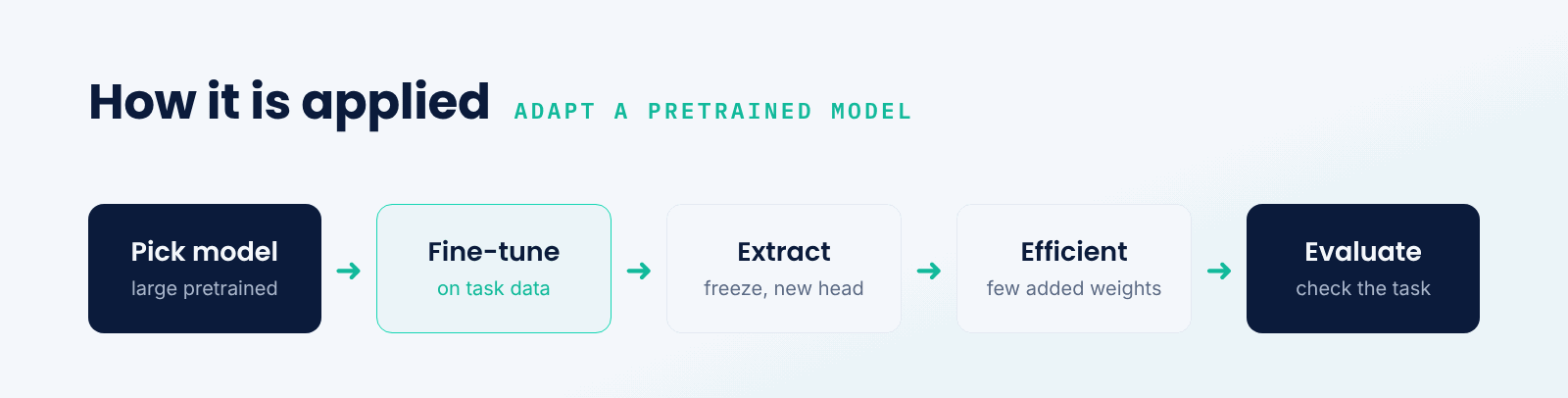
- Pick a pretrained model. Start from a model trained on a large, general dataset.
- Fine-tune. Continue training the model on your task-specific data.
- Feature extraction. Freeze most layers and train only a new task-specific head.
- Parameter-efficient tuning. Adapt a small number of added weights, leaving the rest fixed.
- Evaluate. Check that the adapted model performs well on the target task.
Which approach fits depends on how much data you have and how similar the new task is to the original. Full fine-tuning adapts the whole model and suits larger datasets; feature extraction and parameter-efficient methods change less and work well when data or compute is limited.
Transfer learning vs. training from scratch
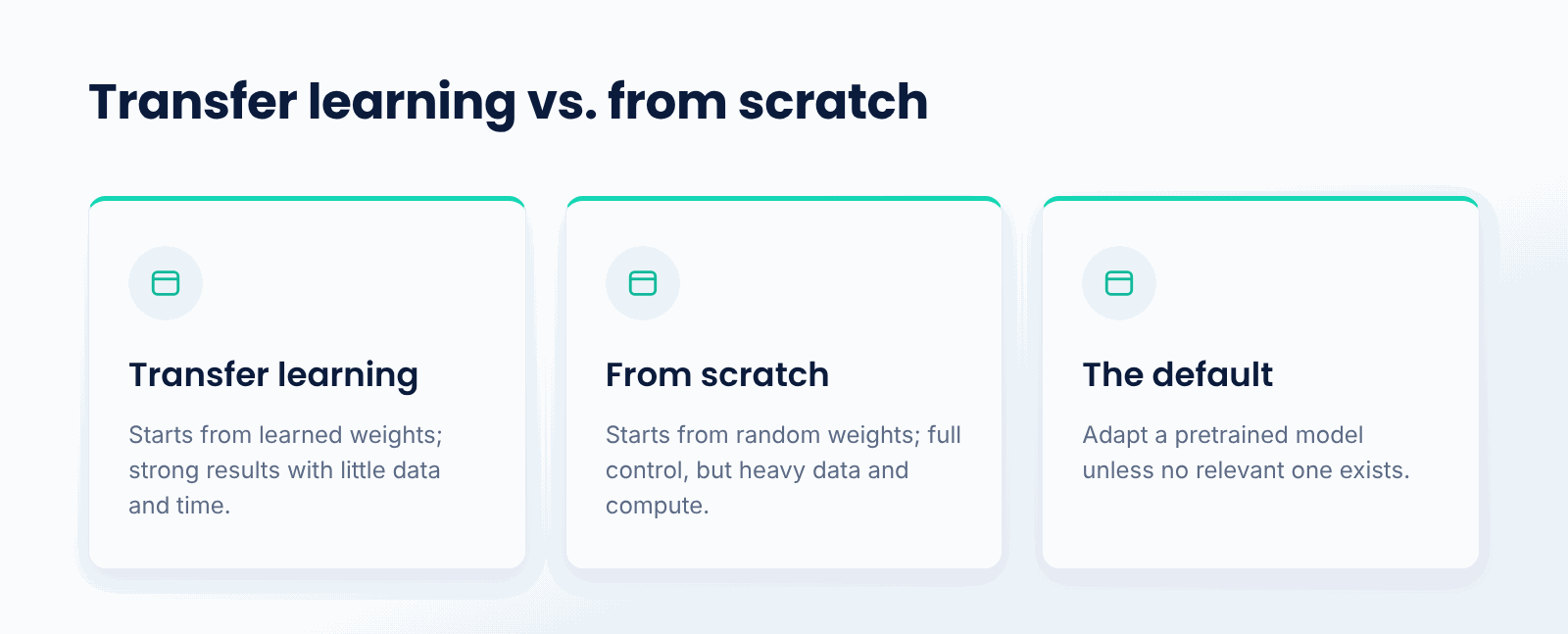
Training from scratch starts with random weights and learns everything from the target data alone. It gives full control but demands large datasets and heavy compute, and it is unnecessary when a suitable pretrained model exists. Transfer learning starts from learned weights and adapts them, reaching good performance with far less data and time.
For the vast majority of practical tasks, transfer learning wins. Training from scratch makes sense only when no relevant pretrained model exists, or when the target domain is so different that general knowledge does not help. Otherwise, adapting a pretrained model is faster, cheaper, and usually more accurate.
Why does transfer learning matter?
- Less data. It reaches good results with far smaller task-specific datasets.
- Lower cost. Adapting a model is much cheaper than training one from scratch.
- Faster. You get a working model in a fraction of the time.
- Better accuracy. General pretraining often lifts performance on the target task.
- Accessibility. It puts strong models within reach of teams without huge resources.
What are the tradeoffs?
- Domain mismatch. If the new task is very different, transfer helps less.
- Inherited bias. The model carries over biases from its pretraining data.
- Base dependence. Quality is bounded by the pretrained model you start from.
- Catastrophic forgetting. Aggressive fine-tuning can erase useful general knowledge.
When should you use transfer learning?
Use it whenever a pretrained model exists that is relevant to your task, which today is almost always the case for text, images, and many other domains. It is the default approach for adapting foundation models to specific applications, from classification to domain-specific assistants.
Train from scratch only when no suitable pretrained model is available or the domain is genuinely unlike anything the model has seen. For everything else, starting from a pretrained model and adapting it is the faster, cheaper, and more reliable path.
Key points about transfer learning
- It reuses a pretrained model as the starting point for a new task.
- Fine-tuning, feature extraction, and parameter-efficient tuning are common methods.
- It needs far less data and compute than training from scratch.
- It is the standard way to adapt foundation models.
- It inherits both the strengths and the biases of the base model.
- Match the method to your data size and task similarity.
Conclusion
Transfer learning reuses the knowledge in a pretrained model to tackle a new, related task, adapting it rather than training from scratch. Through fine-tuning and related methods, it reaches strong performance with far less data, compute, and time, which is why it is the standard way to apply foundation models. Its main caveats are domain mismatch and inherited bias from the base model.
TrueFoundry helps teams fine-tune and serve adapted models on their own infrastructure, so transfer learning can go from a base model to a deployed, task-specific model in one place. As foundation models become the starting point for most AI work, transfer learning is the technique that makes them useful.

Govern, Deploy and Trace AI in Your Own Infrastructure
Frequently Asked Questions
What is transfer learning in simple terms?
This technique uses an existing model trained on one problem as the base for another similar problem. The model is fine-tuned rather than trained from scratch, which saves data, compute, and time.
How is transfer learning related to fine-tuning?
The process of fine-tuning is by far the most frequently used form of performing transfer learning. You start with a pretrained model and keep training it using task-specific data so that it adapts the learned knowledge to the new task, rather than starting from random weights.
When should I train from scratch instead?
Only when no relevant pretrained model exists, or when your domain is so different that general knowledge does not transfer. In almost all other situations, adapting a pretrained model is faster, cheaper, and more accurate than training from scratch.
What is catastrophic forgetting?
It is when a model becomes overtrained to an extent where the beneficial knowledge acquired during pretraining is stripped away in the process of adapting to a narrow task. Parameter-efficient methods and careful training help avoid it by changing the model less.
Does transfer learning work across very different tasks?
This is particularly effective if the new task is related to the original one. In general, the further apart the two domains are, the less useful the prior knowledge gained through pretraining, and eventually it makes sense to train from scratch or select a more relevant base model.


- © 2022 ENSEMBLE Technologies



Subscribe to our newsletter
The latest news, articles, and resources sent to your inbox


