


What Is a TPU and Why Does It Matter?

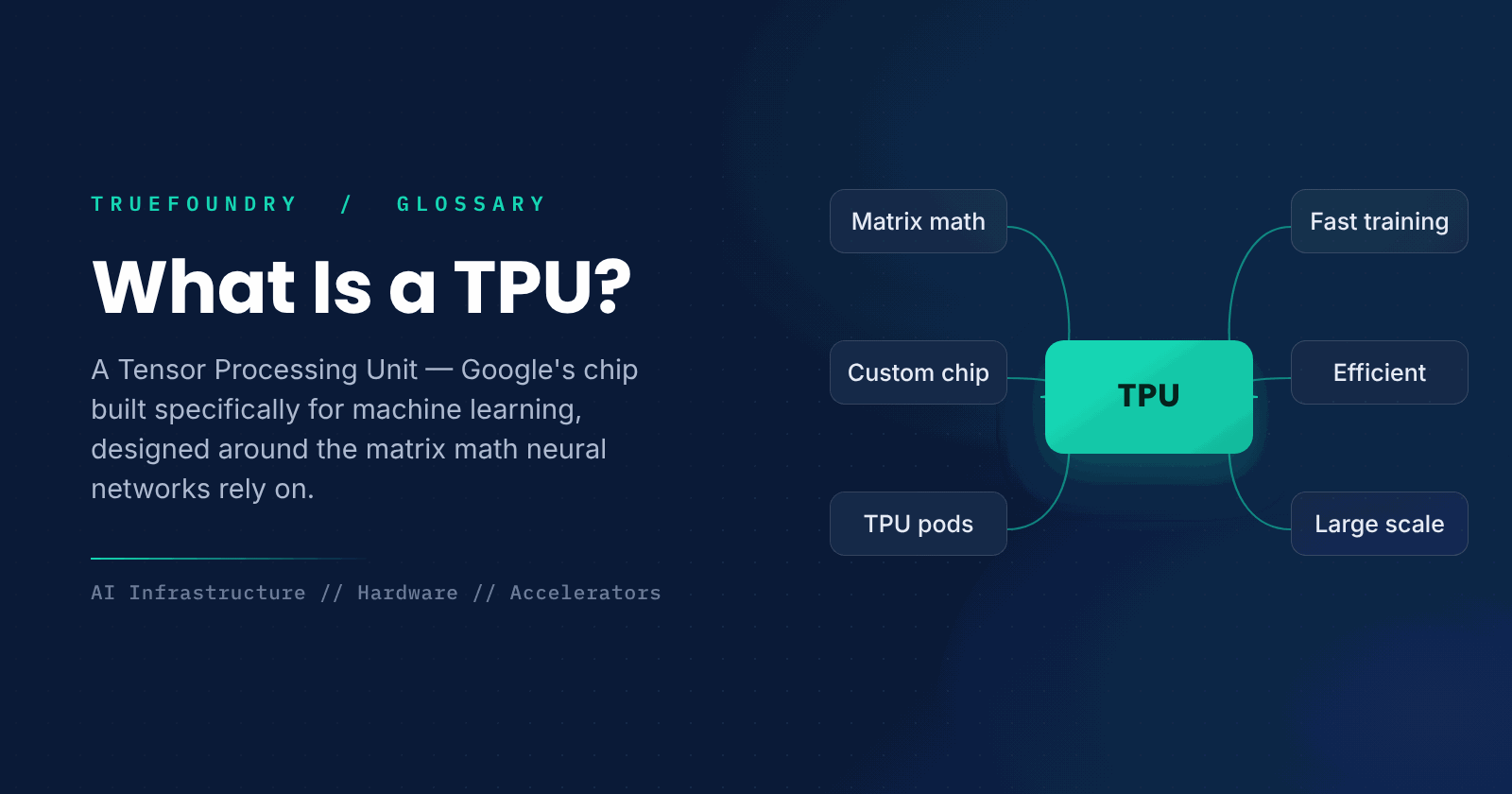
Training and running modern AI models takes enormous amounts of a particular kind of computation: multiplying large matrices of numbers. General-purpose processors can do this, but not efficiently enough for the largest models. That demand led to specialized hardware, and the TPU is Google's answer, a chip built from the ground up for machine learning.
A TPU, short for Tensor Processing Unit, is designed around the exact math that neural networks rely on, which makes it very fast and power-efficient for AI workloads. It is a major alternative to GPUs for large-scale training and inference. This guide explains what a TPU is, how it differs from other chips, and when it matters.
We will cover the definition, how TPUs work, how they compare to CPUs and GPUs, and when to use them.
What is a TPU?
A TPU, or Tensor Processing Unit, is a custom chip, known as an application-specific integrated circuit, designed by Google specifically to accelerate machine learning workloads. Rather than being general-purpose, it is optimized for the large matrix multiplications at the core of neural networks, which lets it perform those operations far faster and more efficiently than a general chip could.
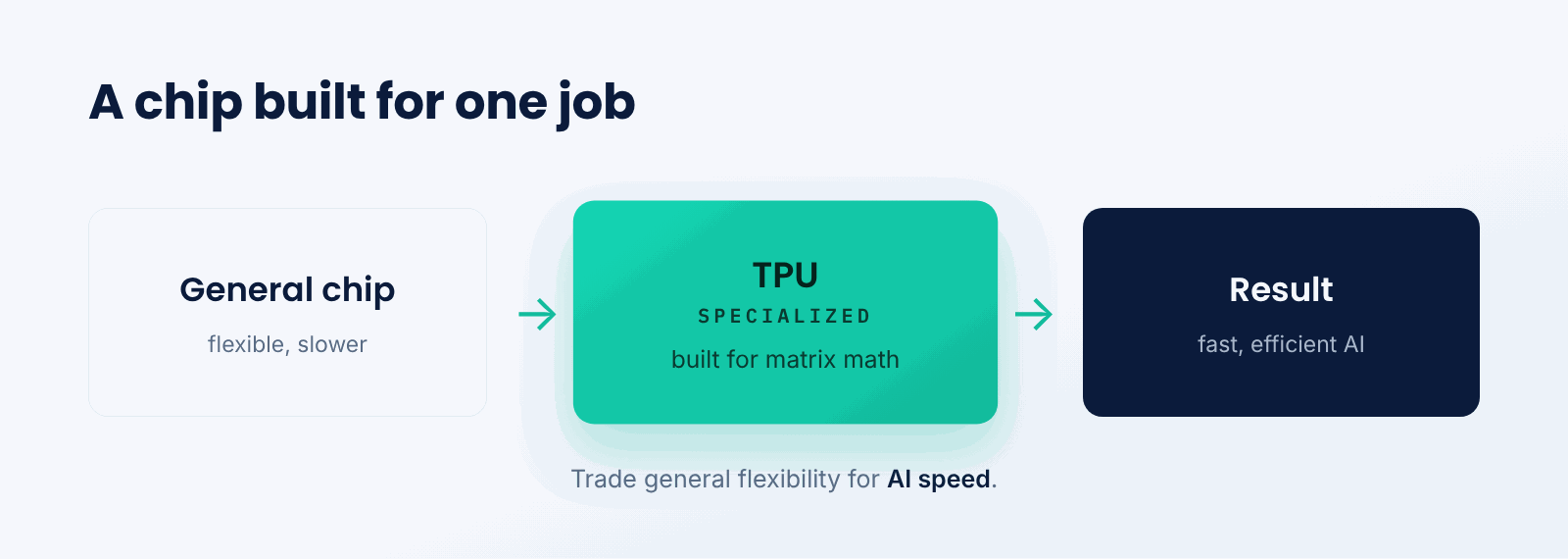
Think of it like a specialized kitchen appliance versus a chef's knife. A knife can do almost anything, but a dedicated tool built for one job, say a bread machine, does that job faster and more consistently. A TPU is that dedicated tool for the matrix math of machine learning.
The key idea is hardware specialization. By building the chip around the specific operations neural networks need, a TPU trades general flexibility for exceptional speed and efficiency on AI workloads.
How does a TPU work?
A TPU accelerates the matrix operations at the heart of neural networks.
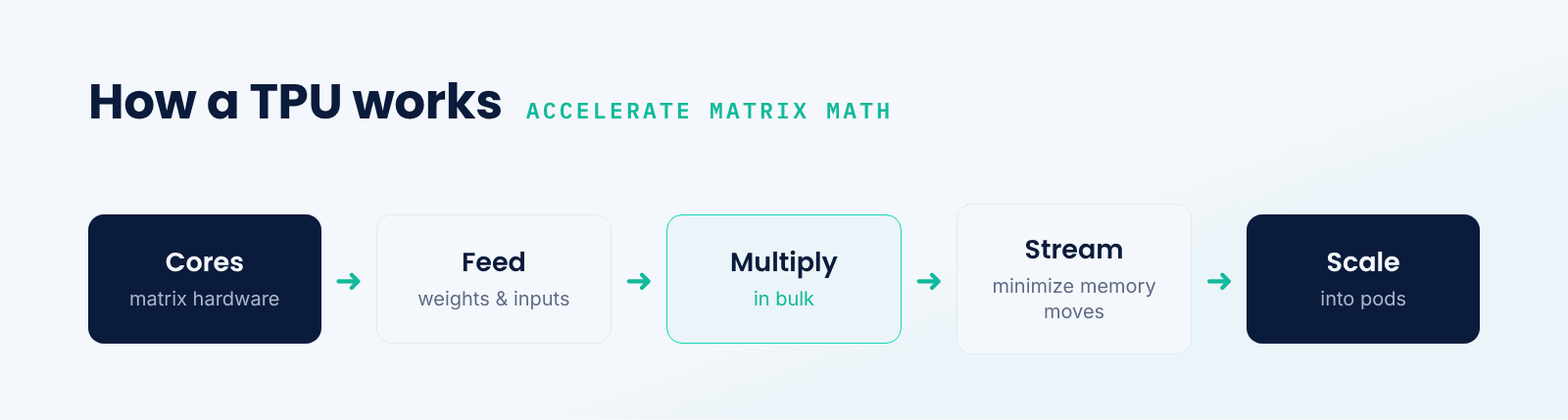
- Specialized cores. It contains hardware built for matrix multiplication.
- Feed the data. Model weights and inputs are streamed into the chip.
- Multiply in bulk. It performs huge matrix operations in parallel.
- Keep data moving. Its design minimizes costly memory transfers.
- Scale out. Many TPUs connect into pods for very large models.
At the heart of a TPU is hardware that multiplies matrices extremely efficiently, with data flowing through it so that results feed directly into the next operation. For the biggest models, many TPUs are linked together into pods with fast interconnects, so they can train and serve models far larger than one chip could handle.
TPU vs. CPU vs. GPU
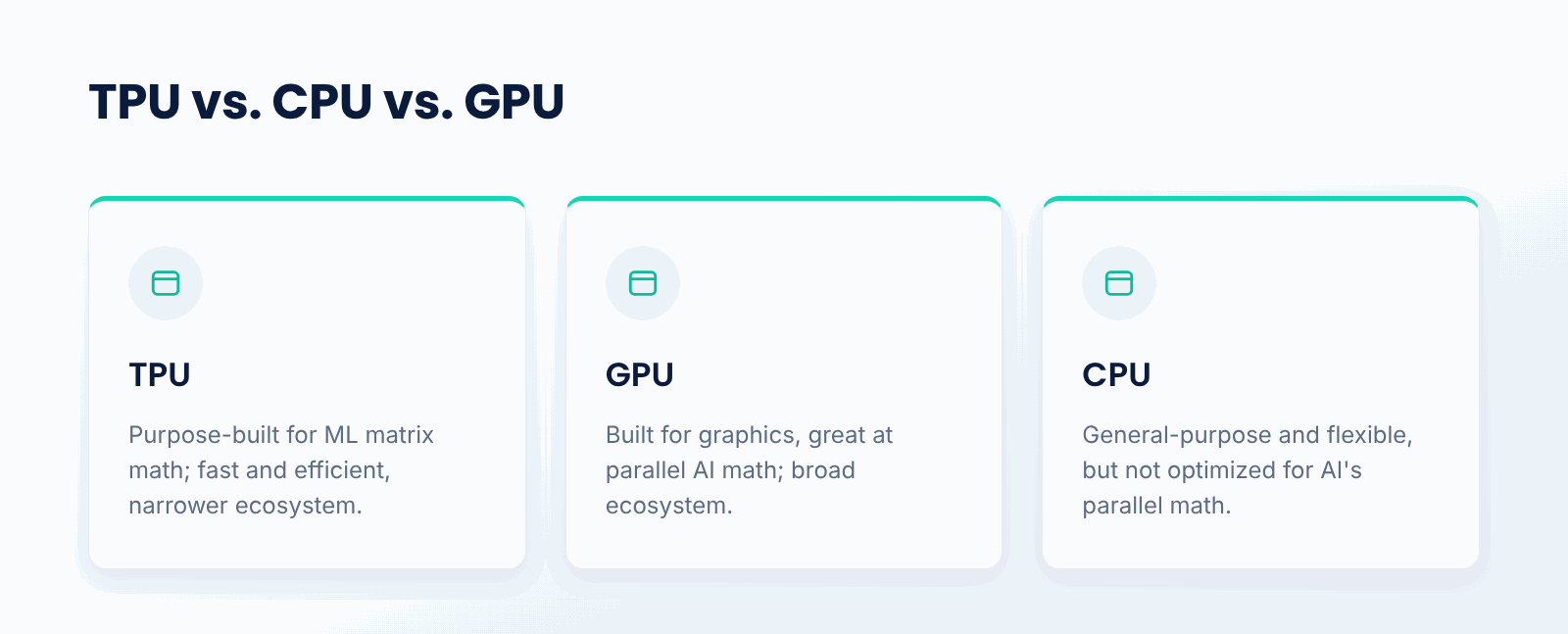
A CPU is a general-purpose processor, flexible but not optimized for the massive parallel math of AI. A GPU was built for graphics but turned out to be excellent at the parallel computation neural networks need, and it is the most widely used AI accelerator, with a broad software ecosystem.
A TPU goes a step further in specialization, built specifically for machine learning's matrix math rather than adapted from another purpose. It can be faster and more power-efficient than a GPU for suitable workloads, especially at large scale on Google Cloud. The tradeoff is less generality and a narrower ecosystem than GPUs, so the best choice depends on your workload and platform.
Why does a TPU matter?
- Speed. It accelerates the core math of neural networks.
- Efficiency. It can be more power-efficient than general chips.
- Scale. TPU pods train and serve very large models.
- Cost. Efficiency can lower the cost of big workloads.
- Choice. It is a major alternative to GPUs for AI.
What are the tradeoffs?
- Less general. It is specialized, not a flexible all-purpose chip.
- Ecosystem. The software support is narrower than for GPUs.
- Availability. TPUs are mainly accessed through Google Cloud.
- Fit. Not every model or framework maps well to a TPU.
When should you use a TPU?
Consider a TPU when you are training or serving large models at scale and want high performance and efficiency, especially if you are already working on Google Cloud, where TPUs are readily available. They shine on large, matrix-heavy workloads that fit their design and supported frameworks.
If you need broad flexibility, a wide software ecosystem, or hardware available across many platforms, GPUs are often the more practical choice. Matching the accelerator to your workload, framework, and platform is what gets the best performance for the cost.
Key points about TPUs
- A TPU is a chip built specifically for machine learning.
- It is optimized for the matrix math neural networks use.
- It can be faster and more efficient than GPUs for AI.
- TPU pods scale to very large models.
- It is less general and has a narrower ecosystem than GPUs.
- It is a major option for large-scale AI on Google Cloud.
Conclusion
A TPU is a chip purpose-built to accelerate machine learning, designed around the matrix math that neural networks depend on. That specialization makes it very fast and power-efficient for training and running large models, and TPU pods scale to the biggest workloads. As a major alternative to GPUs, especially on Google Cloud, it is an important option for large-scale AI, with the tradeoff of less generality and a narrower ecosystem.
TrueFoundry helps teams run AI workloads across different hardware on their own infrastructure, including GPUs and other accelerators, matching the compute to the workload. When choosing hardware for large-scale AI, understanding what a TPU offers helps you make the right call.

Govern, Deploy and Trace AI in Your Own Infrastructure
Frequently Asked Questions
What is a TPU in simple terms?
It is a chip that Google created specifically for machine learning, so it differs from an ordinary processor in its specialized architecture. Instead of being a generic chip, it is built around the matrix math neural networks rely on, so it can train and run large models faster and more efficiently than an ordinary processor.
How is a TPU different from a GPU?
A GPU was designed for graphics and then repurposed for AI, so it has a very wide software ecosystem. A TPU is purpose-built for machine learning's matrix math, so it can be faster and more power-efficient for suitable workloads, but it is more specialized and has a narrower ecosystem than GPUs.
What does a TPU do well?
Large matrix multiplications, which are the heart of neural network training and inference. The TPU executes these operations quickly by using hardware tailored to them and moving data efficiently, and several TPUs can be interconnected in pods for extremely large models.
How do I access a TPU?
The main place to find TPUs is Google Cloud, where they can be used for model training and inference. This is unlike GPUs, which are offered by many cloud providers and can also be bought directly, giving GPUs wider availability across platforms.
When should I use a TPU instead of a GPU?
Consider a TPU for large, matrix-heavy training or inference at scale, especially if you are on Google Cloud with a supported framework. If you need broad flexibility, a wide ecosystem, or hardware across many platforms, a GPU is often more practical.


- © 2022 ENSEMBLE Technologies



Subscribe to our newsletter
The latest news, articles, and resources sent to your inbox


