


What Is Top-p Sampling and Why Does It Matter?

When a language model generates text, at each step it has a probability for every possible next word. How it picks from those probabilities shapes the output: always choosing the single most likely word makes text repetitive, while choosing too freely makes it incoherent. Top-p sampling is a popular method for striking the balance.
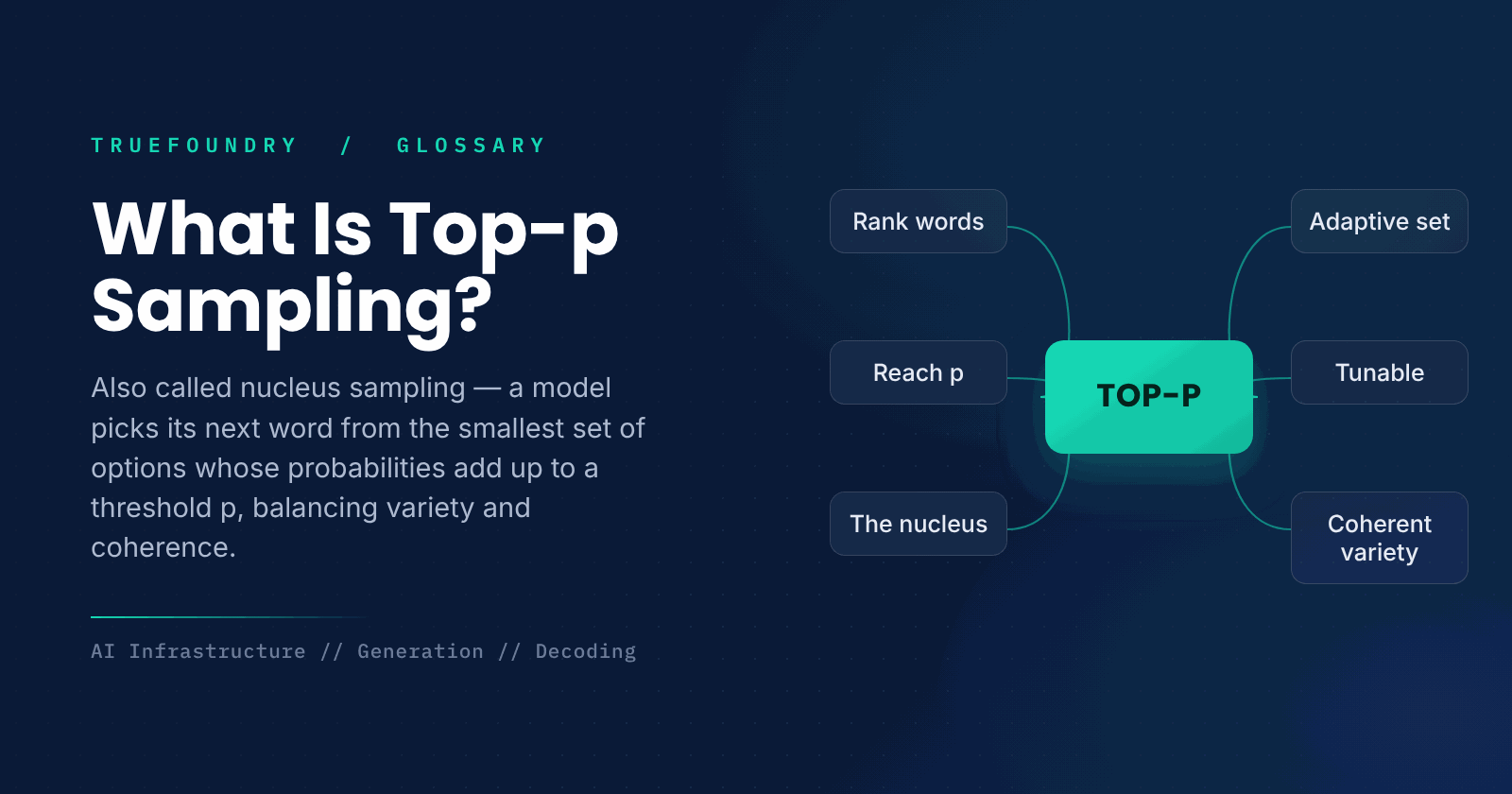
Also known as nucleus sampling, top-p sampling chooses the next word from only the most likely candidates, specifically, the smallest group whose combined probability reaches a threshold p. This adapts to how confident the model is, giving good variety without drifting into nonsense. This guide explains how it works and how to use it.
We will cover the definition, how it works, how it compares to other sampling methods, and when to use it.
What is top-p sampling?
Top-p sampling, or nucleus sampling, is a text-generation method in which the model, at each step, considers the smallest set of next-word candidates whose probabilities add up to at least a chosen threshold p, then picks from that set. The value of p, between 0 and 1, controls how wide the pool of candidates is, and the set adjusts automatically to the model's confidence at each step.

Think of it like a shortlist that grows or shrinks with certainty. When the model is very sure, a few options already cover most of the probability, so the shortlist is short. When it is unsure, the probability is spread out, so the shortlist is longer. Top-p always picks from the shortlist that captures the top p of the probability.
The key idea is an adaptive candidate set. Rather than a fixed number of options, top-p includes just enough of the most likely words to reach the threshold, which responds naturally to how confident the model is.
How does top-p sampling work?
At each step, top-p builds a candidate pool up to probability p and samples from it.
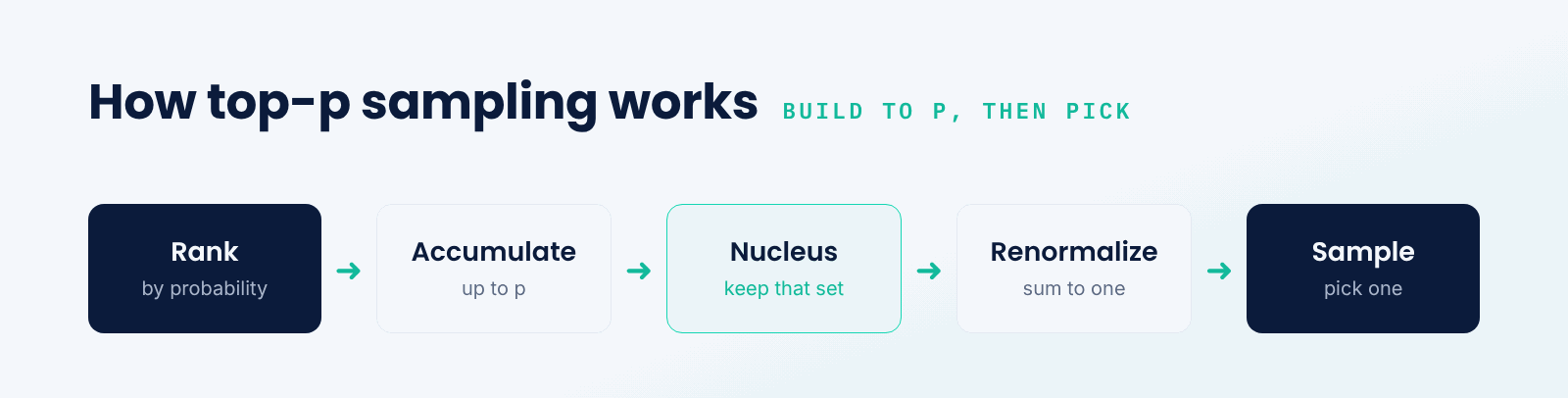
- Rank candidates. Order next words by probability, highest first.
- Accumulate. Add them up until the total reaches the threshold p.
- Form the nucleus. Keep just that smallest set of top candidates.
- Renormalize. Rescale their probabilities to sum to one.
- Sample. Pick the next word randomly from that set.
Because the pool is defined by cumulative probability rather than a fixed count, it naturally narrows when the model is confident and widens when it is not. A low p keeps only the very top choices, making output focused and safe; a high p admits more, making it more varied and creative.
Top-p vs. top-k vs. temperature
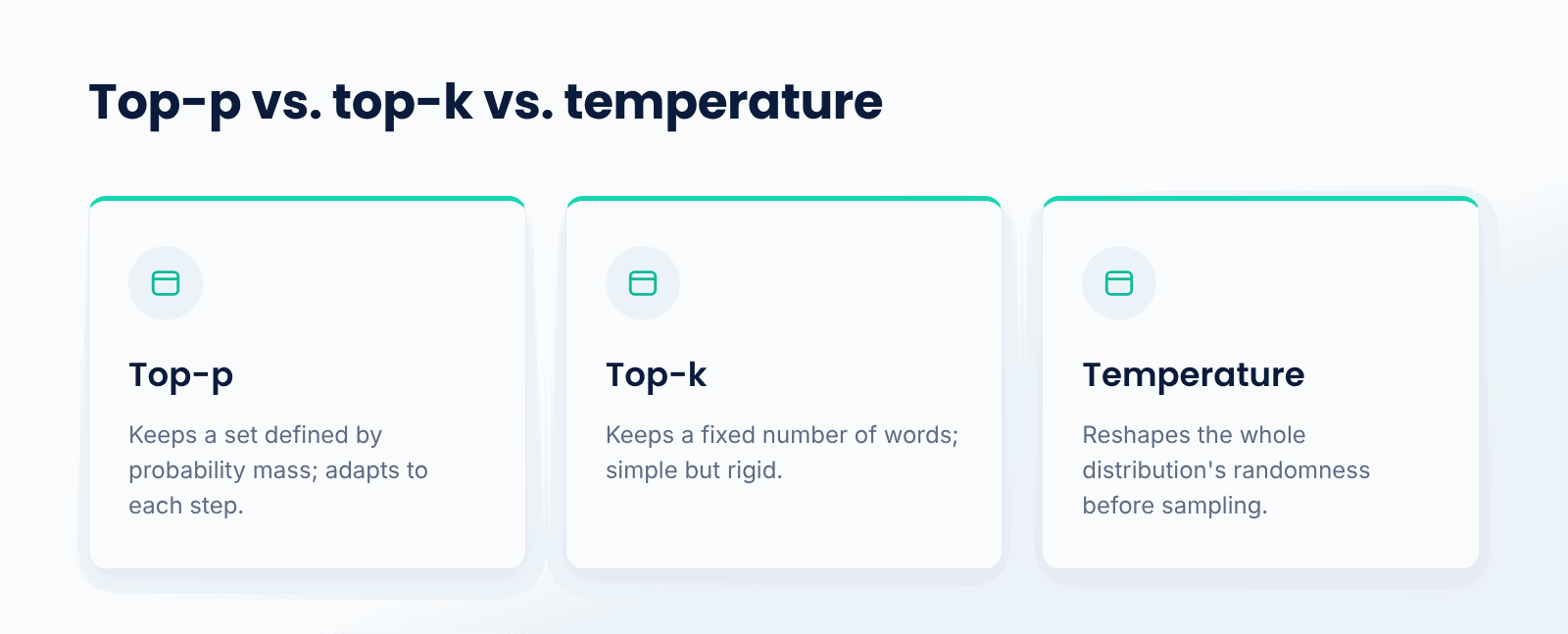
Top-k sampling keeps a fixed number of the most likely words, say the top 40, regardless of their probabilities. It is simple but rigid: the same count may be too many when the model is confident and too few when it is not. Top-p instead keeps a set defined by probability mass, so it adapts to each step.
Temperature is a different control: it reshapes the whole probability distribution to be flatter or sharper, making all choices more or less random, before sampling. Top-p and temperature are often used together, with temperature setting overall randomness and top-p trimming the unlikely tail. Each controls a different aspect of how text is generated.
Why does top-p sampling matter?
- Balance. It trades off variety and coherence well.
- Adaptive. The candidate set adjusts to the model's confidence.
- Control. p tunes how focused or creative the output is.
- Quality. It avoids both repetition and incoherence.
- Widely used. It is a standard generation setting.
What are the tradeoffs?
- Tuning. The right p depends on the task.
- Not alone. It interacts with temperature and other settings.
- Randomness. Any sampling makes output non-deterministic.
- Edge cases. Extreme p values can hurt quality.
When should you use top-p sampling?
Use top-p sampling when you want generated text that is varied and natural without becoming incoherent, which covers most open-ended generation. Tune p lower for focused, reliable output, such as factual answers, and higher for creative, diverse output, such as brainstorming or storytelling.
If you need deterministic, repeatable output, you may turn sampling off and always pick the most likely word. But for natural, controllable generation, top-p sampling, often alongside temperature, is one of the most common and effective settings.
Key points about top-p sampling
- Top-p samples from the smallest set of words summing to p.
- It is also called nucleus sampling.
- The candidate set adapts to the model's confidence.
- Lower p is more focused; higher p is more varied.
- It is often combined with temperature.
- It balances coherence and creativity in output.
Conclusion
Top-p sampling, or nucleus sampling, picks a language model's next word from the smallest set of candidates whose probabilities reach a threshold p, adapting the pool to how confident the model is. This balances variety and coherence, avoiding both repetition and nonsense, and the value of p gives direct control over how focused or creative the output is. Often used with temperature, it is a standard and effective way to control generation.
TrueFoundry helps teams serve and control models on their own infrastructure, including the generation settings like top-p that shape model output. When you need text that is varied yet coherent, top-p sampling is a key control to understand.

Govern, Deploy and Trace AI in Your Own Infrastructure
Frequently Asked Questions
What is top-p sampling in simple terms?
It is a way a language model chooses its next word. The possible words are sorted by likelihood, and the model keeps the smallest group of the most likely ones whose probabilities sum to a threshold p, then picks from that group. This gives it more choices when uncertain and fewer when confident.
What does the p value control?
The size of the set of candidate words. The smaller the value of p, the fewer words remain in the set, concentrating the output and making it more predictable. A larger p leaves more words in the set, increasing variation and creativity. It is the main dial for the balance between focus and diversity.
How is top-p different from top-k?
Top-k keeps a fixed number of the most likely words, like the top 40, regardless of their probabilities. Top-p keeps a set defined by total probability, so it adapts at each step, narrowing when the model is confident and widening when it is uncertain. Top-p is more flexible than top-k.
How does top-p relate to temperature?
They control different things and can be combined. Temperature reshapes the whole distribution to be more or less random before sampling, while top-p removes the improbable tail from consideration. Temperature sets the overall randomness; top-p decides how many candidates to consider.
When should I use top-p sampling?
Whenever you want varied text that stays coherent, which is most open-ended generation. Use a lower p for focused, consistent output such as factual answers, and a higher p for more creative output such as brainstorming. For fully repeatable output, you would turn sampling off instead.


- © 2022 ENSEMBLE Technologies



Subscribe to our newsletter
The latest news, articles, and resources sent to your inbox


