


What Is Tensor Parallelism and Why Does It Matter?

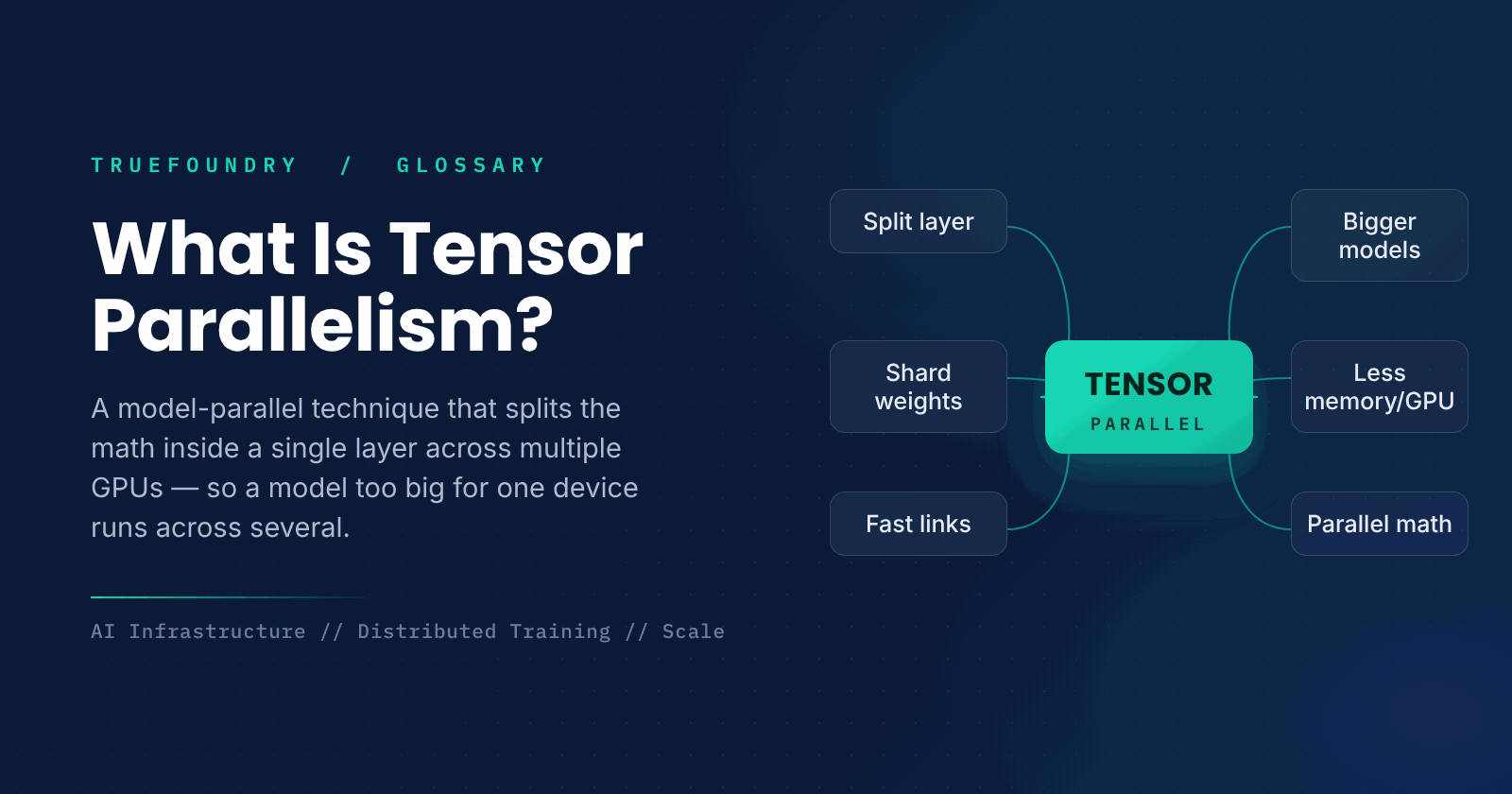
Modern large models can be too big to fit on a single GPU, even just to hold their weights. When that happens, the work has to be spread across multiple GPUs, and there are several ways to split it. Tensor parallelism is one of the most important: it divides the math inside each layer across devices, so several GPUs cooperate on the same operation.
This is different from simply putting different layers on different GPUs. Tensor parallelism cuts a single layer's matrix operations into pieces, giving each GPU a slice to compute, then combines the results. It is a cornerstone of training and serving the largest models. This guide explains what it is, how it works, and when it matters.
We will cover the definition, the mechanics, how it compares to other parallelism strategies, and when to use it.
What is tensor parallelism?
Tensor parallelism is a model-parallelism technique that splits the computation within a single layer across multiple GPUs. The large matrices that make up a layer's operations are divided into chunks, each GPU computes its chunk, and the partial results are combined into the full output. Each GPU thus holds only a fraction of the layer's weights and does a fraction of its math.
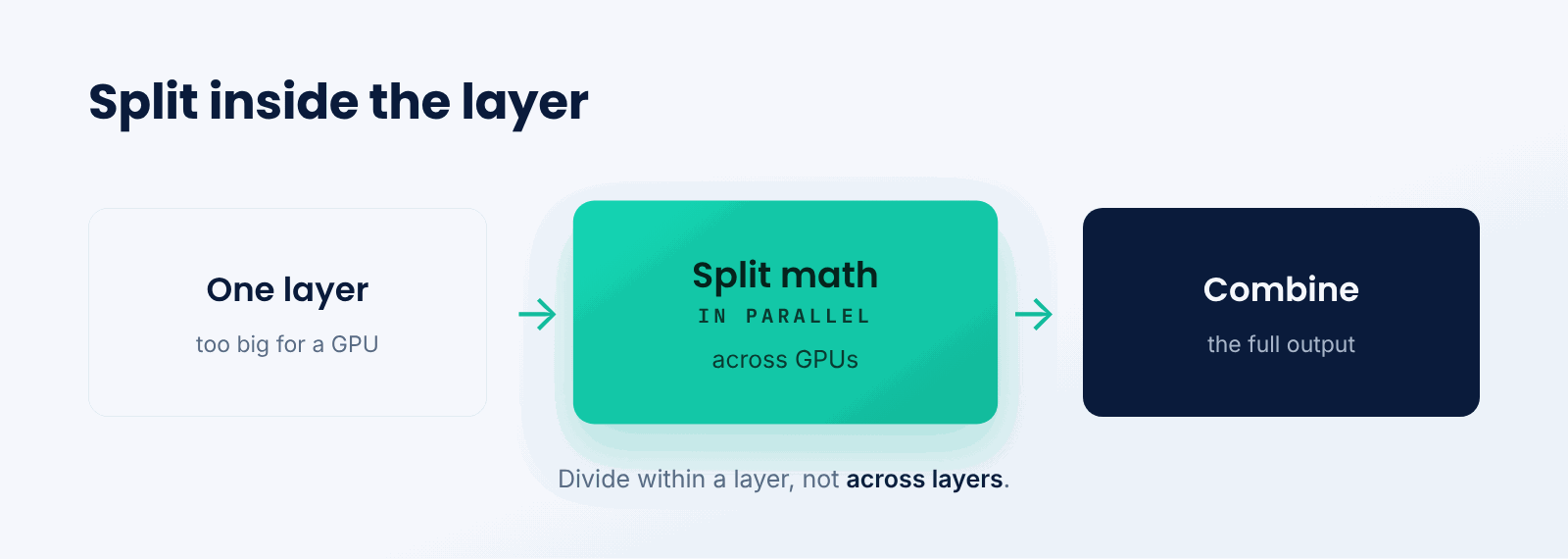
Think of it like several accountants working on one giant spreadsheet at the same time. Rather than each taking a different spreadsheet, they split the columns of the same one, each totals their columns, and then they add the pieces together. Tensor parallelism splits one layer's work the same way.
The key idea is splitting within a layer, not across layers. This is what makes it possible to run a layer whose weights or activations are too large for any single GPU to hold on its own.
How does tensor parallelism work?
Tensor parallelism partitions each layer's matrices, computes in parallel, and combines results.
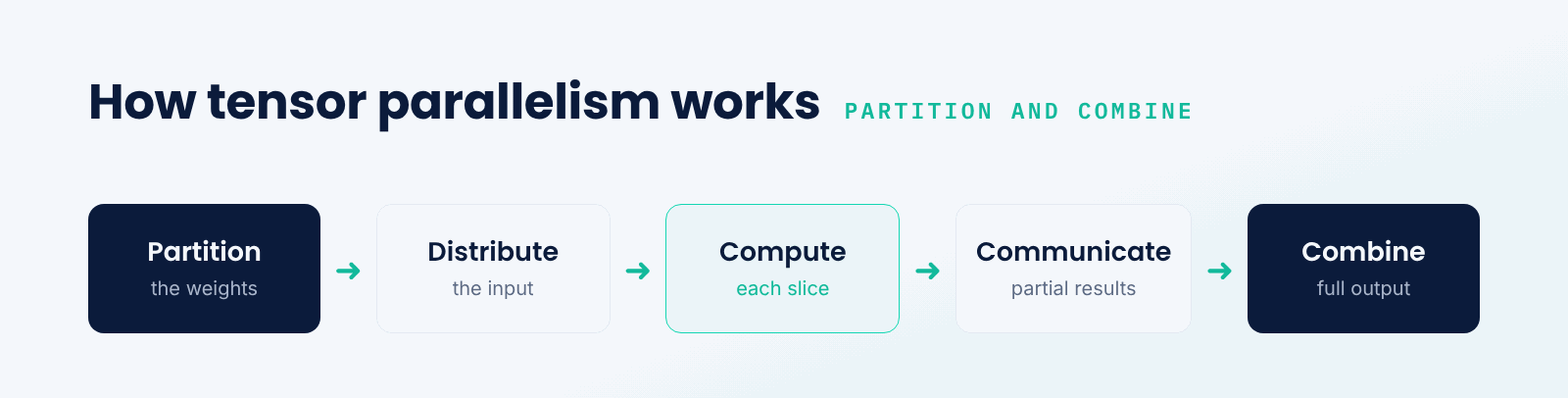
- Partition the weights. Split each layer's large matrices across GPUs.
- Distribute the input. Send the needed input to every GPU.
- Compute in parallel. Each GPU multiplies its slice of the matrix.
- Communicate. GPUs exchange partial results over fast links.
- Combine. Merge the pieces into the full layer output.
Because the GPUs must exchange partial results within each layer, tensor parallelism relies on very fast interconnects between devices. It is most effective when the GPUs are closely linked, such as within a single server, where the communication cost stays small relative to the computation saved.
Tensor vs. pipeline vs. data parallelism
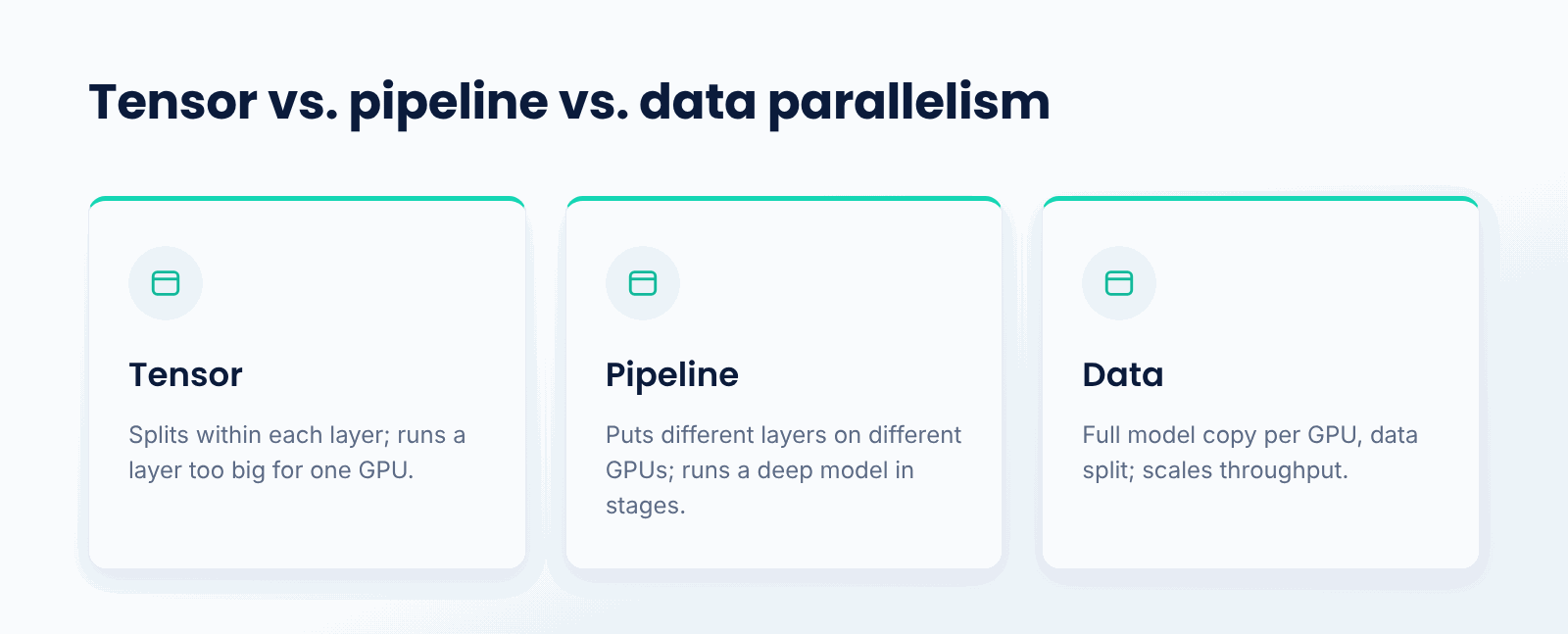
Data parallelism puts a full copy of the model on each GPU and splits the data between them; it scales throughput but needs the whole model to fit on one device. Pipeline parallelism puts different layers on different GPUs, so a model too deep for one device can run in stages. Tensor parallelism instead splits within each layer, so a single layer too big for one GPU can still run.
These strategies are complementary and are often combined. A very large model might use tensor parallelism inside each server, pipeline parallelism across servers, and data parallelism across replicas. Tensor parallelism specifically solves the problem of a layer that is too large for one GPU, at the cost of heavy intra-layer communication.
Why does tensor parallelism matter?
- Scale. It lets models too big for one GPU run across several.
- Memory. Each GPU holds only a fraction of each layer's weights.
- Speed. The split math runs in parallel across devices.
- Composability. It combines with pipeline and data parallelism.
- Foundation. It underpins training and serving the largest models.
What are the challenges?
- Communication. GPUs must exchange results within every layer.
- Interconnect. It needs fast links, ideally within one server.
- Complexity. Splitting layers correctly is intricate to implement.
- Diminishing returns. Too many GPUs raise communication cost sharply.
When should you use tensor parallelism?
Use tensor parallelism when a model, or even a single layer, is too large to fit on one GPU. It is essential for the largest models, where no single device can hold the weights, and it is most effective when the cooperating GPUs share a fast interconnect, such as those in one server.
If your model already fits on a single GPU, you do not need tensor parallelism and simpler data parallelism may serve better. But for truly large models, it is one of the core tools that make training and serving possible at all.
Key points about tensor parallelism
- Tensor parallelism splits one layer's math across GPUs.
- Each GPU holds and computes part of the same operation.
- It enables models too large for a single GPU.
- It needs fast interconnects to exchange partial results.
- It combines with pipeline and data parallelism.
- It is core to large-model training and serving.
Conclusion
Tensor parallelism makes it possible to run models that are too large for a single GPU by splitting the math inside each layer across several devices. Each GPU computes part of the same operation and the partial results are combined, so a layer no single device could hold can still run. It is a cornerstone of training and serving the largest models, especially when GPUs share fast interconnects.
TrueFoundry helps teams train and serve large models efficiently on their own infrastructure, including the parallelism strategies that spread a model across many GPUs. When a model outgrows a single device, tensor parallelism is one of the key techniques that keeps it running.

Govern, Deploy and Trace AI in Your Own Infrastructure
Frequently Asked Questions
What is tensor parallelism in simple terms?
This is how models are run across multiple GPUs, with the computations within each layer split up. Rather than a single GPU performing an operation in its entirety, multiple GPUs each perform part of it and their results are then combined. This lets a model too big for one GPU run on several together.
How is tensor parallelism different from pipeline parallelism?
In pipeline parallelism, different layers are allocated to different GPUs, enabling the model to run in stages. In tensor parallelism, each layer is split and its computations are distributed between multiple GPUs. They solve different problems and are usually combined.
Why does tensor parallelism need fast interconnects?
Because the GPUs must exchange partial results within every layer. That communication happens continuously during computation, so slow links would dominate the runtime. It works best when the cooperating GPUs share a fast connection, such as those inside a single server.
Can tensor parallelism be combined with other strategies?
Yes, and generally it is for very large models. A typical setup uses tensor parallelism within each server, pipeline parallelism between servers, and data parallelism between replicas, so the three techniques combined scale the model far beyond one GPU.
When do I need tensor parallelism?
When your model, or even just a single layer, is too big to fit into one GPU. It becomes crucial for the biggest models. If your model already fits into one device, you do not need it, and simpler data parallelism may work better.


- © 2022 ENSEMBLE Technologies



Subscribe to our newsletter
The latest news, articles, and resources sent to your inbox


