


What Is Supervised Fine-Tuning and Why Does It Matter?

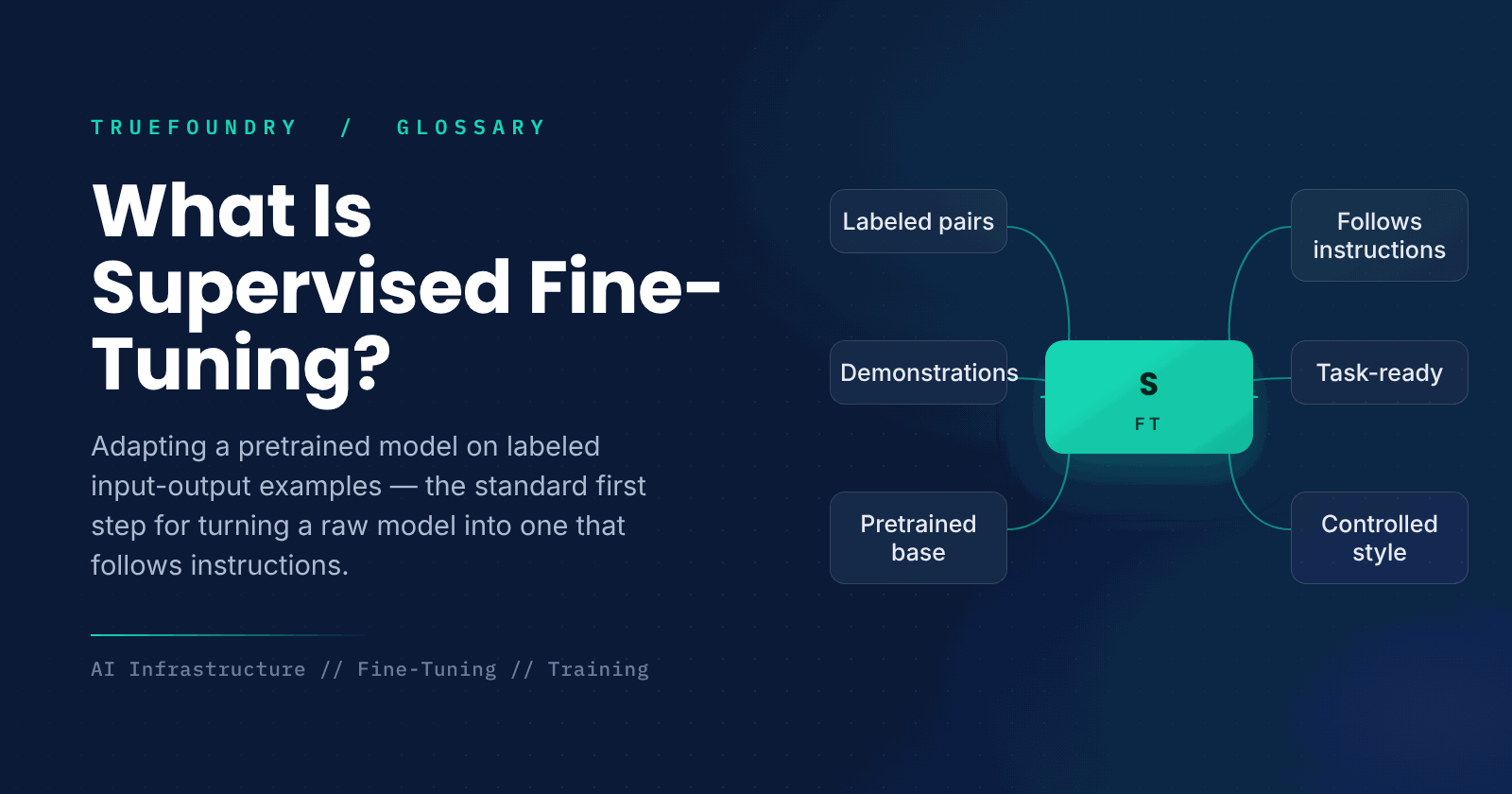
A pretrained language model has absorbed broad knowledge from huge amounts of text, but it does not yet reliably do what you ask. It can continue text, but it has not been taught to follow instructions, answer in a particular style, or perform a specific task. Supervised fine-tuning is how you teach it, by training on curated examples of exactly the behavior you want.
This is the standard first step in adapting a model for real use. By showing the model many input-output pairs that demonstrate the right response, you nudge its weights toward imitating them, turning a general-purpose predictor into a useful assistant or task-specific tool. This guide explains what supervised fine-tuning is, how it works, and where it fits.
We will cover the definition, the training process, how it compares to pretraining and preference tuning, and when to use it.
What is supervised fine-tuning?
Supervised fine-tuning, often shortened to SFT, is the process of continuing to train a pretrained model on a labeled dataset of input-output pairs, so it learns to produce the outputs you want for the given inputs. Because each example comes with the correct answer, the training is supervised: the model is directly shown the target response and adjusts to match it.
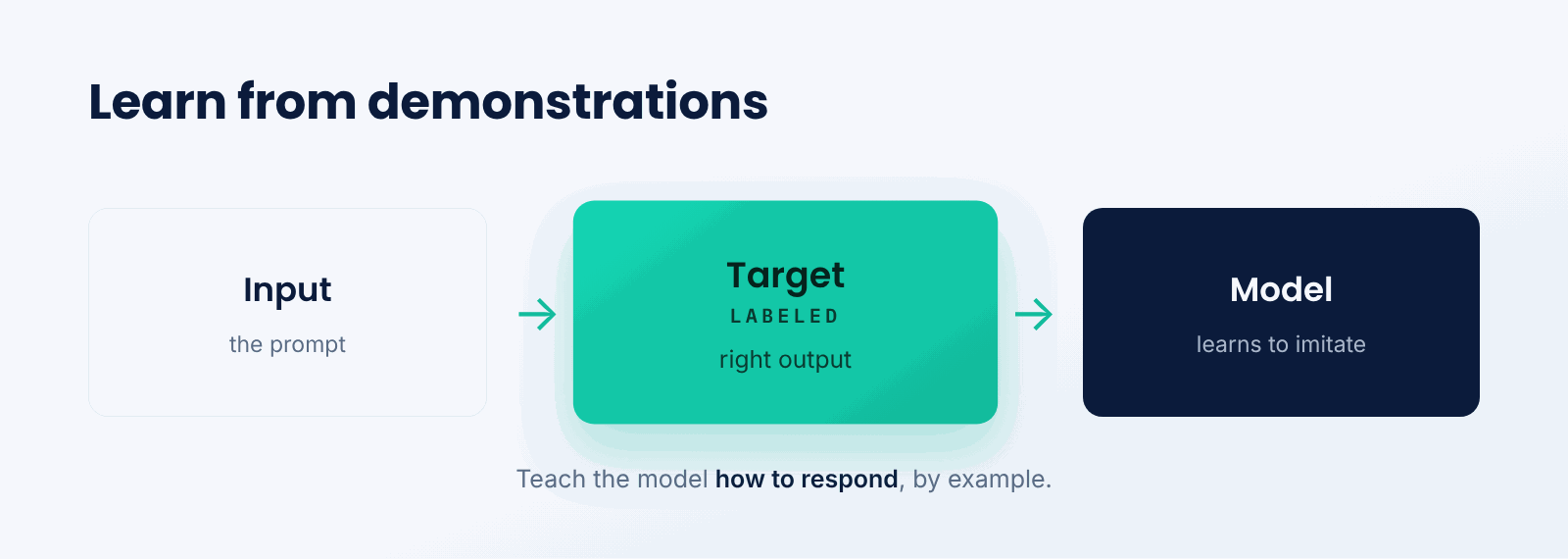
Think of it like an apprenticeship after general schooling. The pretrained model already knows a great deal about language and the world, like a well-read graduate. Supervised fine-tuning is the on-the-job training where it is shown worked examples of the exact tasks it will do, and learns to reproduce that behavior.
The key idea is learning from demonstrations. You are not teaching the model new facts so much as teaching it how to respond: what format to use, what instructions to follow, and what a good answer looks like for your task.
How does supervised fine-tuning work?
SFT trains the model to reproduce labeled target outputs for each input.
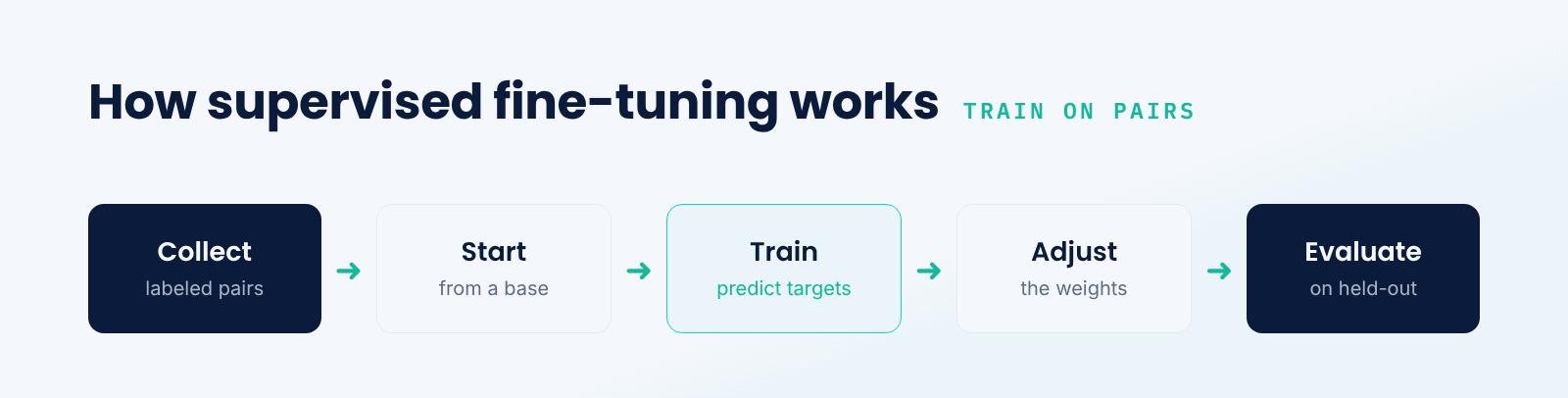
- Collect data. Gather input-output pairs that demonstrate the desired behavior.
- Start from a base. Begin with a pretrained model.
- Train on pairs. Show each input and have the model predict the target output.
- Adjust weights. Update the model to reduce the gap from the targets.
- Evaluate. Test on held-out examples to confirm it generalizes.
The training objective is to make the model's output match the labeled target for each input. Over many examples, the model learns the general pattern rather than memorizing specific answers. The result is a model that responds in the demonstrated style and follows the kinds of instructions in the training data.
SFT vs. pretraining vs. preference tuning
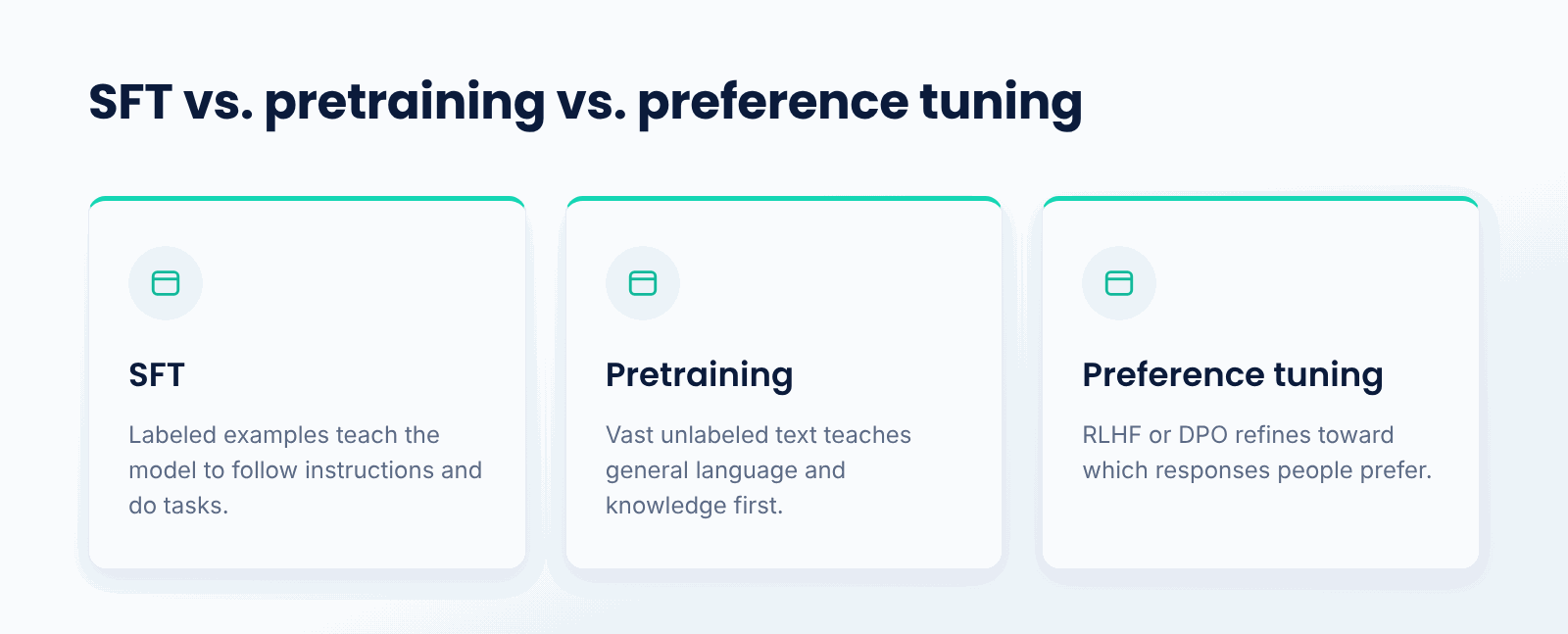
Pretraining teaches the model general language and knowledge from vast unlabeled text, with no specific task in mind. Supervised fine-tuning comes next, using labeled examples to teach the model to follow instructions and perform tasks. It builds directly on the foundation pretraining laid.
Preference tuning, such as RLHF or DPO, usually comes after SFT. Instead of showing the model a single correct answer, it teaches the model which of several responses people prefer, refining tone, helpfulness, and safety. SFT establishes competent behavior; preference tuning polishes it toward human preferences.
Why does supervised fine-tuning matter?
- Instruction following. It turns a raw model into one that obeys prompts.
- Task specialization. It adapts a general model to your specific task.
- Control. It shapes format, style, and tone through examples.
- Foundation. It is the base for later preference tuning.
- Data leverage. A modest set of good examples can go a long way.
What are the challenges?
- Data quality. Poor or inconsistent examples teach poor behavior.
- Labeling cost. Creating high-quality examples takes real effort.
- Overfitting. Too narrow a dataset can hurt general ability.
- Scope limits. SFT alone may not capture nuanced human preferences.
When should you use supervised fine-tuning?
Use supervised fine-tuning when you need a model to follow specific instructions, adopt a particular style, or perform a task that prompting alone does not handle reliably. It is the right tool when you have, or can create, a set of labeled examples that demonstrate the behavior you want.
If a well-crafted prompt on a capable model already does the job, you may not need fine-tuning at all. But when you need consistent, specialized behavior, supervised fine-tuning is the standard and most direct way to get it, and the usual first step before any preference tuning.
Key points about supervised fine-tuning
- SFT adapts a pretrained model using labeled input-output pairs.
- It teaches the model to imitate demonstrated behavior.
- It turns a raw model into an instruction follower.
- It usually precedes preference tuning like RLHF or DPO.
- Data quality is the biggest driver of results.
- It is ideal when prompting alone is not reliable enough.
Conclusion
Supervised fine-tuning is how a pretrained model is taught to behave, by training it on labeled examples of the inputs and outputs you want. It is the standard first step in adapting a model for real use, turning a general predictor into one that follows instructions and performs specific tasks. The quality of the demonstration data largely determines how good the result is.
TrueFoundry helps teams fine-tune and serve models efficiently on their own infrastructure, including supervised fine-tuning pipelines that turn base models into task-ready assistants. When you need reliable, specialized behavior, SFT is where adaptation begins.

Govern, Deploy and Trace AI in Your Own Infrastructure
Frequently Asked Questions
What is supervised fine-tuning in simple terms?
It means teaching a pretrained model by example. You give it many input-output pairs that show the correct response, and it adjusts to imitate them, turning a general model into one that follows instructions and handles specific tasks.
How is SFT different from pretraining?
Pretraining enables the model to learn language and knowledge from large amounts of text that are not labeled and have no particular task assigned to them. SFT follows pretraining and uses labeled samples to teach the model to carry out tasks and follow instructions, building on what pretraining established.
How is SFT different from RLHF or DPO?
SFT gives the model only one right way of responding to each input. Preference tuning such as RLHF or DPO instead trains the model on which response among many options people prefer. SFT is usually done first to establish competent behavior, and preference tuning then refines it toward human preferences.
How much data does supervised fine-tuning need?
This depends on the task itself; however, quality always matters more than sheer quantity. In many cases, a few examples created in a thoughtful and consistent way work better than a large but noisy set, because the model learns the behavior the examples demonstrate, good or bad.
When should I use SFT instead of just prompting?
Use SFT in cases where merely giving prompts is insufficient to elicit the required behavior from your model, or when you need consistent style, format, or task performance. If you have a great prompt for a strong model, you might not even need SFT.


- © 2022 ENSEMBLE Technologies



Subscribe to our newsletter
The latest news, articles, and resources sent to your inbox


