


What Is Structured Output and How Does It Work?

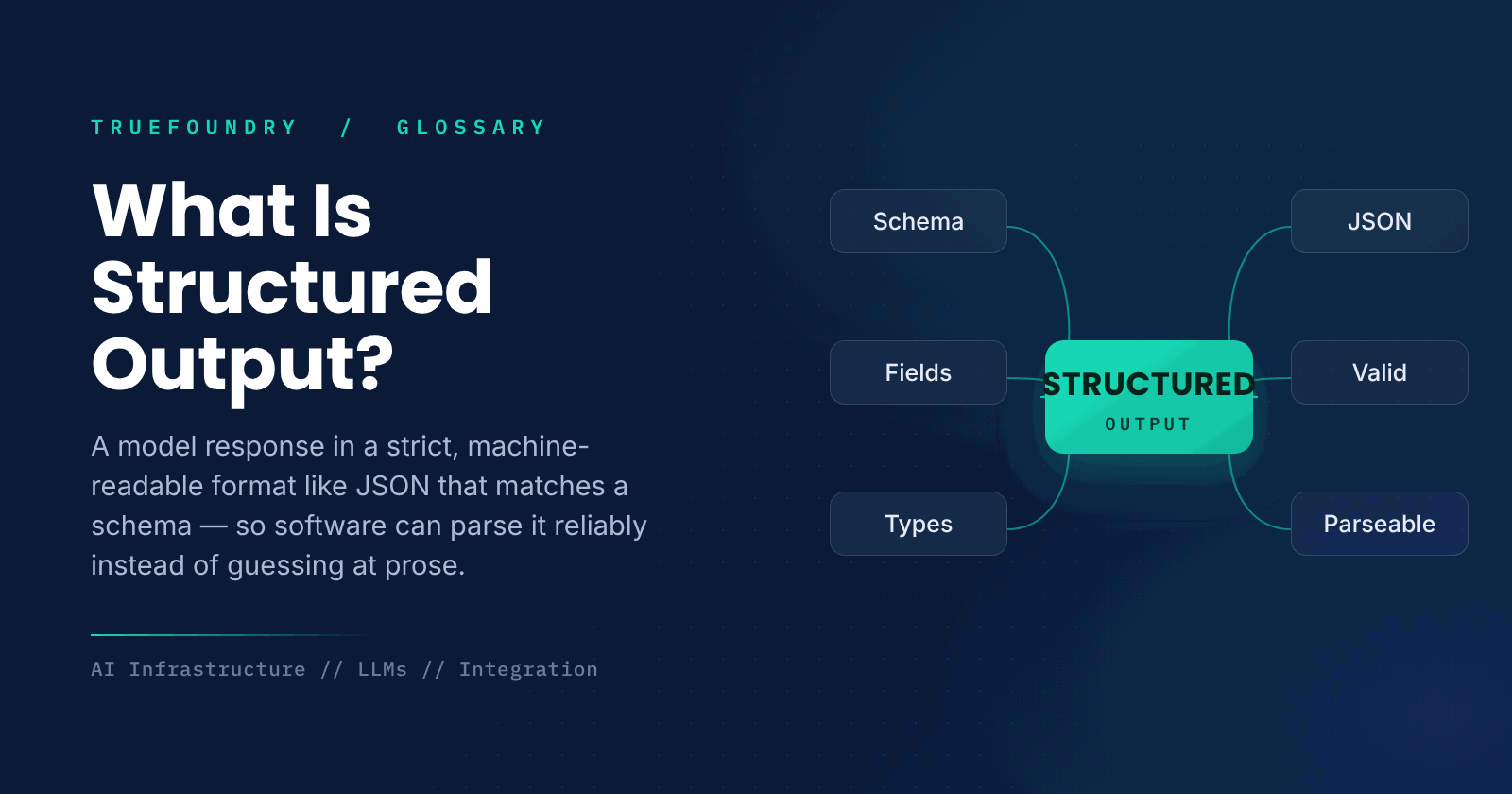
A language model naturally produces free-flowing text, which is great for humans but awkward for software. If a program needs a specific field, such as a price or a date, it cannot rely on the model wrapping it in a friendly sentence. It needs the data in a predictable shape. Structured output is how you get that.
By asking or forcing a model to respond in a defined format like JSON, you turn its output from prose into data your code can parse with confidence. This is what makes it possible to wire models into applications, pipelines, and tools reliably.
This guide explains what structured output is, how it works, the techniques that produce it, and why it matters.
What is structured output?
Structured output is a model response that conforms to a strict, predefined format rather than free text. Most often this is JSON that follows a schema specifying the exact fields, their types, and which are required. The result is data that a program can parse directly, without fragile text processing or guesswork.

Think of the difference between a handwritten note and a filled-in form. The note might contain the same information, but the form puts every piece in a labeled box, so anyone processing it knows exactly where to look. Structured output turns the model's note into that form.
The key point is reliability. Software needs the shape of a response to be predictable, and structured output provides that contract between the model and the code that consumes it.
How does structured output work?
Getting reliable structured output combines defining the format with enforcing it.
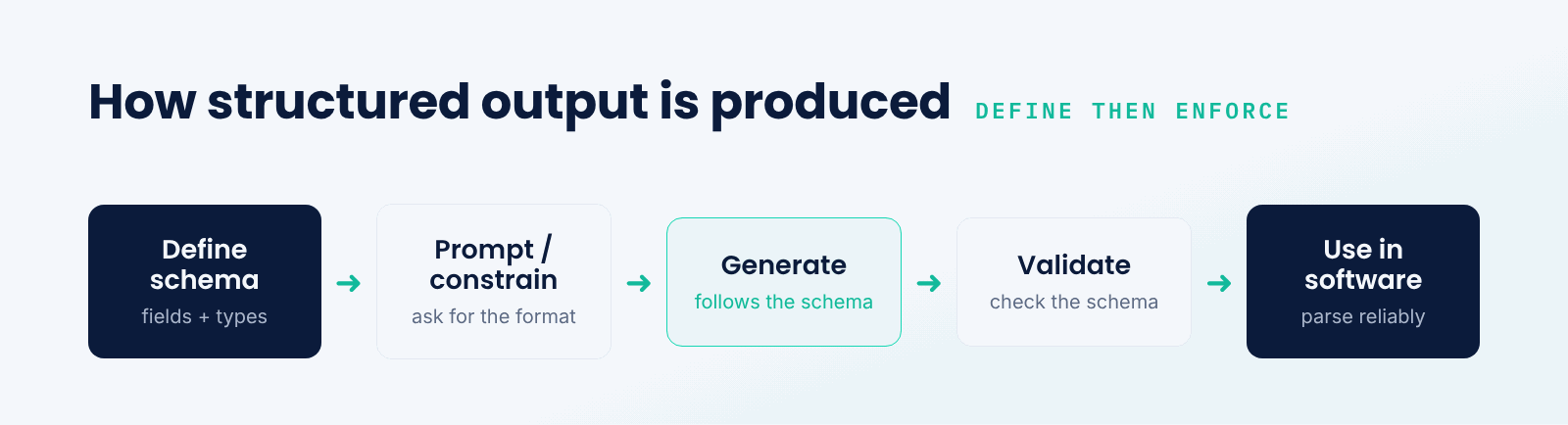
- Define the schema. You specify the fields, types, and required values the output must contain.
- Prompt or constrain. You ask the model for that format, or restrict its decoding so it must comply.
- Generate the output. The model produces a response that follows the schema.
- Validate. The output is checked against the schema, and invalid responses are caught or retried.
- Use it in software. The validated data is parsed and passed into the application or pipeline.
The strongest methods go beyond asking nicely. Constrained decoding restricts the tokens the model can produce so the output is guaranteed to be valid against the schema, removing the risk of malformed responses entirely.
Prompting vs. function calling vs. constrained decoding
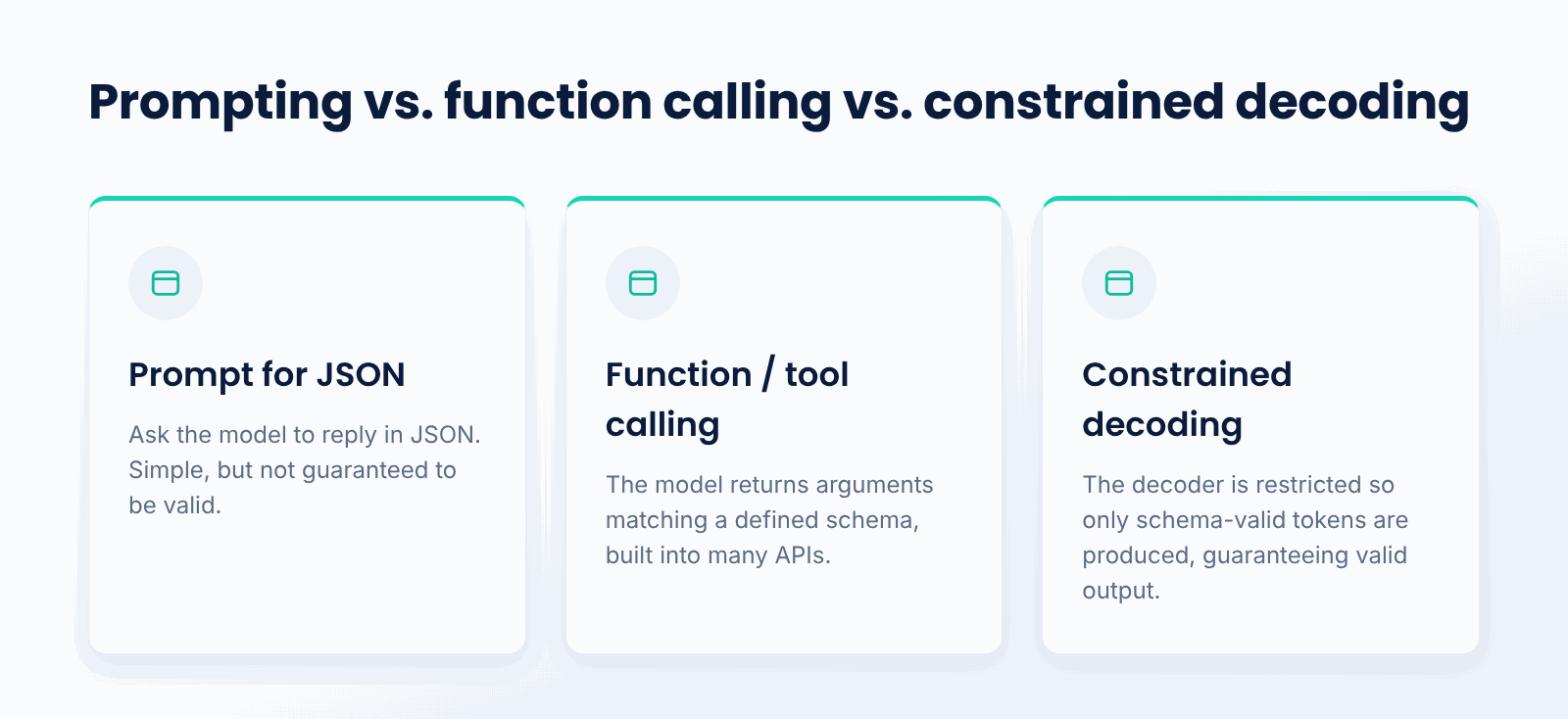
There are three main ways to get structured output, with increasing reliability. Prompting for JSON simply asks the model to reply in the format; it is easy but not guaranteed to be valid. Function or tool calling, built into many model APIs, has the model return arguments that match a defined schema, which is more reliable. Constrained decoding restricts the generation so only schema-valid tokens can be produced, guaranteeing valid output every time.
Which you choose depends on how strict you need to be. Prompting may be enough for a forgiving pipeline, while anything that must never receive malformed data should use function calling or constrained decoding.
Why does structured output matter?
- Reliable integration. Software can parse the output directly instead of guessing at free text.
- Tool and agent use. Agents need structured arguments to call tools and APIs correctly.
- Data extraction. Pulling fields from documents or text into a database needs a fixed shape.
- Fewer errors. A validated schema catches malformed responses before they break downstream code.
- Composability. Structured responses can be chained between steps and systems predictably.
What are the challenges?
- Invalid output. Without constraints, models can still produce malformed or incomplete JSON.
- Schema design. An overly rigid or complex schema can be hard for the model to satisfy.
- Quality trade-offs. Forcing structure too hard can sometimes reduce the quality of the content.
- Validation needed. You still need to validate and handle failures rather than trusting output blindly.
When should you use structured output?
Use it whenever a model's response feeds into software rather than a human. Tool calling, data extraction, classification with fixed labels, form filling, and any API that returns machine-readable results all depend on structured output to work reliably.
For purely conversational replies meant to be read by a person, free text is fine and more natural. The moment code consumes the output, structure becomes essential.
Best practices for structured output
- Define a clear schema with explicit types and required fields.
- Prefer function calling or constrained decoding over plain prompting when validity matters.
- Validate every response against the schema and handle failures with a retry or fallback.
- Keep schemas as simple as the task allows, since complex ones are harder to satisfy.
- Give an example of the desired output in the prompt to guide the model.
- Enforce structured output policies behind a gateway so they are consistent across models.
Conclusion
Structured output turns a model's free text into strict, machine-readable data that software can parse with confidence. By defining a schema and enforcing it through prompting, function calling, or constrained decoding, you get responses your code can rely on. It is the foundation of tool use, data extraction, and any serious integration of a model into an application.
TrueFoundry's AI Gateway supports structured output and tool calling across models, with validation and observability in one layer, so the data your systems receive from a model is consistent and dependable. Whenever a model talks to code rather than a person, structured output is what makes the conversation reliable.

Govern, Deploy and Trace AI in Your Own Infrastructure
Frequently Asked Questions
What is structured output in simple terms?
It is requiring the model to return an answer in a specific structured format such as JSON, as opposed to free text. This way, the response is parsed reliably by the software rather than guessed at.
Why not just ask the model for JSON?
You can do that, but prompting alone will not ensure valid output, since the model can still produce invalid JSON. The more reliable way to enforce validity is through function calling or constrained decoding.
What is constrained decoding?
Constrained decoding constrains the possible tokens the model can generate, ensuring that the output adheres to the schema. Since invalid tokens cannot be produced, the output is guaranteed to be structurally correct.
How is structured output related to tool calling?
Tool and function calling depend on structured output, because the model produces arguments that conform to a tool's schema. It is that structure that enables an agent to call tools and APIs correctly, rather than passing free text.
When should I not use structured output?
In cases where the reply is meant to be read by a person and not processed by a program. Conversational answers are more natural written freely, without any particular structure; structure is needed only when software consumes the output.


- © 2022 ENSEMBLE Technologies



Subscribe to our newsletter
The latest news, articles, and resources sent to your inbox


