


What Is a Service Mesh and Why Does It Matter?


Modern applications are often built from many small services that constantly talk to each other over the network. As the number of services grows, managing that communication, routing requests, securing connections, retrying failures, and understanding what is happening, becomes a major challenge. A service mesh is the infrastructure layer built to handle it.
Instead of building communication logic into every service, a service mesh moves it into a dedicated layer of lightweight proxies that sit alongside each service and manage its traffic. This makes service-to-service communication reliable, secure, and observable without burdening the application code. This guide explains what a service mesh is, how it works, and when it matters.
We will cover the definition, how it works, what it provides, and when to use it.
What is a service mesh?
A service mesh is a dedicated infrastructure layer that controls and observes how services communicate with one another in a distributed application. It handles the concerns of service-to-service networking, such as routing, encryption, retries, and monitoring, in a consistent way across all services, separate from the business logic those services contain.
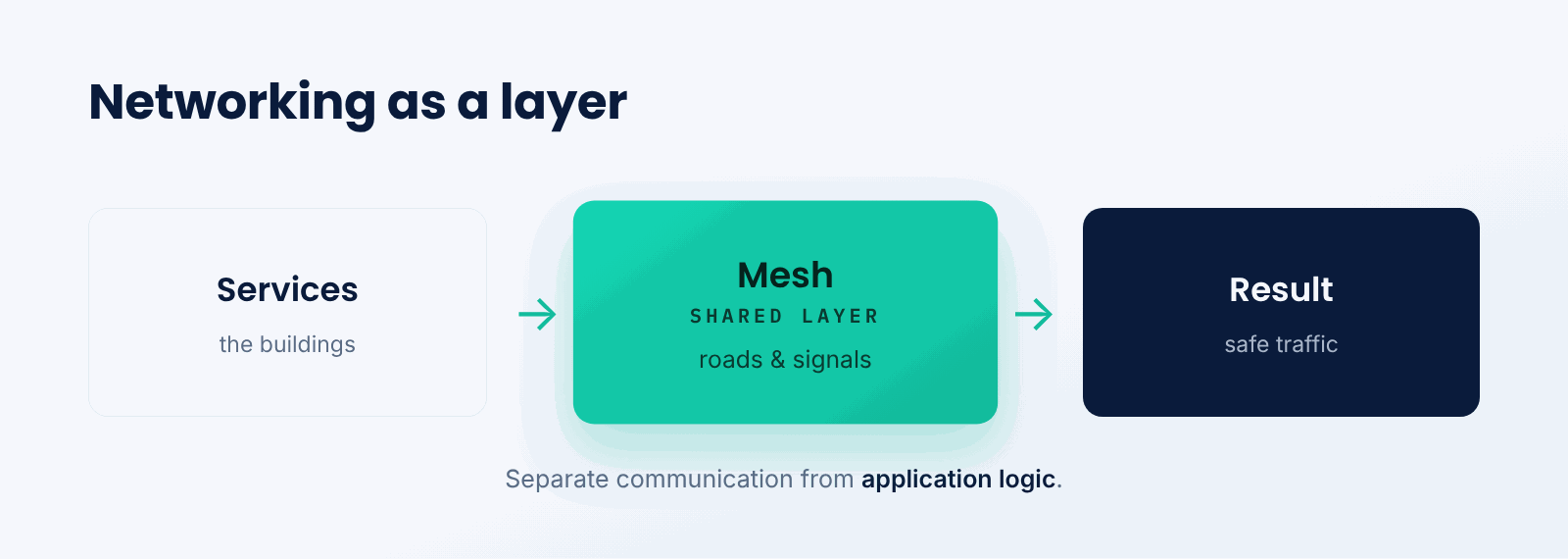
Think of it like the road and traffic system of a city. The buildings are the services, and the mesh is the roads, traffic lights, and signage that get messages safely and efficiently from one to another. The buildings do not each manage traffic; the shared system does, consistently for everyone.
The key idea is separating communication from application logic. By pulling networking concerns into a shared layer, a service mesh gives every service the same reliable, secure, observable communication without each one reimplementing it.
How does a service mesh work?
A service mesh runs a proxy next to each service and routes all traffic through them.
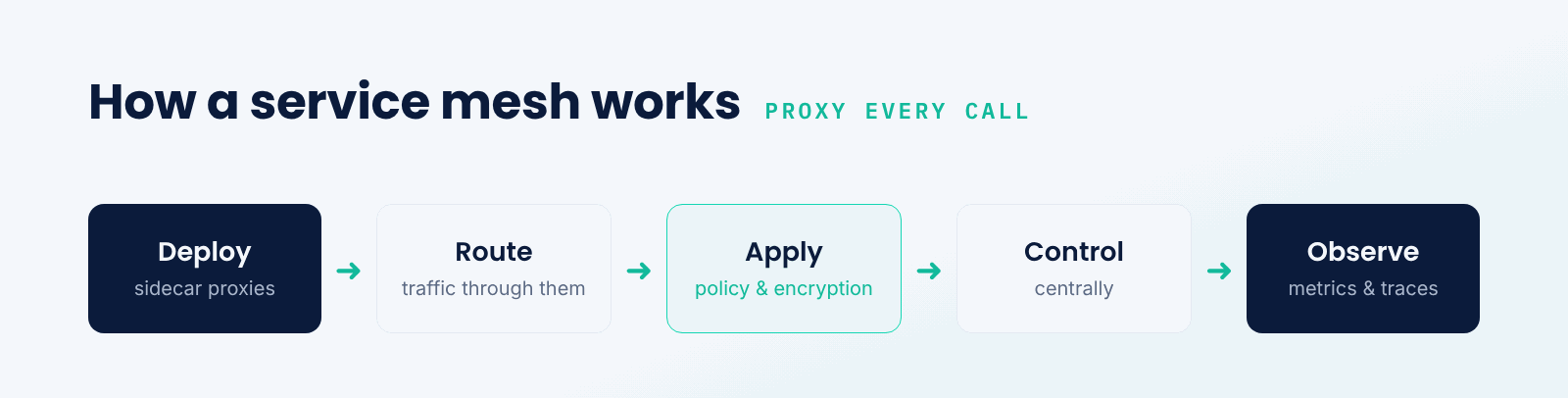
- Deploy proxies. Place a lightweight proxy, a sidecar, beside each service.
- Route through proxies. All service traffic flows through these proxies.
- Apply policy. Proxies handle routing, retries, and encryption.
- Control centrally. A control plane configures all the proxies.
- Observe. The proxies emit metrics, logs, and traces for all traffic.
The proxies form the data plane, carrying the actual traffic, while a control plane sets their rules and policies centrally. Because every request passes through a proxy, the mesh can enforce security, manage traffic, and collect detailed telemetry uniformly, all without changing the services themselves.
What does a service mesh provide?
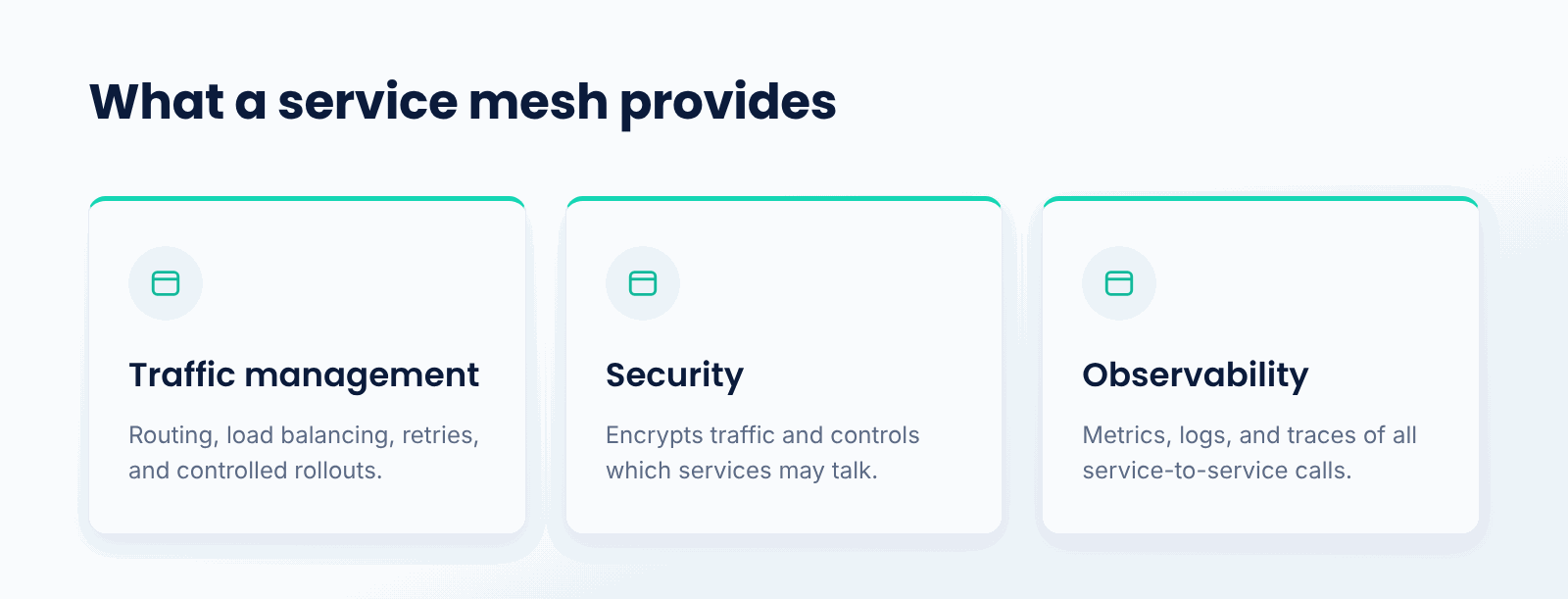
A service mesh provides three broad capabilities. For traffic management, it handles routing, load balancing, retries, and controlled rollouts between service versions. For security, it can encrypt traffic between services and enforce which services may talk to which, often with mutual authentication.
For observability, it gives detailed metrics, logs, and traces of service-to-service communication, so teams can see how requests flow and where problems arise. Delivering all of this consistently, without changing application code, is the core value of a service mesh, at the cost of the added complexity of running the mesh itself.
Why does a service mesh matter?
- Reliability. It adds retries, load balancing, and failure handling.
- Security. It encrypts and controls service-to-service traffic.
- Observability. It makes communication visible with metrics and traces.
- Consistency. It applies the same rules across all services.
- Clean code. It keeps networking logic out of applications.
What are the tradeoffs?
- Complexity. Running a mesh adds moving parts to operate.
- Overhead. The proxies add some latency and resource use.
- Learning curve. Teams must learn to configure and run it.
- Overkill for small systems. A few services may not need one.
When should you use a service mesh?
Use a service mesh when you run many services that communicate heavily and you need consistent security, reliability, and observability across them. It is especially valuable in large microservice architectures, where managing communication service by service becomes unmanageable and error-prone.
For a small application with just a few services, a service mesh may add more complexity than it is worth, and simpler approaches suffice. As the number of services and the need for uniform control grow, a service mesh becomes increasingly worthwhile.
Key points about service meshes
- A service mesh manages service-to-service communication.
- It uses proxies beside each service, set by a control plane.
- It provides traffic management, security, and observability.
- It keeps networking logic out of application code.
- It adds operational complexity and some overhead.
- It is most valuable in large microservice systems.
Conclusion
A service mesh is a dedicated layer that manages how services communicate, handling routing, security, and observability through lightweight proxies beside each service and a central control plane. It makes communication in complex systems reliable, secure, and visible without burdening application code, at the cost of added operational complexity. For large microservice architectures, it is a key piece of infrastructure.
TrueFoundry helps teams run and connect services on their own infrastructure, including the networking, security, and observability that service meshes provide for distributed systems. When many services must communicate reliably and securely, a service mesh is how that is managed at scale.

Govern, Deploy and Trace AI in Your Own Infrastructure
Frequently Asked Questions
What is a service mesh in simple terms?
It is an infrastructure layer that controls how the services within an application communicate with one another. The communication between those services is routed, secured, and monitored by small proxies sitting next to each service, freeing the services from that work.
How does a service mesh work?
It places a small proxy, known as a sidecar, alongside each service and passes all network traffic through the sidecars. A central control plane configures them, so routing, encryption, retries, and telemetry collection happen consistently throughout the mesh without changing the services.
What does a service mesh provide?
Three main things: traffic management such as routing, load balancing, and retries; security such as encrypting and controlling service-to-service traffic; and observability through metrics, logs, and traces. It delivers all of this consistently across services without any application code change.
What is the difference between the data plane and control plane?
The data plane is the set of proxies that carry the actual traffic between services. The control plane is the central component that configures those proxies with rules and policies. Together they let the mesh manage communication consistently from one place.
When should I use a service mesh?
When you run many services that communicate heavily and need consistent security, reliability, and observability across them, as in a large microservice architecture. For a small application with only a few services, a mesh may add more complexity than it is worth.


- © 2022 ENSEMBLE Technologies



Subscribe to our newsletter
The latest news, articles, and resources sent to your inbox


