


What Is Serverless Inference and Why Does It Matter?

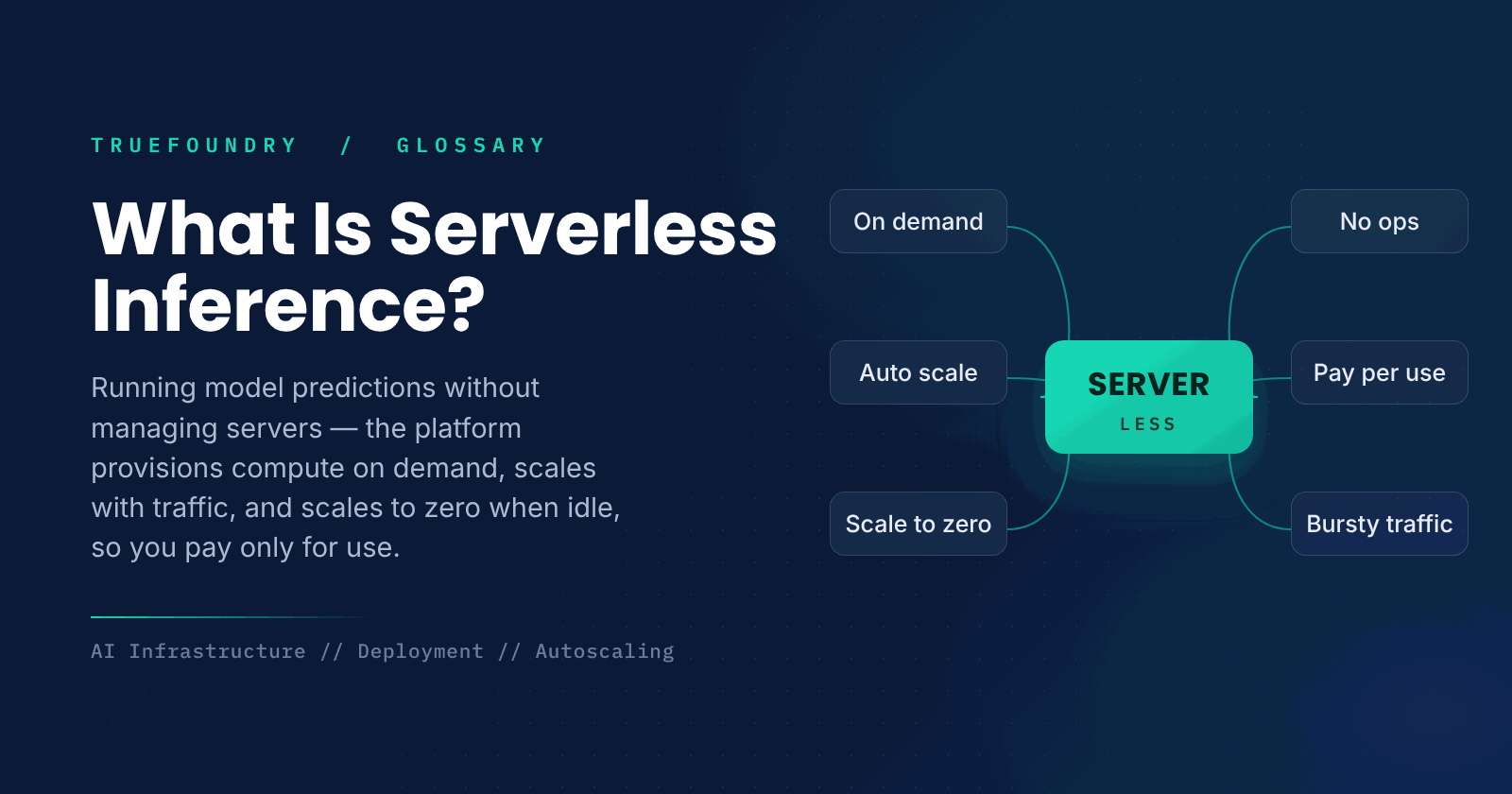
Running a model in production usually means keeping servers ready to answer requests, which you have to provision, scale, and pay for whether or not they are busy. For workloads with uneven traffic, that means either paying for idle capacity or scrambling when demand spikes. Serverless inference offers a different model: you hand the platform your model, and it handles the infrastructure.
With serverless inference, compute is created when requests arrive, scaled with demand, and released when idle, so you pay only for what you use. It removes the burden of managing servers and fits workloads where traffic is variable or hard to predict. This guide explains what it is, how it works, and its tradeoffs.
We will cover the definition, how it works, how it compares to always-on serving, and when to use it.
What is serverless inference?
Serverless inference is a deployment model in which a platform runs your model's predictions on demand, automatically managing the underlying compute. You do not provision or maintain servers; instead, the platform allocates resources when requests come in, scales them with load, and can scale down to zero when there is no traffic, charging you only for actual usage.
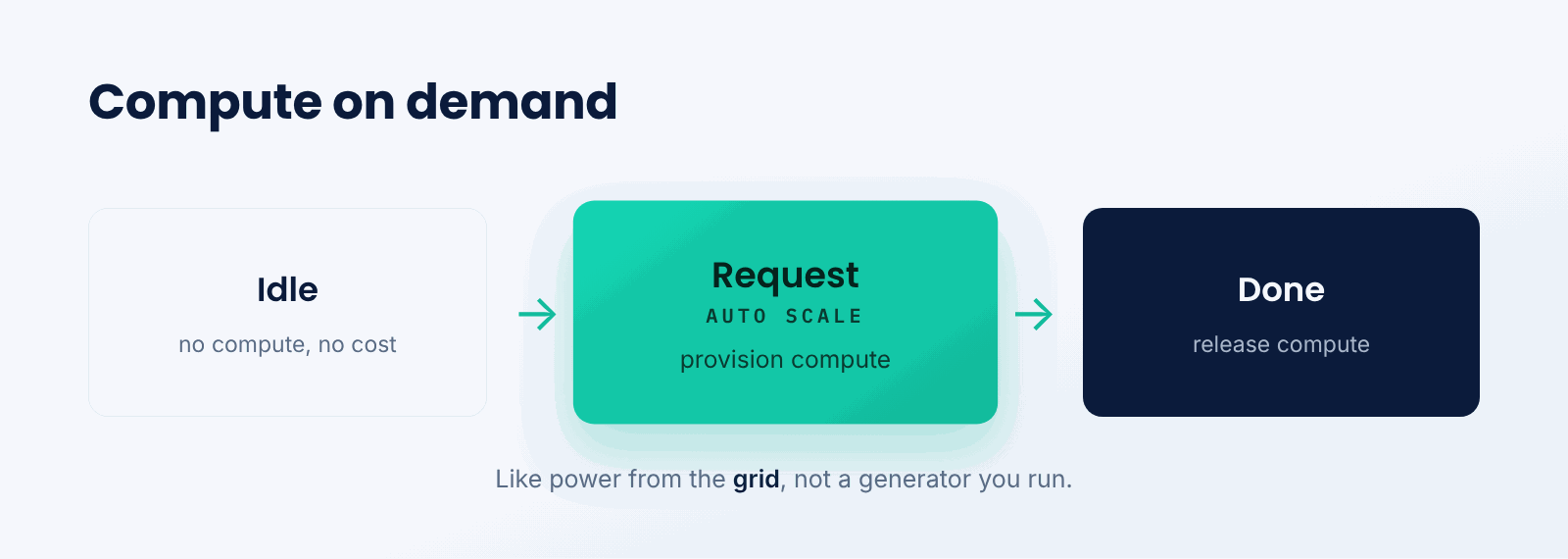
Think of it like electricity from the grid rather than a generator you own and run. You do not keep a machine humming around the clock; you draw power when you need it and pay for what you consume. Serverless inference gives you model predictions the same way, with the platform running the machinery behind the scenes.
The key idea is offloading infrastructure management. You focus on the model and the requests, and the platform takes care of provisioning, scaling, and tearing down the compute that serves them.
How does serverless inference work?
The platform spins up compute when requests arrive and releases it when they stop.
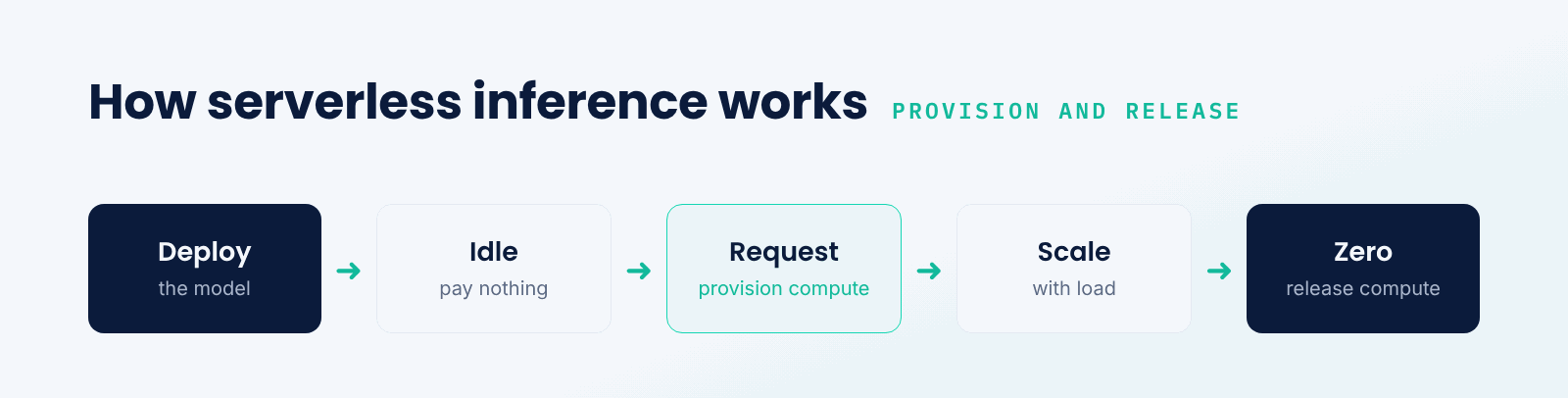
- Deploy the model. Hand the platform your model and its requirements.
- Wait idle. With no traffic, no compute runs and you pay nothing for it.
- Receive a request. The platform provisions compute to handle it.
- Scale with load. It adds or removes capacity as demand changes.
- Scale to zero. When traffic stops, it releases the compute again.
Because compute is created on demand, the first request after an idle period may incur a delay while resources start up, known as a cold start. Platforms work to minimize this, but it is the main tradeoff of scaling to zero. Once warm, the service responds normally and scales smoothly with demand.
Serverless vs. always-on inference
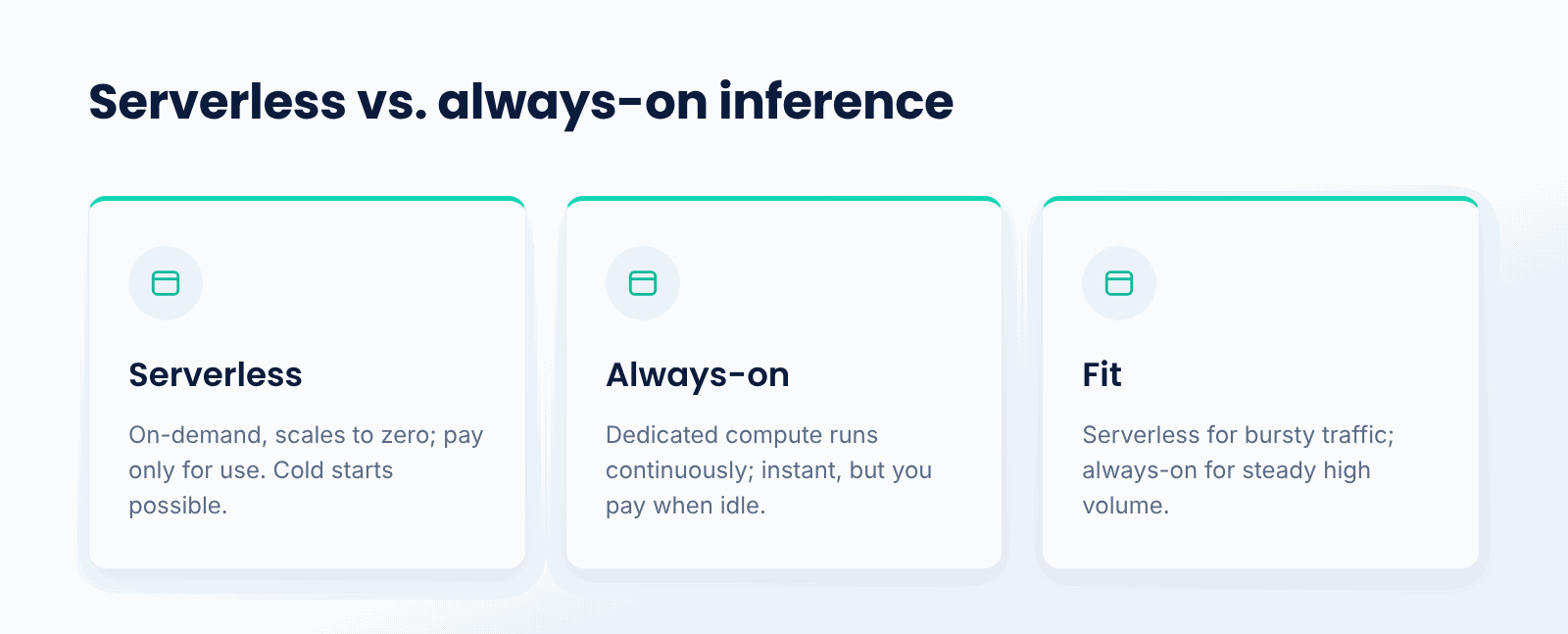
Always-on serving keeps dedicated compute running continuously, ready to answer instantly. It gives predictable low latency and no cold starts, but you pay for the capacity even when it sits idle, which is wasteful for uneven traffic. It suits steady, high-volume workloads where the servers are rarely idle.
Serverless inference instead provisions on demand and scales to zero, so you pay only for usage and avoid idle cost. The tradeoff is possible cold-start latency and less control over the environment. It suits variable, bursty, or low-volume workloads, where paying for always-on capacity would be inefficient.
Why does serverless inference matter?
- No server management. The platform handles the infrastructure.
- Cost efficiency. You pay only for the compute you use.
- Automatic scaling. Capacity follows demand up and down.
- Scale to zero. Idle workloads cost nothing to keep available.
- Faster iteration. Teams ship models without building ops.
What are the tradeoffs?
- Cold starts. The first request after idle can be slower.
- Less control. You have limited say over the environment.
- Cost at scale. Steady high traffic can be cheaper always-on.
- Limits. Large models or special hardware may not be supported.
When should you use serverless inference?
Use serverless inference for workloads with variable, unpredictable, or low traffic, where paying for always-on servers would waste money on idle capacity. It is ideal for new applications, internal tools, and bursty workloads, and for teams that want to deploy models without managing infrastructure.
For steady, high-volume traffic where servers would rarely sit idle, or where cold-start latency is unacceptable, always-on serving may be the better choice. Matching the serving model to the traffic pattern is what keeps both cost and latency in check.
Key points about serverless inference
- Serverless inference runs predictions without managing servers.
- Compute is provisioned on demand and scales with load.
- It can scale to zero, so idle costs nothing.
- You pay only for the compute you use.
- Cold starts are the main tradeoff of scaling to zero.
- It suits variable, bursty, or low-volume workloads.
Conclusion
Serverless inference lets you run model predictions without managing the servers behind them, with the platform provisioning compute on demand, scaling it with traffic, and releasing it when idle. You pay only for what you use and avoid the cost of idle capacity, at the cost of possible cold-start latency. For variable or unpredictable workloads, it is an efficient, low-overhead way to serve models.
TrueFoundry helps teams deploy and serve models on their own infrastructure, including autoscaling and scale-to-zero serving that keeps inference cost in line with actual demand. When traffic is uneven, serverless-style inference is how you serve efficiently without paying for idle servers.

Govern, Deploy and Trace AI in Your Own Infrastructure
Frequently Asked Questions
What is serverless inference in simple terms?
It means you do not have to manage any servers at all, since the service creates compute when requests come in, scales it with demand, and stops it when idle. This way you pay only for the compute you use, much like pulling electricity from the grid instead of running your own generator.
What is a cold start?
It is the delay on the first request after a period of no activity, while the platform provisions and warms up compute to handle it. This is the main compromise of scaling to zero; platforms aim to reduce it, and once warmed up the service performs normally.
How is serverless different from always-on inference?
Always-on serving keeps compute running continuously, ready to respond instantly and predictably, but you are charged even when it is idle. Serverless works based on usage and can scale to zero, charging you only when you use it. The tradeoff is possible cold-start latency and less control over the environment.
Does serverless inference save money?
For low or unpredictable traffic, usually yes, because you avoid paying for idle capacity. For predictable high-volume traffic, where servers would rarely be idle, always-on serving can be cheaper. The savings depend on how uneven your traffic is.
When should I use serverless inference?
For bursty or low-volume jobs, new services, internal tools, and whenever you want to deploy models without managing your own infrastructure. For consistently high-volume traffic and latency-sensitive uses where cold starts are unacceptable, always-on serving might be more appropriate.


- © 2022 ENSEMBLE Technologies



Subscribe to our newsletter
The latest news, articles, and resources sent to your inbox


