


What Is Scale to Zero and How Does It Work?

Most services are provisioned to be ready at all times, which means paying for them even when no one is using them. For workloads that are busy only some of the time, that is money spent on idle machines. Scale to zero removes that waste by letting a service shut down entirely when idle and spin back up the moment it is needed again.
The idea matters most where compute is expensive and usage is intermittent, which describes a lot of AI workloads. A GPU model endpoint that handles occasional requests does not need to run around the clock; scale to zero lets it cost nothing while idle, trading a little startup delay for large savings.
This guide explains what scale to zero is, how it works, its tradeoffs, and when it is the right choice.
What is scale to zero?
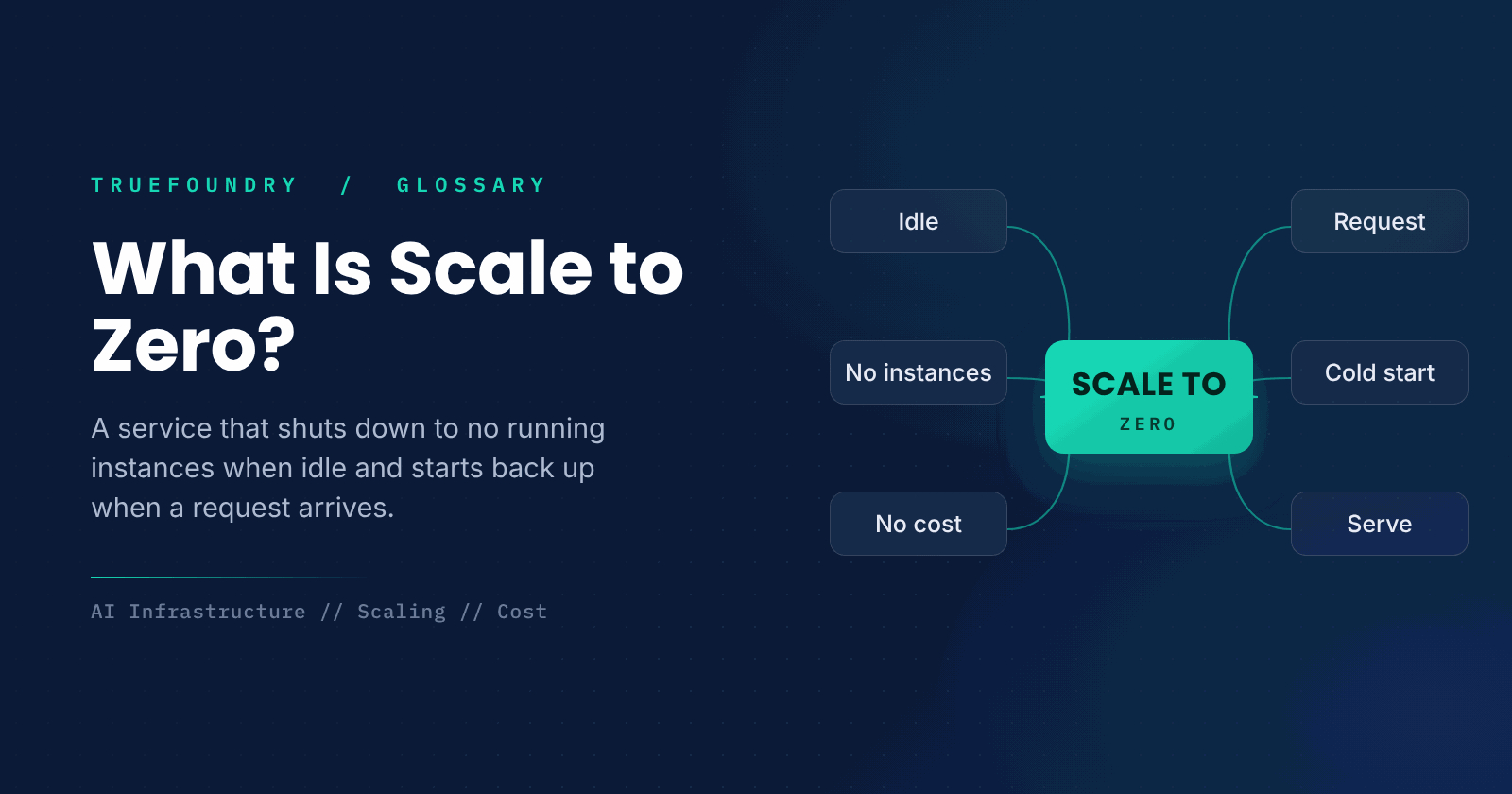
Scale to zero is an autoscaling behavior in which a service reduces its number of running instances all the way to zero when there is no demand, releasing its compute resources entirely. When a new request arrives, the platform starts an instance back up to handle it, so the service costs nothing while idle but is still available on demand.
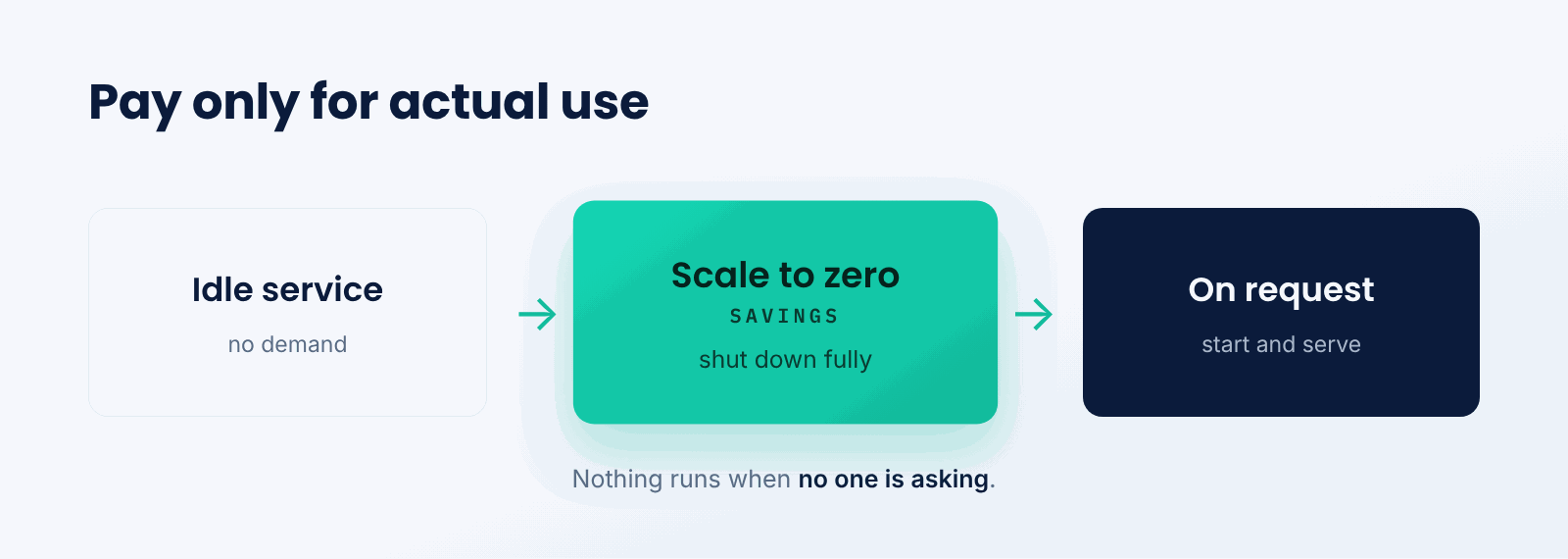
Think of it like lights with a motion sensor. Rather than leaving them on all night, they switch off when the room is empty and come on the instant someone walks in. Scale to zero does the same for compute: nothing runs when no one is asking, and capacity appears when a request arrives.
The key idea is paying only for actual use. Instead of a baseline cost for always-on capacity, idle periods cost nothing, which is a fundamental shift for intermittently used services.
How does scale to zero work?
The platform watches for demand, removes all instances when idle, and restores one on the next request.
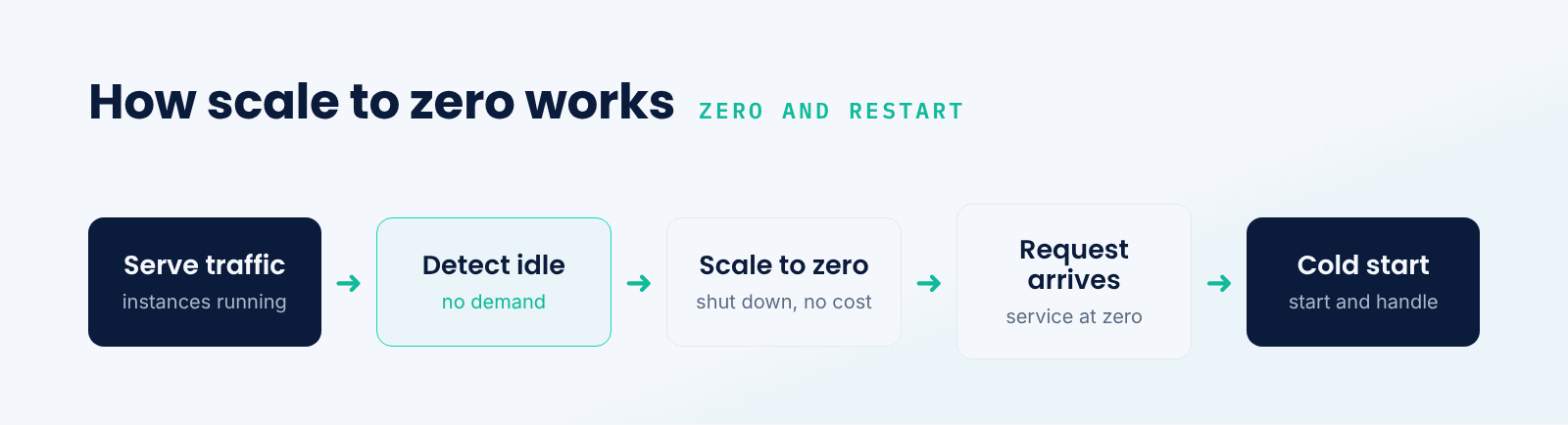
- Serve traffic. The service runs instances while requests are coming in.
- Detect idle. When traffic stops for a set period, the platform notices no demand.
- Scale to zero. All instances are shut down, releasing compute and stopping cost.
- Request arrives. A new request comes in while the service is at zero.
- Cold start. The platform starts an instance, which then handles the request.
The cold start is the cost of the approach. Starting from zero takes longer than hitting an already-running instance, so the first request after idle is slower. Managing that delay is the main challenge of using scale to zero well.
Scale to zero vs. always-on vs. autoscaling
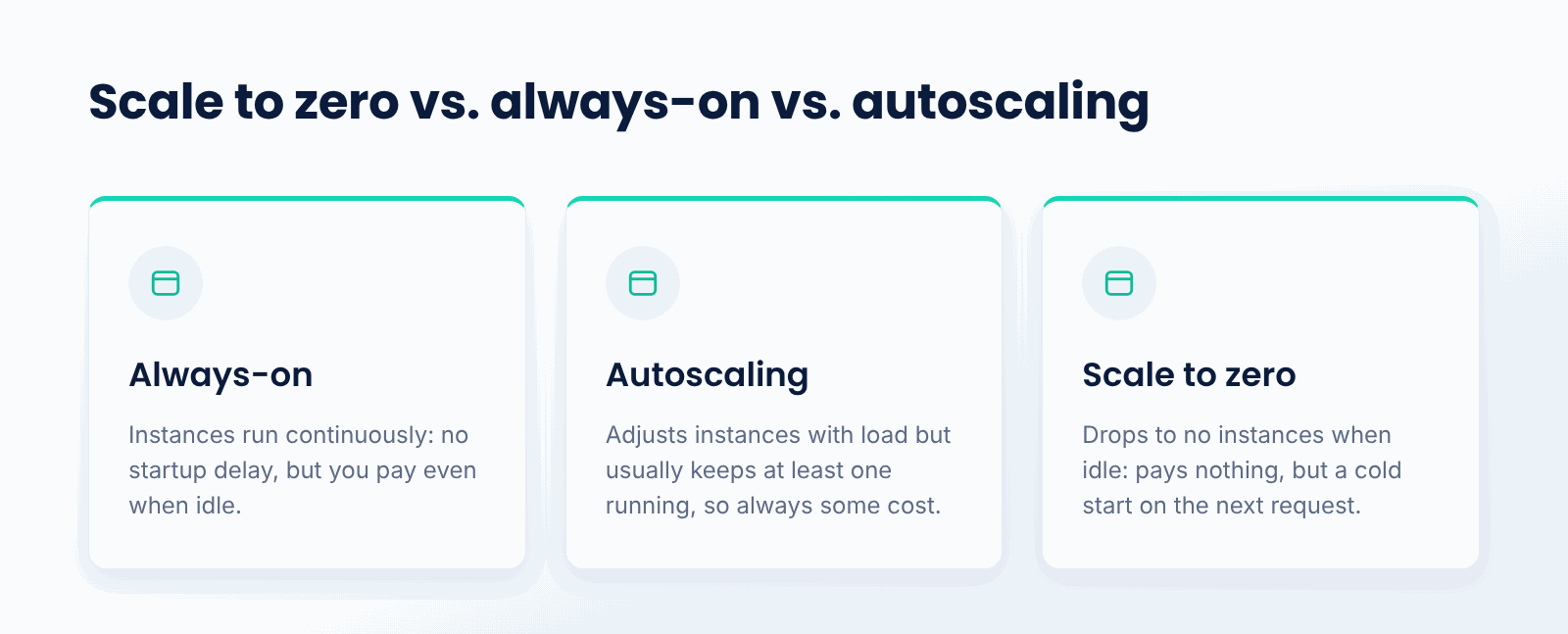
These approaches trade cost against readiness. Always-on keeps instances running continuously, so there is no startup delay but you pay even when idle. Standard autoscaling adjusts the number of instances with load but usually keeps at least one running, so it never fully stops paying. Scale to zero goes all the way down to no instances when idle, paying nothing but accepting a cold start on the next request.
The right choice depends on the workload. Always-on suits steady, latency-sensitive traffic; scale to zero suits intermittent, cost-sensitive workloads that can tolerate an occasional cold start. Autoscaling with a minimum sits in between.
Why does scale to zero matter?
- Cuts idle cost. You stop paying for compute that is not being used.
- Suits bursty workloads. Intermittent services cost nothing between bursts.
- Big GPU savings. Idle GPUs are expensive, so zeroing them saves the most.
- Enables many services. Low idle cost makes it affordable to run more endpoints.
- Aligns cost with use. Spending tracks real demand rather than provisioned capacity.
What are the challenges?
- Cold starts. The first request after idle waits for an instance to start.
- Large models. Loading big models on start can make cold starts slow.
- Latency sensitivity. Some services cannot tolerate any startup delay.
- Tuning. Idle timeouts and warmup strategies need to be set thoughtfully.
When should you use scale to zero?
It fits workloads that are used intermittently and can tolerate a short delay on the first request, especially expensive ones like GPU endpoints. Development environments, internal tools, and low-traffic model services are strong candidates where idle savings outweigh the cold-start cost.
For steady, high-traffic, or strictly latency-sensitive services, always-on or autoscaling with a minimum is better. The question is whether the savings from zeroing idle capacity are worth the occasional cold start, which depends on the traffic pattern.
Best practices for scale to zero
- Use it for intermittent workloads where idle time is significant.
- Tune idle timeouts so services do not zero out mid-use or linger too long.
- Reduce cold-start time by optimizing model loading and image size.
- Keep a warm instance for latency-sensitive paths that cannot wait.
- Prioritize scale to zero for costly GPU endpoints with bursty traffic.
- Monitor cold-start frequency and latency to balance cost against responsiveness.
Conclusion
Scale to zero lets a service shut down to no instances when idle and start again on the next request, so idle time costs nothing. The tradeoff is a cold start on the first request after idle, which makes it ideal for intermittent, cost-sensitive workloads, especially expensive GPU endpoints, and less suited to steady, latency-critical traffic. Used well, it aligns spending directly with real demand.
TrueFoundry supports scale to zero for model deployments on your own infrastructure, so idle GPU endpoints cost nothing while staying available on demand. As teams run more model services, scaling idle ones to zero is a direct way to cut the cost of AI.

Govern, Deploy and Trace AI in Your Own Infrastructure
Frequently Asked Questions
What is scale to zero in simple terms?
It is shutting a service down completely when no one is using it, then restarting it whenever a request comes in. You incur zero cost during the idle time, at the cost of a short startup delay before the first request is answered.
What is a cold start?
It is the delay when a service that has scaled to zero must start an instance before it can handle a request. Because starting from scratch takes longer than using a running instance, the first request after idle is slower.
How is scale to zero different from autoscaling?
Autoscaling increases or decreases the number of instances based on load but normally keeps at least one active. Scale to zero goes all the way to no instances when idle, so it pays nothing while idle but incurs a cold start on the next request.
Why is scale to zero valuable for GPUs?
Because GPUs are expensive, an idle GPU endpoint wastes a lot of money. Scaling it to zero means it costs nothing between bursts of use, which is where the savings are largest, so bursty GPU workloads benefit most.
When should you not use scale to zero?
For steady, high-traffic services, or ones that cannot tolerate any startup delay. There, always-on or autoscaling with a minimum instance is better, since the latency of cold starts would outweigh the savings on idle capacity.


- © 2022 ENSEMBLE Technologies



Subscribe to our newsletter
The latest news, articles, and resources sent to your inbox


