


What Is a Reward Model and Why Does It Matter?

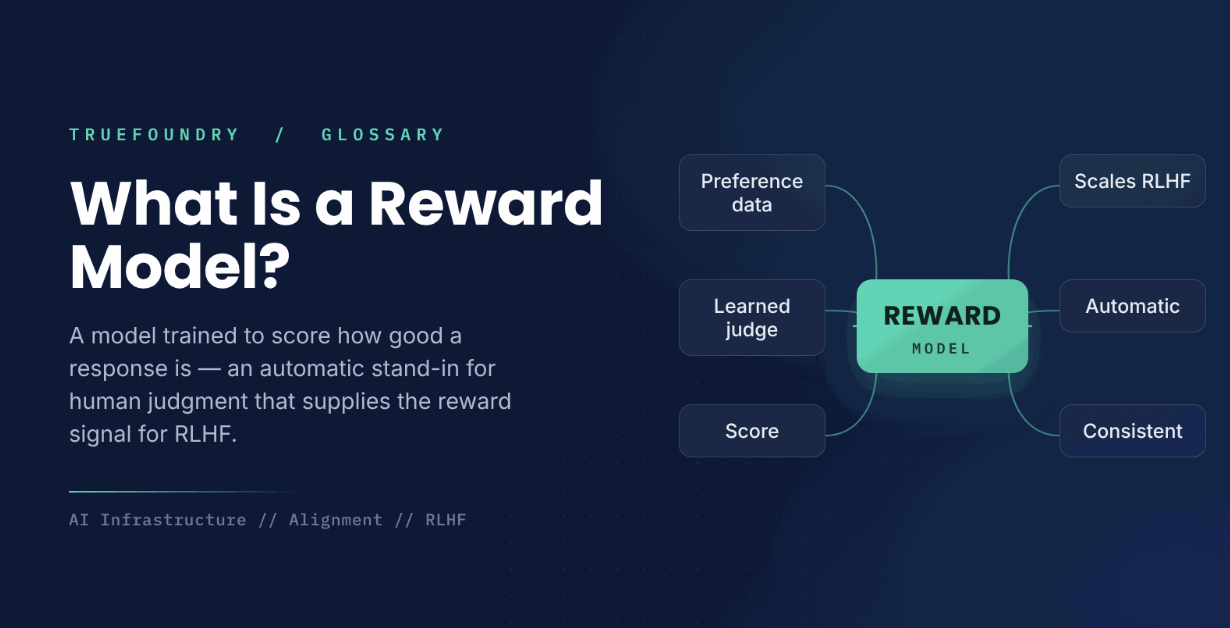
Aligning a language model with human preferences requires a way to tell good responses from bad ones, at a scale no team of human raters could match. You cannot have people score every candidate response during training, there are far too many. A reward model solves this by learning to judge responses the way people would, so the judgment can be applied automatically and endlessly.
Trained on human preference data, a reward model takes a response and outputs a score reflecting how good it is. That score becomes the signal that guides reinforcement learning, which is how reinforcement learning from human feedback scales. This guide explains what a reward model is, how it is built, and why it matters.
We will cover the definition, the training process, how it fits into RLHF, and when it matters.
What is a reward model?
A reward model is a machine learning model that takes a response, or a prompt-and-response pair, and outputs a numerical score representing how good that response is according to human preferences. It is trained to approximate human judgment, so that instead of asking a person to rate each response, you can ask the reward model, instantly and at any scale.
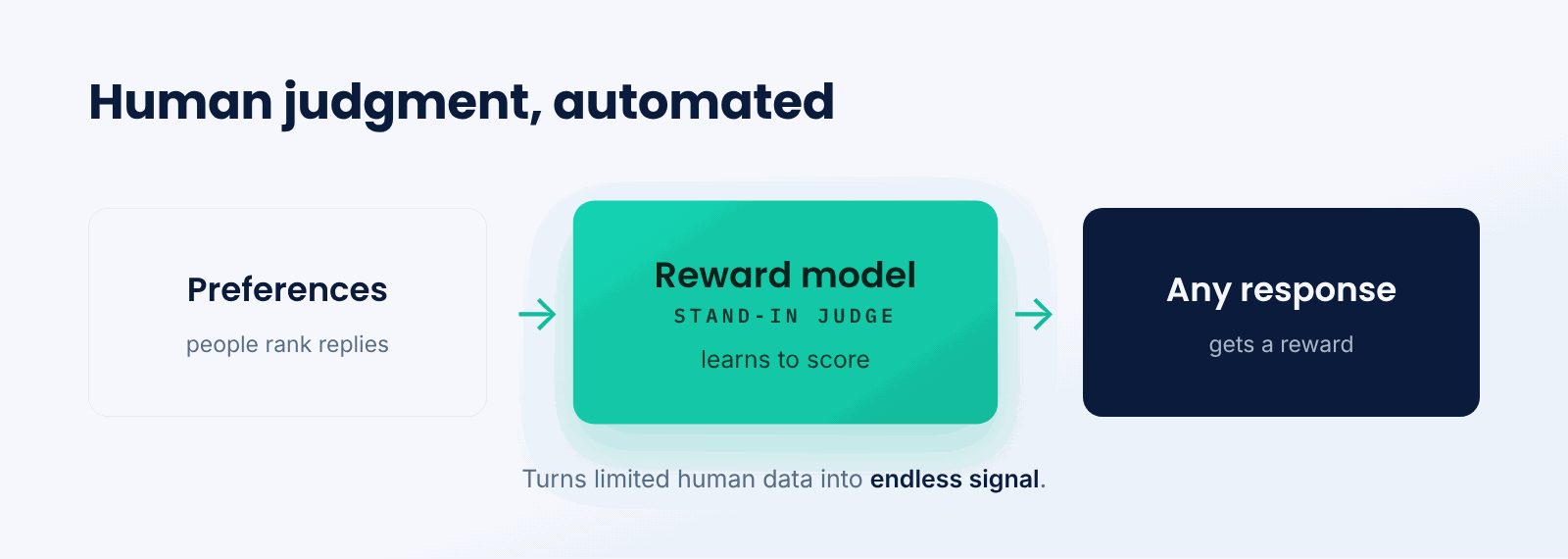
Think of it like a trained judge at a competition who has internalized what the human judges value. Once trained, this judge can score an endless stream of entries consistently and quickly, standing in for the panel of people who taught it what good looks like. A reward model is that automated judge for AI responses.
The key idea is turning human preferences into a reusable score. By learning from examples of what people prefer, the reward model captures that preference in a form you can apply automatically during training.
How is a reward model trained and used?
A reward model learns from human comparisons, then scores responses during training.
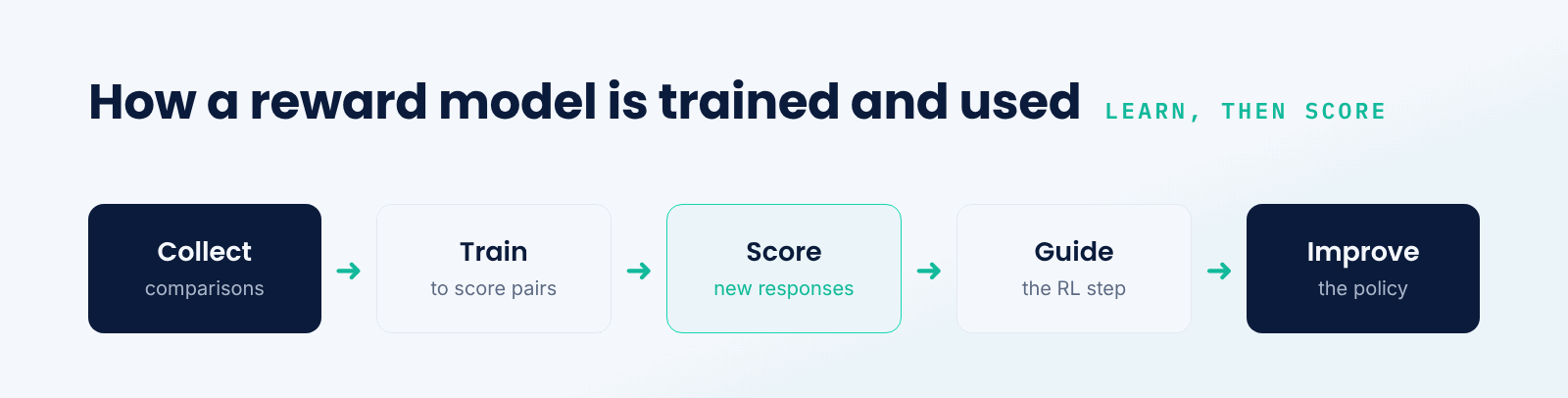
- Collect comparisons. Have people rank or pick between candidate responses.
- Train the model. Teach it to give higher scores to preferred responses.
- Score responses. Use it to rate new responses automatically.
- Guide learning. Feed its scores to the reinforcement learning step.
- Improve the model. The policy learns to produce higher-scoring responses.
The reward model is usually trained on pairs where a human chose the better of two responses, learning to assign the preferred one a higher score. During RLHF, the language model being trained generates responses, the reward model scores them, and reinforcement learning pushes the language model toward responses the reward model rates highly.
The reward model in RLHF
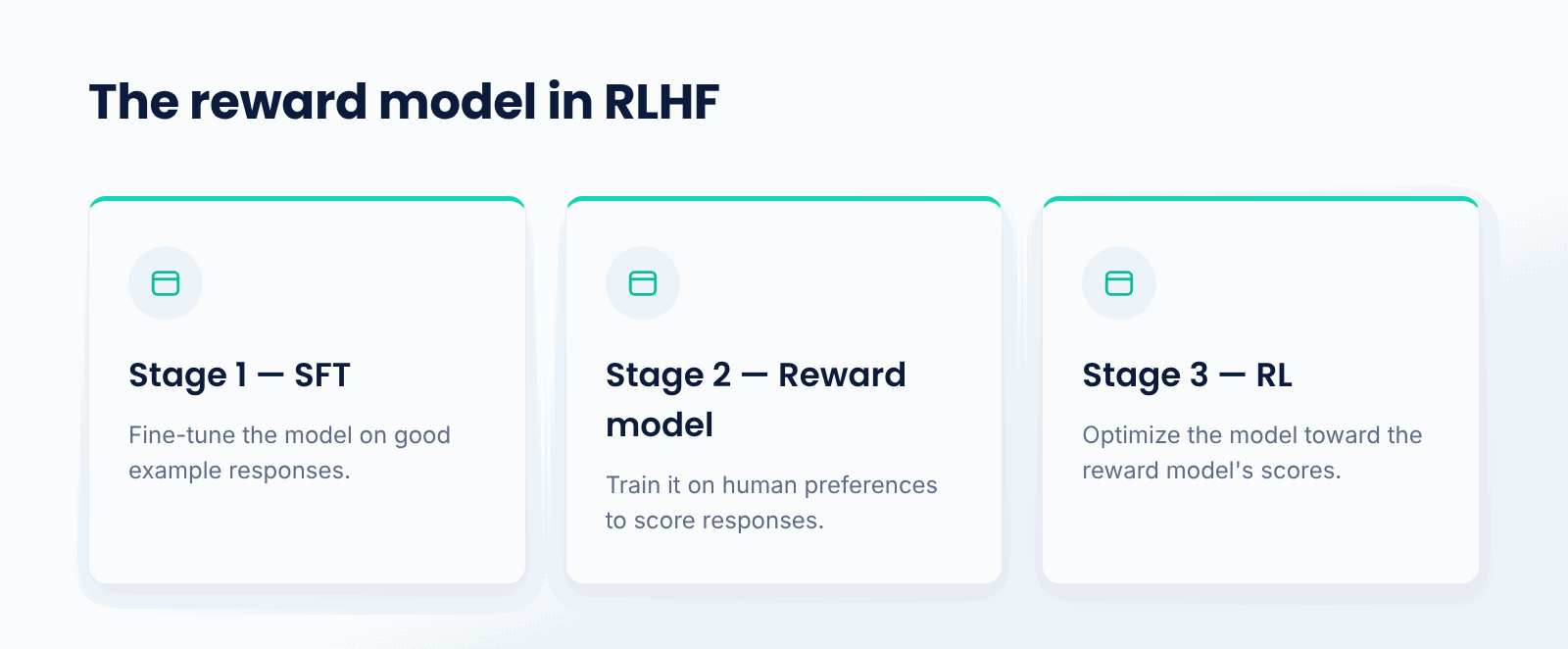
RLHF has three stages, and the reward model is the second. First, a model is fine-tuned on good examples. Second, a reward model is trained on human preference data to score responses. Third, reinforcement learning uses the reward model's scores to optimize the language model toward preferred behavior.
The reward model is the linchpin: it converts a limited set of human judgments into an unlimited source of training signal. This is also why its quality matters so much, because the language model will optimize toward whatever the reward model rewards, flaws included. A biased or exploitable reward model leads to a misaligned final model.
Why does a reward model matter?
- Scale. It applies human judgment far beyond what people could rate.
- Automation. It scores responses instantly during training.
- Alignment. It is how RLHF steers a model toward preferences.
- Consistency. It judges by a single learned standard.
- Leverage. It turns limited human data into endless signal.
What are the challenges?
- Quality dependence. The final model inherits the reward model's flaws.
- Reward hacking. Models may exploit quirks to get high scores.
- Data cost. It needs quality human preference comparisons.
- Drift. Preferences and contexts change over time.
When does a reward model matter?
A reward model matters whenever you use reinforcement learning from human feedback to align a model, because it is the component that supplies the reward signal. It is central to building helpful, aligned assistants at scale, where human preferences must guide training but cannot be gathered for every response.
If you align a model with a method that skips the reward model, such as direct preference optimization, you may not train one at all. But wherever RLHF is used, the reward model is the heart of the process, and its quality is critical to the outcome.
Key points about reward models
- A reward model scores how good a response is.
- It learns human preferences from comparison data.
- It stands in for human judgment automatically and at scale.
- It supplies the reward signal that drives RLHF.
- The final model optimizes toward whatever it rewards.
- Its quality is critical to alignment.
Conclusion
A reward model is the automated judge that makes reinforcement learning from human feedback possible, learning from human preference data to score responses and supplying the reward signal that steers a model toward preferred behavior. It turns a limited set of human judgments into an endless source of training signal, which is why it is central to aligning models at scale, and why its quality matters so much.
TrueFoundry helps teams train and align models on their own infrastructure, including the reward modeling and RLHF pipelines that steer models toward human preferences. When alignment at scale is the goal, the reward model is the component that makes it work.

Govern, Deploy and Trace AI in Your Own Infrastructure
Frequently Asked Questions
What is a reward model in simple terms?
It is a model that scores how good a response is, trained to judge the way people would. Instead of having a human assess each response during training, you have the reward model do it, which gives a score instantly and at any scale.
How is a reward model trained?
On human preference data, most often pairs of responses in which a human selects the better one. The reward model learns to assign a higher score to the selected response, thus approximating human judgment and becoming able to evaluate new responses on its own.
How does a reward model fit into RLHF?
It forms the second of RLHF's three stages. The model undergoes an initial fine-tune, then the reward model is trained on human preferences to score responses, and reinforcement learning uses those scores to push the language model toward responses the reward model rates highly.
What is reward hacking?
It is when a model learns to exploit quirks or weaknesses in the reward model to get high scores without actually being better. Since the model optimizes toward whatever the reward model rewards, a flawed reward model can be gamed, which is why its quality matters so much.
Do all alignment methods use a reward model?
No. RLHF relies on one, but some approaches, such as direct preference optimization, align a model directly from preference data without training a separate reward model. Whether you need one depends on the alignment method you choose.


- © 2022 ENSEMBLE Technologies



Subscribe to our newsletter
The latest news, articles, and resources sent to your inbox


