


What Is Retrieval-Augmented Generation and Why Does It Matter?

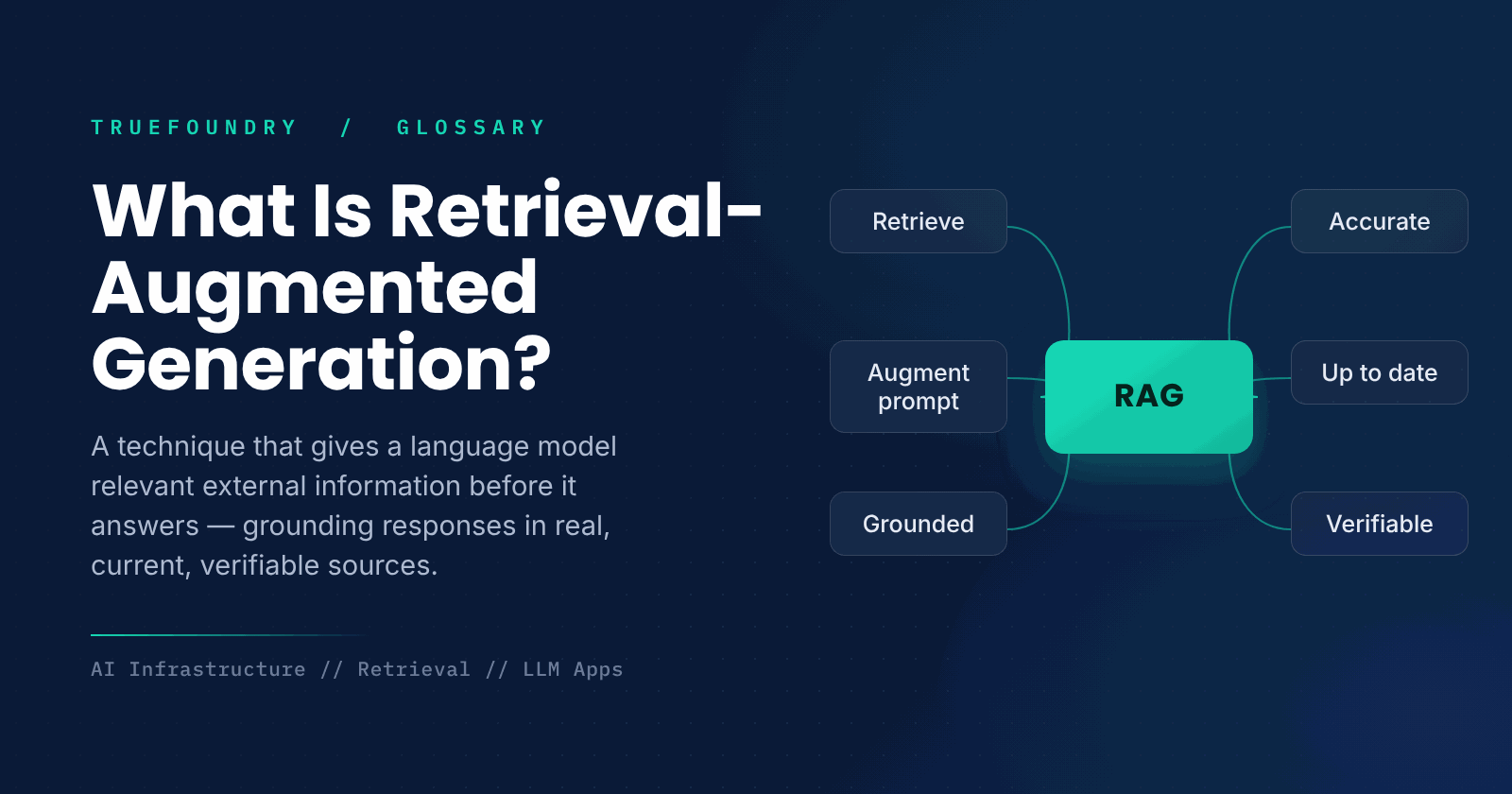
A language model knows only what it learned during training, which means its knowledge is fixed, can be out of date, and does not include your private or specific data. Ask it about a recent event or an internal document and it may answer confidently but wrongly. Retrieval-augmented generation solves this by letting the model look things up before it answers.
With RAG, the system first retrieves relevant information from an external source, such as a document store, and gives it to the model as context. The model then answers grounded in that information rather than its memory alone. This makes responses more accurate, current, and verifiable, which is why RAG is a core pattern in modern AI. This guide explains how it works and when to use it.
We will cover the definition, how RAG works, how it compares to fine-tuning, and when to use it.
What is retrieval-augmented generation?
Retrieval-augmented generation is a technique that combines a language model with a retrieval step, so that the model is given relevant external information before generating an answer. When a question comes in, the system searches a knowledge source for related content and passes it to the model as context, which the model then uses to produce a grounded response.
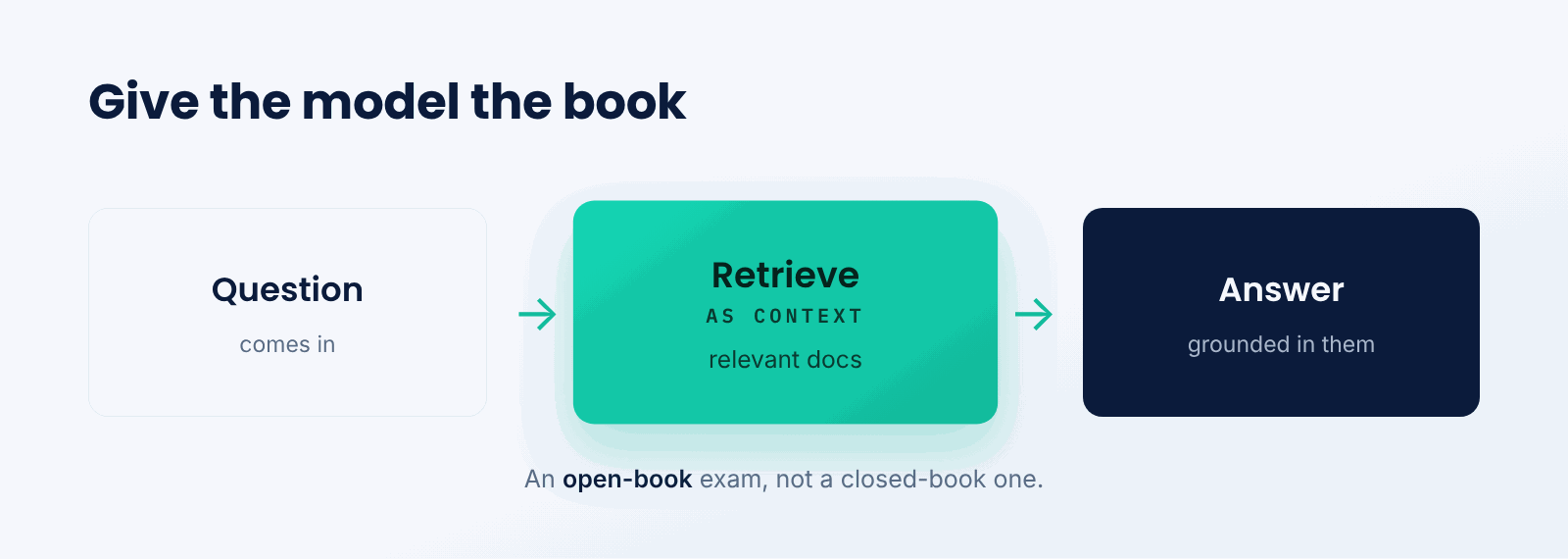
Think of it like an open-book exam instead of a closed-book one. A closed-book answer relies only on memory and can be wrong or outdated. An open-book answer lets you consult the relevant pages first, so your response is grounded in the actual material. RAG gives the model the book.
The key idea is grounding generation in retrieved facts. Rather than trusting the model's memory, RAG supplies the specific information needed for the question, so the answer reflects real, current, and relevant sources.
How does RAG work?
RAG retrieves relevant content, then has the model answer using it as context.
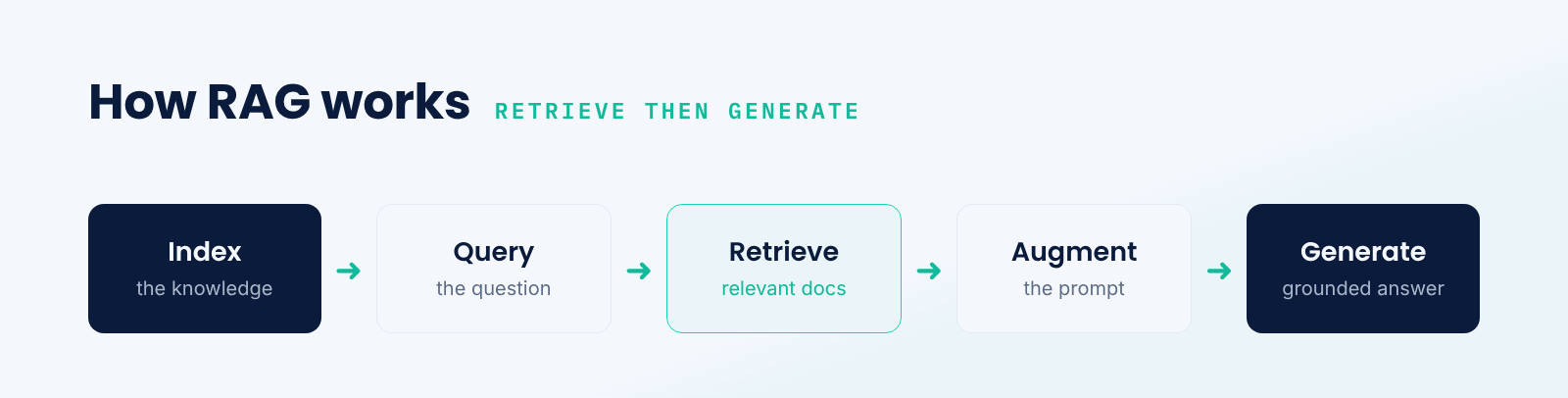
- Index the knowledge. Turn documents into searchable form, often vectors.
- Receive a question. Take the user's query.
- Retrieve. Find the most relevant documents for that query.
- Augment. Add the retrieved content to the model's prompt as context.
- Generate. Have the model answer grounded in that context.
Retrieval is usually done with semantic search over a vector store, so the system finds content by meaning. The retrieved passages are placed into the prompt alongside the question, and the model is instructed to answer using them. Many systems also cite the sources, so answers can be checked.
RAG vs. fine-tuning
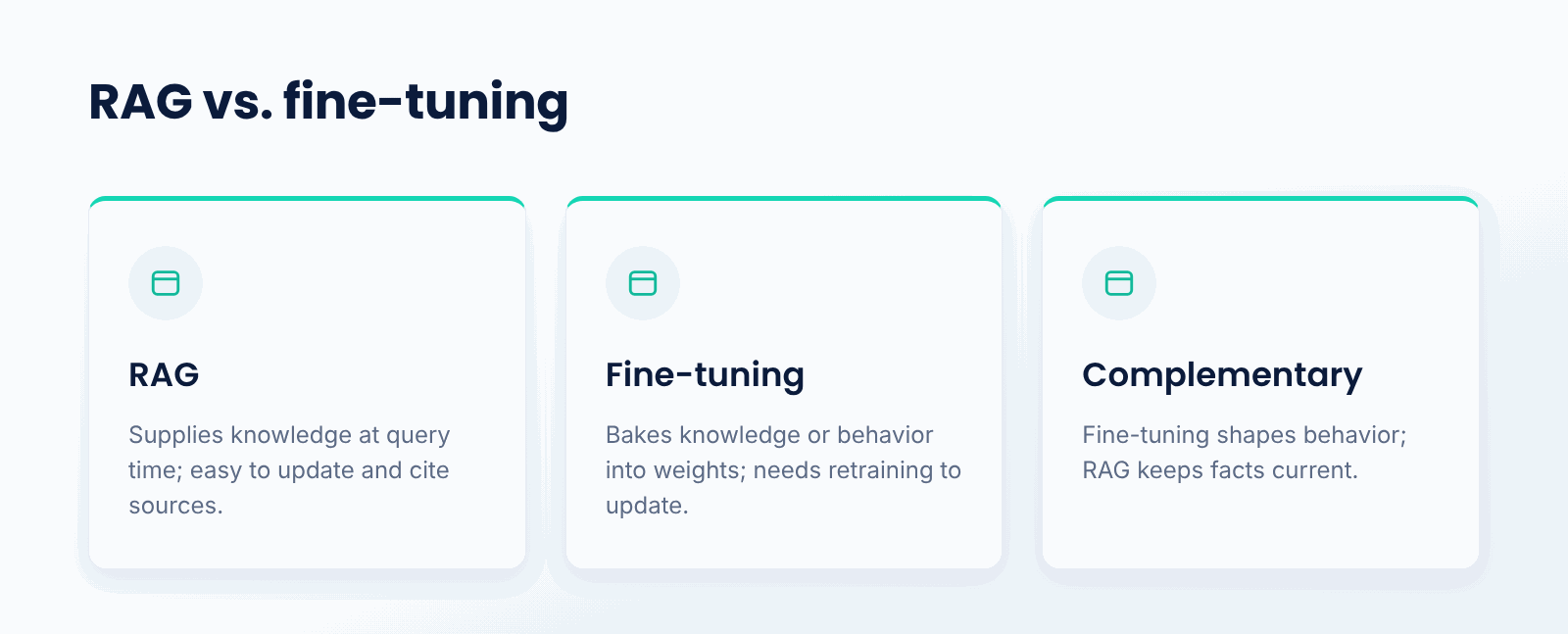
Fine-tuning changes the model itself by training it on new data, baking knowledge or behavior into its weights. It is powerful for teaching style or skills, but updating knowledge means retraining, and the model can still hallucinate about facts it did not fully absorb.
RAG leaves the model unchanged and instead supplies knowledge at query time from an external source. This makes knowledge easy to update, just change the documents, and lets answers cite their sources. The two are complementary: fine-tuning shapes how a model behaves, while RAG keeps it supplied with current, specific facts. For knowledge-grounded answers, RAG is usually the better fit.
Why does RAG matter?
- Accuracy. It grounds answers in real retrieved information.
- Freshness. It uses current data without retraining the model.
- Private knowledge. It lets a model use your own documents.
- Verifiability. It can cite the sources behind an answer.
- Fewer hallucinations. Grounding reduces made-up facts.
What are the challenges?
- Retrieval quality. Bad retrieval leads to bad answers.
- Context limits. Only so much can fit in the prompt.
- Infrastructure. It needs indexing and vector search.
- Freshness of index. The knowledge store must be kept updated.
When should you use RAG?
Use RAG when answers must be grounded in specific, current, or private information, such as internal documents, product knowledge, or recent data the model was not trained on. It is ideal for question-answering over your own content, support assistants, and any application where accuracy and up-to-date facts matter.
If your task depends on style, format, or a skill rather than external facts, fine-tuning may serve better, and the two can be combined. But whenever you need a model to answer from a body of knowledge reliably and verifiably, RAG is the standard approach.
Key points about RAG
- RAG retrieves relevant information before the model answers.
- It grounds responses in external, current knowledge.
- It reduces hallucinations and supports source citations.
- Retrieval is usually semantic search over a vector store.
- It updates knowledge by changing documents, not retraining.
- It is a core pattern for reliable AI applications.
Conclusion
Retrieval-augmented generation makes language models more reliable by retrieving relevant information and giving it to the model as context before it answers. This grounds responses in real, current, and specific knowledge, reduces hallucinations, and lets answers cite their sources, without retraining the model. As the standard way to build knowledge-grounded AI, RAG is a core pattern for accurate, trustworthy applications.
TrueFoundry helps teams build and serve retrieval-augmented systems on their own infrastructure, including the retrieval, vector search, and serving that RAG depends on. When answers must be grounded in your own up-to-date knowledge, RAG is how you get there.

Govern, Deploy and Trace AI in Your Own Infrastructure
Frequently Asked Questions
What is retrieval-augmented generation in simple terms?
It entails providing the model with the relevant information it needs before it responds to a query. The system looks up documents related to the question and uses that content as context for the response, rather than relying on the model's memory alone, so the answer is grounded in real, current information.
How does RAG reduce hallucinations?
By grounding the model's answer in retrieved documents rather than its own memory. When the model is given the correct, relevant information and asked to answer from it, there is a very low chance of fabrication, and its answers can often be traced back to the sources.
How is RAG different from fine-tuning?
Fine-tuning modifies the model by training it on new data, embedding knowledge or behavior into its weights. RAG does not modify the model but supplies knowledge from an external source at query time. RAG makes knowledge easy to update and cite; fine-tuning is better for shaping style or skills.
What does RAG need to work?
A knowledge source indexed for search, usually represented as vectors in a vector store; a retrieval step that finds relevant content for each query; and a language model that answers using the retrieved context. Good retrieval quality is essential, since the answer is only as good as what is retrieved.
When should I use RAG?
When answers must be grounded in specific, current, or private information, such as internal documents or recent data the model was not trained on. It is ideal for question-answering over your own content and support assistants. If style or skills matter more than facts, fine-tuning may fit better.


- © 2022 ENSEMBLE Technologies



Subscribe to our newsletter
The latest news, articles, and resources sent to your inbox


