


What Is a Reranker and Why Does It Matter?

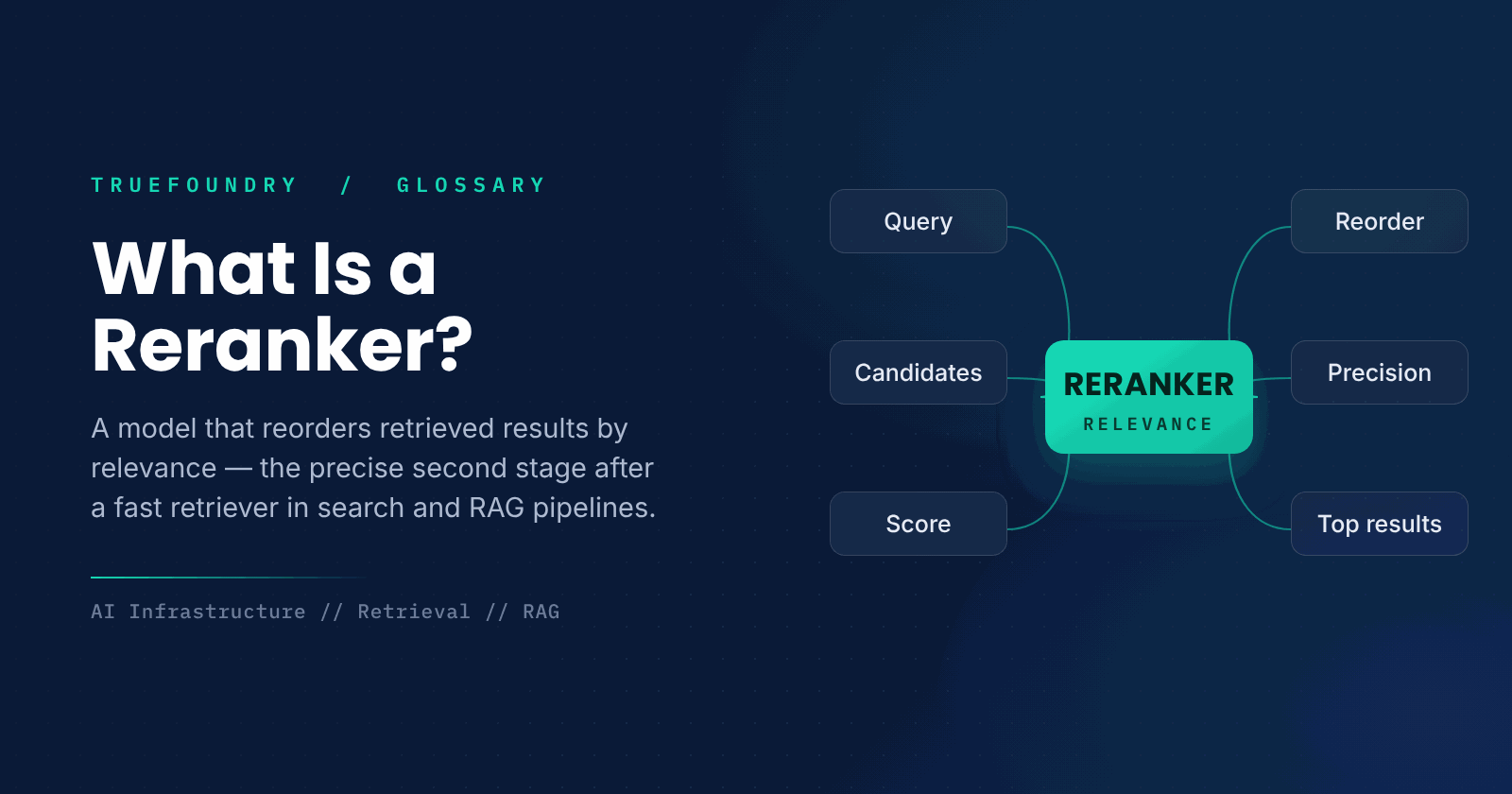
Rerankers are models that rank sets of retrieved items based on their relevance to a query. In retrieval and RAG systems, there is an initial retrieval step where a quick retriever pulls lots of documents, and a reranker then scores the retrieved documents more carefully in order to put the most relevant ones first.
Reranker essentials
- A reranker sorts retrieved results according to their relevance to the query.
- It operates following a quick first-stage retriever.
- It is more precise in scoring each query-document pair than retrieval.
- It enhances the contextual information that goes into a RAG system.
- It sacrifices additional computation for improved ordering of results.
Search and retrieval systems face a tension: the methods fast enough to scan millions of documents are not precise, and the methods precise enough to judge relevance well are too slow to run on everything. Rerankers resolve this with a two-stage approach, letting a quick retriever cast a wide net and a careful reranker sort the catch.
In retrieval-augmented generation, where a language model answers using retrieved documents, the quality of those documents largely determines the quality of the answer. A reranker is what ensures the few documents the model actually reads are the most relevant ones available, not just the ones a fast search happened to rank highly.
This guide explains what a reranker is, how it fits into a retrieval pipeline, how it differs from first-stage retrieval, and when it is worth adding.
What is a reranker?
A reranker is a model that takes a query and a set of candidate documents and assigns each a relevance score, producing a new ordering. Unlike a first-stage retriever, which compares precomputed representations for speed, a reranker examines the query and each document together, which lets it judge relevance far more accurately.
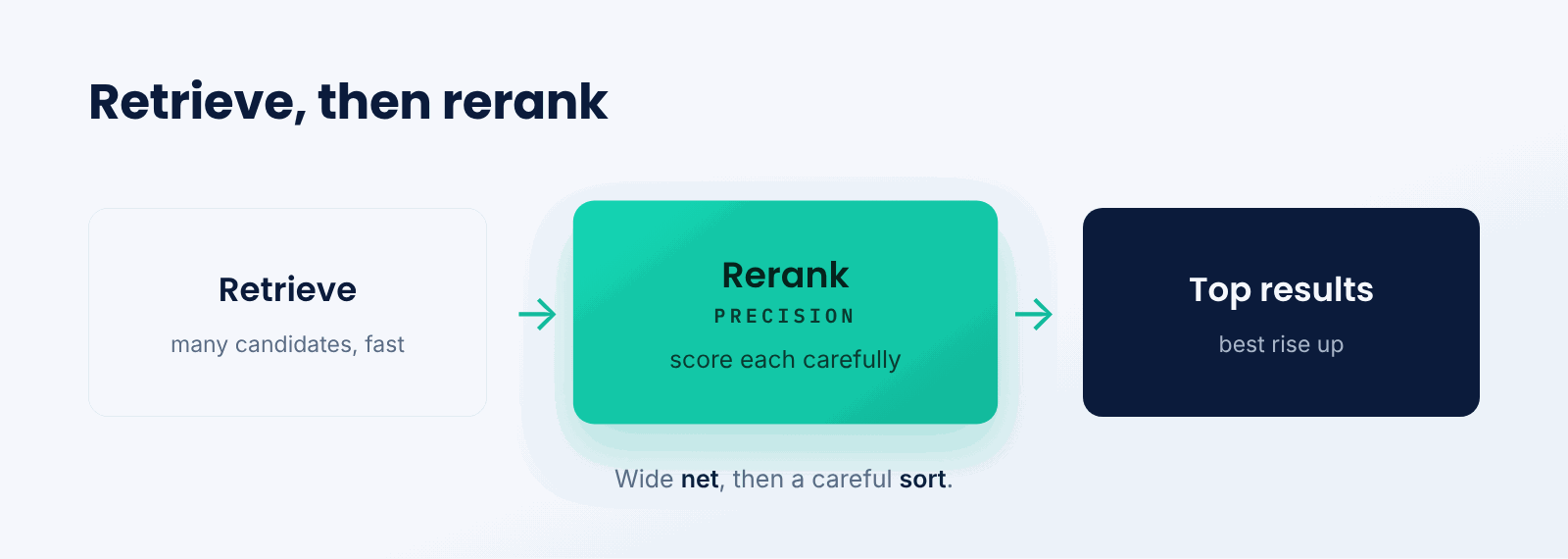
Think of it like hiring. A first pass through many resumes quickly screens for basic keywords and filters hundreds down to a shortlist. Then a careful reviewer reads each shortlisted resume closely against the actual role and ranks the finalists. The reranker is that careful reviewer, applied to retrieved documents.
The key idea is precision on a shortlist. Rerankers are too expensive to run over an entire corpus, but applied to the few dozen candidates a retriever returns, they dramatically improve which results end up at the top.
How does a reranker fit into retrieval?
A reranker is the second stage in a retrieve-then-rerank pipeline.
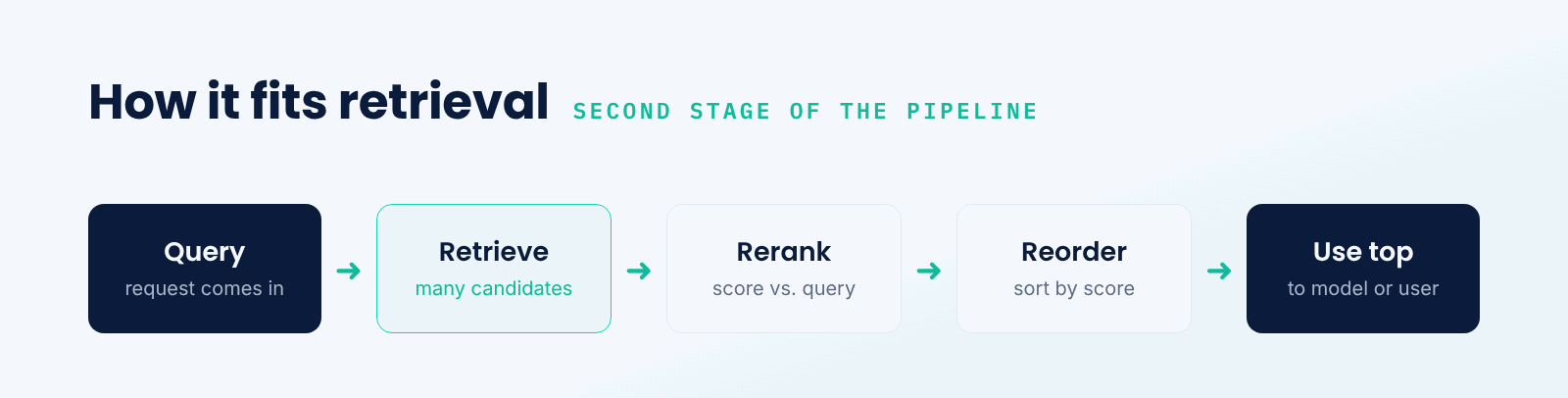
- Query comes in. A user question or search request arrives.
- Retrieve candidates. A fast retriever returns many possibly-relevant documents.
- Rerank. The reranker scores each candidate against the query for relevance.
- Reorder. Documents are sorted by the reranker's scores.
- Use the top. The best few are passed to the model or shown to the user.
The retriever optimizes for recall, making sure the relevant documents are somewhere in the candidate set, while the reranker optimizes for precision, making sure the truly relevant ones rise to the top. Together they deliver both coverage and accuracy.
Reranker vs. first-stage retrieval
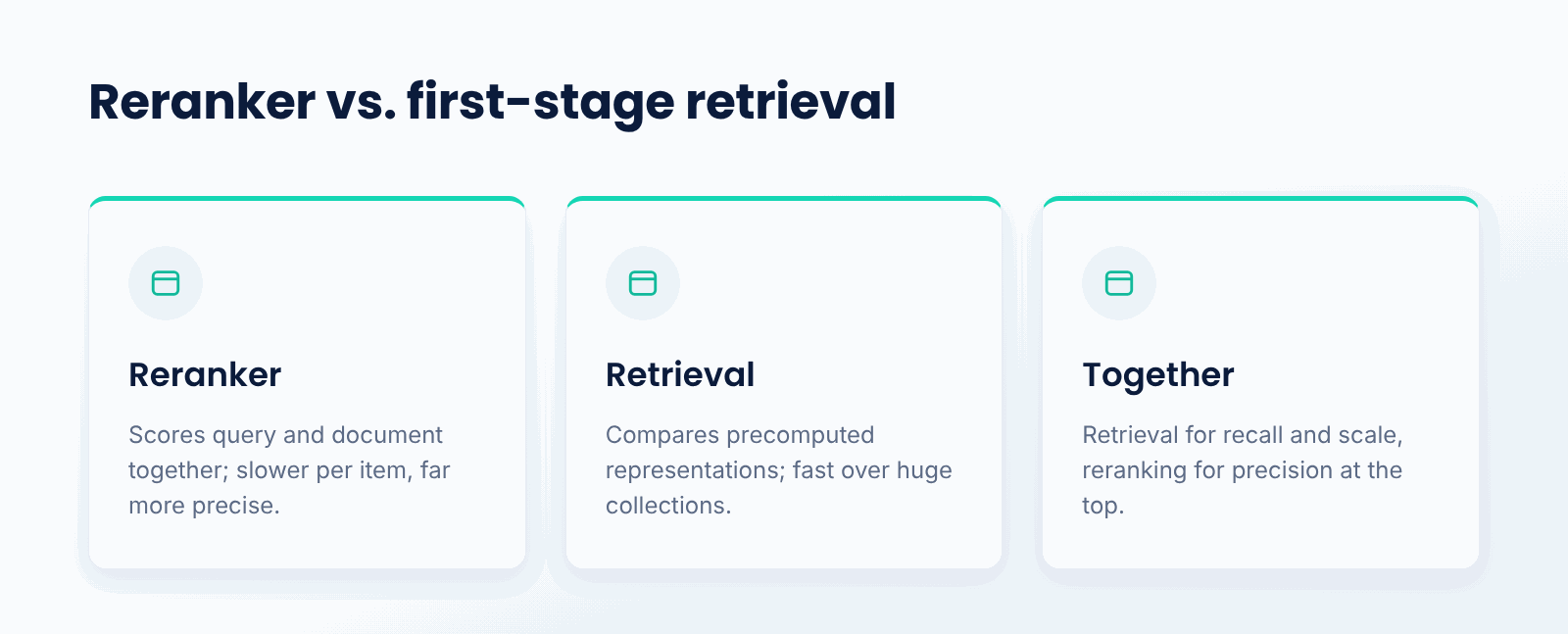
First-stage retrieval, whether keyword-based or vector-based, compares precomputed representations of the query and documents, which is fast enough to search huge collections but limited in how precisely it can judge relevance. A reranker processes the query and each document together, which is slower per item but far more accurate.
The two are not competitors but partners. Retrieval handles scale, narrowing millions of documents to a manageable set; reranking handles precision, ordering that set correctly. Using a reranker on top of retrieval typically gives a large quality boost that retrieval alone cannot match.
Why does a reranker matter?
- Better relevance. It puts the most relevant results at the top.
- Stronger RAG. It improves the documents a model reasons over.
- Higher precision. It judges relevance more accurately than retrieval.
- Less noise. It filters out candidates that only superficially match.
- Better answers. More relevant context leads to better model responses.
What are the tradeoffs?
- Added latency. Reranking takes time on top of retrieval.
- Compute cost. Scoring each query-document pair uses a model per candidate.
- Candidate limit. Only the retrieved shortlist can be reranked, not the whole corpus.
- Extra component. It adds a model to build, serve, and maintain.
When should you use a reranker?
Add a reranker when retrieval quality is limiting your results, especially in RAG systems where feeding the model more relevant documents directly improves answers. It is most valuable when the first-stage retriever returns relevant documents but orders them poorly, which is common.
If retrieval alone already surfaces the right results at the top, or if latency budgets are extremely tight, a reranker may not be worth the cost. But for most serious retrieval and RAG applications, the precision it adds is well worth the extra step.
Key points about rerankers
- A reranker reorders retrieved candidates by relevance.
- It runs as a second stage after fast retrieval.
- It scores query and document together for higher precision.
- It is too costly to run over a whole corpus, only a shortlist.
- It substantially improves RAG and search quality.
- It adds latency and compute in exchange for better ordering.
Conclusion
A reranker reorders a retrieved shortlist by carefully scoring how relevant each document is to the query. Running after a fast first-stage retriever, it adds the precision that retrieval alone lacks, putting the best results at the top, which is especially valuable in RAG systems where context quality drives answer quality. Its cost is extra latency and compute on the candidate set.
TrueFoundry helps teams build and serve retrieval and RAG pipelines on their own infrastructure, including rerankers that sharpen result quality. When retrieval is the bottleneck, a reranker is often the most effective way to improve it.

Govern, Deploy and Trace AI in Your Own Infrastructure
Frequently Asked Questions
What is a reranker in simple terms?
It is a model that ranks search or retrieval results based on the relevance of each item to your query. An initial fast search retrieves a large number of candidate items, which the reranker then carefully scores so the most relevant ones end up at the top.
How is a reranker different from a retriever?
A retriever quickly compares precomputed representations to find several candidate documents from a large collection, favoring speed and coverage. A reranker, however, analyzes the query and each document together, which is slower but much more accurate, and runs only on the retrieved shortlist.
Why are rerankers used in RAG?
Because a RAG model's response relies on the information in the documents it reads. A reranker guarantees that the small set of documents used by the model is the most relevant one from retrieval, which directly improves the accuracy and usefulness of the generated answer.
Why not just rerank everything?
Because the reranker scores the query-document pairs individually, which takes far too long to do for a set of millions of documents. Rerankers are used only on the shortlist generated by the efficient retriever, where the additional accuracy is feasible.
Does a reranker slow down my system?
It causes a small delay and processing overhead, since the model scores each candidate. In most retrieval and RAG applications the increased quality is justified, but in low-latency situations it is wise to restrict how many candidates get reranked.


- © 2022 ENSEMBLE Technologies



Subscribe to our newsletter
The latest news, articles, and resources sent to your inbox


