


What Is Pipeline Parallelism and Why Does It Matter?

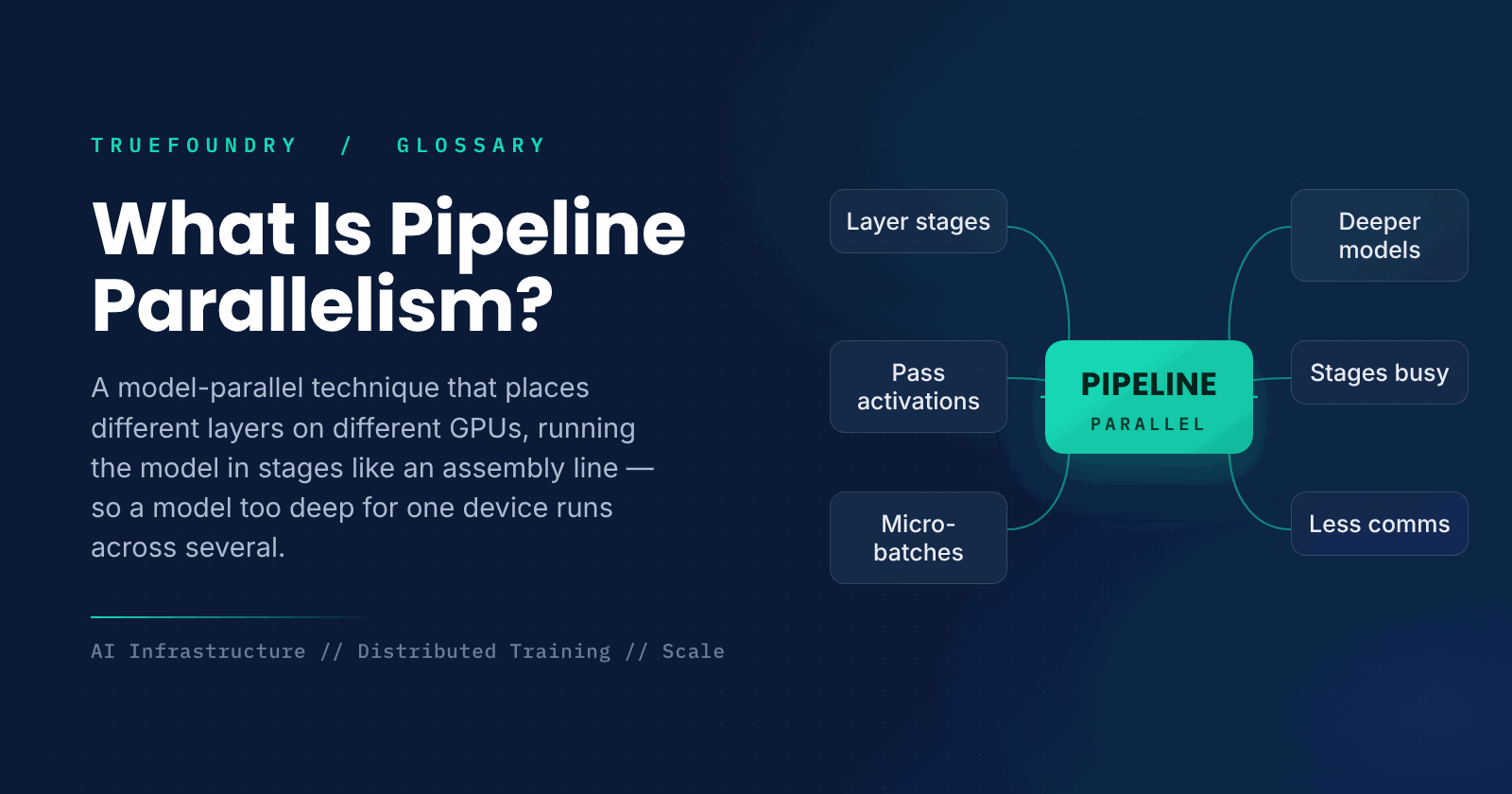
When a model has too many layers to fit on a single GPU, one way to spread the work is to put different layers on different devices. Pipeline parallelism does exactly this, turning the model into an assembly line where each GPU owns a consecutive block of layers and passes its output to the next. It is one of the main strategies for running models too large for one device.
The challenge is keeping all the GPUs busy, because a naive split leaves most of them idle while one works. Pipeline parallelism solves this by feeding several small batches through the line at once, so every stage is working on a different batch. This guide explains what it is, how it works, and how it compares to other parallelism strategies.
We will cover the definition, the mechanics, how it relates to tensor and data parallelism, and when to use it.
What is pipeline parallelism?
Pipeline parallelism is a model-parallelism technique that splits a model by layers across multiple GPUs, so each device holds and runs a consecutive stage of the model. Data flows through the stages in order: the first GPU computes the early layers and passes its activations to the next, and so on, until the final GPU produces the output.
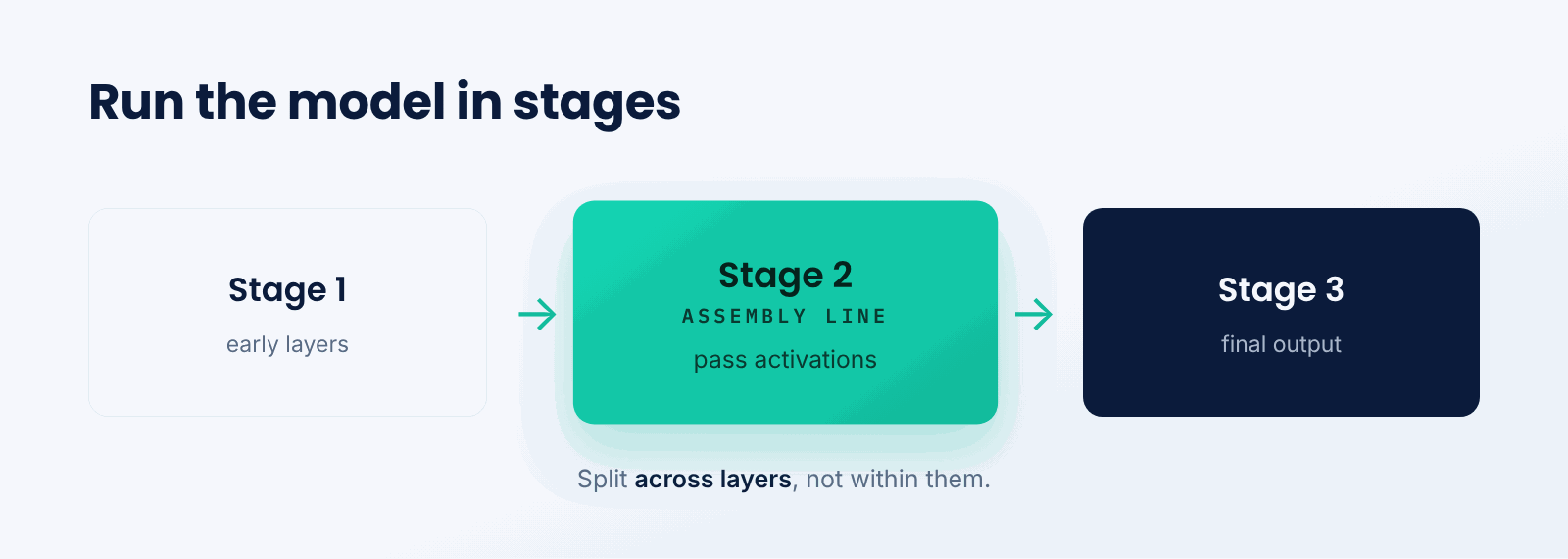
Think of it like a factory assembly line. Each worker handles one set of steps and passes the product to the next station. No single worker builds the whole product, just as no single GPU holds the whole model, but together the line turns out finished results.
The key idea is splitting across layers, not within them. This lets a model that is too deep for one GPU run by distributing its layers, with each GPU responsible for only part of the depth.
How does pipeline parallelism work?
Pipeline parallelism assigns layer stages to GPUs and streams micro-batches through them.
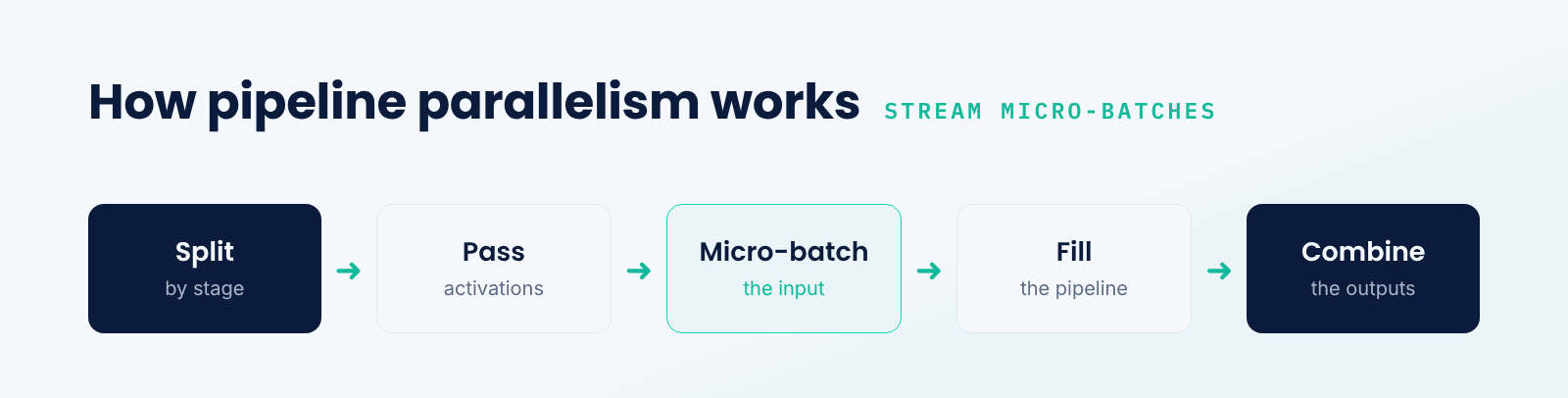
- Split by stage. Assign each GPU a consecutive block of layers.
- Pass activations. Each stage sends its output to the next GPU.
- Split the batch. Break each batch into smaller micro-batches.
- Fill the pipeline. Feed micro-batches so every stage stays busy.
- Combine. Collect the outputs as they emerge from the last stage.
Without micro-batches, only one GPU works at a time while the others wait, which is wasteful. By streaming many micro-batches through the pipeline, each stage processes a different batch simultaneously, keeping the GPUs busy. There is still some idle time at the start and end of the pipeline, known as the bubble, which smaller micro-batches help reduce.
Pipeline vs. tensor vs. data parallelism
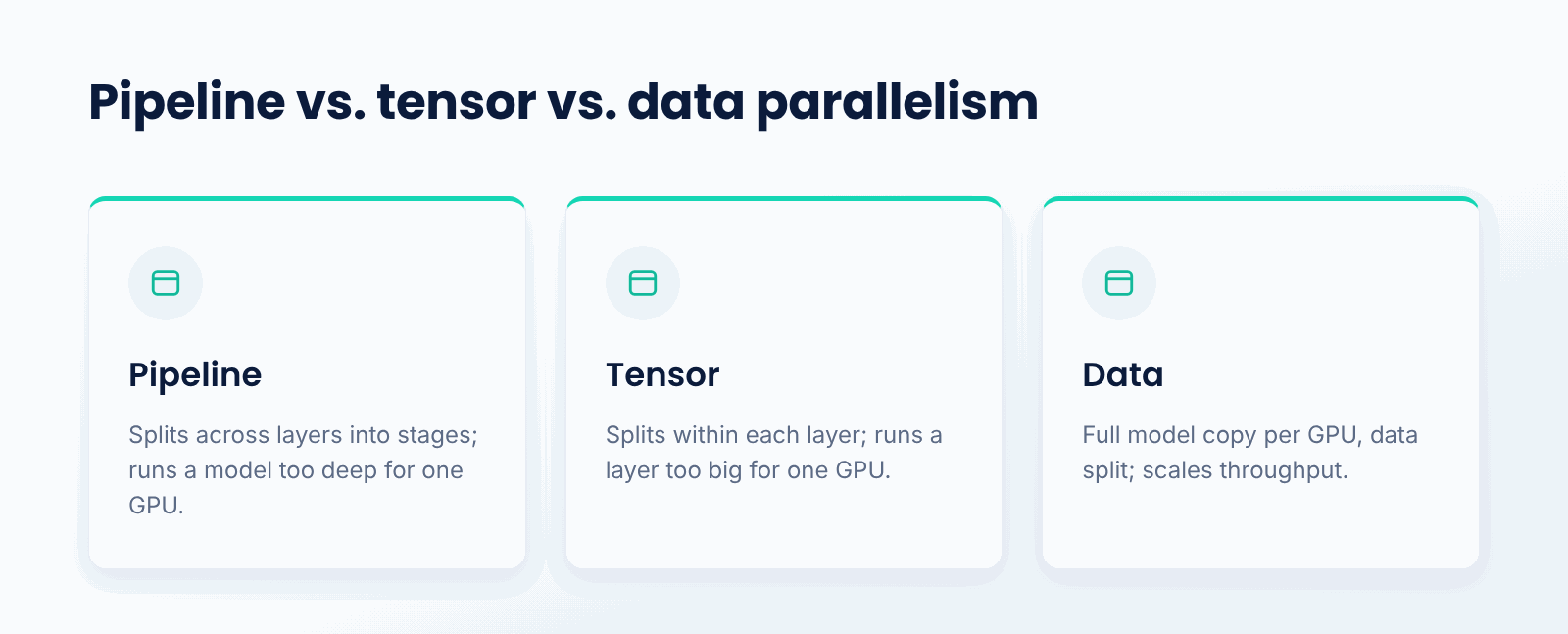
Data parallelism replicates the whole model on each GPU and splits the data; it needs the full model to fit on one device. Tensor parallelism splits the math within each layer across GPUs, solving the case of a layer too big for one device. Pipeline parallelism splits across layers, solving the case of a model too deep for one device.
The three are complementary and often combined for the largest models: tensor parallelism inside a server, pipeline parallelism across servers, and data parallelism across replicas. Pipeline parallelism specifically handles model depth, with lighter communication than tensor parallelism but the added complexity of managing the pipeline and its bubble.
Why does pipeline parallelism matter?
- Depth. It runs models too deep for a single GPU.
- Efficiency. Micro-batches keep all stages busy.
- Lighter communication. It passes activations only between stages.
- Composability. It combines with tensor and data parallelism.
- Scale. It helps train and serve the largest models.
What are the challenges?
- The bubble. Stages sit idle at the pipeline's start and end.
- Balance. Stages must be sized evenly to avoid bottlenecks.
- Complexity. Managing micro-batches and stages is intricate.
- Latency. A single request still passes through every stage in turn.
When should you use pipeline parallelism?
Use pipeline parallelism when a model is too deep to fit on one GPU and you want to spread its layers across devices. It is especially useful across GPUs that are not tightly linked, since it communicates less than tensor parallelism, passing only activations between stages rather than exchanging results within every layer.
If your model fits on a single GPU, you do not need it, and if a single layer is the problem rather than overall depth, tensor parallelism may fit better. For large, deep models, pipeline parallelism is one of the key tools, often alongside the other strategies.
Key points about pipeline parallelism
- Pipeline parallelism splits a model across layers onto different GPUs.
- The model runs in stages, like an assembly line.
- Micro-batches keep every stage busy at once.
- A pipeline bubble causes some idle time to manage.
- It communicates less than tensor parallelism.
- It combines with tensor and data parallelism for large models.
Conclusion
Pipeline parallelism runs a model too deep for one GPU by splitting its layers across devices, so the model works like an assembly line with each GPU owning a stage. By streaming micro-batches through the pipeline, it keeps all the stages busy, and because it passes only activations between stages, it communicates less than tensor parallelism. It is a core strategy for training and serving large, deep models.
TrueFoundry helps teams train and serve large models efficiently on their own infrastructure, including the parallelism strategies that spread a model across many GPUs. When a model is too deep for one device, pipeline parallelism is one of the key techniques that keeps it running.

Govern, Deploy and Trace AI in Your Own Infrastructure
Frequently Asked Questions
What is pipeline parallelism in simple terms?
It is a method of running a large model across multiple GPUs, where each one gets a block of the model's layers, so they become individual stations on an assembly line. The data passes through each stage in order, allowing a model too deep for a single GPU to run across several together.
How is pipeline parallelism different from tensor parallelism?
Pipeline parallelism applies parallelism between layers, with each stage allocated to a different GPU. Tensor parallelism applies parallelism within a layer, so several GPUs process one layer that a single GPU cannot. Pipeline parallelism handles model depth; tensor parallelism handles a layer too big for one GPU.
What is the pipeline bubble?
It refers to the idle time at both ends of the pipeline, where some stages have no batch to process yet or have already finished. By feeding many small micro-batches through the pipeline, the bubble is minimized and more stages stay busy more of the time.
Why use micro-batches in pipeline parallelism?
Because without them only one stage operates at a time while the others wait. By breaking the batch into smaller micro-batches and passing them through the pipeline, every stage works on a different micro-batch at once, keeping all the GPUs busy and improving efficiency.
When should I use pipeline parallelism?
When the model is too deep to fit on one GPU and you need to distribute its layers across several devices. It is especially useful when the GPUs are loosely connected, because it communicates less than tensor parallelism. In the biggest models it is usually combined with tensor and data parallelism.


- © 2022 ENSEMBLE Technologies



Subscribe to our newsletter
The latest news, articles, and resources sent to your inbox


