


What Is Parameter-Efficient Fine-Tuning and How Does It Work?

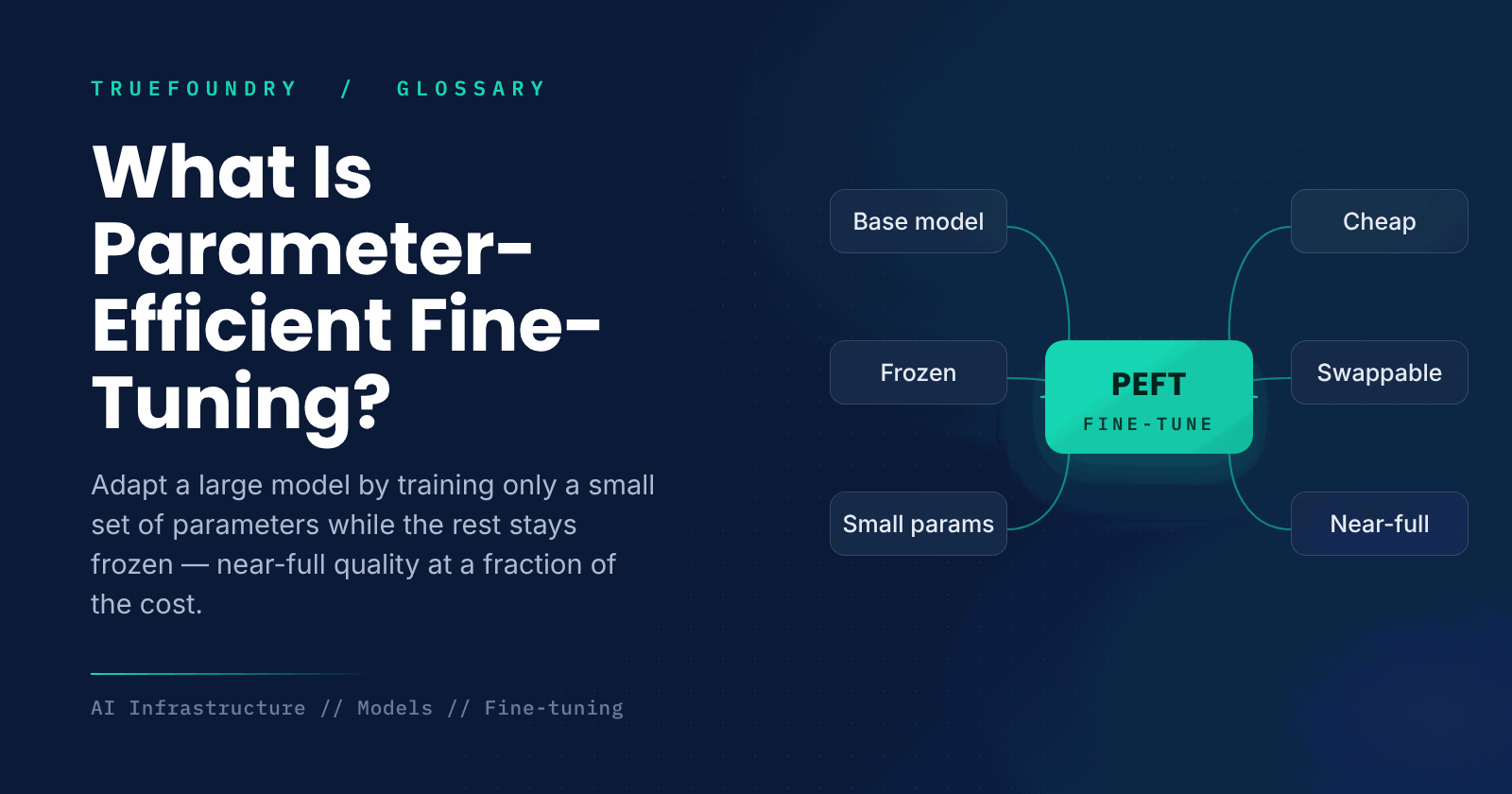
Fully fine-tuning a large language model means updating every one of its billions of weights, which demands enormous memory and produces a full-size copy of the model for each task. For most teams that is impractical. Parameter-efficient fine-tuning is the family of techniques that made adapting large models affordable, by changing far fewer parameters.
The shared idea is simple: freeze the pretrained model and train only a small set of extra or selected parameters that steer its behavior. You get a model adapted to your task without paying the full cost of retraining it.
This guide explains what parameter-efficient fine-tuning is, how it works, the main methods, and when to use it.
What is parameter-efficient fine-tuning?
Parameter-efficient fine-tuning, or PEFT, is a set of methods that adapt a pretrained model by training only a small fraction of its parameters. The bulk of the model stays frozen, and learning is concentrated in a few new or selected weights, cutting the trainable parameter count from billions to a few million or fewer.
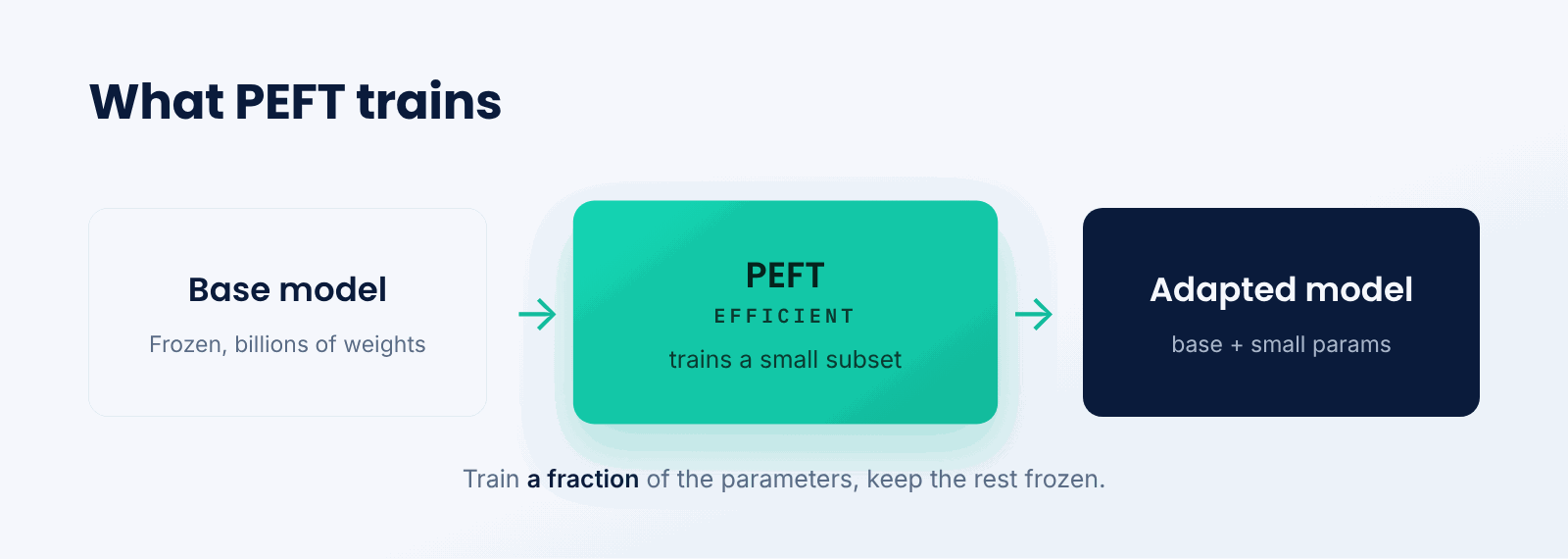
Think of tailoring an off-the-rack suit instead of weaving a new one. The suit already fits mostly well; a tailor adjusts the hem and sleeves with a few small changes rather than remaking the whole garment. PEFT makes those small, targeted adjustments to a model that is already capable, instead of rebuilding it.
The key insight is that adapting a model to a new task usually requires only a small change, so you do not need to touch most of its weights to get the behavior you want.
How does parameter-efficient fine-tuning work?
PEFT attaches a small set of trainable parameters to a frozen model and tunes only those.
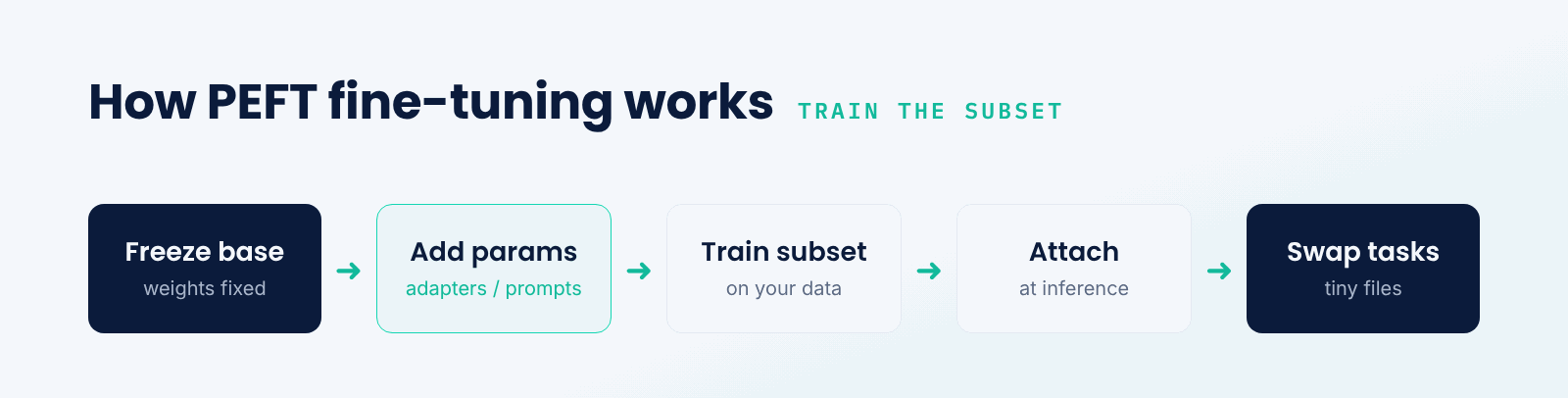
- Freeze the base model. The pretrained weights are kept fixed and are not updated during training.
- Add small trainable parameters. A method inserts adapters, low-rank matrices, or soft prompts that it will train.
- Train only the subset. Learning updates just those few parameters on your task's data, which is fast and cheap.
- Attach at inference. The small parameters are applied alongside the frozen model to produce the adapted behavior.
- Swap per task. Because the tuned parameters are tiny, you can switch tasks by loading a different set.
Since only a small subset is trained, memory use falls sharply and each result is a few megabytes rather than a full model copy. That is what makes training and storing many specialized variants practical.
LoRA vs. adapters vs. prompt tuning
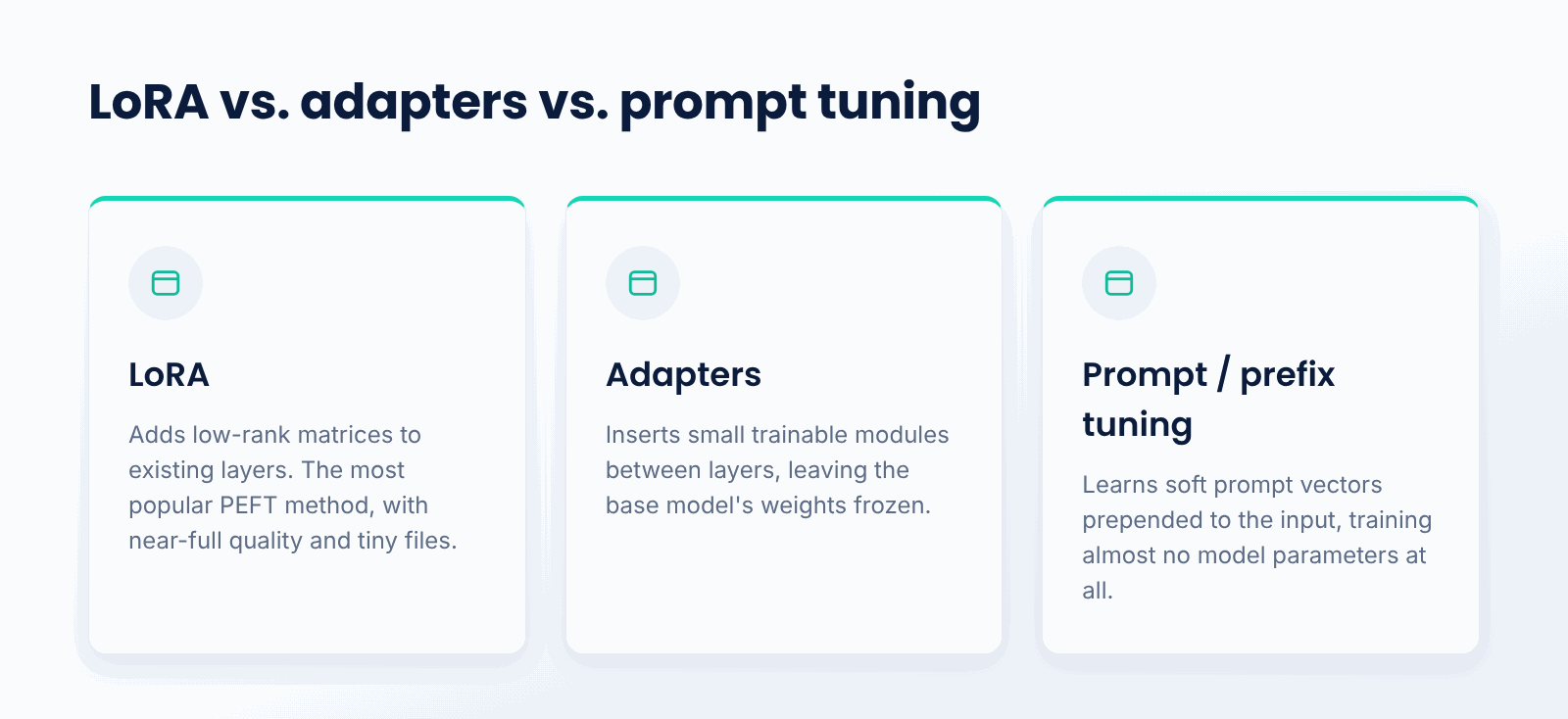
PEFT is a family, not a single method. LoRA adds small low-rank matrices to existing layers and is the most widely used, offering near-full quality with tiny adapters. Adapter modules insert small trainable layers between the model's existing layers while keeping the base frozen. Prompt and prefix tuning go further, learning soft prompt vectors prepended to the input and training almost no model parameters at all.
These methods trade off how many parameters they train against how much they can change the model. LoRA is the common default because it hits a sweet spot of strong quality and very low cost, but the others fit cases where you want to train even less.
What are the benefits of PEFT?
- Lower memory. Freezing the base and training a small subset fits fine-tuning on much smaller hardware.
- Tiny artifacts. A tuned result is a few megabytes, versus a full multi-gigabyte model copy per task.
- Faster and cheaper. Training far fewer parameters means quicker runs and lower cost.
- Many variants. You can keep lots of task-specific adapters on one shared base model.
- Near-full quality. On most tasks PEFT matches full fine-tuning closely despite training a fraction of the weights.
What are the limits of PEFT?
- Not always equal to full tuning. Tasks needing a deep change in behavior can still favor full fine-tuning.
- Method and setting choices. Which method, rank, or placement you pick affects quality and needs tuning.
- Serving many adapters adds complexity. Hot-swapping tuned parameters per request requires runtime support.
- Data still matters. PEFT makes training cheap, but a poor dataset yields a poor result regardless.
When should you use PEFT?
PEFT is the right default whenever you want to adapt a large model to your data without the cost of full fine-tuning. Specializing a model for a domain, a tone, or a task, especially when you need several variants, is exactly where it shines.
Reserve full fine-tuning for cases that demand a deep behavioral shift and where you have the hardware and budget. For most teams and most tasks, PEFT delivers most of the benefit at a small fraction of the cost.
Best practices for PEFT
- Start with LoRA, which is the most proven and well-supported PEFT method.
- Use a modest adapter size or rank first, raising it only if the task needs more capacity.
- Curate a clean, representative dataset, since data quality still drives the result.
- Keep tuned parameters separate from the base so you can swap tasks without duplicating the model.
- Combine with a quantized base, as in QLoRA, to fine-tune very large models on limited hardware.
- Serve adapters behind an engine and gateway that can load and route them efficiently.
Conclusion
Parameter-efficient fine-tuning makes adapting large models practical by freezing the base and training only a small set of parameters. It cuts the memory, compute, and storage of fine-tuning by orders of magnitude while matching full tuning closely on most tasks, and it produces tiny, swappable artifacts instead of full model copies. Methods like LoRA have made it the default way to customize an LLM.
TrueFoundry supports efficient fine-tuning with PEFT methods like LoRA and serving the results on your own infrastructure, with base models and adapters managed behind one gateway alongside autoscaling and observability. For teams customizing open-weight models, PEFT is usually the most practical path from a base model to one tuned for their needs.

Govern, Deploy and Trace AI in Your Own Infrastructure
Frequently Asked Questions
What is parameter-efficient fine-tuning in simple terms?
This technique saves on cost because it trains just a fraction of the model. It gives you a customized model for your needs without the memory cost of training all the weights.
How is PEFT different from full fine-tuning?
Full fine-tuning involves updating all the weights and requires a complete copy of the model per task. In PEFT, the base is frozen and only a few parameters are trained, which results in massive reductions in memory and storage compared with full fine-tuning.
Is LoRA the same as PEFT?
LoRA is an example of PEFT, and perhaps the most used one. PEFT is the more general family that also covers adapter modules and prompt or prefix tuning, where only a limited number of parameters are trained.
Does PEFT reduce model quality?
Rarely more than slightly. For most tasks PEFT approximates full fine-tuning rather accurately. For tasks where the model needs to change fundamentally, full fine-tuning can still have an edge.
What is QLoRA?
QLoRA is a combination of LoRA and a quantized base model, so the frozen weights require far less memory. QLoRA lets us fine-tune very large models even on limited hardware, while keeping LoRA's efficiency.


- © 2022 ENSEMBLE Technologies



Subscribe to our newsletter
The latest news, articles, and resources sent to your inbox


