


What Is OpenTelemetry and How Does It Work?

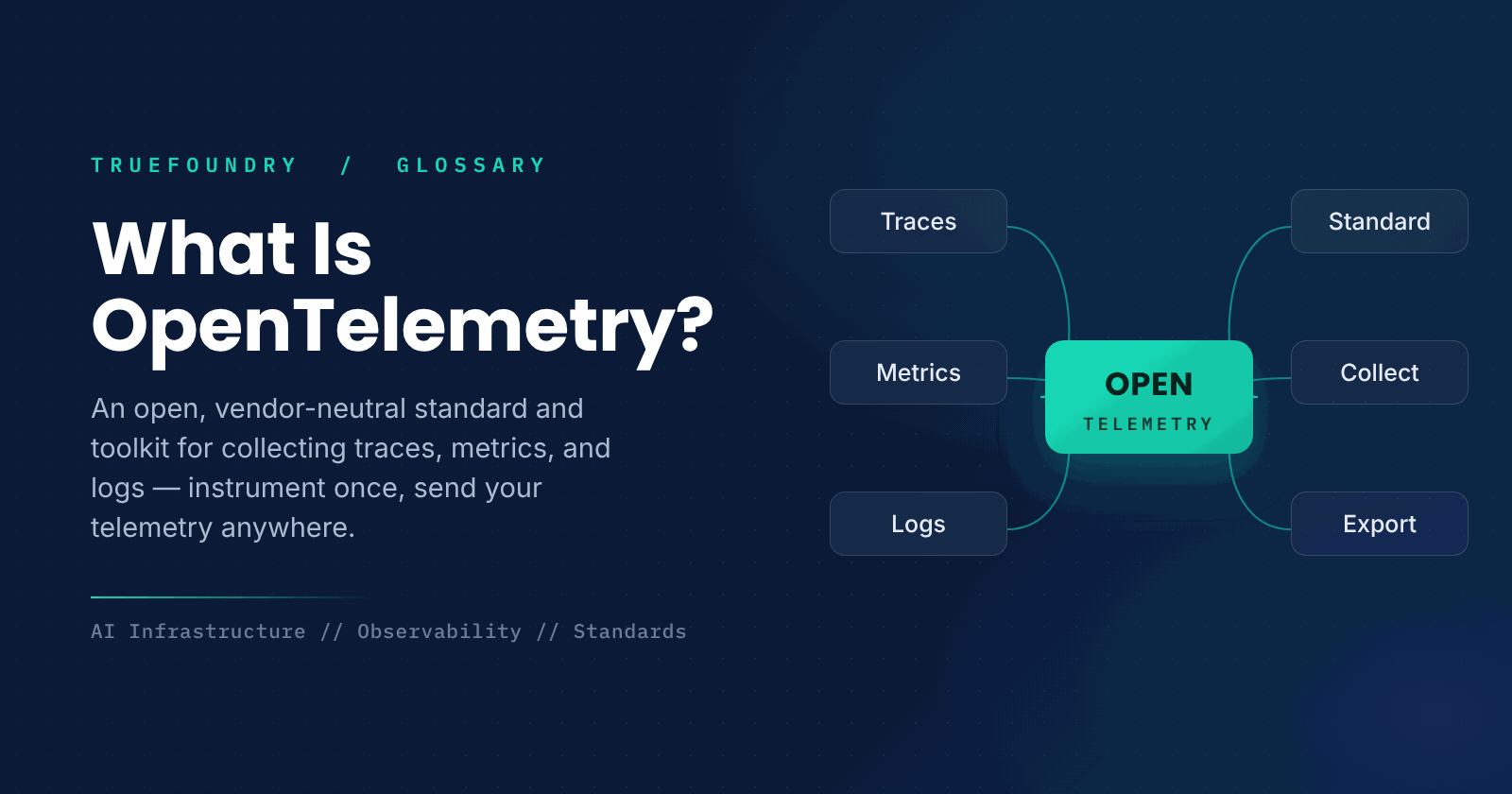
Every observability tool needs the same raw material: data about what your software is doing. For years, each vendor had its own agent and format to collect it, so switching tools meant re-instrumenting everything. OpenTelemetry fixed that by becoming a single, open standard for telemetry that every tool can speak.
With OpenTelemetry, you add instrumentation to your application once, and it produces traces, metrics, and logs in a common format you can send to whatever backend you choose. That portability is why it has become the de facto standard for observability, and increasingly for monitoring LLM applications too.
This guide explains what OpenTelemetry is, how it works, how it compares with vendor agents, and why it matters.
What is OpenTelemetry?
OpenTelemetry, often shortened to OTel, is an open-source observability framework and standard for generating, collecting, and exporting telemetry data. It defines a common model for the three signals, traces, metrics, and logs, and provides the APIs, SDKs, and a collector needed to produce that data from applications and send it to any compatible analysis tool.
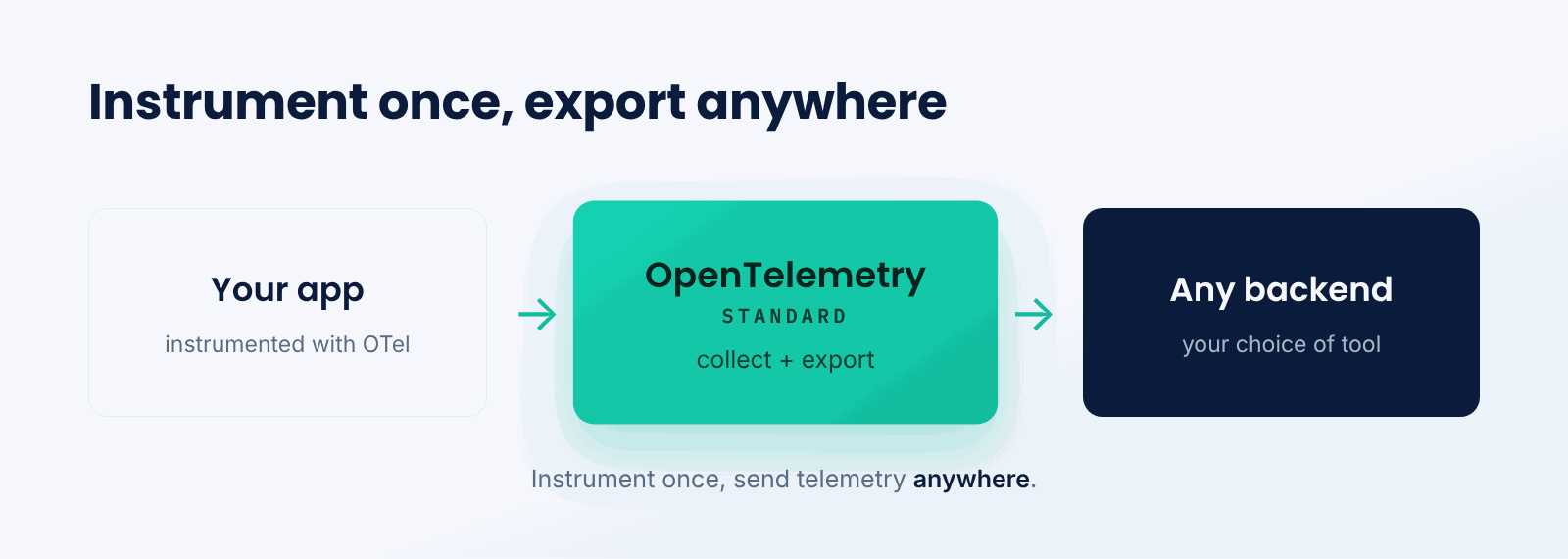
Think of it like a universal plug standard for observability. Before, every monitoring tool had its own proprietary socket, so moving to a new tool meant rewiring the building. OpenTelemetry is the common socket: wire your app to it once, and you can plug into any backend that supports the standard.
The key idea is vendor neutrality. OpenTelemetry separates producing telemetry from analyzing it, so the instrumentation in your code is independent of the tool you use to look at the data.
How does OpenTelemetry work?
OpenTelemetry generates telemetry in your app and routes it to a backend of your choice.
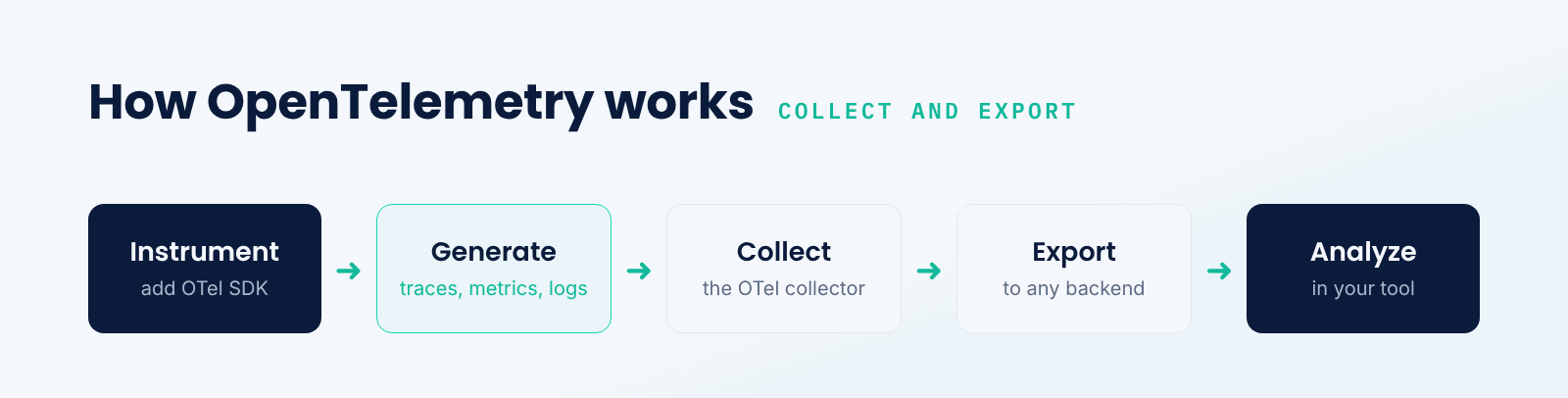
- Instrument the app. You add OpenTelemetry SDKs or auto-instrumentation to your code.
- Generate signals. As the app runs, it produces traces, metrics, and logs in the OTel format.
- Collect the data. The OpenTelemetry Collector gathers, processes, and batches the telemetry.
- Export anywhere. The collector sends the data to one or more backends that support the standard.
- Analyze. You view and query the telemetry in your chosen observability tool.
Because the collector sits between your app and the backends, you can change tools, add destinations, or process data in transit without touching the instrumentation in your code. That decoupling is much of OpenTelemetry's value.
OpenTelemetry vs. vendor agents and custom logging
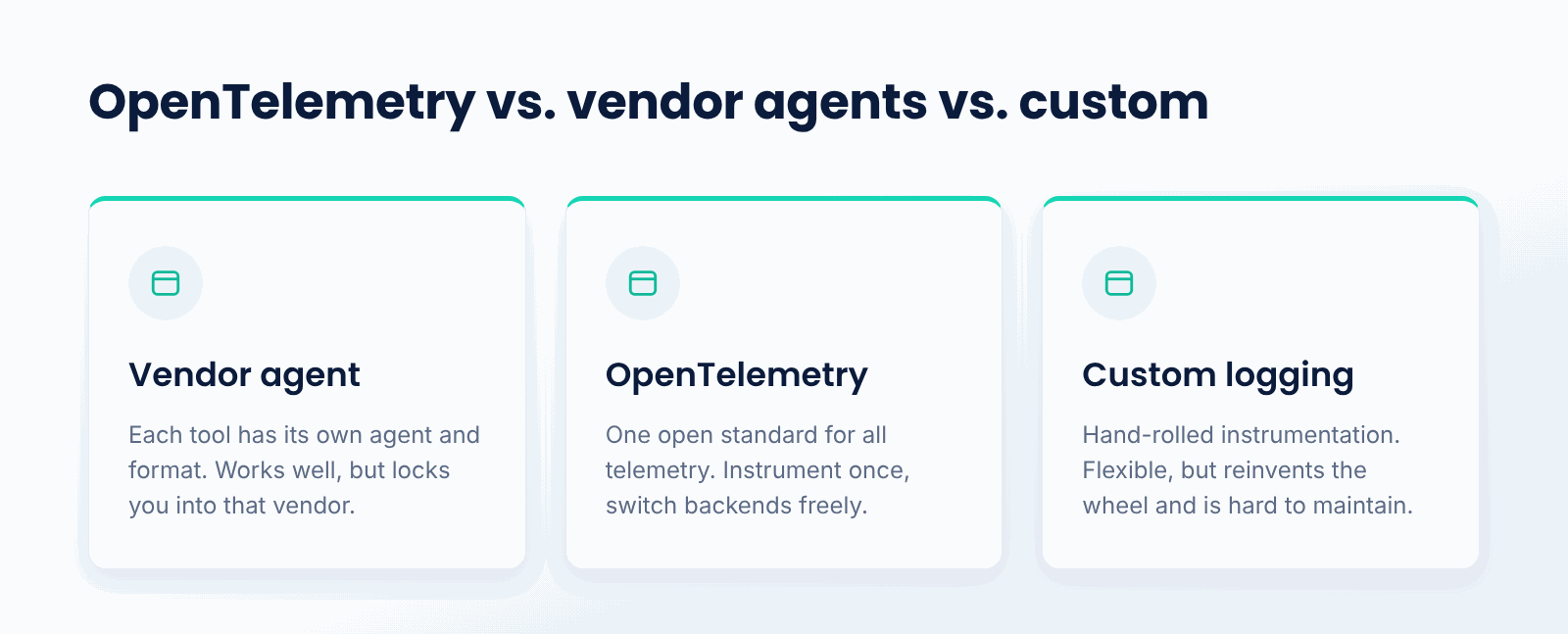
There are three ways to collect telemetry. A vendor agent is specific to one tool, with its own format, which works well but locks you into that vendor. Custom logging is hand-rolled instrumentation you build yourself, which is flexible but reinvents the wheel and is hard to maintain. OpenTelemetry is one open standard for all telemetry: you instrument once and can switch or combine backends freely, which avoids lock-in and standardizes how data is produced.
The advantage of OpenTelemetry is freedom and consistency. Because it is a shared standard rather than a single vendor's format, it has broad support and lets you keep your instrumentation even as your tooling changes.
What are the benefits of OpenTelemetry?
- No vendor lock-in. Instrument once and send data to any compatible backend.
- One standard for all signals. Traces, metrics, and logs share a common model.
- Broad support. Most observability tools and languages support OpenTelemetry.
- Flexibility. The collector lets you process, filter, and route telemetry without code changes.
- Future-proofing. Switching or adding tools does not mean re-instrumenting your app.
What are the considerations?
- Setup effort. Instrumenting and running a collector takes initial work to get right.
- Data volume. Telemetry can be voluminous, so sampling and filtering matter for cost.
- Maturity varies. Support across languages and signals is strong but not uniformly complete.
- Still needs a backend. OpenTelemetry collects data; you still need a tool to store and analyze it.
When should you use OpenTelemetry?
Use it whenever you want observability without tying yourself to one vendor, which is most of the time. For any application, including LLM systems, instrumenting with OpenTelemetry keeps your options open and gives you a consistent way to produce telemetry across services.
If you are fully committed to a single tool and will never switch, its native agent may be marginally simpler. But the portability of OpenTelemetry usually outweighs that, especially as systems and tooling evolve.
Best practices for OpenTelemetry
- Use auto-instrumentation where available to get started quickly.
- Run the collector so you can process and route telemetry without code changes.
- Sample traces sensibly to control data volume and cost.
- Standardize attributes and naming so data is consistent across services.
- Capture LLM-specific signals, like tokens and cost, alongside standard telemetry.
- Pair OpenTelemetry with a gateway so LLM traffic is instrumented consistently in one place.
Conclusion
OpenTelemetry is the open standard for collecting traces, metrics, and logs from software in a vendor-neutral way. By separating producing telemetry from analyzing it, it lets you instrument an application once and send the data to any compatible backend, avoiding lock-in and standardizing observability. It has become the default foundation for monitoring modern systems, LLM applications included.
TrueFoundry's AI Gateway can emit OpenTelemetry-compatible telemetry for the LLM traffic it handles, so your model observability flows into the same tools as the rest of your stack. Whatever backend you prefer, OpenTelemetry is how you keep instrumentation portable and your observability consistent.

Govern, Deploy and Trace AI in Your Own Infrastructure
Frequently Asked Questions
What is OpenTelemetry in simple terms?
It is an open standard and framework for gathering telemetry, traces, metrics, and logs, from your software. Your application only needs to be instrumented once, and then you can send the data to any observability tool that supports OpenTelemetry.
What are the three signals in OpenTelemetry?
Traces, which bind together the steps of a request; metrics, which are statistical aggregates such as latency and error rate; and logs, which are detailed records of events. OpenTelemetry is a standardized way of collecting and exporting all three.
Why is OpenTelemetry vendor-neutral?
Because it decouples telemetry generation from telemetry analysis. Your instrumentation follows the open standard, and the collector can export to any backend, so you can change or combine observability tools without re-instrumenting your application.
What is the OpenTelemetry Collector?
It is a component that receives telemetry from your application, processes it, and forwards it to one or more backends. Since it sits between your application and your tooling, you can filter, sample, and route data without re-instrumenting.
Can OpenTelemetry be used for LLM observability?
Yes. OpenTelemetry increasingly supports LLM use cases, providing traces of requests plus additional signals such as token usage and cost, so model observability can integrate with the rest of the observability in your infrastructure.


- © 2022 ENSEMBLE Technologies



Subscribe to our newsletter
The latest news, articles, and resources sent to your inbox


