


What Is Model Merging and Why Does It Matter?

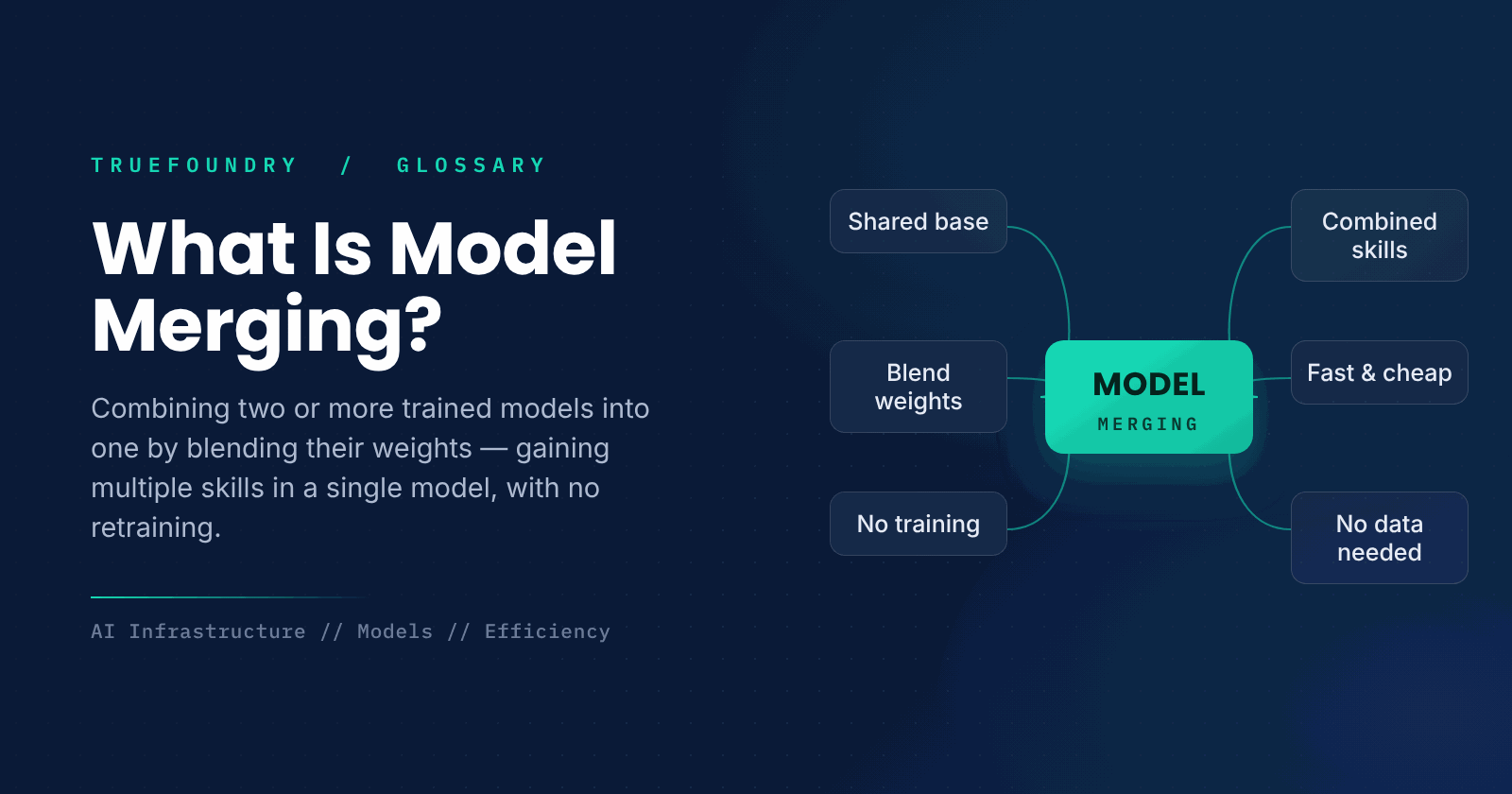
Suppose you have one model that is good at coding and another that is good at writing, and you want a single model that does both. The obvious approach, training a new model on everything at once, is expensive and slow. Model merging offers a shortcut: combine the existing models' weights directly into one model that carries both skills, with no training run at all.
This works surprisingly well when the models share a common ancestor, because their weights are compatible. By blending them, the merged model can inherit strengths from each source, making it a fast and cheap way to combine capabilities. This guide explains what model merging is, how it works, and when to use it.
We will cover the definition, how merging works, how it compares to retraining, and when to use it.
What is model merging?
Model merging is the process of combining two or more trained models into a single model by mathematically blending their weights, rather than training a new model on combined data. The result is one set of weights that aims to carry the capabilities of all the merged models, produced in moments instead of through a full training run.
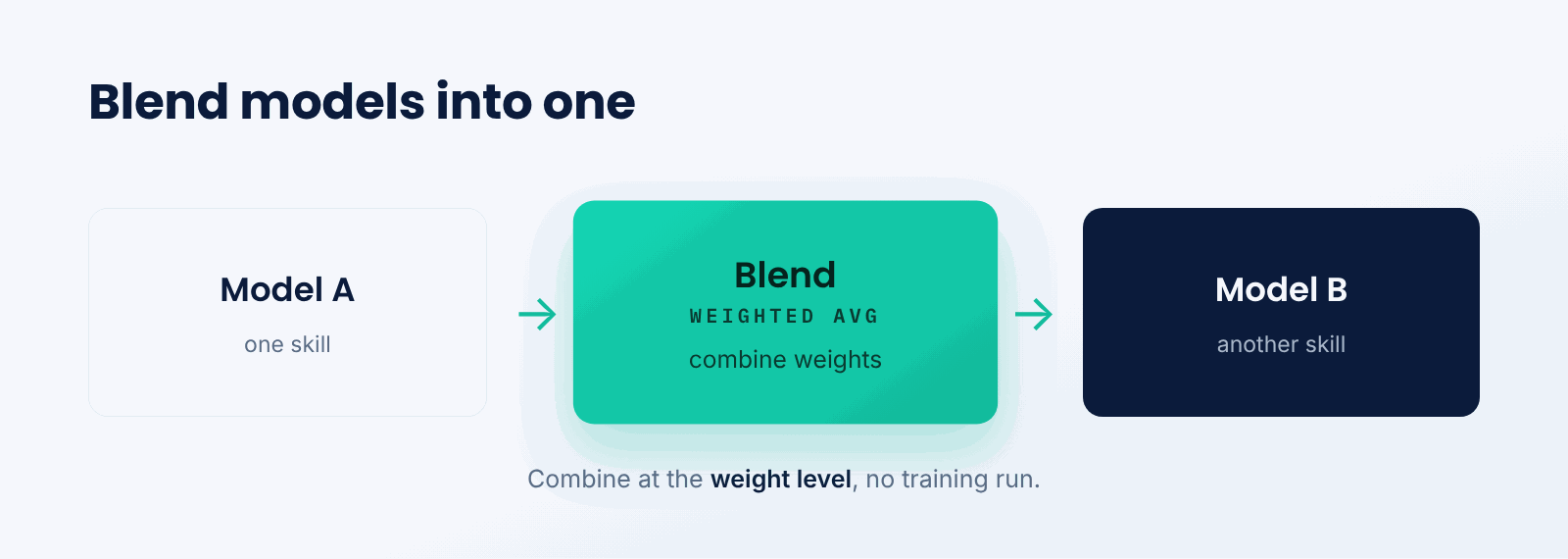
Think of it like blending ingredients into one dish rather than cooking several separate meals. Each source model brings its own flavor, a skill or style, and merging mixes them into a single model that carries a bit of each. Done well, the combination is more capable than any one source alone.
The key idea is combining at the weight level. Because the models' weights live in the same space, especially when they come from a shared base, they can be blended directly to fuse their behaviors.
How does model merging work?
Model merging blends compatible weights from several models into one set.
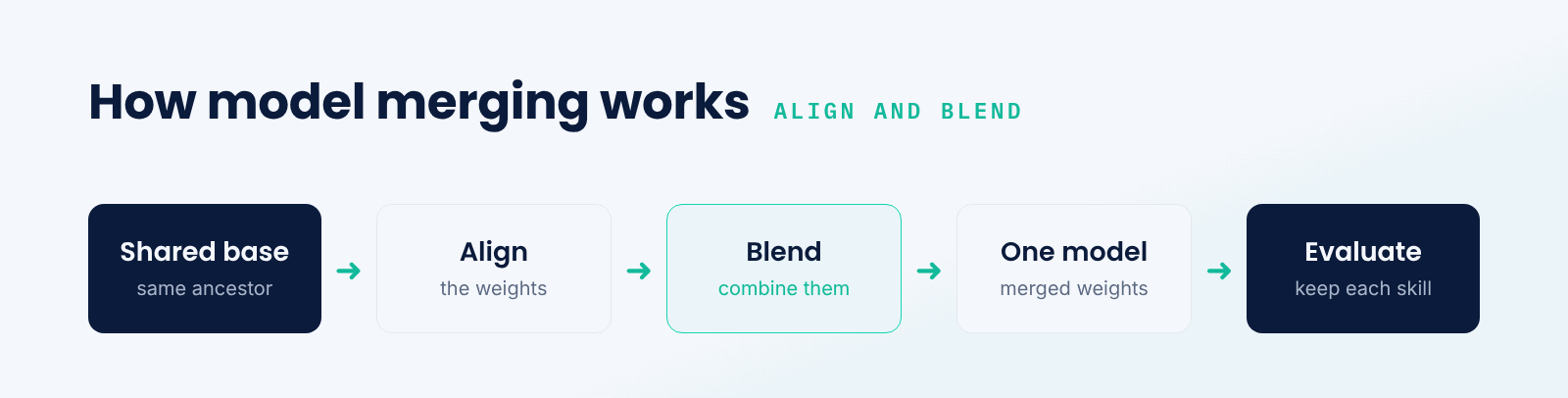
- Start from a shared base. Use models fine-tuned from the same ancestor.
- Align the weights. Match up corresponding weights across models.
- Blend them. Combine the weights, often as a weighted average.
- Produce one model. Get a single set of merged weights.
- Evaluate. Test that the merged model keeps each skill.
The simplest merge is a weighted average of the models' weights, and more advanced methods combine the changes each model made to the shared base more carefully to reduce interference. Because no training is involved, merging is fast and cheap, but it requires the models to be compatible, which usually means sharing a base.
Model merging vs. retraining
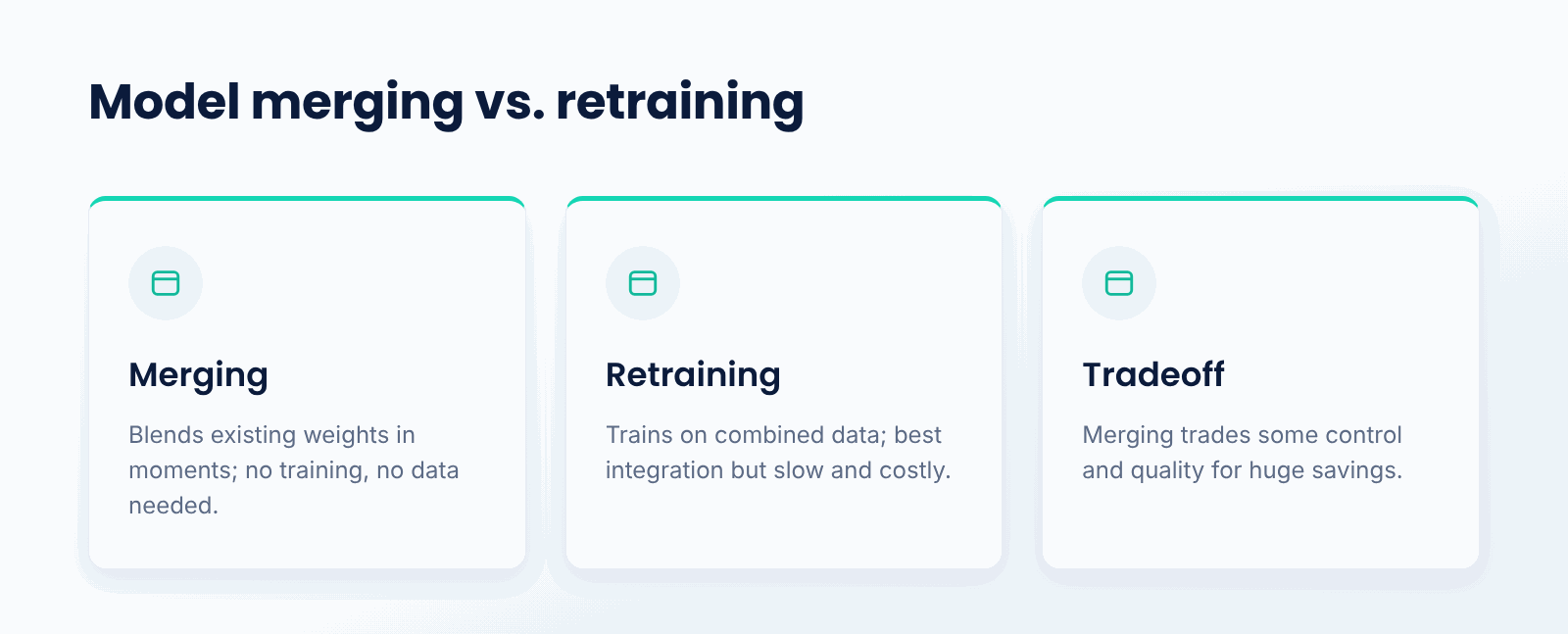
Retraining a single model on all the combined data is the thorough way to get a model with multiple skills. It can produce the best-integrated result, but it is expensive and slow, requiring the data, compute, and time of a full training run, and access to all the original data.
Model merging instead fuses existing models' weights in moments, with no training and no need for the original data. The tradeoff is less control and the risk that skills interfere or degrade, since the blend is not jointly optimized. For quickly combining capabilities cheaply, merging is often the better choice; for the highest-quality integration, retraining may still win.
Why does model merging matter?
- Speed. It combines models in moments, with no training run.
- Cost. It avoids the expense of joint retraining.
- Capability. One merged model can carry multiple skills.
- No data needed. It works from weights, not original datasets.
- Experimentation. It makes combining models easy to try.
What are the tradeoffs?
- Compatibility. Models usually need a shared base to merge well.
- Interference. Skills can degrade or conflict when blended.
- Less control. The blend is not jointly optimized.
- Evaluation. Merged models must be tested to confirm they work.
When should you use model merging?
Use model merging when you want to combine the capabilities of two or more models quickly and cheaply, and they share a common base so their weights are compatible. It is ideal for experimenting with combinations, consolidating specialized fine-tunes, and building capable models without the cost of a full training run.
If the models do not share a base, or you need the best possible integration of skills, retraining on combined data may be the better path. But when speed and cost matter and compatibility holds, merging is a remarkably efficient way to combine models.
Key points about model merging
- Model merging blends the weights of multiple models into one.
- It combines capabilities without any training run.
- It works best when models share a common base.
- It is far faster and cheaper than retraining.
- Skills can interfere, so merged models need testing.
- It is ideal for quickly combining compatible models.
Conclusion
Model merging combines two or more trained models into one by blending their weights, producing a model with multiple skills in moments rather than through an expensive training run. It works best when the models share a common base, and while it offers less control than retraining, it is a remarkably fast and cheap way to combine capabilities. For experimenting and consolidating fine-tunes, it is a powerful tool.
TrueFoundry helps teams build, combine, and serve models on their own infrastructure, including workflows for merging and evaluating models efficiently. When you need to combine capabilities without the cost of retraining, model merging is a technique worth having.

Govern, Deploy and Trace AI in Your Own Infrastructure
Frequently Asked Questions
What is model merging in simple terms?
It is combining two or more trained models into one by blending their weights, without any new training. The merged model carries skills from each of its sources, so you get a model with multiple capabilities quickly and cheaply.
How does model merging work?
By mathematically blending the weights of the source models, often as a weighted average, into a single set of weights. It works best when the models share a common base, because then their weights are compatible and can be combined directly without retraining.
How is merging different from retraining?
Retraining trains a single model on all the combined data, which can give the best-integrated result but needs large amounts of time, money, and the original data. Merging combines the existing weights in moments with no training and no data, trading some control and quality for huge savings in time and cost.
Do models need to be related to merge?
Usually yes. Merging works best when the models share a common base or ancestry, because their weights then live in the same space and are compatible. Unrelated models generally cannot be merged effectively, since their weights do not align.
When should I use model merging?
When you want a fast, cheap way to fuse the abilities of compatible models, such as consolidating specialized fine-tunes or experimenting with combinations. If the models lack a common base, or you need the best possible integration, retraining may be better.


- © 2022 ENSEMBLE Technologies



Subscribe to our newsletter
The latest news, articles, and resources sent to your inbox


