


What Is Model Drift and Why Does It Matter?

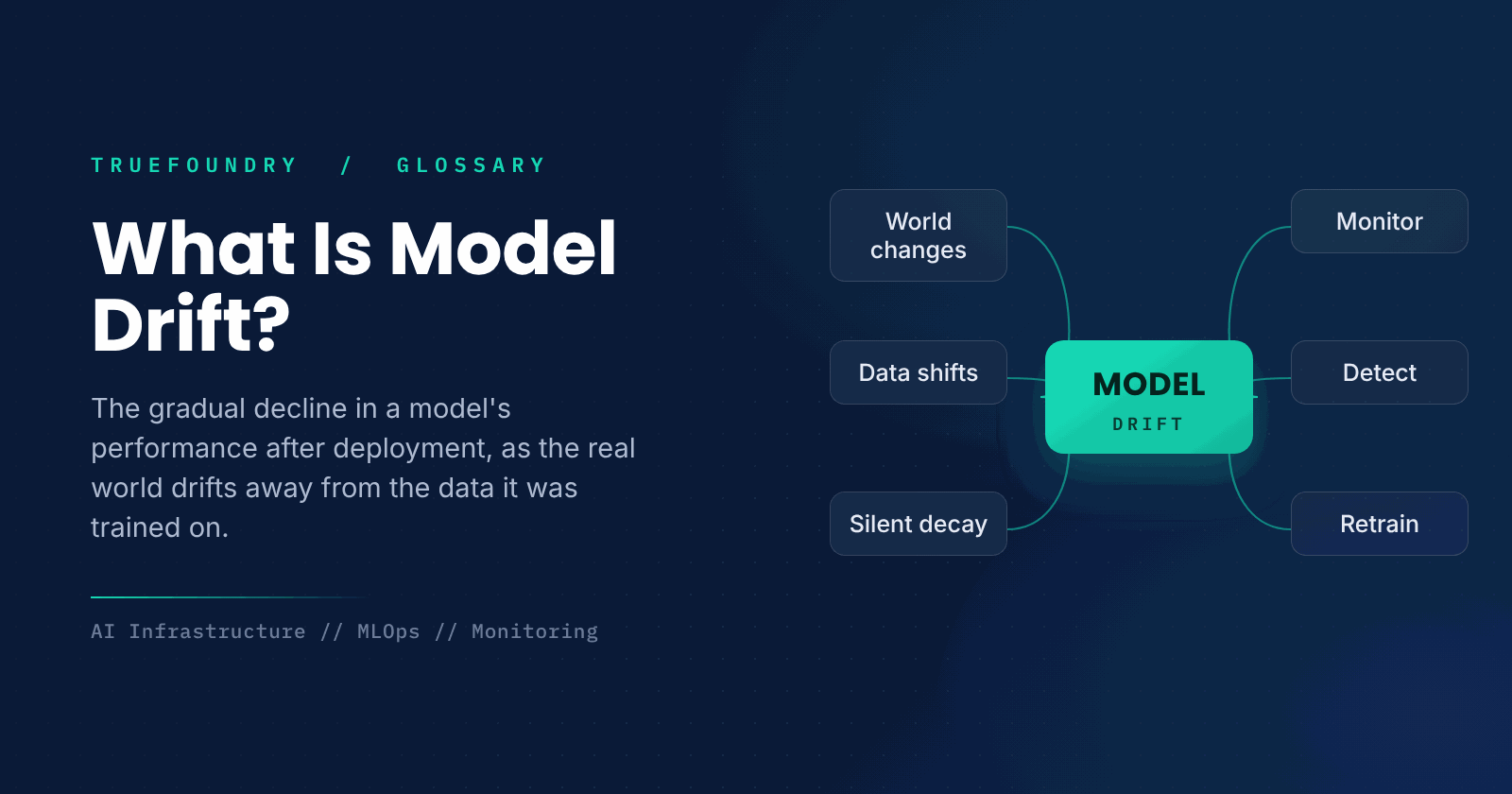
A machine learning model is trained on a snapshot of the world, but the world keeps moving. Customer behavior shifts, new products appear, language evolves, and conditions change. As that happens, a model trained on yesterday's data gradually becomes a worse fit for today's, and its accuracy slips. This slow decay is model drift.
Drift is one of the defining challenges of running models in production. Unlike a software bug that fails loudly, drift is silent: the model keeps producing predictions, they just quietly get worse. Catching it requires actively monitoring performance, because nothing in the system will raise an alarm on its own.
This guide explains what model drift is, what causes it, how it relates to data drift, and how to detect and address it.
What is model drift?
Model drift is the degradation of a model's predictive performance over time after deployment, caused by changes in the data or the relationships it learned. The model itself does not change, but the world it operates in does, so its learned patterns become a progressively worse match for current reality.
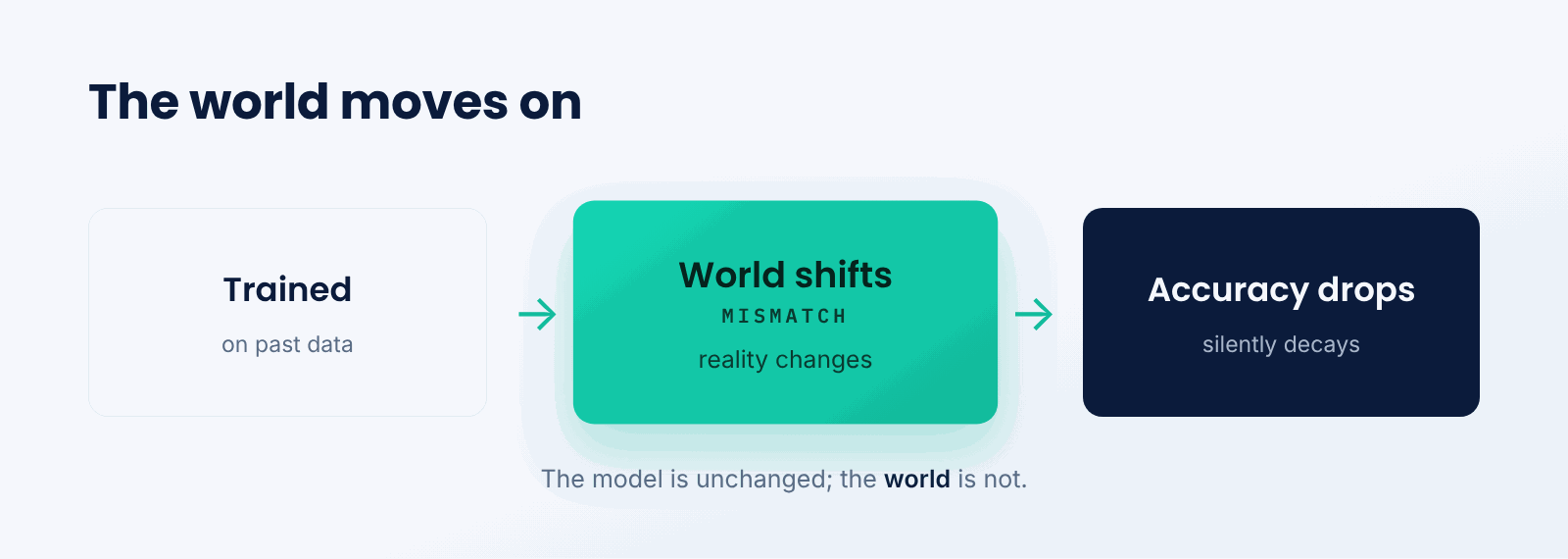
Think of it like a map of a growing city. When drawn, the map is accurate, but as roads are built and neighborhoods change, it slowly falls out of date. The map did not change; the city did. A model is like that map, and drift is the growing gap between what it encodes and the world as it now is.
The key idea is that performance decays even though the model is unchanged. Because the mismatch grows silently, the only way to know how much a model has drifted is to measure its performance against current outcomes.
What causes model drift?
Drift arises from different kinds of change between training and production.
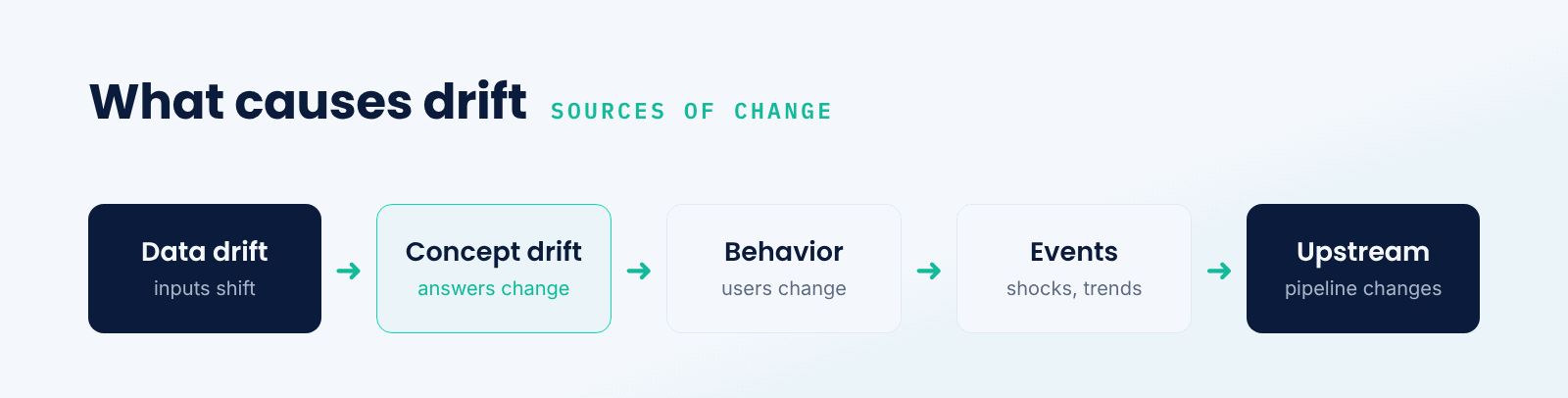
- Data drift. The distribution of inputs shifts from the training data.
- Concept drift. The relationship between inputs and the target changes.
- Changing behavior. Users or systems behave differently over time.
- External events. Shocks like new trends or disruptions alter the data.
- Upstream changes. Changes in data sources or pipelines shift what the model sees.
These causes differ in important ways. Data drift changes what the inputs look like, while concept drift changes what the right answer is for a given input. Both degrade performance, but they call for understanding which kind of change has occurred to respond correctly.
Model drift vs. data drift
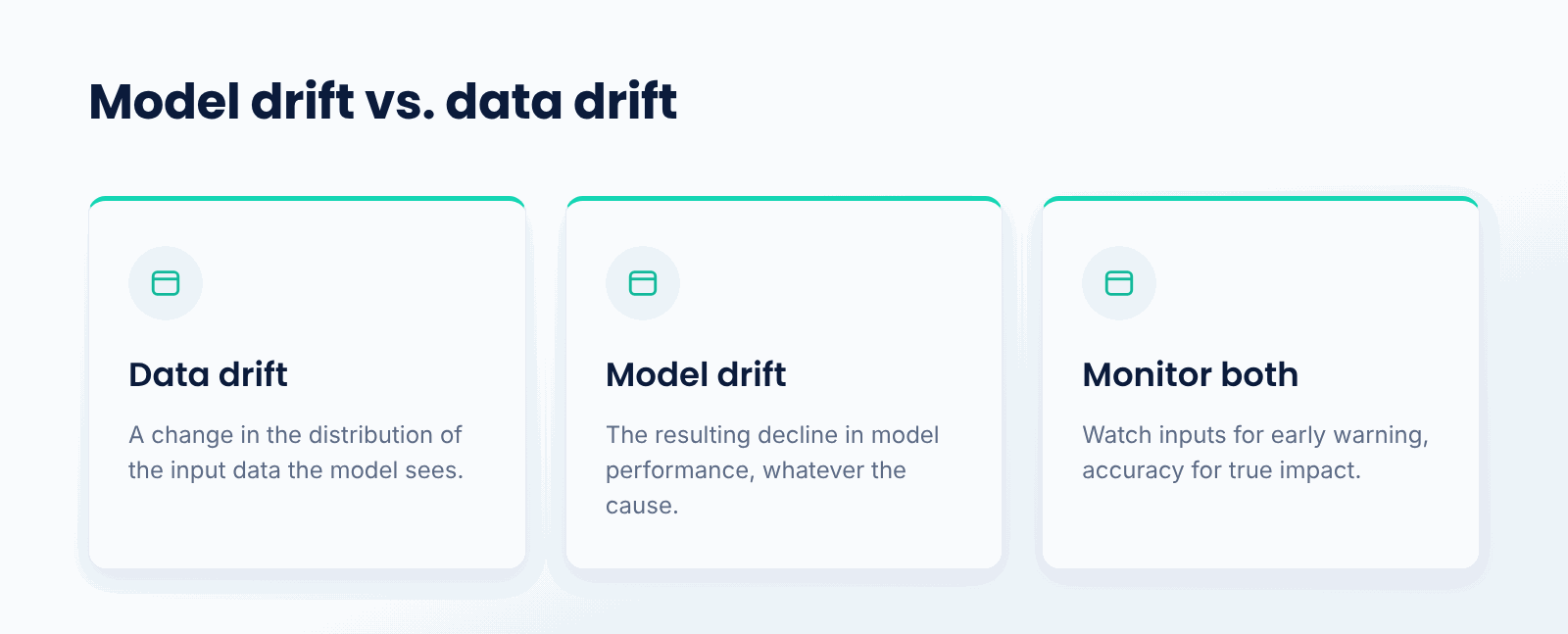
The terms are related but distinct. Data drift refers specifically to a change in the distribution of the input data the model receives. Model drift, sometimes used interchangeably with concept drift, refers to the resulting decline in model performance, whatever its cause. In short, data drift is one driver; model drift is the outcome of concern.
Monitoring both is useful. Watching input distributions catches data drift early, often before performance visibly suffers, while tracking prediction accuracy against actual outcomes measures model drift directly. Used together, they give both an early warning and a true measure of impact.
Why does model drift matter?
- Silent failure. Accuracy declines without any obvious error.
- Bad decisions. Degraded predictions lead to worse outcomes downstream.
- Trust. Undetected drift erodes confidence in the model.
- Compliance. In regulated settings, performance decay can be a serious issue.
- Maintenance. It makes ongoing monitoring and retraining necessary.
How do you detect and fix drift?
- Monitor performance. Track accuracy or other metrics against real outcomes.
- Watch input distributions. Detect data drift before performance drops.
- Set alerts. Trigger warnings when metrics cross thresholds.
- Retrain. Update the model on fresh, representative data.
- Automate. Build pipelines that retrain and redeploy regularly.
When should you worry about drift?
Worry about it for any model running in a changing environment, which is most of them. The faster the underlying world changes, the faster drift sets in, so fast-moving domains like fraud, recommendations, or demand forecasting need especially close monitoring and frequent retraining.
Even in slower domains, drift eventually appears, so no production model should be left unmonitored. The right cadence of checking and retraining depends on how quickly performance degrades, which monitoring is what tells you.
Key points about model drift
- Model drift is performance decline after deployment.
- It is caused by the world diverging from the training data.
- Data drift changes inputs; concept drift changes input-output relationships.
- It is silent and must be actively monitored.
- It is addressed by retraining on fresh data.
- Faster-changing domains drift faster and need closer watch.
Conclusion
Model drift is the quiet decline in a model's performance after deployment, as the world moves away from the data it was trained on. Because it fails silently, catching it requires actively monitoring predictions against real outcomes and watching for shifts in the input data, then retraining on fresh data to restore accuracy. It is why a deployed model needs ongoing care, not just a one-time launch.
TrueFoundry helps teams deploy, monitor, and retrain models on their own infrastructure, with the observability needed to catch drift and the pipelines to refresh models when it appears. Managing drift well is what keeps a model accurate long after it ships.

Govern, Deploy and Trace AI in Your Own Infrastructure
Frequently Asked Questions
What is model drift in simple terms?
Model drift describes a deployed model whose accuracy decays over time due to a changing reality that falls out of alignment with the training data. The core premise is simple: everything else stays constant, while the world evolves and drifts away from the static model.
What causes model drift?
Changes between training and production. The inputs shift (data drift), the relationship between inputs and the correct answer changes (concept drift), user behavior evolves, or external events and upstream data changes alter what the model sees. Each factor degrades performance, and together they pose an ongoing threat.
How is model drift different from data drift?
Data drift describes a shift in the distribution of a model's inputs. Model drift describes the subsequent loss of performance, whatever the underlying driver. Data drift is one driver; model drift is the outcome you ultimately care about and measure.
How do you detect model drift?
By monitoring the model's performance against real-world outcomes and watching the input data's distribution for shifts. Alerts trip when key metrics cross certain thresholds. Input monitoring anticipates the effect, and accuracy monitoring quantifies the harm done.
How do you fix model drift?
Usually by training the model on new, representative data, capturing whatever changes in reality have happened since the last version shipped. Automation is fairly standard here too; teams build scheduled or drift-monitored pipelines for continuous retraining and redeployment.


- © 2022 ENSEMBLE Technologies



Subscribe to our newsletter
The latest news, articles, and resources sent to your inbox


