


What Are Model Cards and Why Do They Matter?


A machine learning model on its own is a black box: a set of weights that produces outputs, with nothing to tell you what it was trained for, how well it works, or where it should not be used. A model card fills that gap. It is a concise document that travels with the model and records the essential facts someone needs to use it responsibly.
As models are shared, reused, and deployed in high-stakes settings, this kind of documentation has become essential. A model card lets a user quickly understand a model's purpose, performance, and limits, and decide whether it fits their needs. This guide explains what model cards are, what they contain, and why they matter.
We will cover the definition, the typical contents, how they support responsible AI, and when to use them.
What is a model card?
A model card is a standardized document that describes a machine learning model's key characteristics: its intended purpose, how it was trained, how it performs across relevant conditions, and its known limitations and risks. It is meant to accompany the model wherever it goes, giving anyone who encounters it the context needed to use it appropriately.
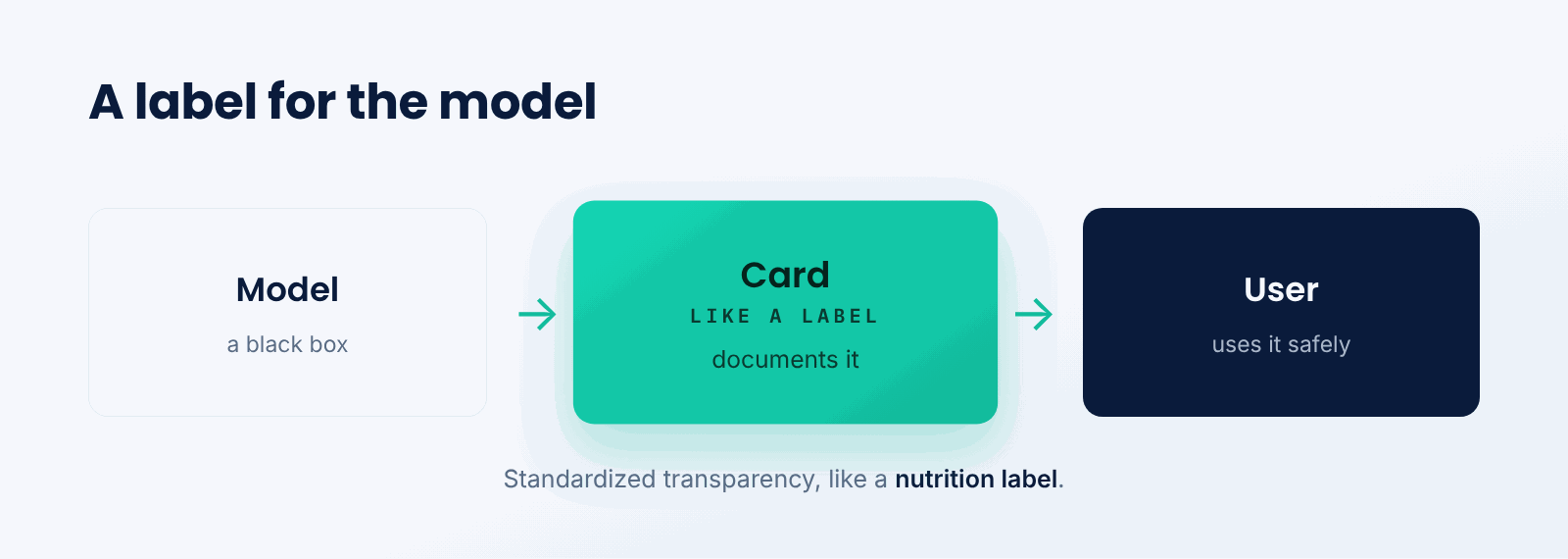
Think of it like the nutrition label on food or the spec sheet for a device. You would not want to consume or install something with no information about what is inside or how it behaves. A model card is that label for an AI model, summarizing what it is and how it performs in a consistent, readable form.
The key idea is standardized transparency. By documenting the same categories of information every time, model cards make it easy to understand and compare models and to spot where one may not be suitable.
What does a model card contain?
A model card gathers the essential facts about a model into consistent sections.
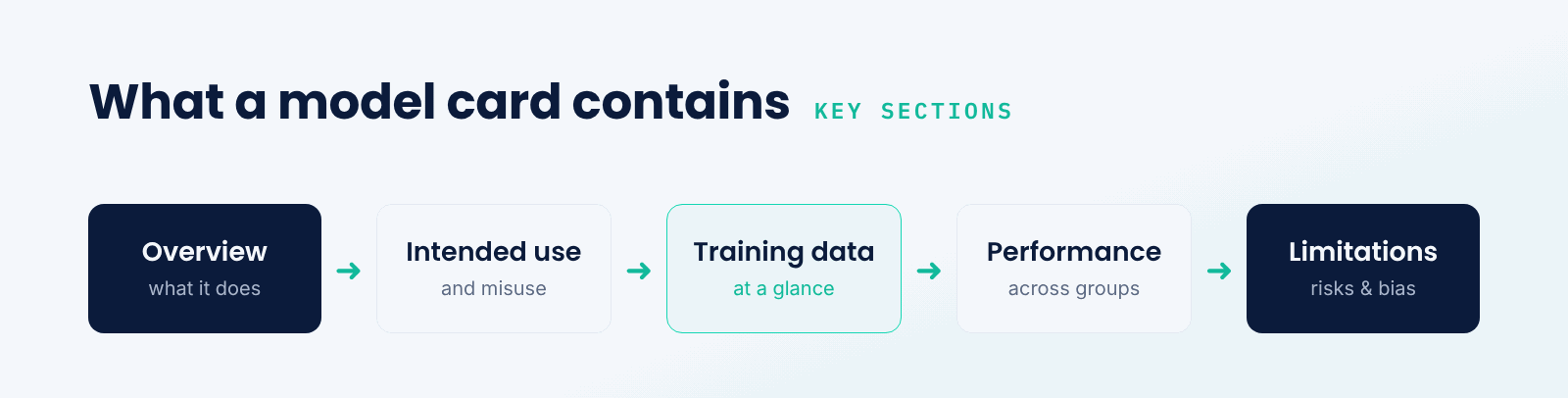
- Overview. What the model does and who built it.
- Intended use. The tasks and settings it is designed for, and ones to avoid.
- Training data. What data it was trained on, at a high level.
- Performance. How well it performs, ideally across different groups or conditions.
- Limitations and risks. Known weaknesses, biases, and ethical considerations.
Good model cards report performance not just overall but across relevant subgroups and conditions, so hidden weaknesses are visible. They are written to be understood by a broad audience, not only the team that built the model, because the people deciding whether to use a model are often not its authors.
Model cards and responsible AI
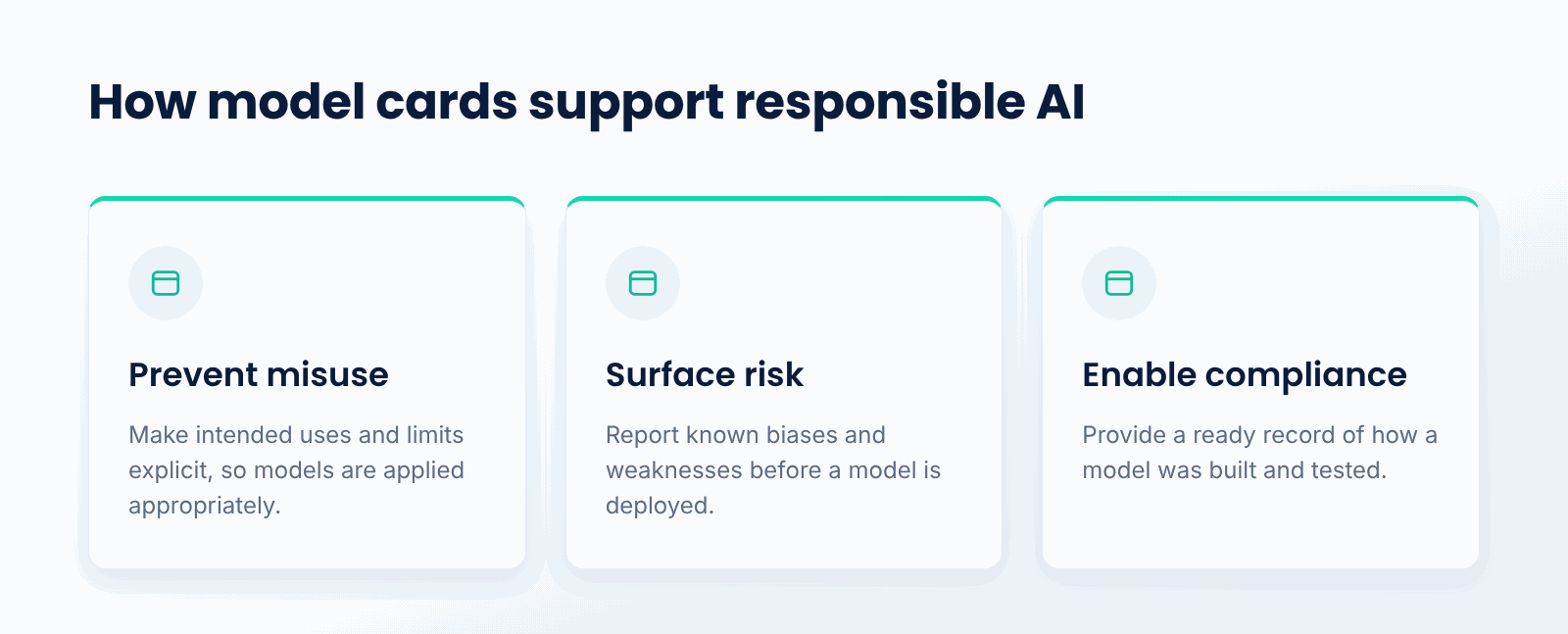
Model cards are a practical tool for responsible AI. By making a model's intended uses, performance, and limitations explicit, they help prevent misuse, such as applying a model to a task or population it was never validated for. They surface known biases and risks so users can weigh them before deploying.
They also support accountability and, increasingly, compliance. As AI regulation grows, documentation of how a model was built and tested is becoming an expectation, and model cards provide a ready format for it. They turn transparency from a vague goal into a concrete, repeatable artifact that accompanies every model.
Why do model cards matter?
- Transparency. They make a model's behavior and limits visible.
- Responsible use. They help people apply models appropriately.
- Comparison. Standard sections make models easy to compare.
- Accountability. They document decisions for later review.
- Compliance. They support growing documentation requirements.
What are the challenges?
- Effort. Writing a thorough card takes real work.
- Honesty. Cards are only useful if limitations are reported candidly.
- Maintenance. They must be updated as the model changes.
- Completeness. Gaps can give a false sense of assurance.
When should you use model cards?
Use model cards whenever a model will be shared, reused, or deployed, which covers most models that leave a single person's experiments. They are especially important for models used in high-stakes domains or by people other than their creators, where understanding limits and intended uses is critical to safe use.
Even for internal models, a model card is good practice, because it preserves the context that is otherwise lost over time. Any time a model matters enough for others to rely on, it is worth documenting with a model card.
Key points about model cards
- A model card documents a model's purpose, build, and performance.
- It records intended uses, limitations, and risks.
- It travels with the model as a standardized record.
- It supports responsible use, comparison, and accountability.
- Good cards report performance across groups and conditions.
- They matter whenever a model is shared or deployed.
Conclusion
A model card is the documentation that lets people use a model responsibly, recording what it does, how it was built, how well it performs, and where it should not be used. Like a nutrition label for AI, it travels with the model and makes its behavior and limits transparent. As models are shared and deployed more widely, model cards have become a cornerstone of accountable AI.
TrueFoundry helps teams manage and deploy models on their own infrastructure, including the documentation and governance that keep model use transparent and accountable. When models move beyond a single experiment, a model card is how their context travels with them.

Govern, Deploy and Trace AI in Your Own Infrastructure
Frequently Asked Questions
What is a model card in simple terms?
It is a small document that holds the key information about a machine learning model in one place, like a nutrition label for AI. It describes what the model does, how it is built, how it performs, and where it should not be used, so anyone can decide whether and how to use it responsibly.
What goes in a model card?
It generally includes a summary of the model's purpose and who developed it, the ways it is intended to be used and the ways it should not be, an explanation of its training data, performance details across relevant conditions, and its known limitations, biases, and risks.
Why are model cards important?
They provide visibility into the capabilities and constraints of a model, which allows for its proper application and ensures it is not used in situations where it has not been validated. They also promote accountability and compliance by documenting how a model was built and tested.
Who writes and reads model cards?
Though the team developing a model normally prepares its card, the readers are often other people, including engineers, decision-makers, and auditors deciding whether to use the model. This is why cards are written for a broad audience, not just the original authors.
When should a model have a card?
Whenever it will be shared, reused, or deployed, and especially in high-stakes settings or when others rely on it. Even internal models benefit, because a card preserves context that would otherwise be lost as time passes and teams change.


- © 2022 ENSEMBLE Technologies



Subscribe to our newsletter
The latest news, articles, and resources sent to your inbox


