


What Is Load Balancing and How Does It Work?

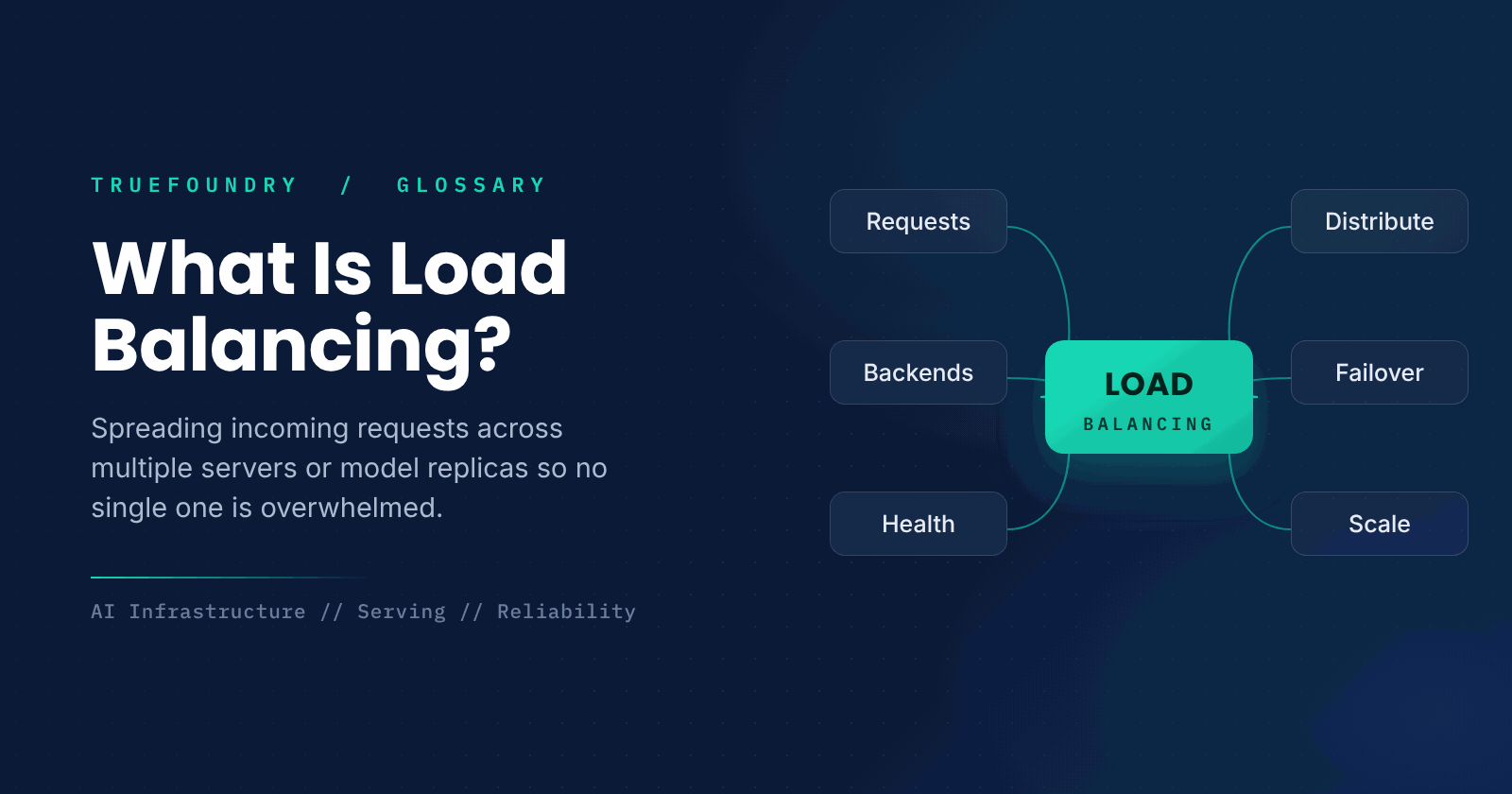
When many users hit an application at once, sending every request to one server quickly overwhelms it: responses slow down, and if that server fails, everything goes with it. Load balancing solves this by putting a layer in front that spreads requests across several identical backends, so the work is shared and no single one becomes a bottleneck.
For LLM applications, where each request is expensive and backends are often scarce GPU replicas, this matters even more. A load balancer keeps traffic flowing smoothly across replicas, and can go further by routing across different models and providers to balance speed, cost, and reliability.
This guide explains what load balancing is, how it works, the main strategies, and why it matters for serving AI at scale.
What is load balancing?
Load balancing is the practice of distributing incoming network requests across a pool of backend servers or model replicas so that the load is shared evenly. A load balancer sits between clients and backends, receives each request, and forwards it to a backend chosen to keep the overall system fast and available.
Think of it like a host at a busy restaurant seating guests across many servers rather than sending everyone to one table. Each server handles a fair share, guests are seated faster, and if one server is busy, the host directs people elsewhere. A load balancer does the same for requests.
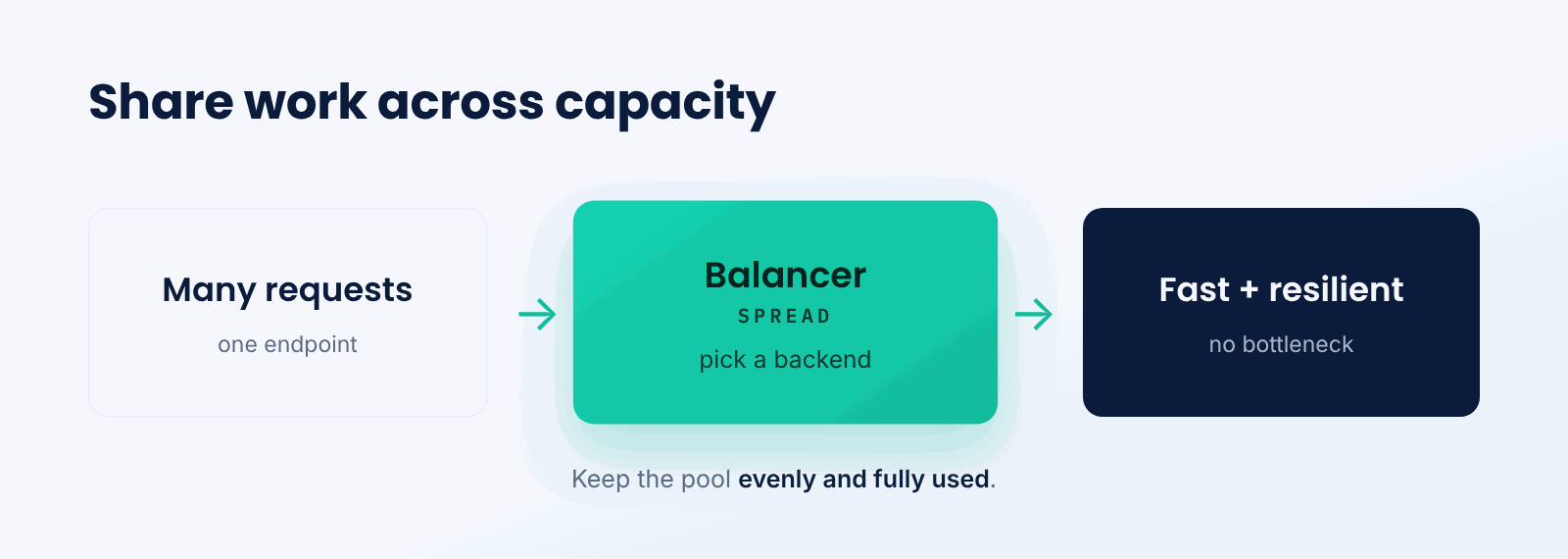
The key idea is sharing work across capacity. Rather than one backend straining while others sit idle, the balancer keeps the pool evenly used, which improves both speed and resilience.
How does load balancing work?
A balancer receives each request, picks a healthy backend by some strategy, and forwards it.
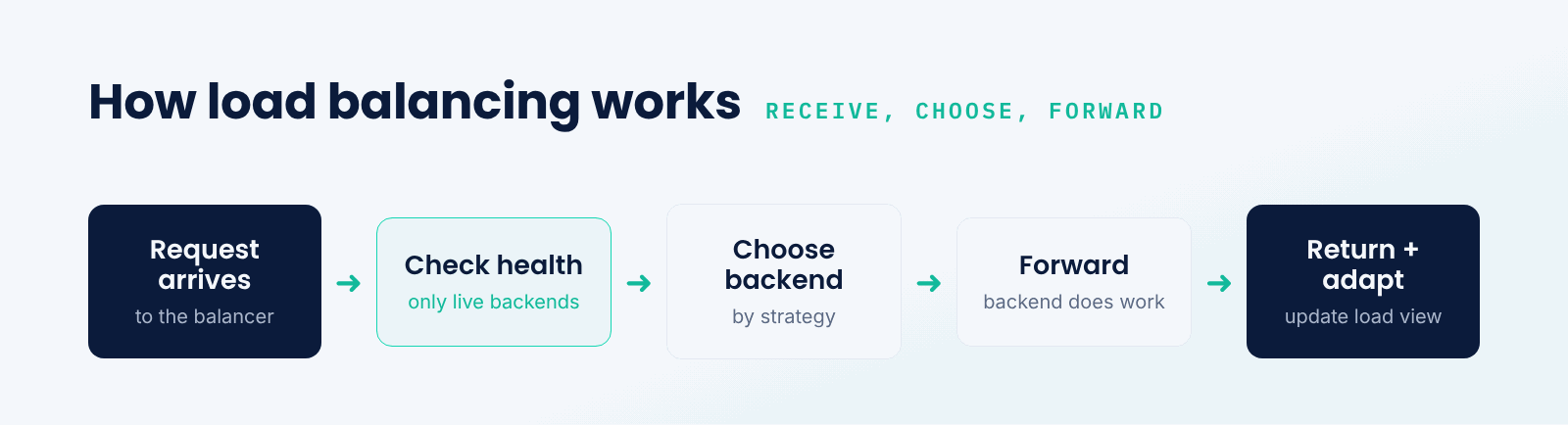
- Request arrives. A client sends a request to the load balancer, not directly to a backend.
- Check health. The balancer considers only backends that are up and responsive.
- Choose a backend. A strategy picks one, by rotation, load, or latency.
- Forward. The request goes to the chosen backend, which does the work.
- Return and adapt. The response is returned, and the balancer updates its view of load.
Health checks are central: by routing around backends that are slow or down, the balancer keeps the application available even when individual servers fail, which is as important as spreading load.
Common load balancing strategies
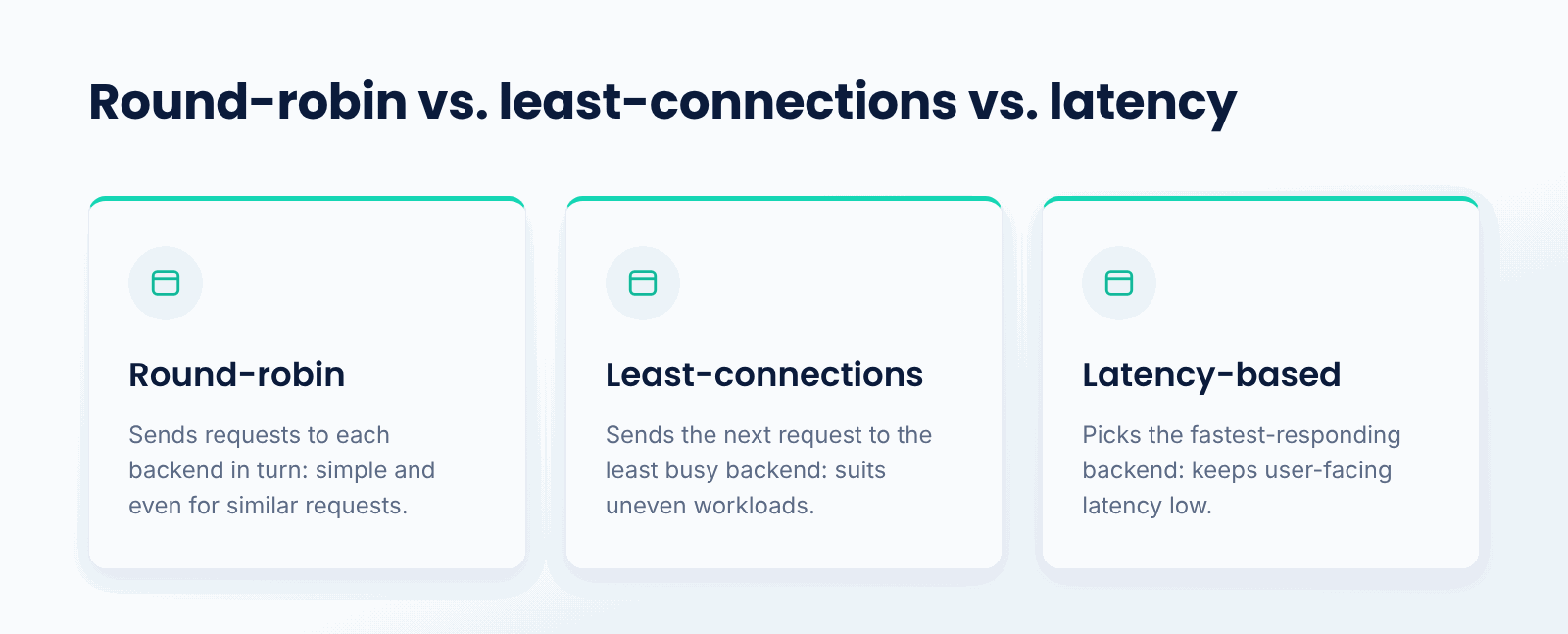
Balancers choose backends in a few common ways. Round-robin sends requests to each backend in turn, which is simple and even when requests are similar. Least-connections sends the next request to the backend handling the fewest active requests, which suits uneven workloads. Latency-based routing picks the backend responding fastest, which keeps user-facing latency low.
Which fits depends on the workload. For LLM serving, where requests vary a lot in size and cost, load- and latency-aware strategies usually beat plain round-robin, because they account for how busy each replica actually is.
Why does load balancing matter?
- Lower latency. Spreading load keeps any one backend from slowing down.
- Higher availability. Routing around failures keeps the application up.
- Better throughput. The pool's full capacity is used, not just one server's.
- Scalability. Adding backends behind the balancer increases capacity smoothly.
- Efficient GPUs. For LLMs, it keeps scarce replicas evenly and fully used.
What are the challenges?
- Uneven requests. LLM requests vary in cost, so naive balancing can still skew load.
- Health detection. Spotting a slow or failing backend quickly is not trivial.
- State. Sticky sessions or shared state complicate where a request can go.
- The balancer itself. It must be highly available so it is not a single point of failure.
When do you need load balancing?
You need it whenever one backend cannot handle your traffic reliably, which is true for almost any production service with real users. For LLM applications serving many requests across multiple replicas or models, load balancing is essential to keep latency and availability acceptable.
A single low-traffic service on one machine may not need it. But as soon as you run multiple backends for capacity or reliability, a load balancer is what ties them into one dependable endpoint.
Best practices for load balancing
- Use health checks so traffic avoids slow or failing backends.
- Pick a strategy that fits your workload, load-aware for variable LLM requests.
- Make the balancer itself redundant so it is not a single point of failure.
- Account for request cost, not just count, when balancing LLM traffic.
- Combine with autoscaling so capacity grows and shrinks with demand.
- For LLMs, balance across models and providers through a gateway.
Conclusion
Load balancing distributes requests across multiple backends so no single one is overwhelmed, keeping latency low and availability high. By routing each request to a healthy, appropriate backend and avoiding failures, it turns a pool of servers or replicas into one fast, resilient endpoint. For LLM serving, where requests are costly and replicas scarce, smart load balancing is key to serving reliably at scale.
TrueFoundry's AI Gateway load-balances LLM traffic across replicas, models, and providers, with health awareness and failover built in. As AI applications grow, load balancing is how teams keep them responsive and available under real-world traffic.

Govern, Deploy and Trace AI in Your Own Infrastructure
Frequently Asked Questions
What is load balancing in simple terms?
It is distributing incoming requests among a number of servers to prevent any one of them from being overwhelmed. A load balancer sits at the front, selects a healthy backend for every request, and keeps the application fast and available.
What are the main load balancing strategies?
Round-robin distributes requests equally among all backends, least-connections directs traffic to the least busy backend, and latency-based routing chooses the quickest-responding one. Load-aware strategies are best for variable workloads like LLM requests.
How does load balancing improve availability?
By running health checks and passing requests only to backends that are up and responsive. If one fails, the balancer sends traffic to the others, so the application keeps working instead of going down with a single server.
Why does load balancing matter for LLMs?
Because LLM replicas are expensive and scarce, and requests vary in cost. Balancing keeps replicas evenly and fully used, avoids overloading any one, and can route across models and providers to balance speed, cost, and reliability.
How is load balancing related to autoscaling?
Load balancing distributes traffic among the backends you have; autoscaling changes how many backends there are. In combination they let an application both use its current capacity well and add or remove capacity as demand changes.


- © 2022 ENSEMBLE Technologies



Subscribe to our newsletter
The latest news, articles, and resources sent to your inbox


