


What Is LLMOps and How Does It Work?

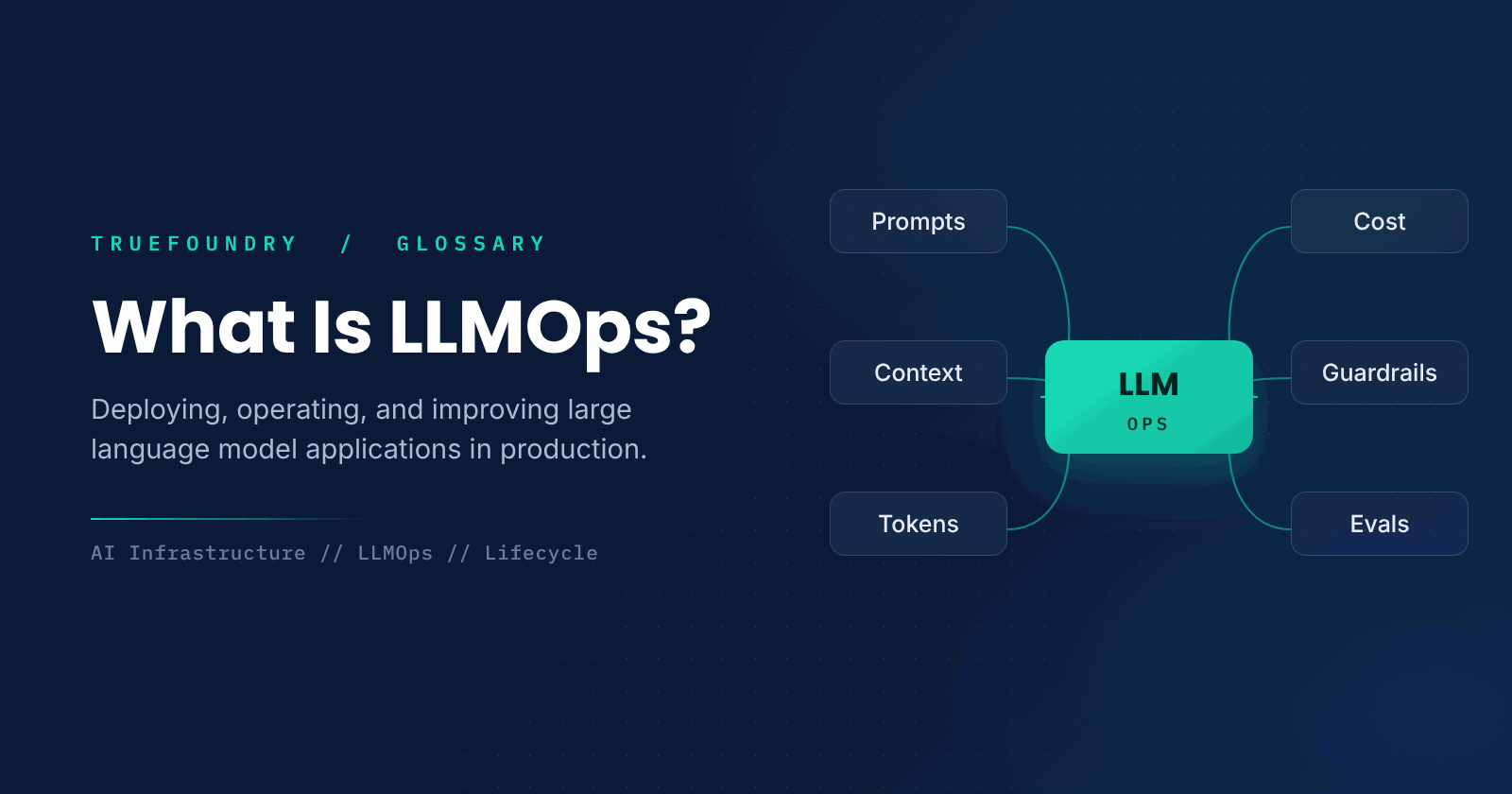
Running a large language model in production is not quite like running a traditional ML model. There are no weights you trained and can retrain; instead there are prompts, context, tokens that cost money, latency that users feel, and outputs that must be kept safe. LLMOps is the set of practices for operating LLM applications with all of that in mind.
It takes the discipline of MLOps, automation, monitoring, versioning, and refocuses it on what matters for LLMs. The artifacts are prompts and configurations rather than trained weights, the costs are per-token, and the quality question is whether outputs are good, safe, and on-task, not just accurate.
This guide explains what LLMOps is, how it works, how it differs from MLOps, and why it matters for anyone running LLM applications.
What is LLMOps?
LLMOps, short for large language model operations, is the set of practices, tools, and processes for deploying, managing, monitoring, and improving LLM-based applications in production. It covers prompt management, context and retrieval, cost and token control, latency, guardrails, and evaluation, the concerns that arise when LLMs rather than custom-trained models power an application.
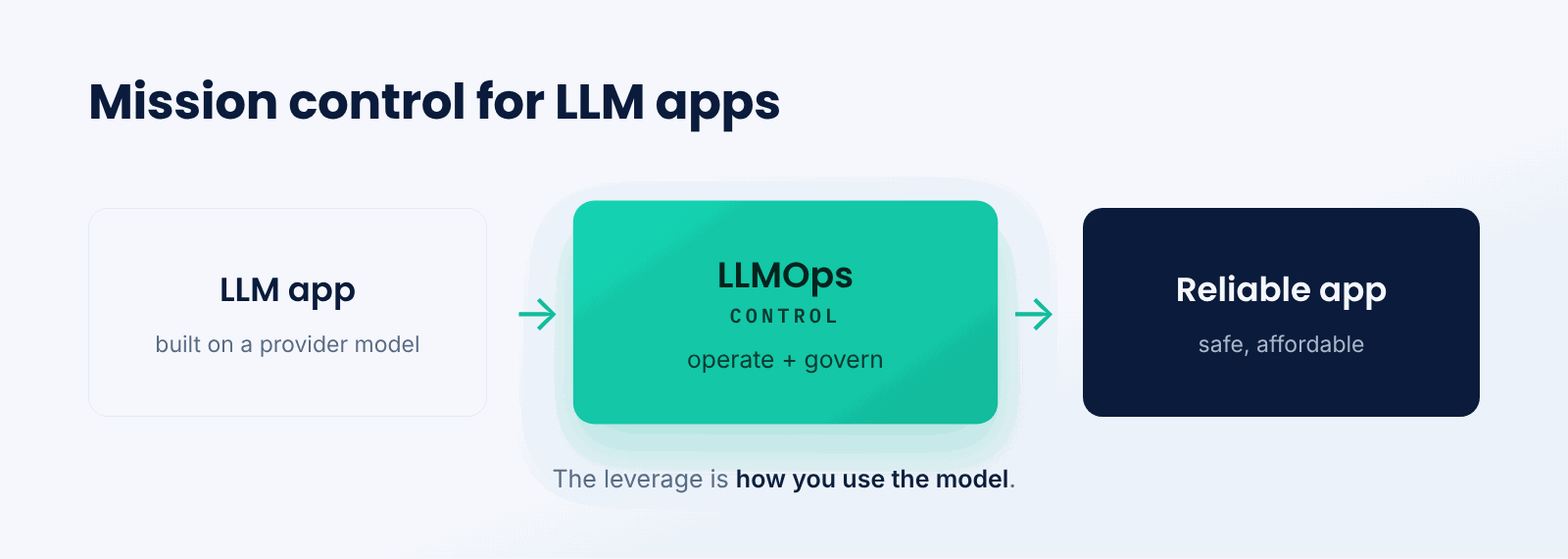
Think of it as mission control for LLM applications. The model itself may come from a provider, but everything around it, the prompts, the data you feed in, the cost, the safety checks, the quality monitoring, needs to be operated deliberately. LLMOps is how you run that control room.
The key idea is that with LLMs, the operational work shifts from training models to orchestrating and governing their use. Managing prompts, cost, and safety becomes the core of the discipline.
How does LLMOps work?
LLMOps manages the lifecycle of an LLM application, from prompt to monitored production.
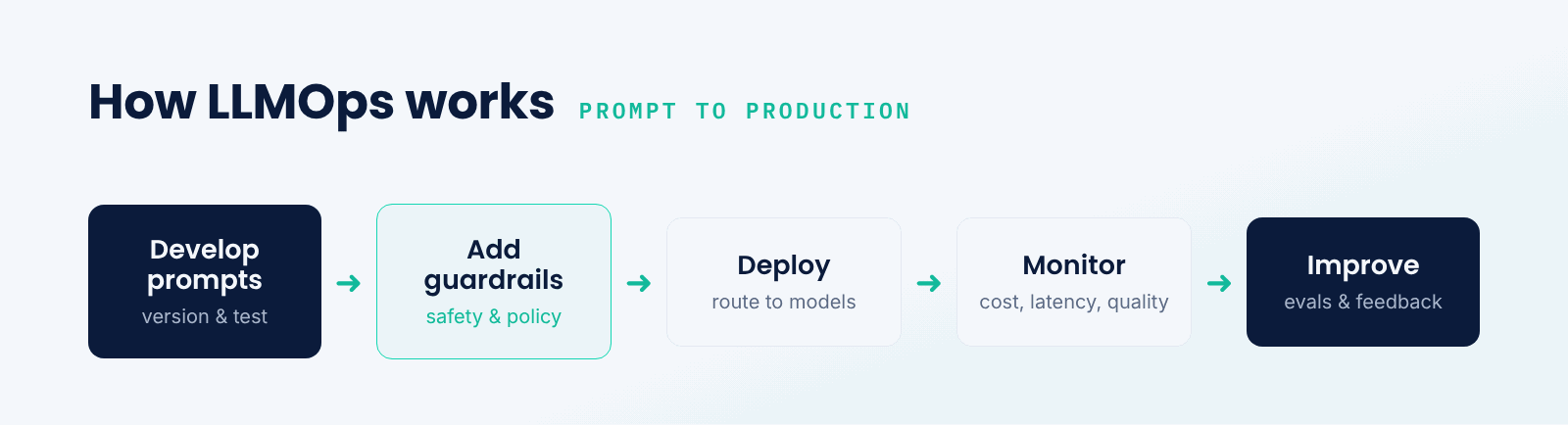
- Develop prompts. Prompts and context strategies are designed, versioned, and tested.
- Add guardrails. Input and output checks enforce safety and policy.
- Deploy. The application is rolled out, often routing to one or more models.
- Monitor. Quality, cost, latency, and safety of live traffic are tracked.
- Improve. Evaluation and feedback drive prompt and configuration changes.
Because you usually do not control the model's weights, improvement in LLMOps comes from changing prompts, context, routing, and guardrails, and measuring the effect, rather than retraining. Evaluation is how you know a change actually helped.
LLMOps vs. MLOps
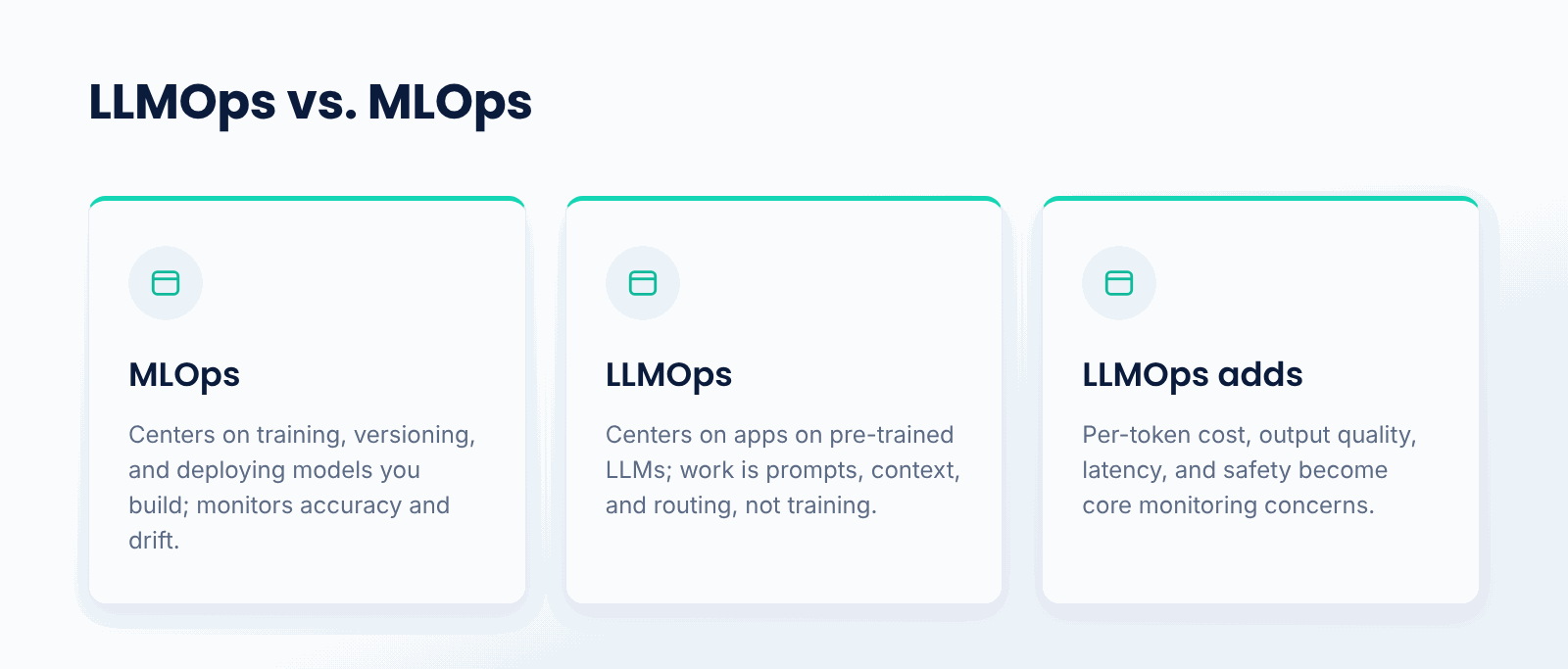
LLMOps is a specialization of MLOps. MLOps centers on training, versioning, and deploying models you build, with monitoring focused on accuracy and drift. LLMOps centers on applications built on pre-trained LLMs, so the work is prompts, context, and routing rather than training, the cost model is per-token, and monitoring adds output quality, safety, and spend.
They share the operational backbone, automation, versioning, monitoring, and continuous improvement. LLMOps simply applies it to a world where the model is a given and the leverage is in how you use it.
Why does LLMOps matter?
- Controls cost. Token-based pricing makes monitoring and limiting spend essential.
- Ensures quality. Evaluation keeps outputs good as prompts and models change.
- Enforces safety. Guardrails keep outputs within policy at scale.
- Manages latency. Operating for responsiveness keeps applications usable.
- Enables iteration. Versioned prompts and evaluation make improvement systematic.
What are the challenges?
- Evaluation is hard. Judging open-ended output quality is harder than scoring accuracy.
- Cost variability. Token usage and spend can swing with prompts and traffic.
- Fast-moving models. New models and versions require constant adaptation.
- Safety. Keeping outputs safe against evolving misuse takes ongoing effort.
When do you need LLMOps?
You need it once an LLM application moves beyond a prototype to serve real users, incur real cost, or require consistent quality and safety. The more traffic, the more models, and the higher the stakes, the more LLMOps matters.
A quick personal demo needs little of it. But any LLM application in production, where cost, quality, and safety all count, benefits from the practices LLMOps provides.
Best practices for LLMOps
- Version and test prompts the way you version code.
- Monitor cost, latency, quality, and safety of live traffic together.
- Apply input and output guardrails on every request.
- Evaluate changes against a consistent test set before rolling out.
- Route across models so you can balance quality, cost, and availability.
- Use a gateway to centralize routing, guardrails, and monitoring across models.
Conclusion
LLMOps is the practice of operating LLM applications in production, adapting MLOps to the realities of prompts, tokens, cost, latency, guardrails, and evaluation. Because the model usually comes from a provider, the work is in how you use it: managing prompts, controlling cost, enforcing safety, and measuring quality. LLMOps is what keeps LLM applications reliable, safe, and affordable as they scale.
TrueFoundry's AI Gateway gives teams a central layer for LLMOps, routing across models, applying guardrails, and monitoring cost, latency, and quality in one place. As LLM applications grow, LLMOps through a governed gateway is how teams keep them under control.

Govern, Deploy and Trace AI in Your Own Infrastructure
Frequently Asked Questions
What is LLMOps in simple terms?
It refers to the practices involved in running large language model applications in production, managing prompts, cost, latency, safety, and quality, so the application stays reliable and affordable rather than just working in a demo.
How is LLMOps different from MLOps?
MLOps involves creating, deploying, and monitoring models you build, tracking accuracy and drift. LLMOps focuses on applications built on pre-trained LLMs, so the work is prompts, context, routing, cost, and output quality rather than training.
Why is managing cost central to LLMOps?
Because LLMs are typically priced per token, so spend scales with usage and prompt size. Without monitoring and limits, cost can climb quickly, which makes tracking and controlling it a core part of operating LLM applications.
How do you improve an LLM app without retraining?
By changing prompts, context, retrieval, routing, and guardrails, then measuring the effect through evaluation. In most cases you do not control the model's weights, so the leverage lies in how you use the model, not in retraining it.
How does a gateway support LLMOps?
A gateway consolidates routing across models, guardrails, and monitoring of cost, latency, and quality. It provides a single place to operate and govern LLM traffic rather than handling each model and application separately.


- © 2022 ENSEMBLE Technologies



Subscribe to our newsletter
The latest news, articles, and resources sent to your inbox


