


What Are LLM Benchmarks and Why Do They Matter?

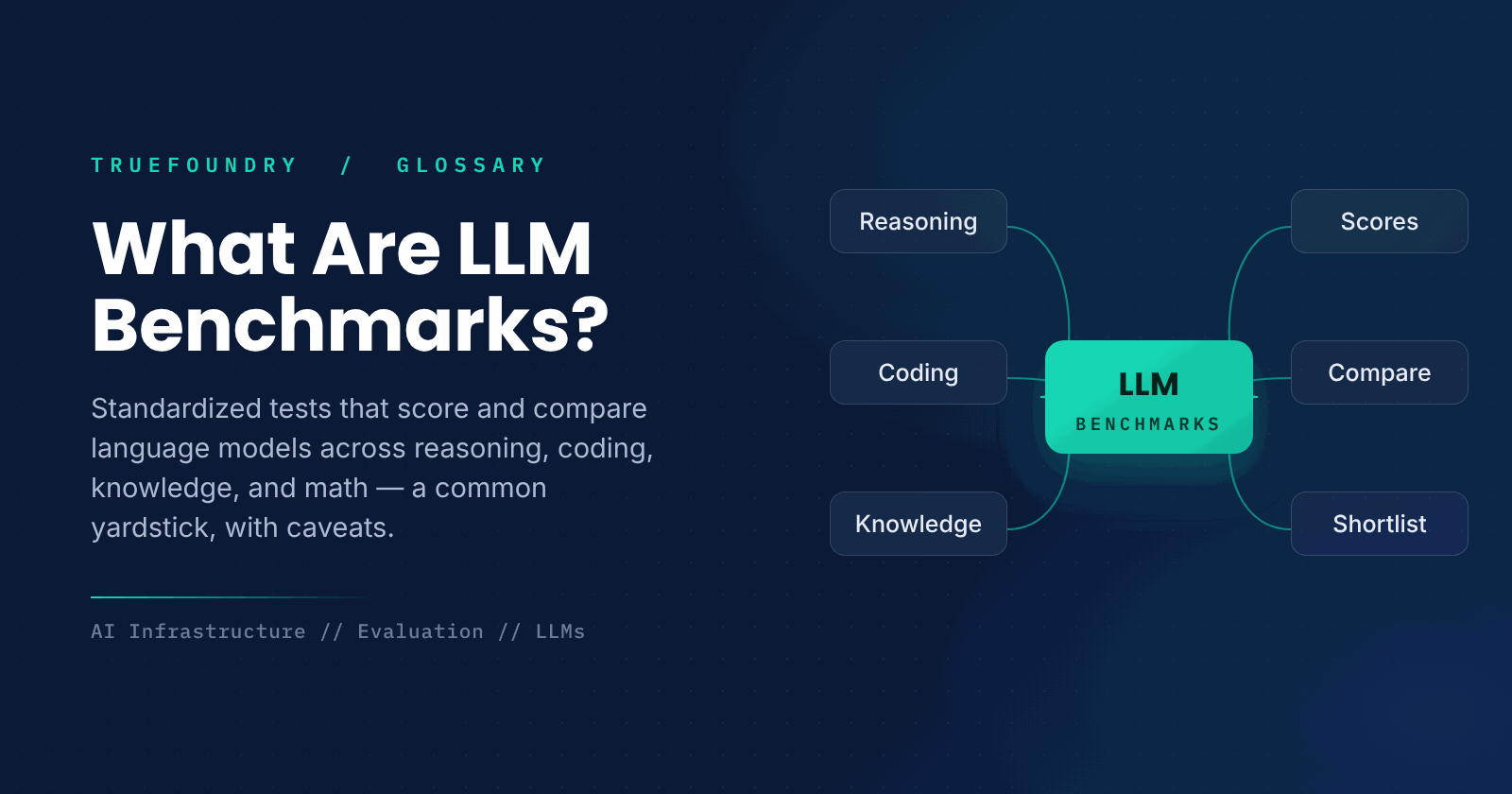
LLM benchmarks are standardized tests that score large language models against one another on dimensions like reasoning, coding, factual knowledge, and mathematical skills. They yield numbers that permit direct comparison between models on a common footing, albeit with real limitations around practical utility and coverage.
LLM benchmark essentials
- LLM benchmarks are standardized evaluations that score model capability.
- They cover tasks ranging from reasoning and programming to knowledge and math.
- They let you compare different models on a common footing.
- They capture only part of real-world usefulness.
- They can be gamed or contaminated, making them far from the entire story.
With new language models appearing constantly, each claiming to be the best, there has to be some common yardstick to compare them. LLM benchmarks are that yardstick: standardized sets of tasks that every model can be run against, producing scores that put very different models on the same scale.
Benchmarks are how the field tracks progress and how teams shortlist models for a use case. But a benchmark score is a narrow measurement, and treating it as the whole truth about a model's quality is a common mistake. Understanding what benchmarks do and do not capture is key to using them well.
This guide explains what LLM benchmarks are, what they measure, how to read them critically, and when to rely on them.
What are LLM benchmarks?
LLM benchmarks are standardized evaluations that measure a language model's performance on defined tasks. Each benchmark is a fixed set of problems with known answers or scoring criteria, so any model can be run against it and assigned a comparable score. Together, a suite of benchmarks paints a picture of a model's strengths across different kinds of tasks.
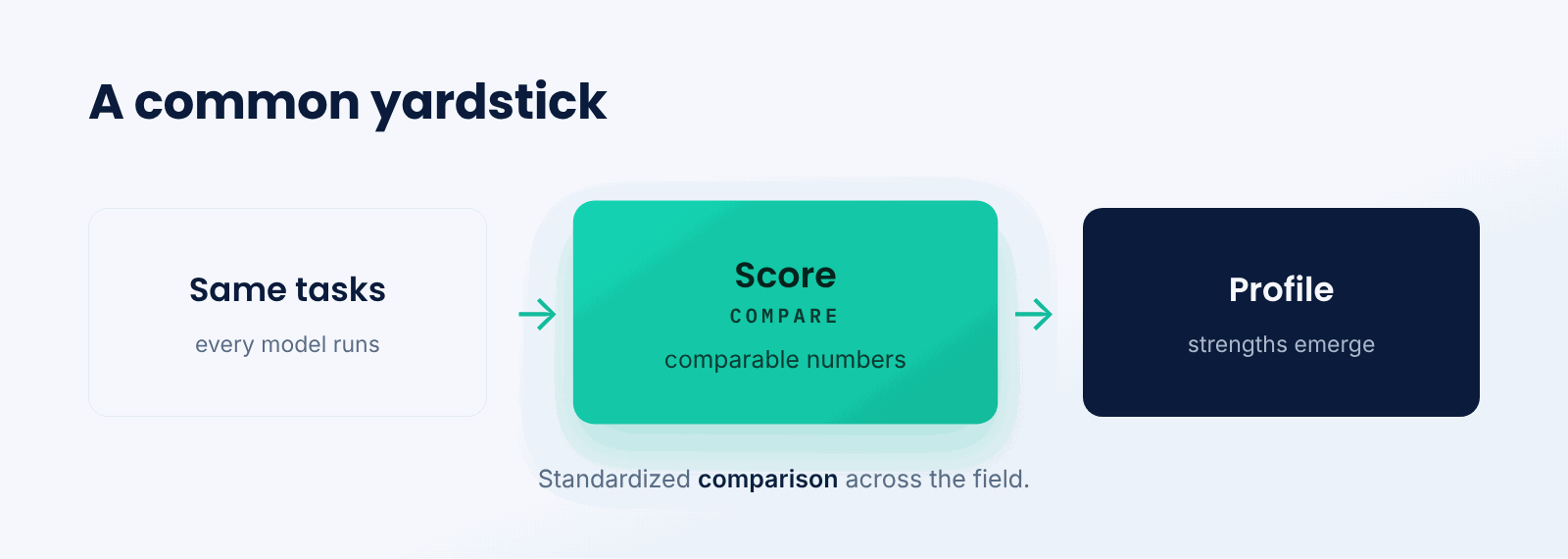
Think of them like standardized exams. A single test score does not capture everything about a student, but it does let you compare many students on the same questions under the same rules. Benchmarks play that role for models, offering a common, repeatable measurement across the field.
The key idea is standardized comparison. Because every model faces the same tasks and scoring, benchmarks make it possible to compare models that were built very differently, which raw demos or anecdotes cannot do.
What do LLM benchmarks measure?
Different benchmarks target different capabilities, and a model's profile emerges from how it does across them.
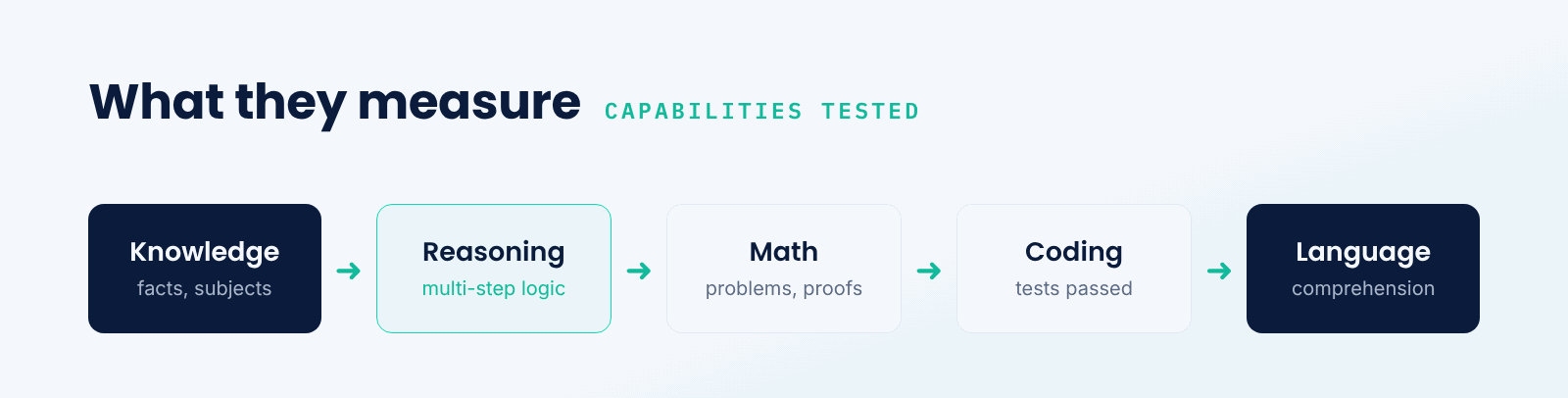
- Knowledge. Factual and academic questions across many subjects.
- Reasoning. Multi-step logical and commonsense problem solving.
- Math. Arithmetic, word problems, and competition-level mathematics.
- Coding. Writing and fixing code against test cases.
- Language. Comprehension, summarization, and instruction following.
No single benchmark covers everything, so models are usually reported across several. A model can be strong on coding but weaker on reasoning, and the full set of scores gives a more honest picture than any one number alone.
Benchmarks vs. real-world performance
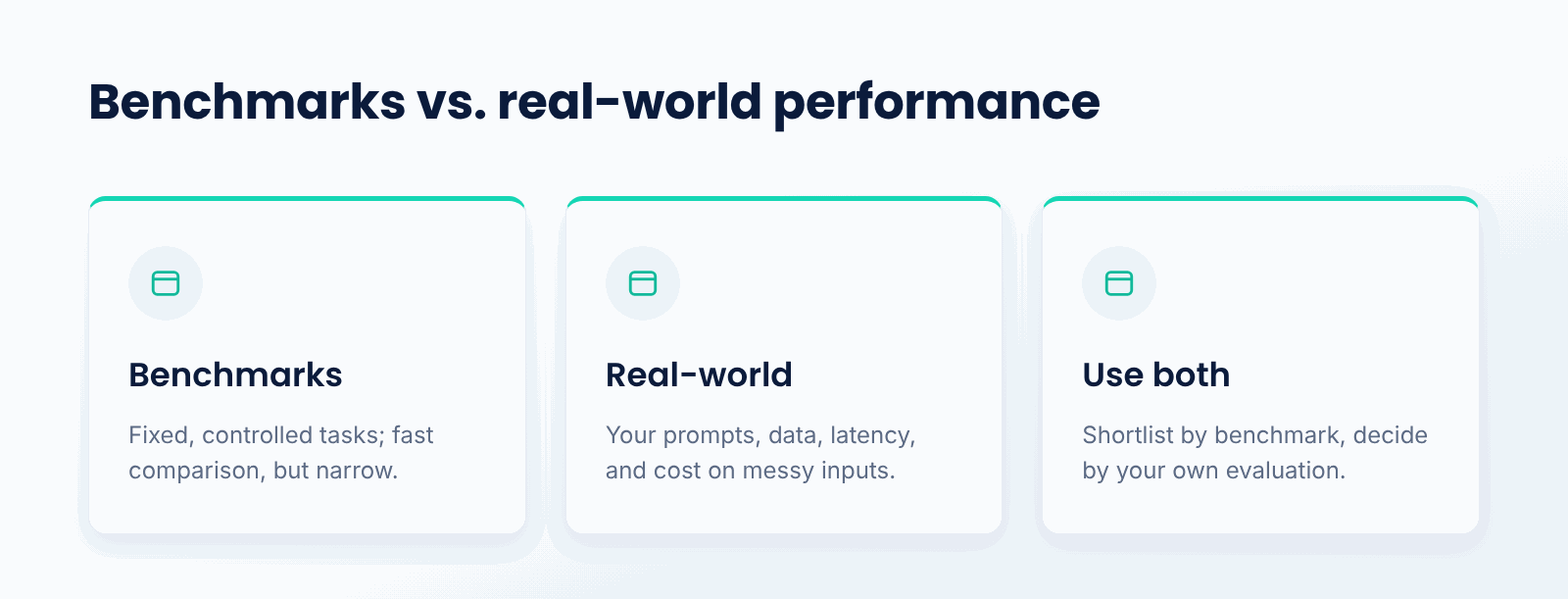
A benchmark measures performance on a fixed, often academic set of tasks under controlled conditions. Real-world performance depends on your specific prompts, data, latency needs, cost, and how the model behaves on the messy inputs your users actually send. High benchmark scores suggest capability but do not guarantee a good fit for your use case.
The two should be used together. Benchmarks are a fast way to shortlist promising models, but the decisive test is evaluating candidates on your own tasks and data. A model that tops a leaderboard may still underperform another on the specific thing you need it to do.
Why do LLM benchmarks matter?
- Comparison. They put different models on a common scale.
- Progress tracking. They show how capabilities improve over time.
- Shortlisting. They help narrow a field of models quickly.
- Transparency. They give public, repeatable measurements.
- Capability profile. A suite reveals a model's relative strengths.
What are the limitations?
- Contamination. Test questions may leak into training data, inflating scores.
- Gaming. Models can be tuned to benchmarks rather than real quality.
- Narrowness. Fixed tasks miss much of real-world use.
- Saturation. Top models cluster near the ceiling, blurring differences.
- Not your task. A benchmark rarely matches your exact use case.
When should you rely on benchmarks?
Use benchmarks to get a quick, comparable sense of models' relative capabilities and to narrow a large field to a few candidates. They are most useful early in selection, when you want a broad read on which models are in the right ballpark for your needs.
Do not let benchmarks make the final decision. Once you have a shortlist, evaluate the models on your own representative tasks and data, where the factors that matter most to you, accuracy on your inputs, latency, and cost, can actually be measured.
Key points about LLM benchmarks
- They are standardized tests scoring model capabilities.
- They span knowledge, reasoning, math, coding, and language.
- They enable comparison on a common footing.
- They can be contaminated or gamed, so read them critically.
- They do not guarantee real-world fit.
- Use them to shortlist, then evaluate on your own tasks.
Conclusion
LLM benchmarks are standardized tests that score and compare models across capabilities like reasoning, coding, knowledge, and math, giving the field a common yardstick for progress and selection. But they capture only part of real-world usefulness and can be contaminated or gamed, so they are best used to shortlist models rather than to make the final call. The decisive test is always your own tasks and data.
TrueFoundry helps teams evaluate, deploy, and serve models on their own infrastructure, including running their own evaluations on real tasks. Benchmarks are a useful starting point, but measuring models on your workload is what truly tells you which one to use.

Govern, Deploy and Trace AI in Your Own Infrastructure
Frequently Asked Questions
What are LLM benchmarks in simple terms?
These are standardized assessments gauging performance on reasoning, coding, and mathematical tasks. All models take the same assessments using the same criteria, producing a consistent set of metrics that allows for direct comparison across drastically different architectures.
What do LLM benchmarks measure?
Diverse capabilities: factual knowledge, reasoning chains, mathematics, code written against test cases, and language comprehension and instruction following. No single benchmark measures all of these at once, so evaluations typically publish model performance across multiple benchmarks to show a full profile.
Do high benchmark scores mean a model is best for me?
Not necessarily. Benchmarks test fixed, generally academic tasks in lab conditions. Your use case involves your prompts, your data, latency requirements, and costs. The highest-performing benchmarked model might fail compared to a second-place finisher in your setting, so you need to run tests yourself.
Why can benchmarks be misleading?
Test prompts can leak into training corpora and inflate the metrics, models can be optimized to the benchmark rather than to real quality, and fixed tasks ignore much of real-world use. Leading models also converge toward a performance ceiling, erasing distinctions that matter.
How should I use benchmarks when choosing a model?
Use them early to establish a comparable read on capabilities and narrow your options. Then evaluate those candidates on your own representative tasks and data, where accuracy on your inputs, latency, and cost can actually be quantified.


- © 2022 ENSEMBLE Technologies



Subscribe to our newsletter
The latest news, articles, and resources sent to your inbox


