


What Is Kubernetes and Why Does It Matter?

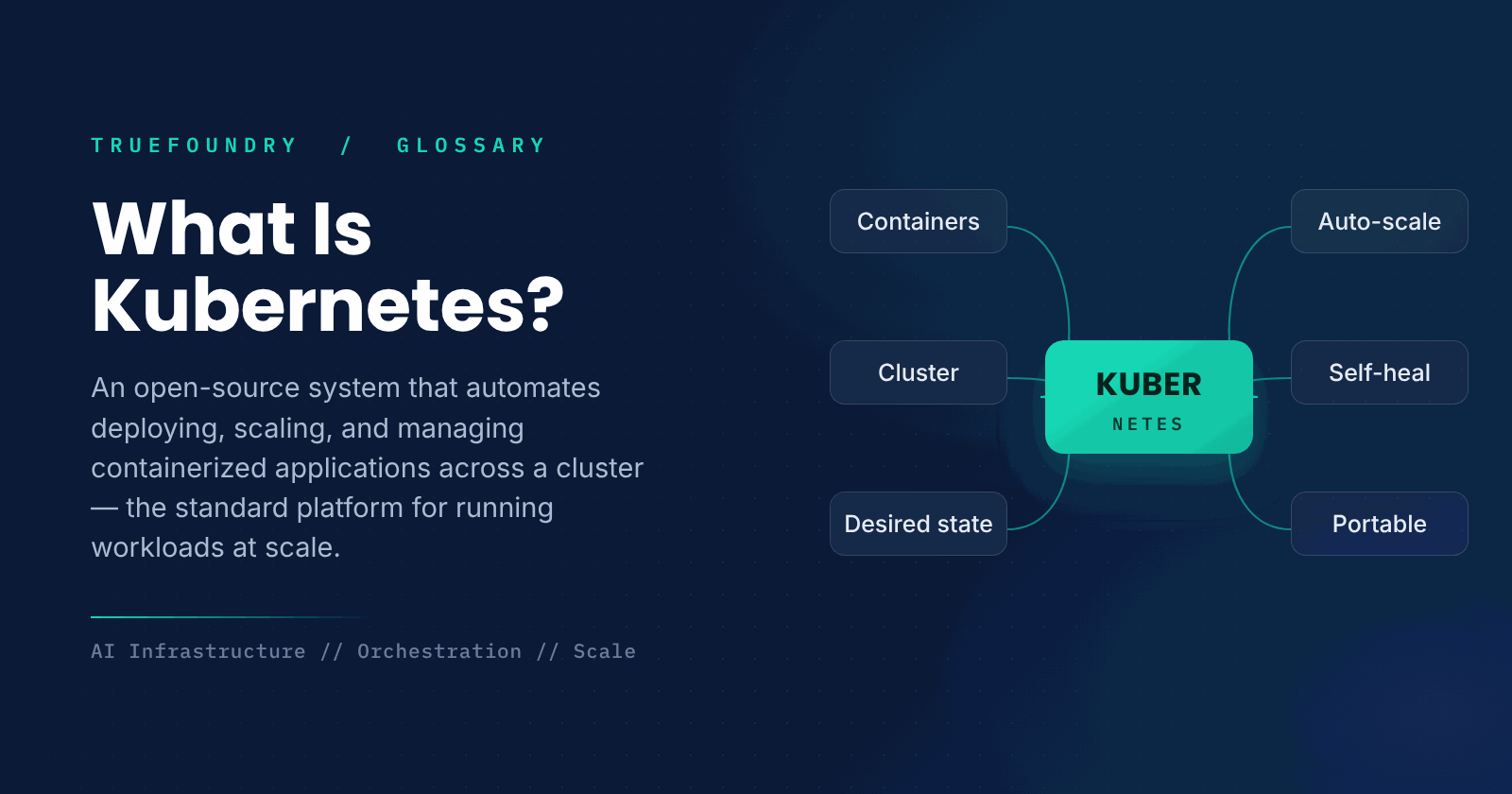
Modern applications are often packaged as containers, lightweight, portable units that bundle code with everything it needs to run. Running a few containers by hand is easy, but running hundreds across many machines, keeping them healthy, scaling them, and recovering from failures, is not. Kubernetes is the system built to automate all of that.
Kubernetes takes your containers and runs them across a cluster of machines, deciding where each one goes, restarting any that fail, and scaling them up or down with demand. You tell it the state you want, and it works to keep reality matching that. It has become the standard way to run applications, including AI workloads, at scale. This guide explains what it is and why it matters.
We will cover the definition, how it works, what it provides, and when to use it.
What is Kubernetes?
Kubernetes is an open-source container orchestration platform that automates deploying, scaling, and managing containerized applications across a cluster of machines. Rather than managing individual containers on individual servers, you give Kubernetes a description of the application you want running, and it schedules the containers, monitors them, and keeps the system in the state you asked for.
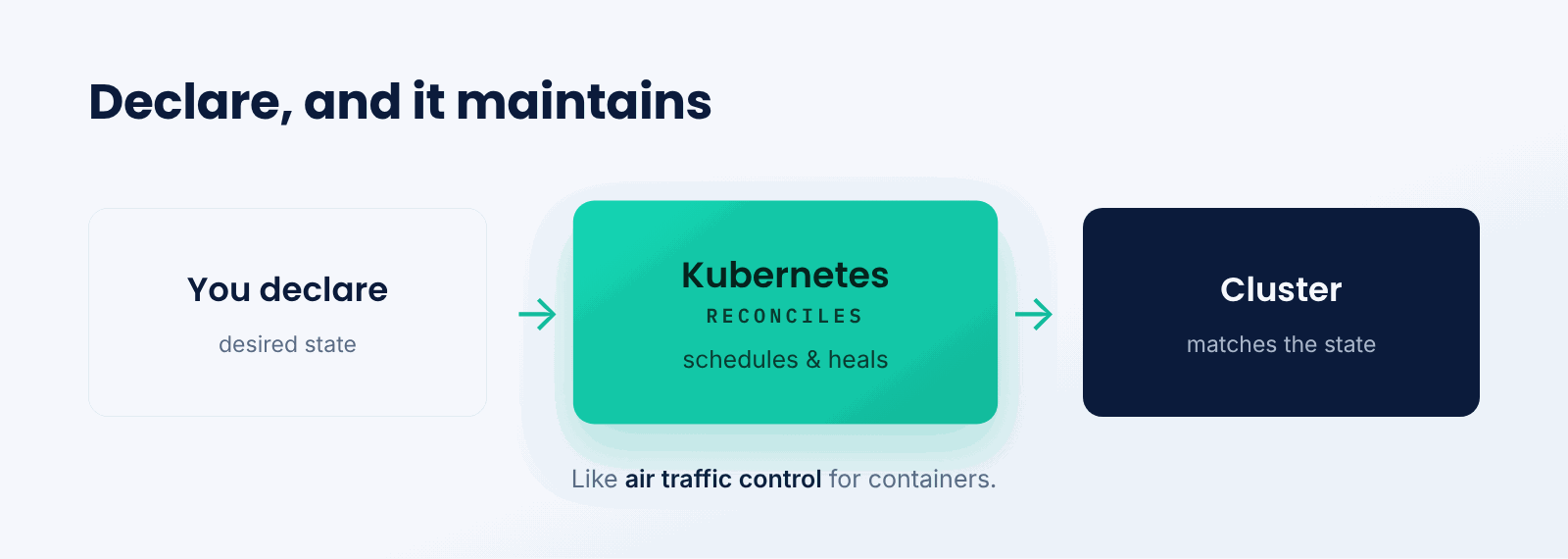
Think of it like an air traffic control system for containers. You do not direct each plane manually; the system decides where everything goes, keeps them from colliding, reroutes around problems, and handles more traffic as it arrives. Kubernetes does this for the containers that make up your applications.
The key idea is declarative, automated orchestration. You declare the desired state, how many copies, how much resource, how they connect, and Kubernetes continuously works to make the actual state match it.
How does Kubernetes work?
You declare a desired state, and Kubernetes schedules and maintains it across the cluster.
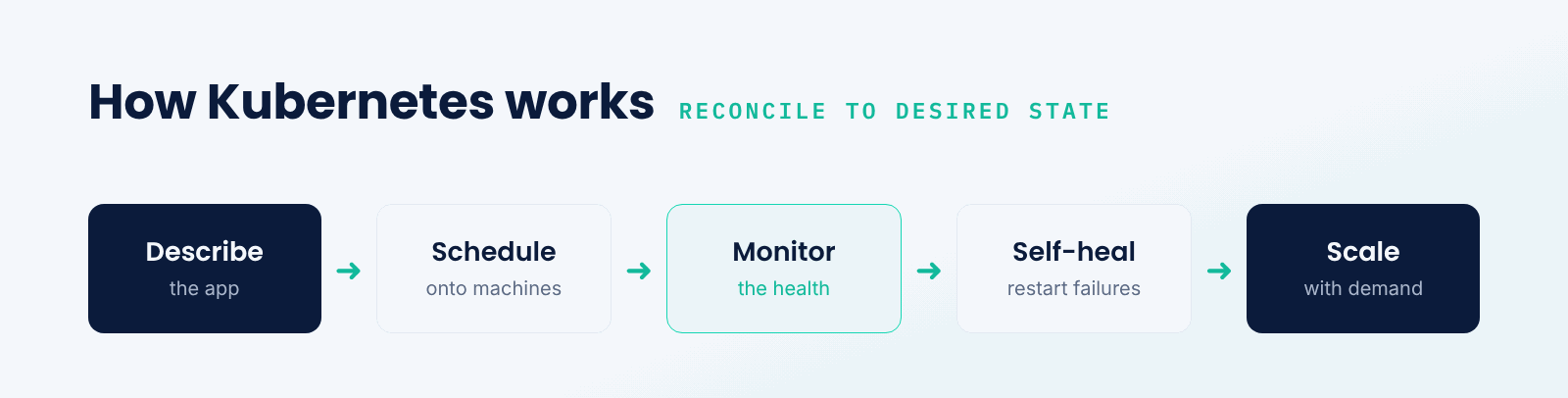
- Describe the app. Declare the containers, counts, and resources you want.
- Schedule. Kubernetes places containers onto machines in the cluster.
- Monitor. It watches the health of everything it is running.
- Self-heal. It restarts or reschedules containers that fail.
- Scale. It adds or removes copies as demand changes.
Kubernetes groups containers into units called pods and runs them across worker machines, all coordinated by a control plane that holds the desired state. Whenever reality drifts from that state, a container crashes, a machine goes down, traffic spikes, Kubernetes acts to restore it, continuously reconciling actual with desired.
What does Kubernetes provide?
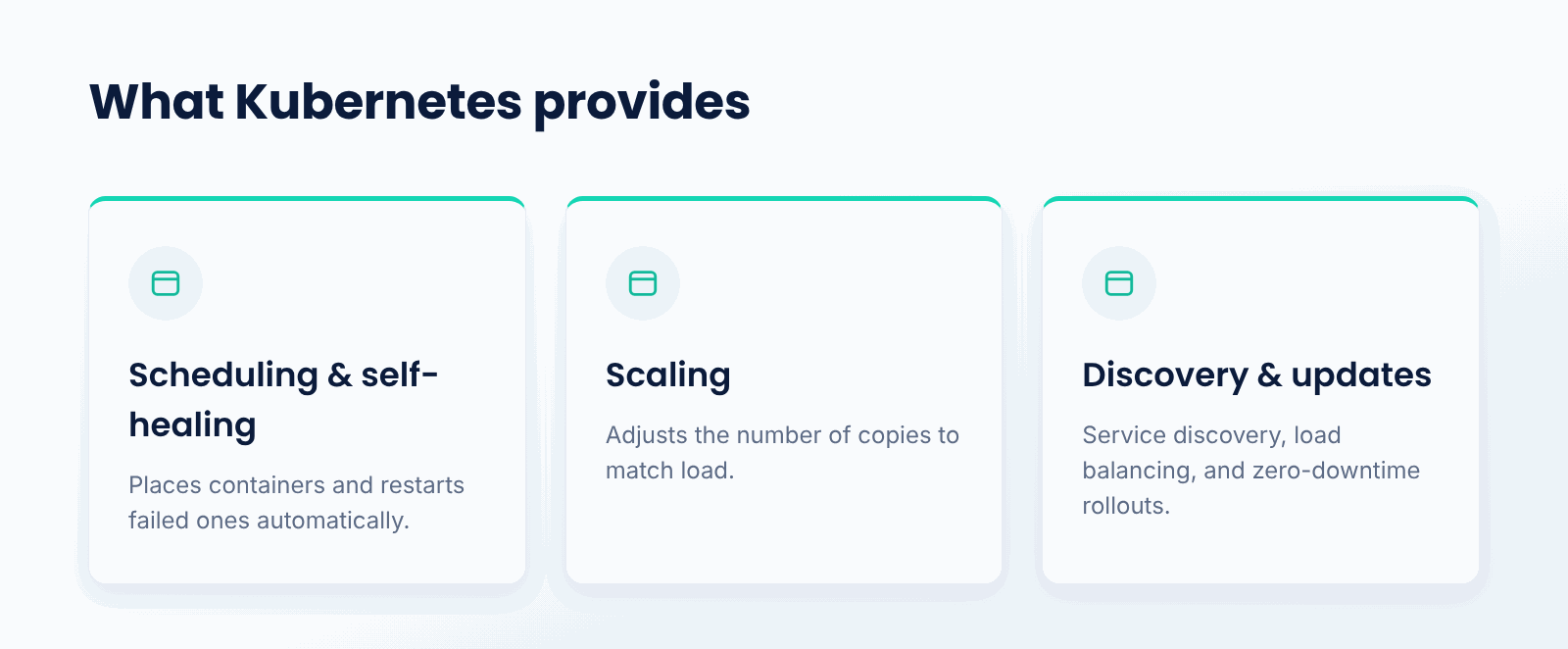
Kubernetes provides several core capabilities. It handles scheduling, placing containers efficiently across machines, and self-healing, restarting failed containers and rescheduling them off broken machines. It provides scaling, adjusting the number of running copies to match load, automatically or on command.
It also handles service discovery and load balancing, so containers can find and distribute traffic to each other, and rolling updates, so new versions can be deployed gradually without downtime. Delivering all of this consistently, across any infrastructure, is what makes Kubernetes the backbone of running applications at scale, at the cost of real operational complexity.
Why does Kubernetes matter?
- Automation. It runs and manages containers without manual effort.
- Reliability. It self-heals and keeps applications running.
- Scalability. It scales applications with demand.
- Portability. It runs the same way across clouds and on-premises.
- Standard. It is the de facto platform for containerized workloads.
What are the challenges?
- Complexity. It is powerful but has a steep learning curve.
- Operations. Running a cluster takes real expertise.
- Overhead. It may be too heavy for very small applications.
- Configuration. Getting settings right requires care.
When should you use Kubernetes?
Use Kubernetes when you run containerized applications that need to scale, stay highly available, or span many machines, which describes most serious production workloads. It is especially valuable for microservices and for AI workloads, where training and serving models benefit from automated scaling and scheduling across GPUs and machines.
For a single small application on one server, Kubernetes may add more complexity than it is worth, and simpler tools suffice. But as scale, reliability, and the number of services grow, Kubernetes becomes the standard foundation for running them.
Key points about Kubernetes
- Kubernetes automates running containers across a cluster.
- You declare the desired state and it maintains it.
- It schedules, scales, and self-heals applications.
- It provides service discovery and rolling updates.
- It runs consistently across clouds and on-premises.
- It is the standard platform for scalable workloads, including AI.
Conclusion
Kubernetes automates the deployment, scaling, and management of containerized applications across a cluster, scheduling containers, keeping them healthy, and scaling them with demand, all from a declaration of the state you want. It has become the standard platform for running applications reliably at scale, including AI workloads, in exchange for real operational complexity. For containerized systems that must scale and stay available, it is the foundation.
TrueFoundry runs on Kubernetes to deploy and scale AI workloads on your own infrastructure, giving you its power for training and serving models without the full burden of managing it. When running AI reliably at scale matters, Kubernetes is the platform underneath.

Govern, Deploy and Trace AI in Your Own Infrastructure
Frequently Asked Questions
What is Kubernetes in simple terms?
It is a system that automatically runs and manages your application's containers across many machines. You specify what you want running, and it decides where to place the containers, scales them according to load, and restarts any that fail, so you do not have to do it by hand.
What problem does Kubernetes solve?
Running many containers across many machines reliably. Doing that coordination by hand is difficult and error-prone. Kubernetes keeps the system in the state you declared, even as containers crash or traffic goes up and down, automating it all for you.
What does Kubernetes actually do?
It allocates containers to machines, monitors their health and restarts failed ones, scales the number of copies based on demand, provides service discovery and load balancing so containers can reach one another, and performs rolling updates so new versions deploy without downtime.
Is Kubernetes good for AI workloads?
Yes. Training and serving models benefit from automated scaling and scheduling across machines and GPUs, which is exactly what Kubernetes provides. This is why many AI platforms run on Kubernetes to deploy and scale models reliably.
When should I use Kubernetes?
When you run containerized applications that must scale, stay highly available, or span many machines, such as microservices or AI workloads. For a single small application on one machine, it may be more complexity than it is worth, and simpler tools suffice.


- © 2022 ENSEMBLE Technologies



Subscribe to our newsletter
The latest news, articles, and resources sent to your inbox


