


What Is a Knowledge Graph and Why Does It Matter?

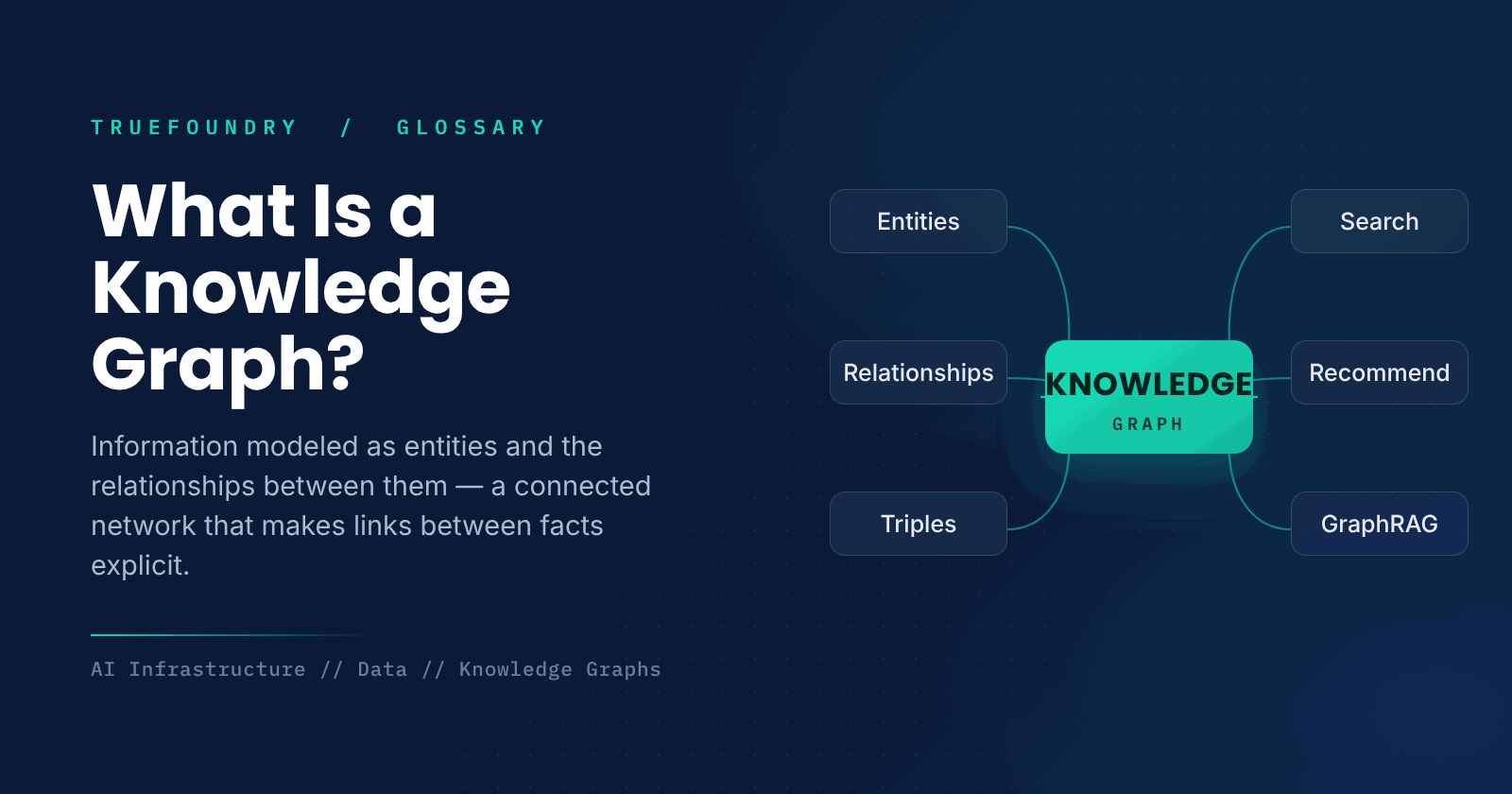
Knowledge graphs are one of the ways used to represent knowledge in terms of entities and the relations between them. As opposed to tables where data is stored in separate rows or documents, a knowledge graph stores information as a network of connected nodes. This makes it easier to trace relationships and answer queries that depend on how things relate.
Knowledge graph essentials
- A knowledge graph represents information as entities and their relationships.
- Entities are the nodes; relationships are the edges between them.
- It reveals the connections between facts, not simply the facts themselves.
- It makes traversing the connections between entities easy.
- It drives search, recommendations, and graph-based RAG.
Most data is stored in ways that record facts but lose the connections between them. A table can tell you a company's founder and a product's maker, but answering how two people are linked through the companies they founded means stitching rows together by hand. A knowledge graph stores those connections directly, as first-class information.
By modeling the world as entities joined by relationships, a knowledge graph makes the links between facts explicit and easy to follow. This structure underlies many systems people use daily, from search engines that understand entities to recommendation systems, and increasingly it powers graph-based approaches to AI retrieval.
This guide explains what a knowledge graph is, how it is structured, how it differs from traditional databases, and where it is used.
What is a knowledge graph?
A knowledge graph is a representation of knowledge as a network of entities and the relationships between them. Each entity, such as a person, place, product, or concept, is a node, and each relationship, such as founded, located in, or works for, is an edge connecting two nodes. The result is a connected structure that captures both facts and how they relate.
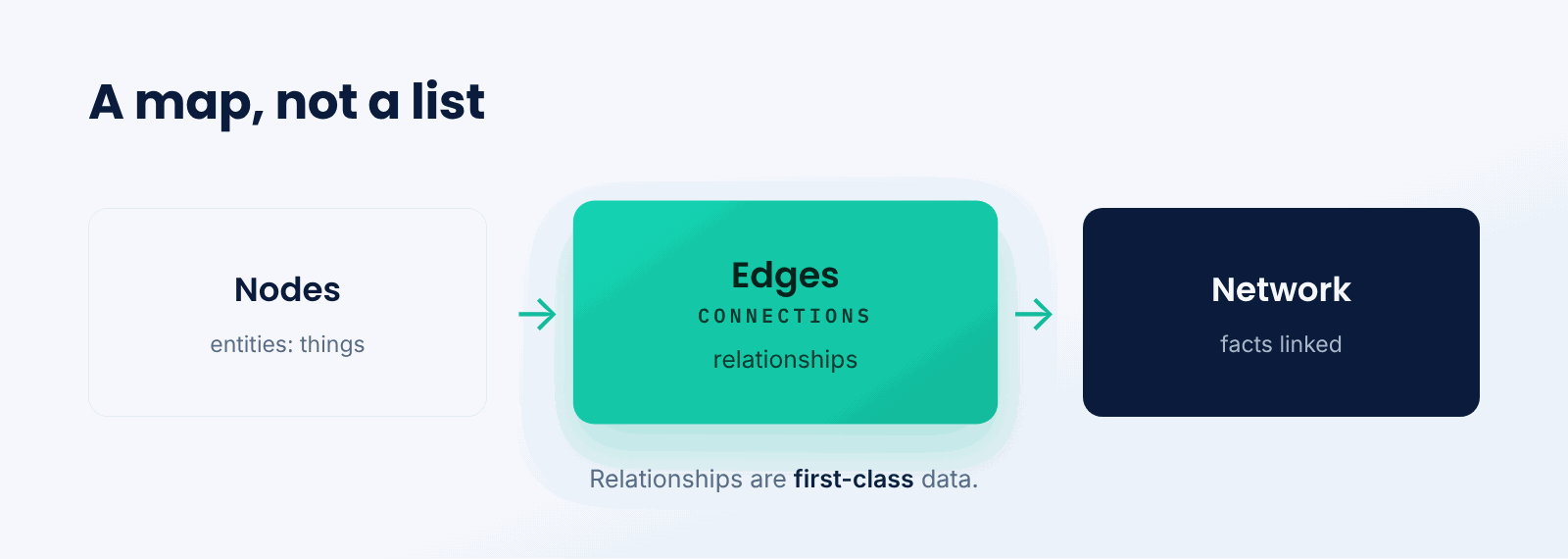
Think of it like a map of relationships rather than a list of facts. A list might tell you separate facts about people and companies, but a map shows the roads between them, so you can trace how one connects to another. A knowledge graph is that map, with entities as places and relationships as the roads.
The key idea is that relationships are stored explicitly. Because connections are first-class data rather than something to reconstruct, you can traverse them directly to answer questions about how entities relate.
How is a knowledge graph structured?
Knowledge graphs are built from simple, repeated building blocks that compose into a rich network.
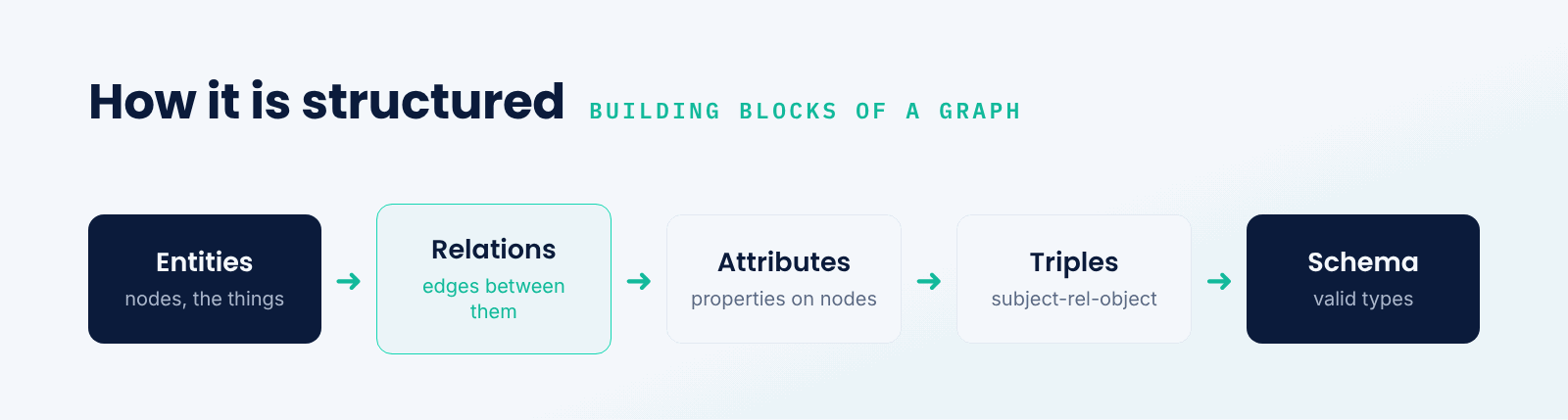
- Entities. The things being described, represented as nodes.
- Relationships. The links between entities, represented as edges.
- Attributes. Properties attached to entities, such as a name or date.
- Triples. Facts expressed as subject-relationship-object, the basic unit.
- Schema. An optional structure defining valid entity and relationship types.
These pieces combine into a graph that can grow organically as new entities and relationships are added. Expressing facts as triples, a subject linked to an object by a relationship, makes the graph both human-readable and efficient to query and traverse.
Knowledge graph vs. traditional database
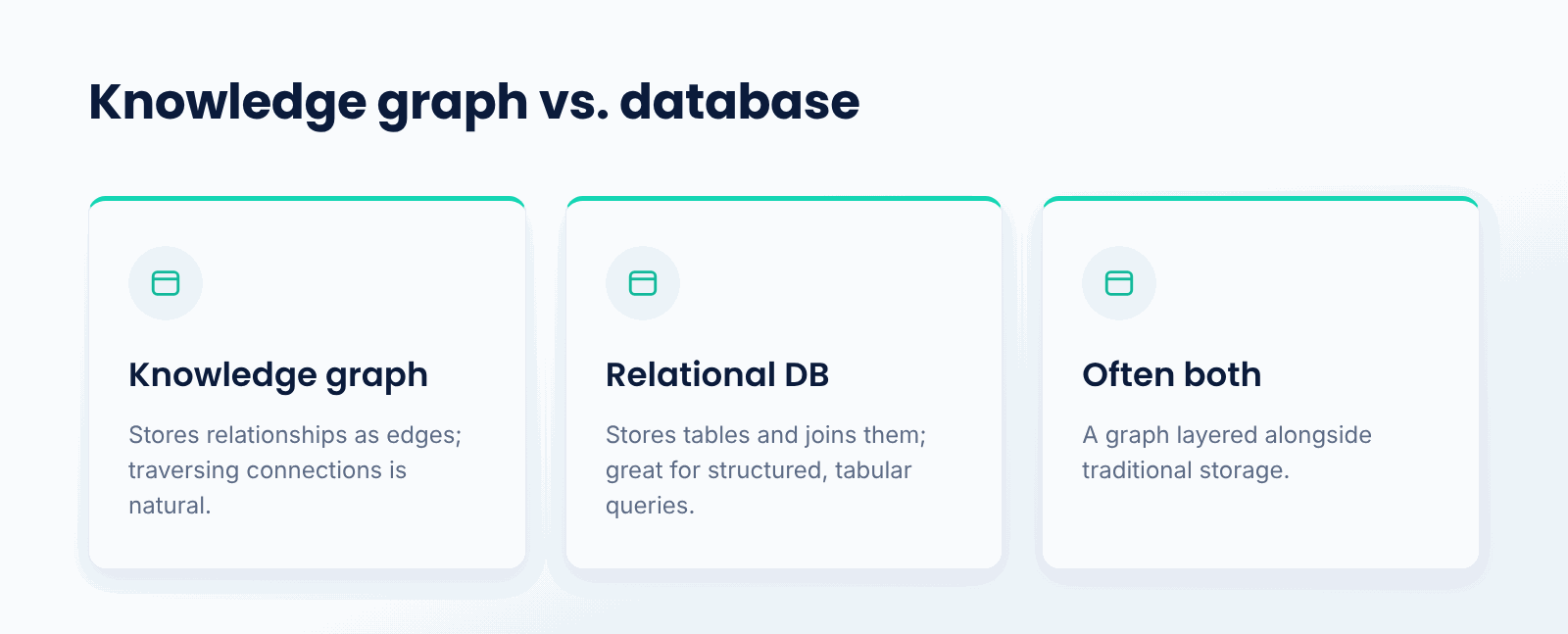
A relational database stores data in tables and joins them when you need to connect records, which is efficient for structured, tabular queries but cumbersome when relationships are deep or variable. A knowledge graph stores relationships directly as edges, so traversing connections, even many hops deep, is natural and fast.
Neither is universally better. Relational databases excel at structured transactions and aggregate queries, while knowledge graphs excel when relationships are central and queries follow chains of connections. Many systems use both, with a graph layered on top of or alongside traditional storage.
Where are knowledge graphs used?
- Search. Understanding entities and their relationships to improve results.
- Recommendations. Connecting users, items, and preferences through relationships.
- GraphRAG. Giving language models connected context for better answers.
- Fraud detection. Spotting suspicious patterns in networks of entities.
- Data integration. Unifying information from many sources into one connected model.
What are the tradeoffs?
- Build effort. Extracting entities and relationships takes work.
- Maintenance. The graph must be kept current as facts change.
- Modeling. Deciding the schema and entity types requires care.
- Not always needed. Simple tabular data may not benefit from a graph.
When should you use a knowledge graph?
Use one when relationships between entities are central to your problem, when you need to traverse connections across many hops, or when you want to integrate information from many sources into a single connected model. These are cases where explicit relationships provide real leverage.
If your data is simple and tabular and your queries do not depend on deep relationships, a traditional database is simpler and sufficient. The knowledge graph pays off specifically when the connections between things carry as much meaning as the things themselves.
Key points about knowledge graphs
- A knowledge graph models entities and their relationships.
- Entities are nodes and relationships are edges.
- Facts are often expressed as subject-relationship-object triples.
- It makes traversing connections direct and efficient.
- It powers search, recommendations, and GraphRAG.
- It is most valuable when relationships are central to the questions.
Conclusion
A knowledge graph represents information as a network of entities connected by relationships, storing the links between facts explicitly rather than leaving them to be reconstructed. This structure makes it easy to traverse connections and answer relationship-driven questions, which is why it underpins search, recommendations, and graph-based RAG. Its cost is the effort of building and maintaining the graph.
TrueFoundry helps teams build AI systems on their own infrastructure, including graph-based retrieval that draws on knowledge graphs for richer context. When relationships matter as much as facts, a knowledge graph is a powerful way to represent what you know.

Govern, Deploy and Trace AI in Your Own Infrastructure
Frequently Asked Questions
What is a knowledge graph in simple terms?
It is a method where information is represented as a collection of interrelated objects. Entities such as persons or products are the nodes, while the connections between them are the edges, which means the graph represents not only the facts but the relationships between them.
What is a triple in a knowledge graph?
Triples form facts in a standardized structure: subject-predicate-object, as in Company founded-by Person. A triple connects two entities via their shared relationship, and multiple triples construct the connected network that forms the graph.
How is a knowledge graph different from a database?
Relational databases hold information within tables and relate those tables through joins, so dealing with nested relationships quickly becomes painful. In a knowledge graph, however, the relationship exists as an edge, so following arbitrary paths through those relationships happens efficiently by construction.
What is a knowledge graph used for?
Search engines use them for entity understanding, recommenders for matching users and items, and GraphRAG to give language models connected context. They also help fraud-detection systems spot complex patterns and unify data from disparate sources into a single, integrated model.
When should I use a knowledge graph?
When relationships between entities matter, when queries travel through lots of connections, or when disparate sources need to be stitched together. When data is tabular and straightforward, with few relationships involved, a conventional database suffices.


- © 2022 ENSEMBLE Technologies



Subscribe to our newsletter
The latest news, articles, and resources sent to your inbox


