


What Is Instruction Tuning and Why Does It Matter?

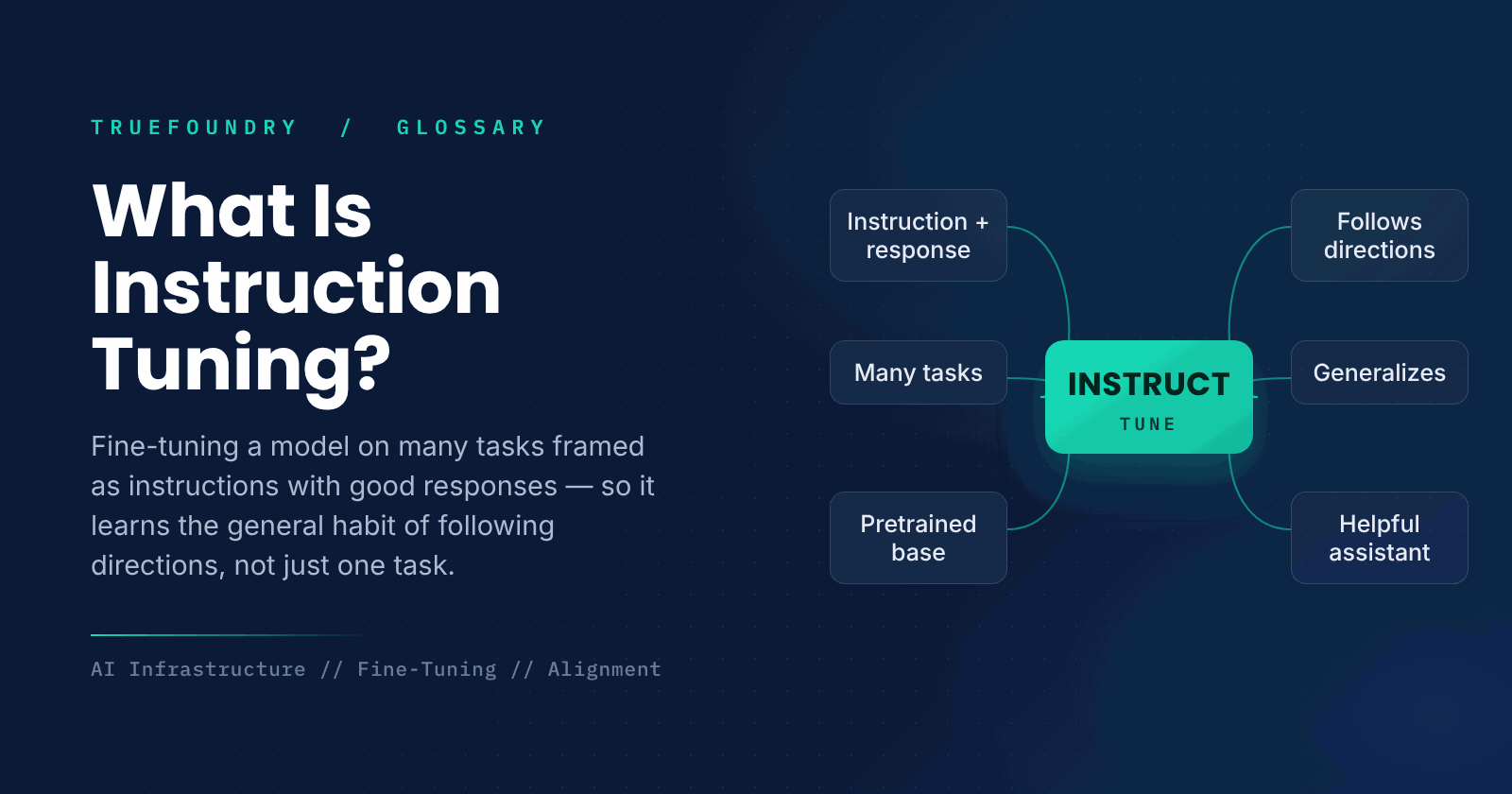
A pretrained language model can continue text, but it does not naturally do what you ask. If you give it an instruction, it might answer, or it might just continue the instruction as if it were part of a document. Instruction tuning fixes this by teaching the model, across many examples, to treat an instruction as something to carry out.
The difference from ordinary fine-tuning is breadth. Instead of training on one task, instruction tuning uses a diverse mix of tasks all framed as instructions with good responses, so the model learns the general habit of following directions. This is a key step in turning a raw model into a helpful assistant. This guide explains what it is and how it works.
We will cover the definition, the process, how it relates to fine-tuning and preference tuning, and when to use it.
What is instruction tuning?
Instruction tuning is a form of supervised fine-tuning that trains a language model on a broad collection of examples, each consisting of an instruction and a high-quality response. By learning from many different instructions across many tasks, the model learns to follow instructions in general, rather than mastering any single task in isolation.
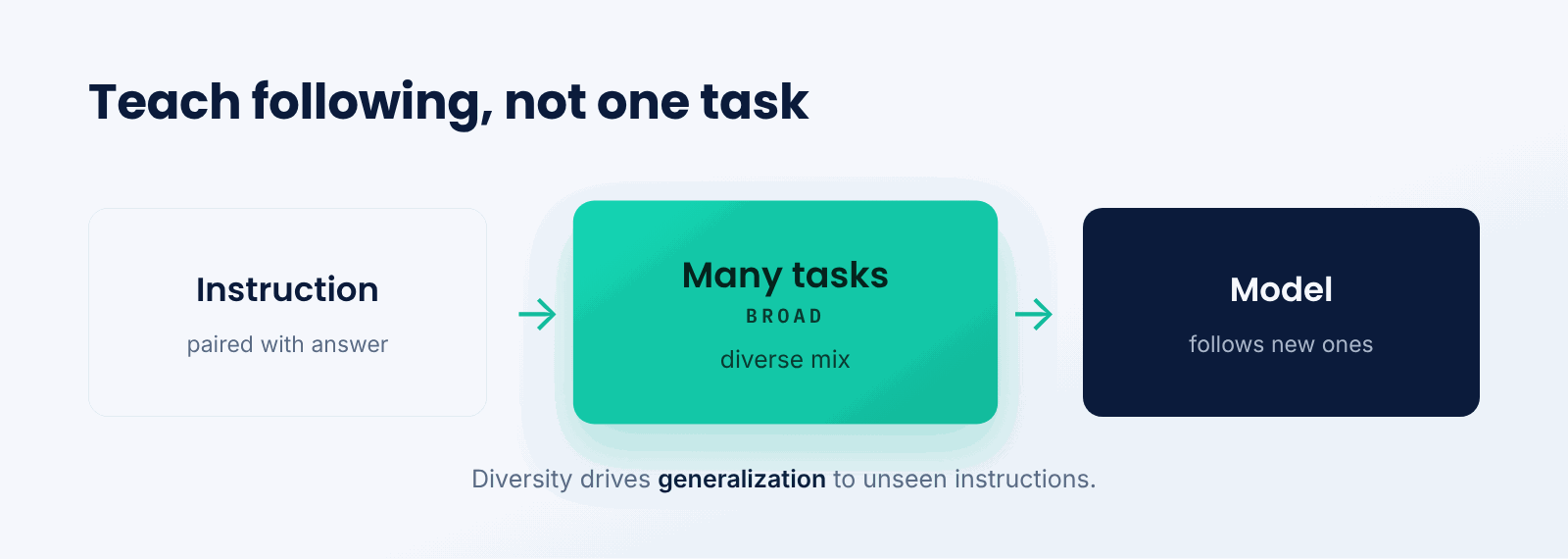
Think of it like training a new employee to follow directions rather than to do one specific job. If you only ever showed them one task, they would learn that task. By walking them through many kinds of requests, they learn the general skill of understanding and acting on instructions, which transfers to requests they have never seen.
The key idea is generalization through diversity. Because the training spans many tasks phrased as instructions, the model learns the underlying pattern of instruction-following and applies it to new instructions at inference time.
How does instruction tuning work?
Instruction tuning fine-tunes on a diverse set of instruction-response pairs.
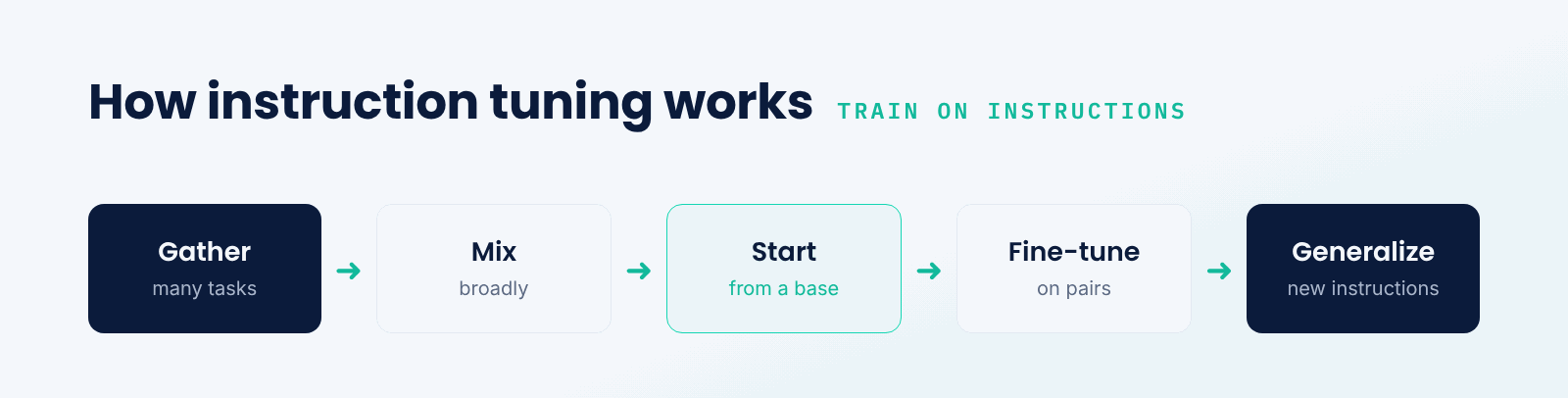
- Gather tasks. Collect many tasks framed as instructions with good answers.
- Mix broadly. Combine diverse instructions so no single task dominates.
- Start from a base. Begin with a pretrained model.
- Fine-tune. Train the model to produce the response for each instruction.
- Generalize. The model learns to follow new instructions it has not seen.
Mechanically this is supervised fine-tuning, but the dataset is deliberately broad and instruction-shaped. The diversity is what matters: by seeing many kinds of instructions, the model learns the general behavior of following directions, which is why instruction-tuned models handle requests far beyond their training examples.
Instruction tuning vs. fine-tuning vs. preference tuning
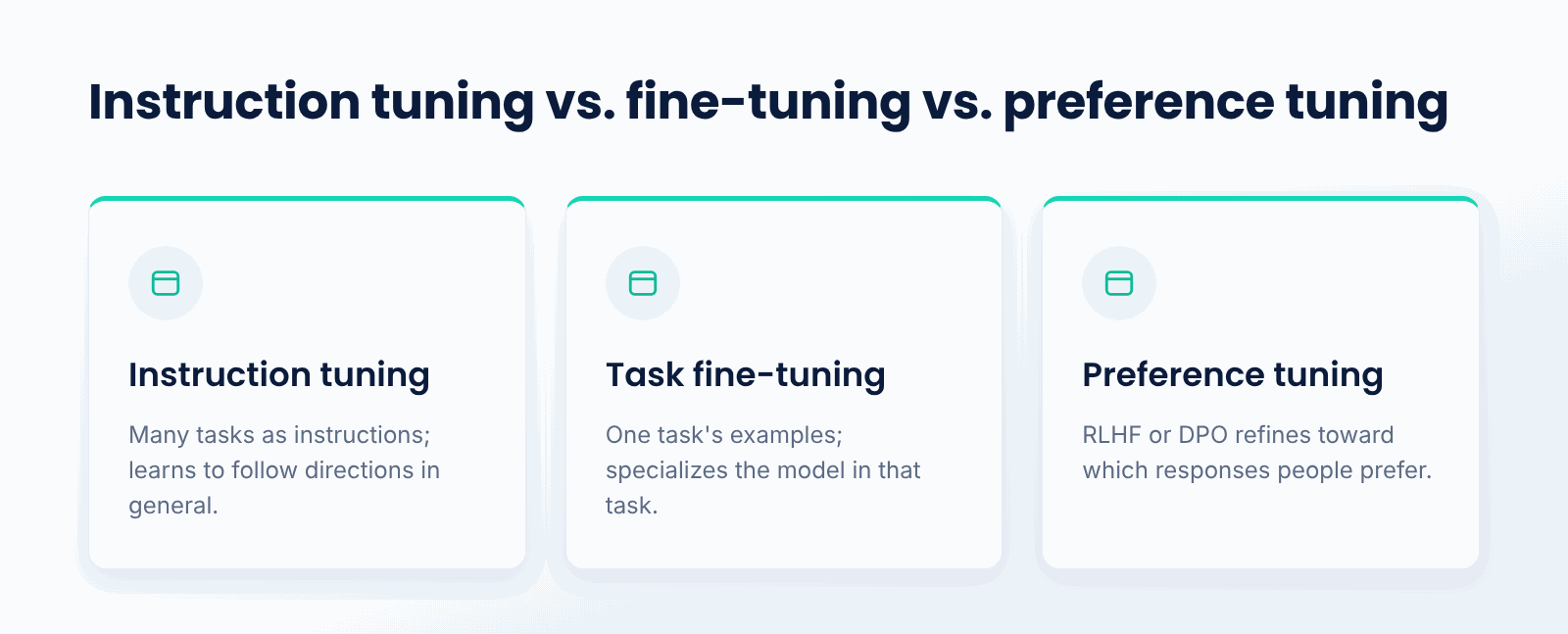
Task-specific fine-tuning trains a model to do one job well, using examples of that single task. Instruction tuning is a broad form of fine-tuning that uses many tasks framed as instructions, so the model learns to follow instructions in general rather than specialize in one. It is the step that makes a model broadly helpful.
Preference tuning, such as RLHF or DPO, usually comes after instruction tuning. It refines the model toward which responses people prefer, improving tone, helpfulness, and safety. Instruction tuning teaches the model to follow directions; preference tuning polishes how well it does so against human preferences.
Why does instruction tuning matter?
- Usability. It turns a raw model into one that follows instructions.
- Generalization. It helps the model handle instructions it has not seen.
- Breadth. One tuned model handles many kinds of tasks.
- Foundation. It is a base for later preference tuning.
- Helpfulness. It makes models behave like useful assistants.
What are the challenges?
- Data diversity. It needs a broad, high-quality mix of instructions.
- Quality. Poor responses teach poor instruction-following.
- Balance. Over-representing some tasks skews the model.
- Not alignment. It teaches following, not human preferences, by itself.
When should you use instruction tuning?
Use instruction tuning when you want a model that follows instructions across a wide range of tasks, rather than one that does a single task. It is the standard step for building a general-purpose assistant from a pretrained model, and it is what gives instruction-following models their broad usefulness.
If you only need a model for one narrow task, task-specific fine-tuning may be simpler and more effective. But for broad, instruction-following behavior, instruction tuning is the method that gets you there, often followed by preference tuning for further polish.
Key points about instruction tuning
- Instruction tuning trains a model to follow instructions in general.
- It fine-tunes on many diverse instruction-response pairs.
- Diversity is what drives generalization to new instructions.
- It turns a raw model into a helpful assistant.
- It usually precedes preference tuning like RLHF or DPO.
- It is ideal for building a general-purpose instruction follower.
Conclusion
Instruction tuning fine-tunes a language model on many tasks framed as instructions with good responses, teaching it the general habit of following directions rather than one specific task. The diversity of the training is what lets it generalize to new instructions, and it is the step that turns a raw model into a helpful, instruction-following assistant. It usually precedes preference tuning for further refinement.
TrueFoundry helps teams fine-tune and serve models on their own infrastructure, including instruction tuning that makes base models broadly useful. When you need a model that reliably follows directions across many tasks, instruction tuning is where that behavior comes from.

Govern, Deploy and Trace AI in Your Own Infrastructure
Frequently Asked Questions
What is instruction tuning in simple terms?
It entails training a language model on many examples of instructions and their good responses, so it learns to follow instructions in general. Rather than training it to perform any particular task, it teaches the habit of following directions, which turns a raw model into a helpful assistant.
How is instruction tuning different from regular fine-tuning?
In regular fine-tuning, the model is trained on one particular task. Instruction tuning, on the other hand, is a more generalized method of fine-tuning that uses numerous tasks framed as instructions, so the model learns to follow instructions in general rather than specialize in a single task.
How is instruction tuning different from RLHF?
Instruction tuning trains the model to follow directions using examples of instructions and their good responses. RLHF and other preference tuning come later, refining the model toward which answers people prefer. One teaches following; the other polishes how well it is done.
Why does diversity matter in instruction tuning?
Because the model generalizes from the diversity it observes. Training on many kinds of instructions teaches the underlying skill of following directions, so the model can handle instructions it was never shown. A narrow dataset would only teach a narrow set of behaviors.
When should I use instruction tuning?
When you want a model that follows instructions across a wide range of tasks, like a general-purpose assistant. If you only need one narrow task, task-specific fine-tuning may be simpler. For broad instruction-following, instruction tuning is the standard approach.


- © 2022 ENSEMBLE Technologies



Subscribe to our newsletter
The latest news, articles, and resources sent to your inbox


