


What Is Hybrid Search and Why Does It Matter?

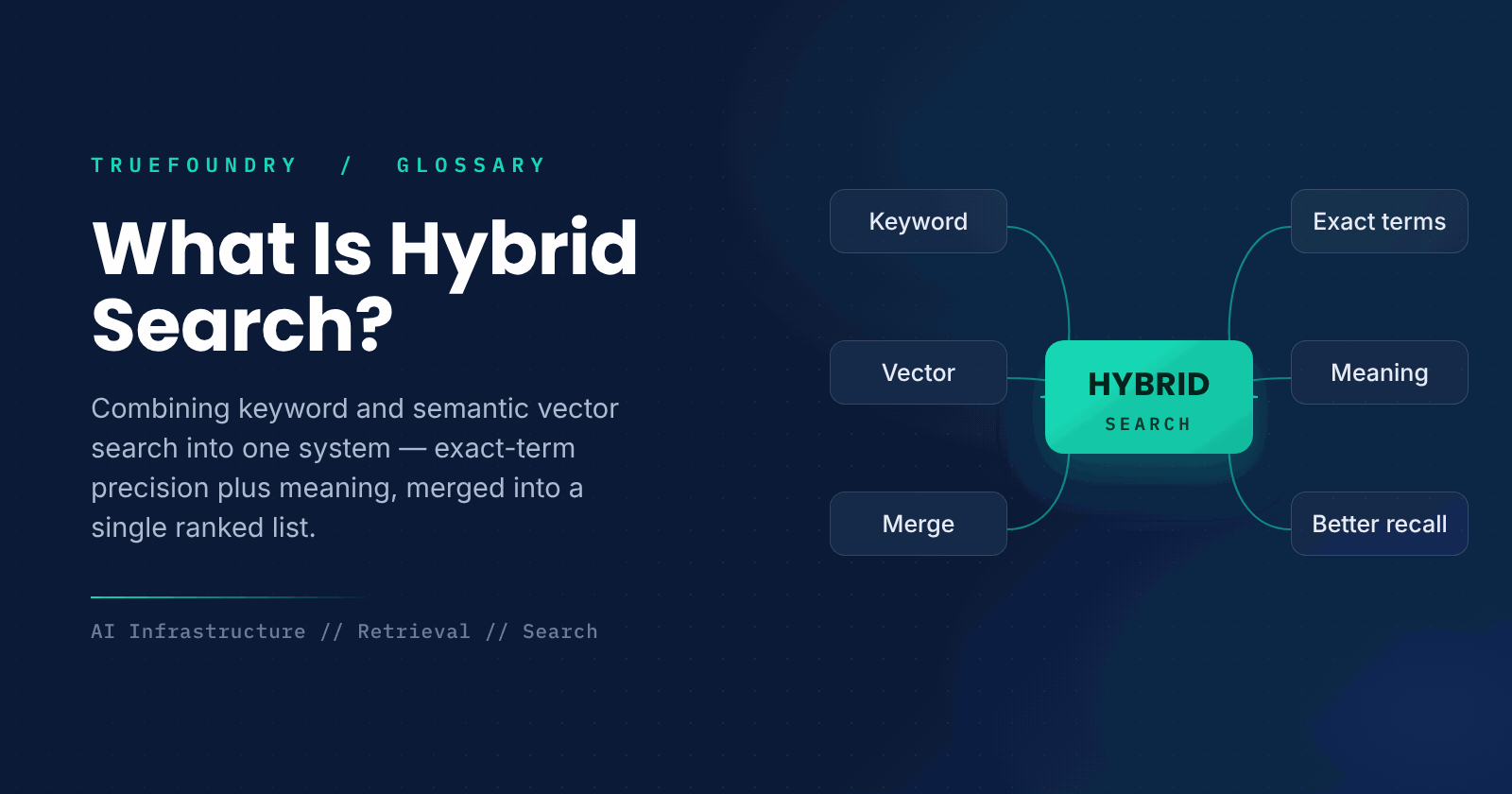
Search has two classic failure modes. Keyword search misses documents that mean the same thing in different words, and pure semantic search can overlook an exact term, a product code, or a rare name that a user typed precisely. Hybrid search fixes both by running both kinds of search and combining what they find.
The approach has become a default for serious retrieval systems, including those feeding retrieval-augmented generation. By blending lexical precision with semantic understanding, hybrid search returns results that are both literally and conceptually relevant, which is hard to achieve with one method on its own.
This guide explains what hybrid search is, how it combines two retrieval methods, how it compares to using either alone, and when it is worth the added complexity.
What is hybrid search?
Hybrid search is a retrieval approach that runs two complementary methods at once, keyword (lexical) search and semantic (vector) search, and merges their results into one ranked list. Keyword search matches the exact words in a query, while vector search compares embeddings to find documents with similar meaning even when the words differ.
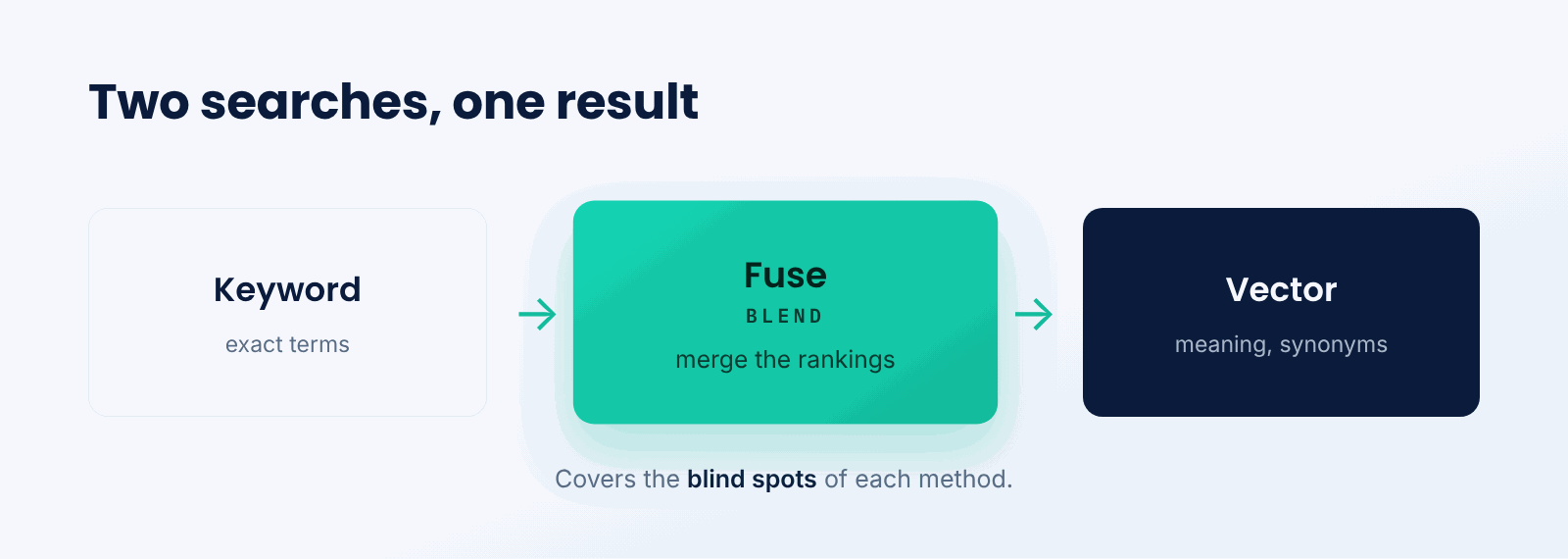
Think of it like asking two different experts. One is a meticulous librarian who finds every document containing your exact phrase; the other is a subject expert who understands what you really mean and finds related material even in different words. Hybrid search consults both and combines their recommendations into a single answer.
The key idea is complementary strengths. Keyword search is precise on exact and rare terms but blind to meaning; vector search understands meaning but can miss literal matches. Combining them covers the weaknesses of each.
How does hybrid search work?
A hybrid system retrieves with both methods and then fuses the two result sets.

- Query comes in. The same query is sent to both search methods.
- Keyword search. A lexical index finds documents with matching terms.
- Vector search. Embeddings find documents with similar meaning.
- Merge scores. The two result sets are combined with a fusion method.
- Return ranked. The merged, reranked list is returned to the model or user.
The fusion step is where hybrid search earns its value. Techniques like reciprocal rank fusion or weighted score combination blend the two rankings so that documents strong in either method, or both, rise to the top. Tuning this balance adapts the system to a given domain.
Hybrid vs. keyword-only vs. vector-only
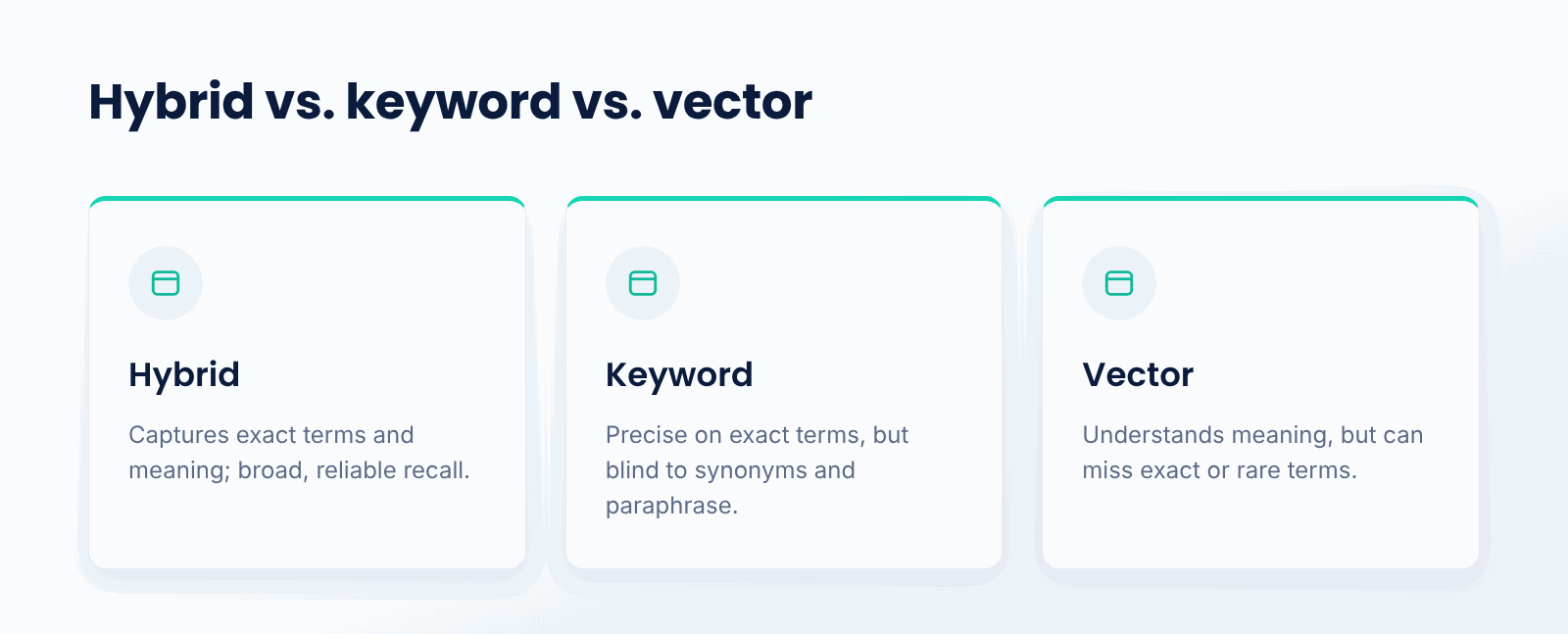
Keyword-only search is fast and precise on exact terms but fails on synonyms and paraphrases. Vector-only search understands meaning and handles paraphrasing well but can miss exact matches, especially rare terms, codes, or names. Hybrid search captures both, trading a little added complexity for broader, more reliable recall.
For many real workloads, queries are a mix: some hinge on an exact term, others on meaning. A single method handles one case well and the other poorly, while hybrid search handles both. That is why it has become the default for retrieval systems that must perform across varied queries.
Why does hybrid search matter?
- Better recall. It finds relevant results that one method alone would miss.
- Exact and semantic. It handles both literal terms and meaning.
- Robustness. It performs well across a wide variety of query types.
- Stronger RAG. It feeds more relevant context into generation.
- Fewer gaps. It reduces the blind spots of either method.
What are the tradeoffs?
- More complexity. It runs and maintains two retrieval systems.
- Fusion tuning. The method for merging results must be chosen and tuned.
- Added latency. Running both searches can take longer than one.
- Infrastructure. It needs both a lexical index and a vector store.
When should you use hybrid search?
Use it when queries vary, some needing exact term matching and others needing semantic understanding, which describes most real search and RAG workloads. It is especially valuable when exact terms matter, such as product names, codes, or technical jargon, alongside natural-language questions.
If your queries are uniformly one type, a single method may suffice: pure keyword search for strictly literal lookup, or pure vector search for purely semantic matching. But for the common mixed case, hybrid search's broader coverage usually justifies the extra complexity.
Key points about hybrid search
- It combines keyword and vector search.
- Keyword handles exact terms; vector handles meaning.
- Results are merged with a fusion method.
- It improves recall across varied queries.
- It is a default for modern RAG pipelines.
- It adds complexity and needs both index types.
Conclusion
Hybrid search combines keyword and semantic vector search, merging their results so that both exact terms and meaning are covered. Because real queries mix literal and conceptual intent, hybrid search delivers broader, more reliable recall than either method alone, which is why it has become standard in retrieval and RAG. Its cost is the added complexity of running and tuning two systems.
TrueFoundry helps teams build and serve retrieval and RAG pipelines on their own infrastructure, including hybrid search that blends lexical and semantic retrieval. When search quality matters, combining both methods is often the most reliable path.

Govern, Deploy and Trace AI in Your Own Infrastructure
Frequently Asked Questions
What is hybrid search in simple terms?
This involves running the keyword-based and the vector-based search processes simultaneously and then combining their results. Keyword search works by identifying exact words, while vector search works by identifying similarity of meaning, so together they find more relevant results than either alone.
Why combine keyword and vector search?
This is because both have their blind spots. Keyword search doesn't recognize synonyms and paraphrases, whereas vector search can miss exact terms like codes and rare names. By using both, you ensure that literal and conceptual queries are handled well.
How are the two result sets merged?
Through a fusion step, for instance reciprocal rank fusion or a weighted combination of scores, which blends the two rankings into one. Documents that perform well using one or both methods end up on top, and the balance can be tuned per domain.
Is hybrid search always better than vector search?
Generally for mixed queries, since it adds exact-term matching that may escape vector-based search. However, if all your queries are purely semantic, vector search alone might do, without the added complexity of hybrid search.
Does hybrid search help RAG?
Yes. The quality of a RAG model's answers relies on the relevance of the retrieved documents, and a hybrid approach increases recall across different kinds of queries, so the model receives better context. That generally leads to more accurate and useful generated answers.


- © 2022 ENSEMBLE Technologies



Subscribe to our newsletter
The latest news, articles, and resources sent to your inbox


