


What Is Groundedness and Why Does It Matter?

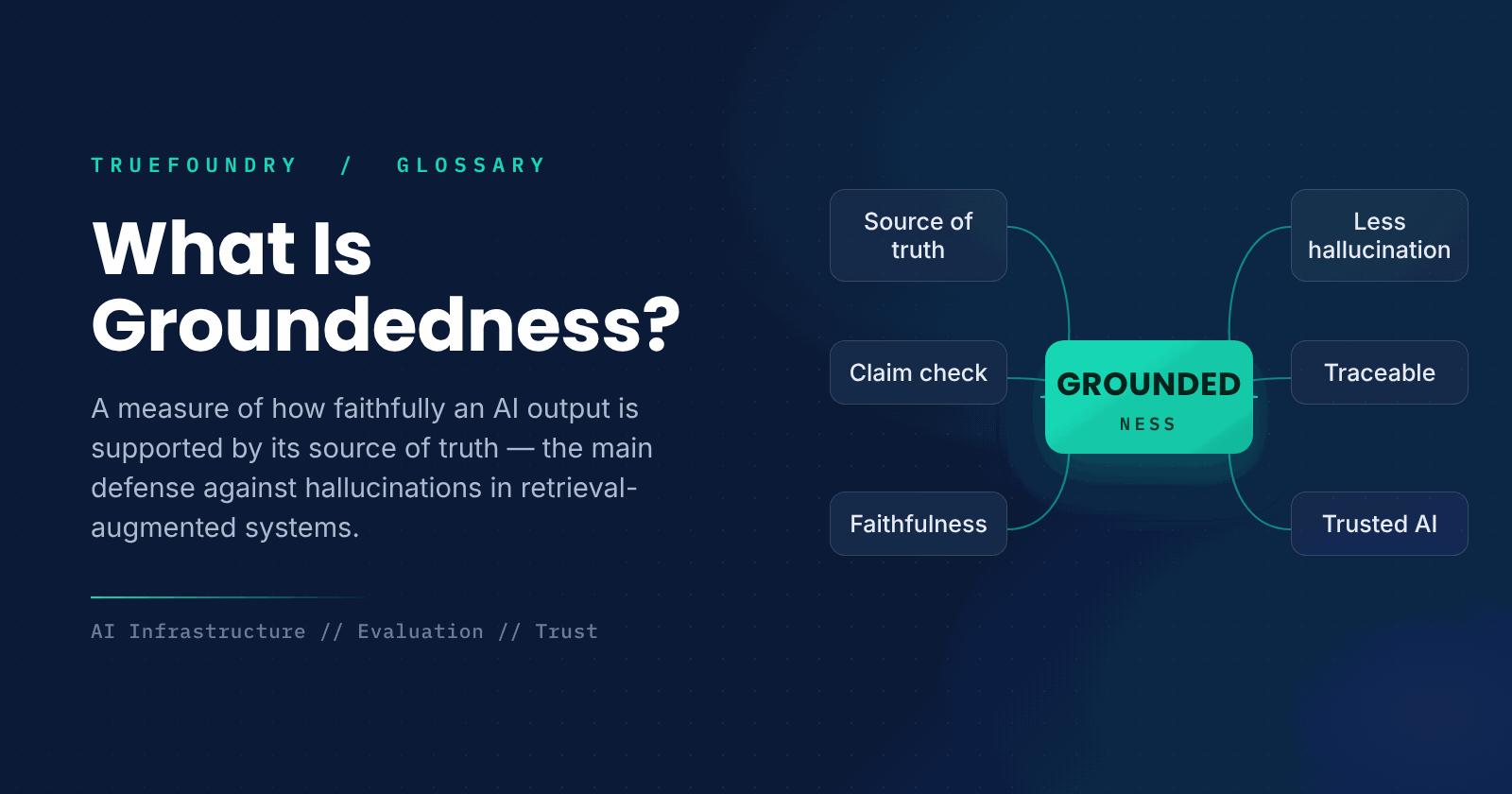
When an AI system answers a question using retrieved documents or supplied context, the critical question is whether the answer actually reflects that source. An answer can sound fluent and confident while quietly inventing facts the source never contained. Groundedness is the measure of how faithfully the output stays tied to its source of truth, and it is one of the most important signals for trusting AI in production.
Groundedness matters most in retrieval-augmented systems, where the whole point is to answer from specific documents rather than from the model's memory. If the answer drifts away from those documents, the system has failed even when the prose reads well. This guide explains what groundedness is, how it is measured, and why it is central to reliable AI.
We will cover the definition, how groundedness is scored, how it relates to hallucination, and when to use it.
What is groundedness?
Groundedness is the degree to which every claim in a model's output is supported by a given source of truth, such as the documents retrieved for a question or the context passed into the prompt. A fully grounded answer contains only statements that can be traced back to the source; an ungrounded answer includes claims the source does not support, whether invented, assumed, or pulled from the model's own training.
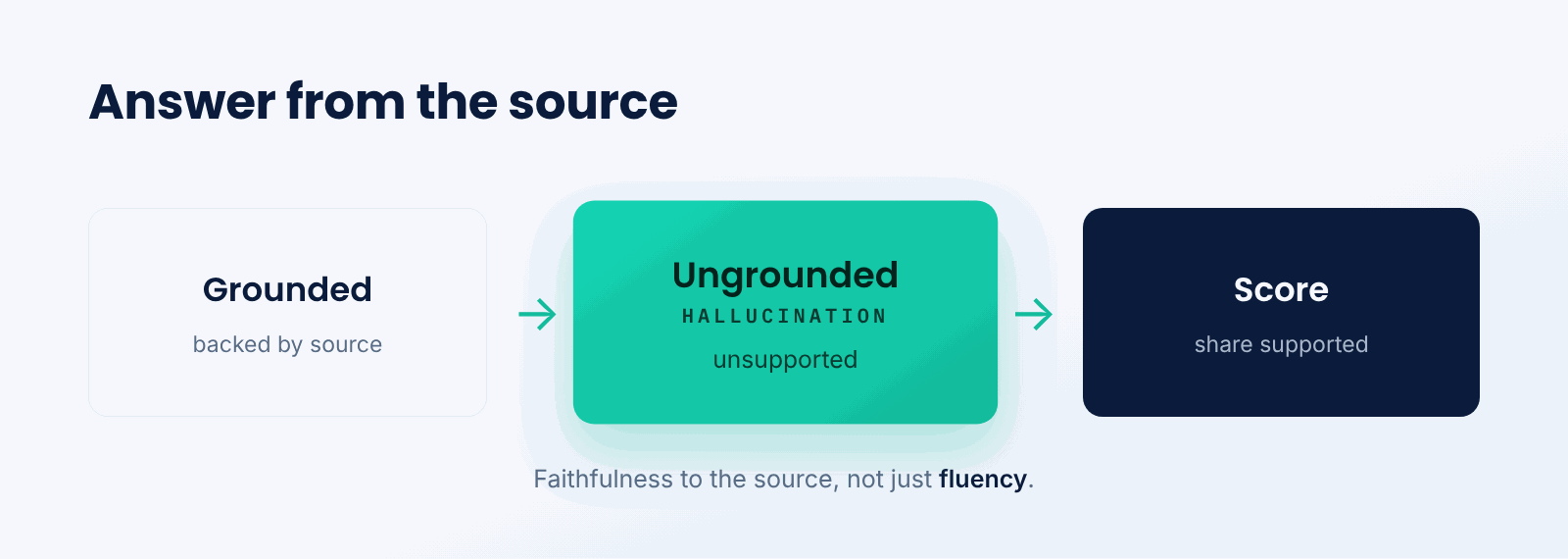
Think of it like a student answering an open-book exam. A grounded student answers using only what is in the book and can point to the page for each claim. An ungrounded student writes confident answers from memory that may or may not match the book. Groundedness asks: can every statement be found in the source?
The key idea is faithfulness to the source, not correctness in the abstract. An answer can be factually true in general yet still ungrounded if the provided source does not support it, because the system was supposed to answer from that source and instead went beyond it.
How is groundedness measured?
Groundedness is scored by comparing each claim in the output against the source context.
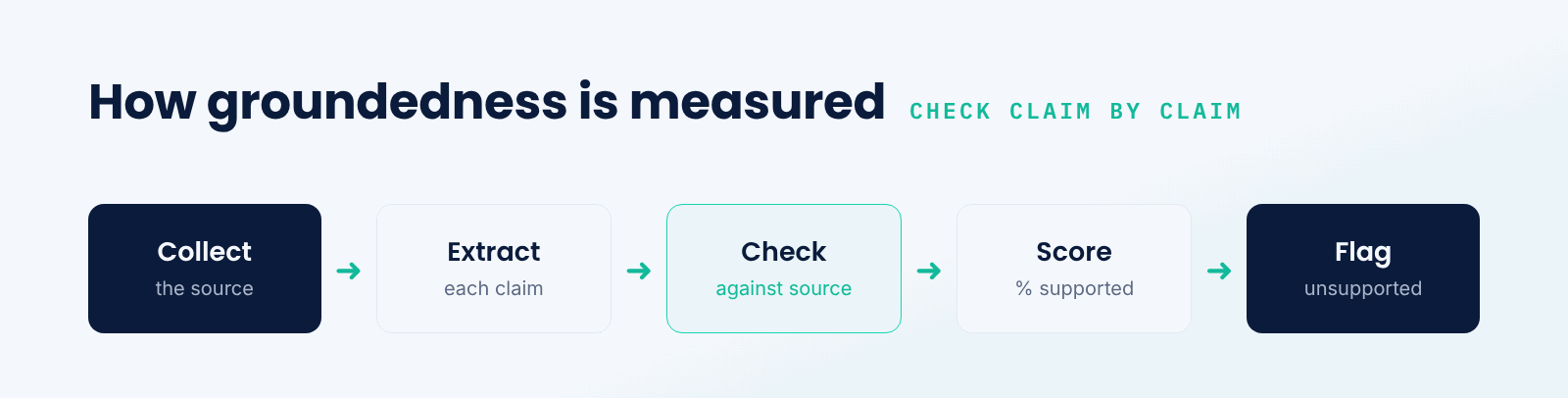
- Collect the source. Gather the retrieved documents or context the answer should rely on.
- Extract claims. Break the output into individual factual statements.
- Check each claim. Test whether the source supports, contradicts, or is silent on it.
- Score. Compute the share of claims that the source supports.
- Flag gaps. Surface unsupported claims as likely hallucinations.
In practice, this check is often automated using another model as a judge, which reads the source and the answer and rates how well each claim is supported. Teams track the resulting groundedness score over time to catch regressions and to compare retrieval or prompting changes.
Groundedness vs. hallucination vs. relevance
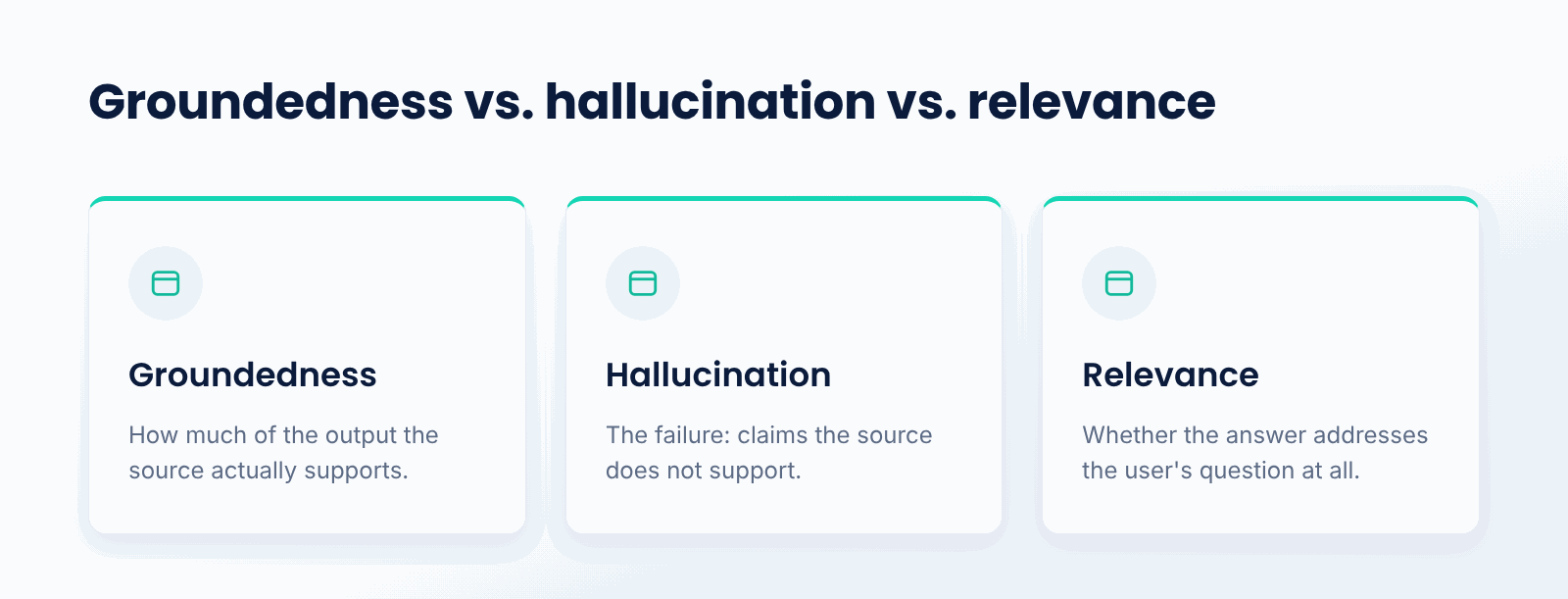
Hallucination is the failure mode: an output contains claims not supported by the source or by reality. Groundedness is the positive measure of the opposite: how much of the output is supported. A low groundedness score is a direct signal that hallucination is occurring.
Relevance is a different axis. An answer can be perfectly grounded in the source yet fail to address the user's actual question, and a relevant answer can still be ungrounded. Good systems need both: answers that are on-topic and faithful to the source. Groundedness specifically guards the faithfulness side.
Why does groundedness matter?
- Trust. Grounded answers can be verified against their source.
- Hallucination control. It directly detects unsupported claims.
- Compliance. Regulated domains need answers traceable to documents.
- Debugging. Low scores point to retrieval or prompting problems.
- Quality gates. It provides a metric to block bad releases.
What are the challenges?
- Judgment cost. Scoring every claim against sources takes compute or human effort.
- Judge reliability. An automated judge can itself make mistakes.
- Partial support. Claims are sometimes only partly backed by the source.
- Not correctness. A grounded answer can still be wrong if the source is wrong.
When should you measure groundedness?
Measure groundedness whenever an AI system is supposed to answer from specific sources, which describes most retrieval-augmented generation and document question-answering systems. It is essential in high-stakes domains like healthcare, finance, and law, where an unsupported claim can cause real harm, and where answers must be traceable to their source.
If your system is meant to be purely generative and creative, with no source of truth to stick to, groundedness is less relevant. But any time the goal is to answer from provided information, groundedness is a core metric to track.
Key points about groundedness
- Groundedness measures support of an output by its source.
- A grounded answer makes only claims the source backs.
- It is the main signal for detecting hallucinations.
- It is scored by checking each claim against the context.
- It differs from relevance, which is about on-topic answers.
- It is essential for trustworthy RAG in production.
Conclusion
Groundedness is the measure of how faithfully an AI output is supported by its source of truth. It is the clearest signal of whether a system is answering from its documents or quietly hallucinating, which makes it central to building AI people can trust. By scoring each claim against the provided context, teams can catch unsupported statements before they reach users.
TrueFoundry helps teams build and evaluate retrieval-augmented systems on their own infrastructure, including the groundedness checks that keep answers faithful to their sources. When reliability matters, measuring groundedness is how you keep AI honest.

Govern, Deploy and Trace AI in Your Own Infrastructure
Frequently Asked Questions
What is groundedness in simple terms?
It refers to the degree to which an AI response adheres to the source it was given. A grounded response only makes claims that are supported by the source documents, while an ungrounded one adds claims the source does not back, which usually means the model is hallucinating.
How is groundedness different from accuracy?
Accuracy refers to whether a statement is true in general. Groundedness refers to whether the statement is supported by the particular source the system was told to use. It is possible for an answer to be accurate in general yet still be ungrounded, if the provided source does not support it.
How do you measure groundedness?
You analyze the answer in terms of its individual claims and compare each one against the source material to see whether it is supported, contradicted, or not found at all. The groundedness score is the percentage of supported claims, and this comparison is usually done automatically by using a model as a judge.
How does groundedness relate to hallucination?
They are two sides of the same coin. Hallucination refers to the case where an output makes claims that have no basis in the source material, and groundedness is the positive measure of how much of the output is supported. A low groundedness score is a direct indicator that hallucination is happening.
When should I track groundedness?
Whenever your system answers from specific documents or context, such as a RAG or document question-answering system. It is especially important in regulated, high-stakes fields like healthcare, finance, and law, where answers must be traceable to a trusted source.


- © 2022 ENSEMBLE Technologies



Subscribe to our newsletter
The latest news, articles, and resources sent to your inbox


