


What Is GraphRAG and Why Does It Matter?

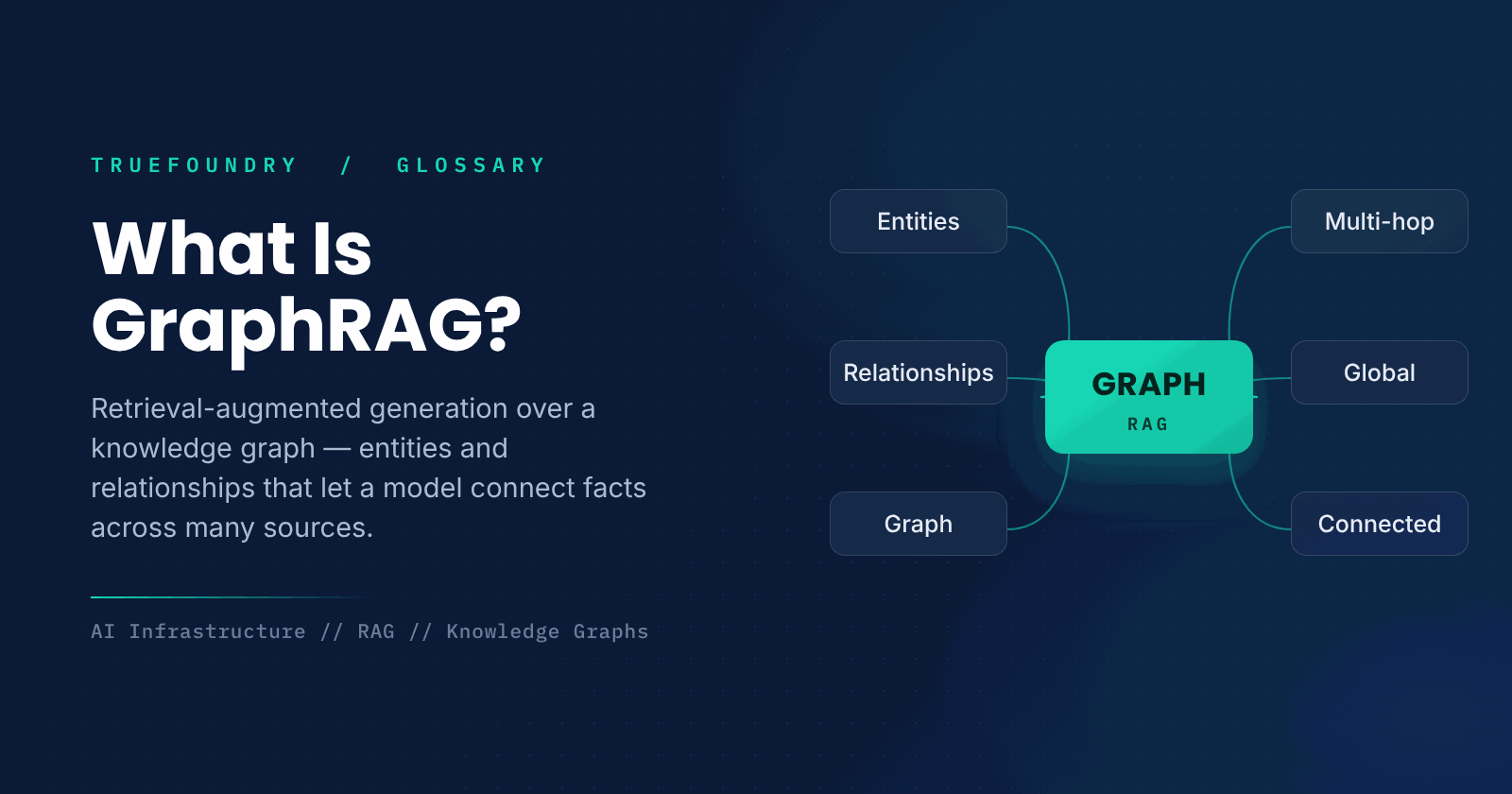
Standard retrieval-augmented generation works by splitting documents into chunks, embedding them, and retrieving the chunks most similar to a query. That works well for questions answered by a single passage, but struggles when an answer requires connecting facts scattered across many documents. GraphRAG was developed to close that gap.
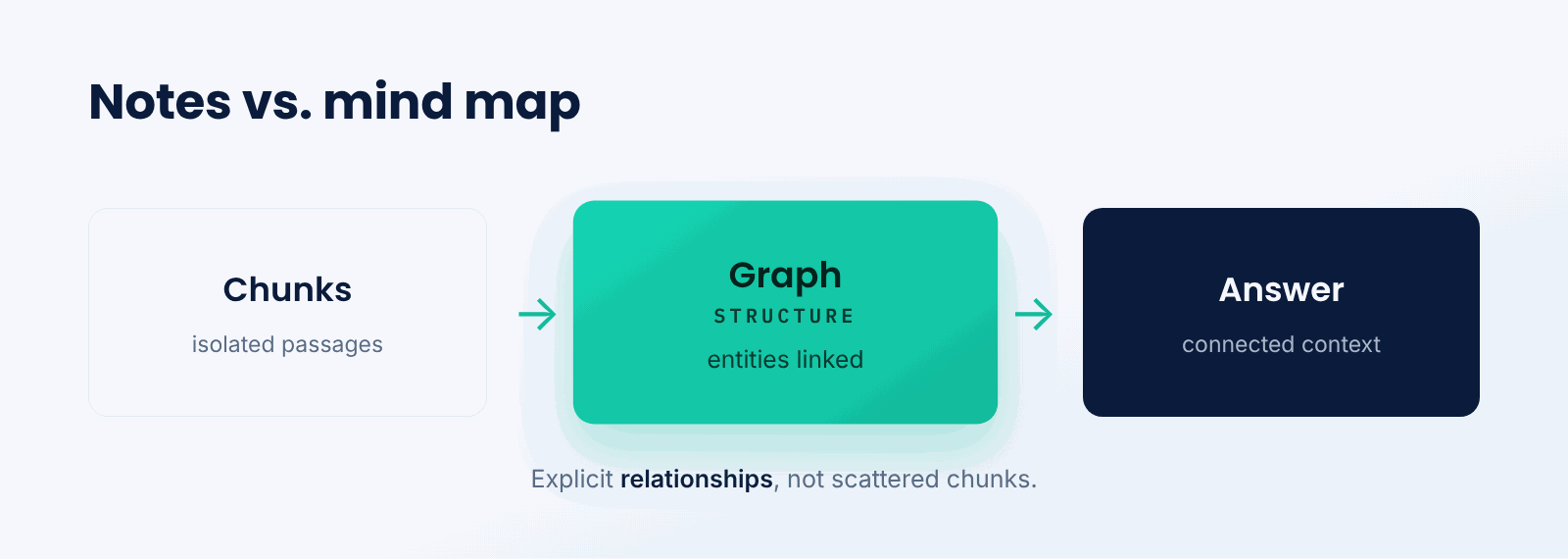
Instead of treating knowledge as a bag of independent chunks, GraphRAG structures it as a graph: entities such as people, products, or concepts, linked by the relationships between them. Retrieving over this structure lets the system follow connections, making it far better at questions that span multiple facts or require a broad view of a corpus.
This guide explains what GraphRAG is, how it works, how it compares to standard RAG, and when its added structure is worth it.
What is GraphRAG?
GraphRAG is retrieval-augmented generation built on a knowledge graph. Rather than retrieving isolated text chunks, it retrieves entities and relationships from a graph constructed from the source data. The language model then generates an answer using this connected, structured context, which captures how pieces of information relate to one another.
Think of the difference between a pile of loose notes and a mind map. Loose notes let you find a single relevant note quickly, but answering a question that spans several notes means hunting through the pile. A mind map shows how ideas connect, so you can trace relationships directly. GraphRAG gives the model that mind map.
The key idea is structured, connected context. By encoding relationships explicitly, GraphRAG lets retrieval follow links between facts, which is what enables answers that require combining information from many places.
How does GraphRAG work?
GraphRAG first builds a knowledge graph from the data, then retrieves over it at query time.
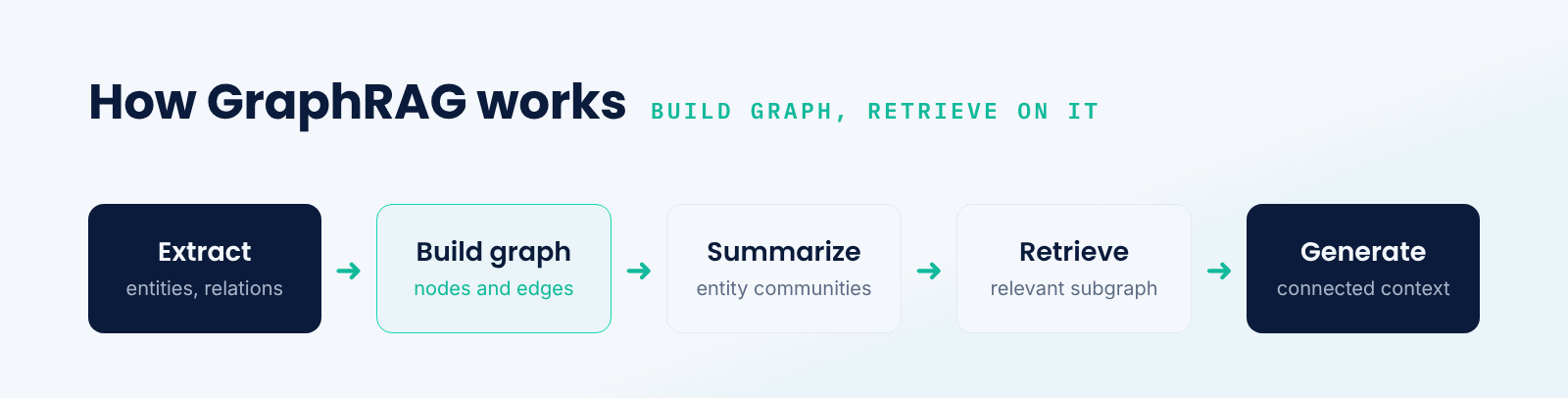
- Extract entities. A model identifies entities and relationships in the source documents.
- Build the graph. Those entities and relationships become nodes and edges.
- Summarize communities. Clusters of related entities can be summarized for broad questions.
- Retrieve on query. Relevant entities, relationships, or summaries are pulled for the query.
- Generate. The model answers using the connected graph context.
Building the graph is extra upfront work, usually done with a language model to extract structure from text. But once built, the graph supports both specific multi-hop queries, by traversing relationships, and broad global queries, by using community summaries that describe large parts of the corpus.
GraphRAG vs. standard RAG
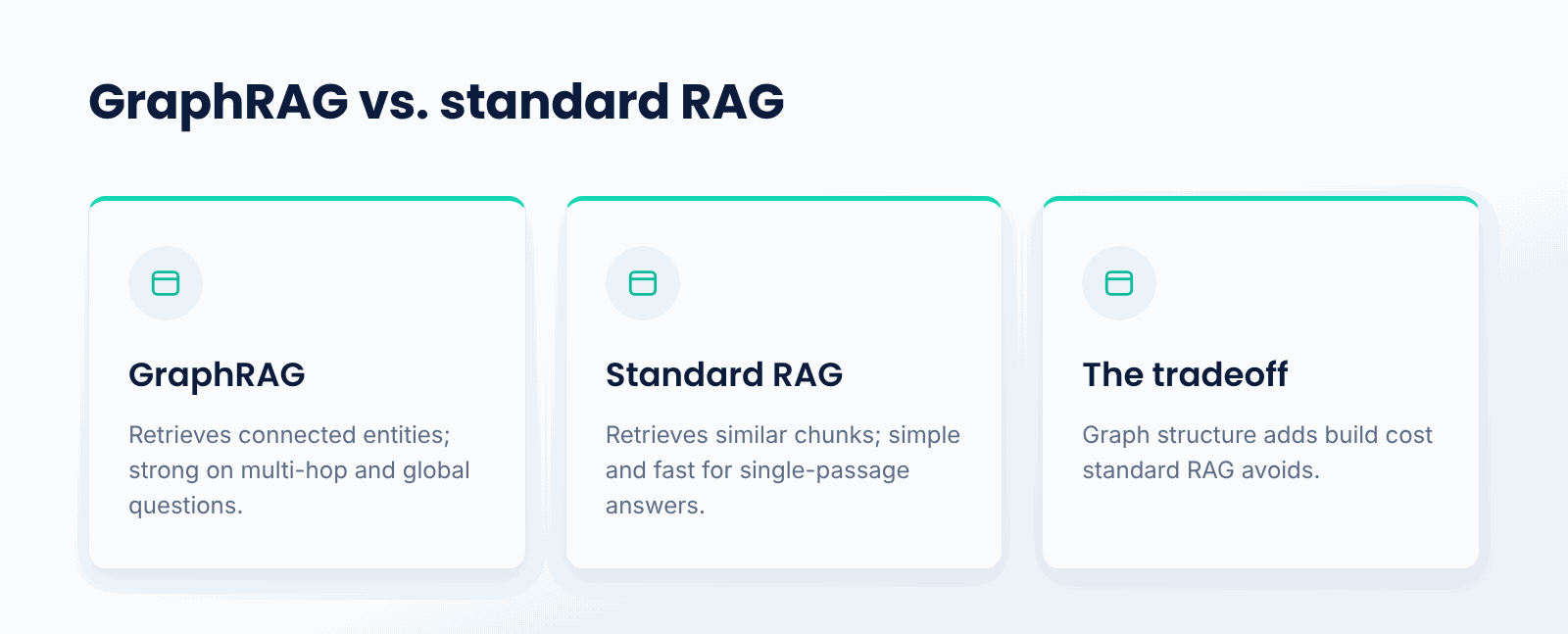
Standard RAG retrieves text chunks by similarity, which is simple, fast, and effective for questions answered by a single passage. It struggles, though, with questions that require connecting many facts or summarizing a whole corpus, because similarity search returns isolated pieces. GraphRAG adds structure that makes those connections explicit.
The tradeoff is cost and complexity. GraphRAG needs a graph-building step and more infrastructure, which standard RAG avoids. So standard RAG remains the right default for straightforward lookup, while GraphRAG earns its keep on multi-hop reasoning and global questions over a body of knowledge.
Why does GraphRAG matter?
- Multi-hop answers. It connects facts across many documents.
- Global questions. Community summaries answer corpus-wide queries.
- Structure. Explicit relationships capture how information relates.
- Fewer gaps. It reduces the isolated-chunk limitation of standard RAG.
- Richer context. The model reasons over connected, not scattered, information.
What are the tradeoffs?
- Build cost. Constructing the graph takes extra compute and processing.
- Complexity. It adds graph infrastructure to the pipeline.
- Maintenance. The graph must be updated as source data changes.
- Overkill for simple cases. Single-passage questions do not need it.
When should you use GraphRAG?
Reach for GraphRAG when answers require connecting information across many documents, when you need corpus-wide or summary-style answers, or when relationships between entities are central to the questions being asked. These are exactly the cases where chunk-based RAG tends to fall short.
For straightforward question answering where each answer lives in a single passage, standard RAG is simpler and usually sufficient. GraphRAG's structure pays off specifically when the reasoning spans multiple facts, so match the approach to the kinds of questions you expect.
Key points about GraphRAG
- It is RAG built on a knowledge graph.
- It represents data as entities and relationships.
- It answers multi-hop and global questions well.
- It needs a graph-building step up front.
- Standard RAG stays better for simple single-passage lookup.
- Match it to questions that span many connected facts.
Conclusion
GraphRAG augments retrieval-augmented generation with a knowledge graph, representing information as connected entities and relationships rather than isolated chunks. This lets it answer multi-hop and corpus-wide questions that standard RAG struggles with, at the cost of building and maintaining the graph. When questions require connecting facts across many sources, GraphRAG's structure is a powerful advantage.
TrueFoundry helps teams build and serve advanced RAG pipelines on their own infrastructure, including graph-based retrieval when questions demand it. For knowledge that is deeply interconnected, GraphRAG can unlock answers that chunk-based retrieval cannot reach.

Govern, Deploy and Trace AI in Your Own Infrastructure
Frequently Asked Questions
What is GraphRAG in simple terms?
This is retrieval-augmented generation in which a knowledge graph containing information about entities and the relationships among them is used rather than isolated text snippets. This enables the system to connect information across facts and answer queries that span many documents.
How is GraphRAG different from standard RAG?
Standard RAG retrieves text snippets by similarity, which works well for single-passage answers, while GraphRAG retrieves entities and relationships from a graph, making links explicit and handling multi-hop and corpus-wide questions that chunk-based retrieval often misses.
What kinds of questions does GraphRAG handle better?
Multi-hop questions that involve integrating facts from multiple documents, and global questions that need summaries of an entire collection. Since the graph captures the links between entities, the system can traverse and summarize connections rather than relying on isolated fragments.
What is the main cost of GraphRAG?
Creation and management of the knowledge graph. Creating the entities and their relations requires additional computing resources that typically use language models, and the graph must be adjusted in line with data changes, which regular chunk-based RAG does not require.
When should I just use standard RAG?
Where your queries can be answered by a single passage and you don't have to connect lots of facts together. Normal RAG is less complex, easier to set up, and generally good enough for straightforward lookup, so GraphRAG's extra structure is not needed there.


- © 2022 ENSEMBLE Technologies



Subscribe to our newsletter
The latest news, articles, and resources sent to your inbox


