


What Is a GPU Cluster and How Does It Work?

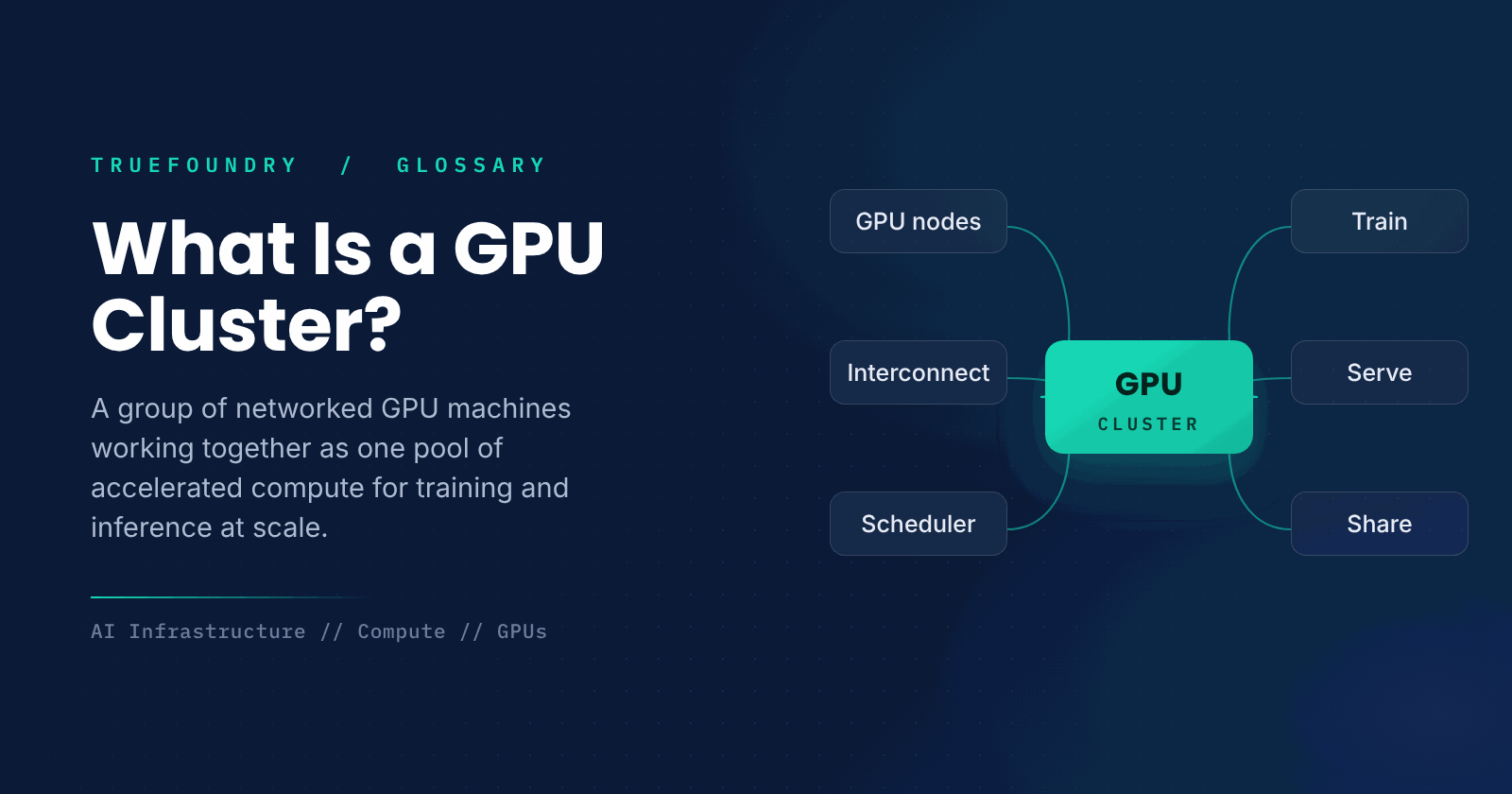
Training a large model or serving AI to many users needs far more compute than a single GPU can provide. A GPU cluster meets that need by pooling many GPUs across many machines into one system that jobs can draw on. It is the engine room of modern AI, where the heavy computation actually happens.
But a cluster is more than a pile of GPUs. What makes it work is the networking that lets GPUs cooperate on one job, and the scheduling that shares the pool fairly across many jobs and users. Get those right and the cluster is powerful and efficient; get them wrong and expensive GPUs sit idle.
This guide explains what a GPU cluster is, how it works, what it is used for, and why efficient use matters.
What is a GPU cluster?
A GPU cluster is a collection of interconnected computers, called nodes, each equipped with one or more graphics processing units, managed together as a unified pool of accelerated compute. The nodes are linked by high-speed networking and coordinated by a scheduler, so large workloads can run across many GPUs at once.
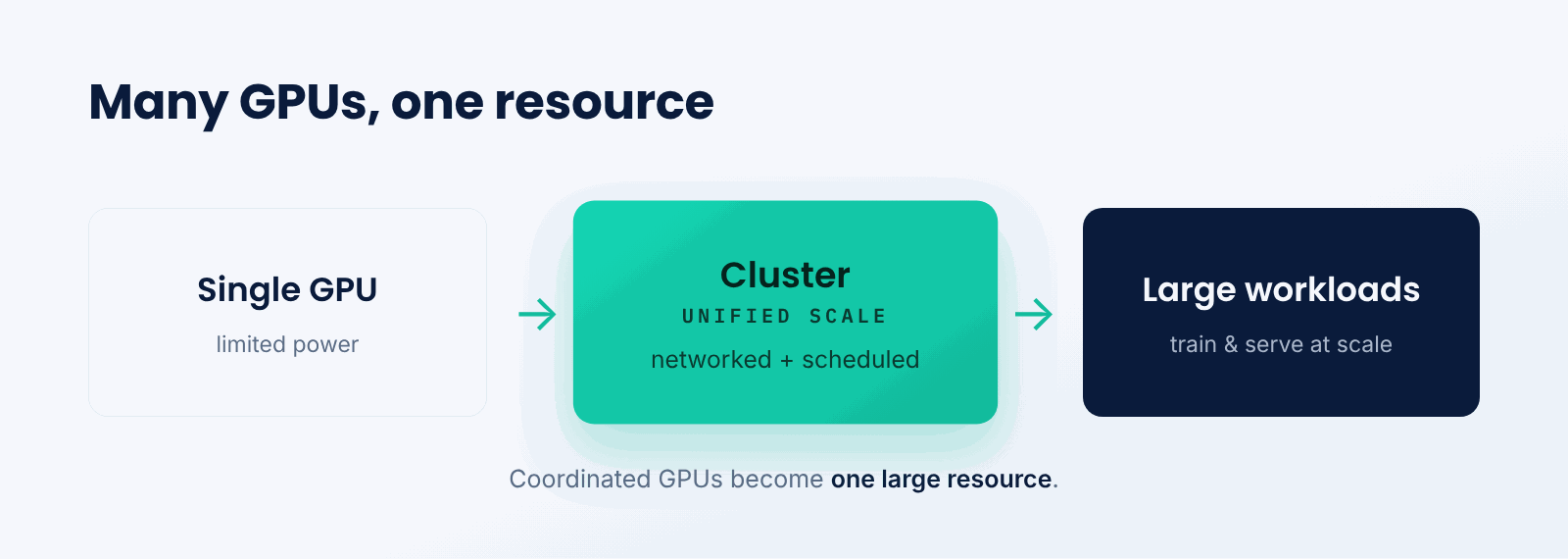
Think of it like a large kitchen with many chefs. One chef can cook one dish; a coordinated brigade can produce a banquet, as long as they share ingredients and space well. A GPU cluster is that brigade for computation, with many GPUs cooking together under a system that keeps them coordinated.
The key idea is unified scale. Individually, GPUs are powerful; connected and coordinated, they become a single resource large enough to train huge models and serve AI at volume.
How does a GPU cluster work?
A cluster combines GPU nodes, fast networking, and a scheduler to run jobs across the pool.
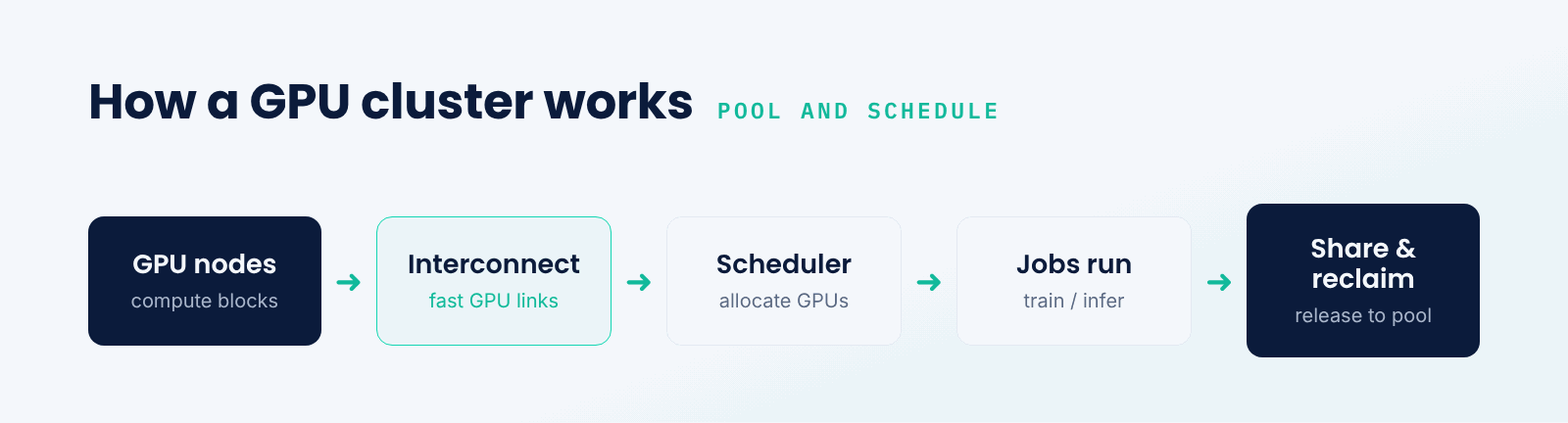
- Nodes with GPUs. Each machine holds one or more GPUs, the compute building blocks.
- Fast interconnect. High-speed networking links GPUs so they can share work and data.
- Scheduler. A system like Kubernetes or Slurm allocates GPUs to jobs and users.
- Jobs run. Training or inference workloads are placed on available GPUs.
- Share and reclaim. Finished jobs release GPUs back to the pool for others.
The interconnect is what distinguishes a true cluster from separate machines. For large training jobs, GPUs must exchange data constantly, so fast links like NVLink or InfiniBand are essential to keep them from waiting on each other.
What is a GPU cluster used for?
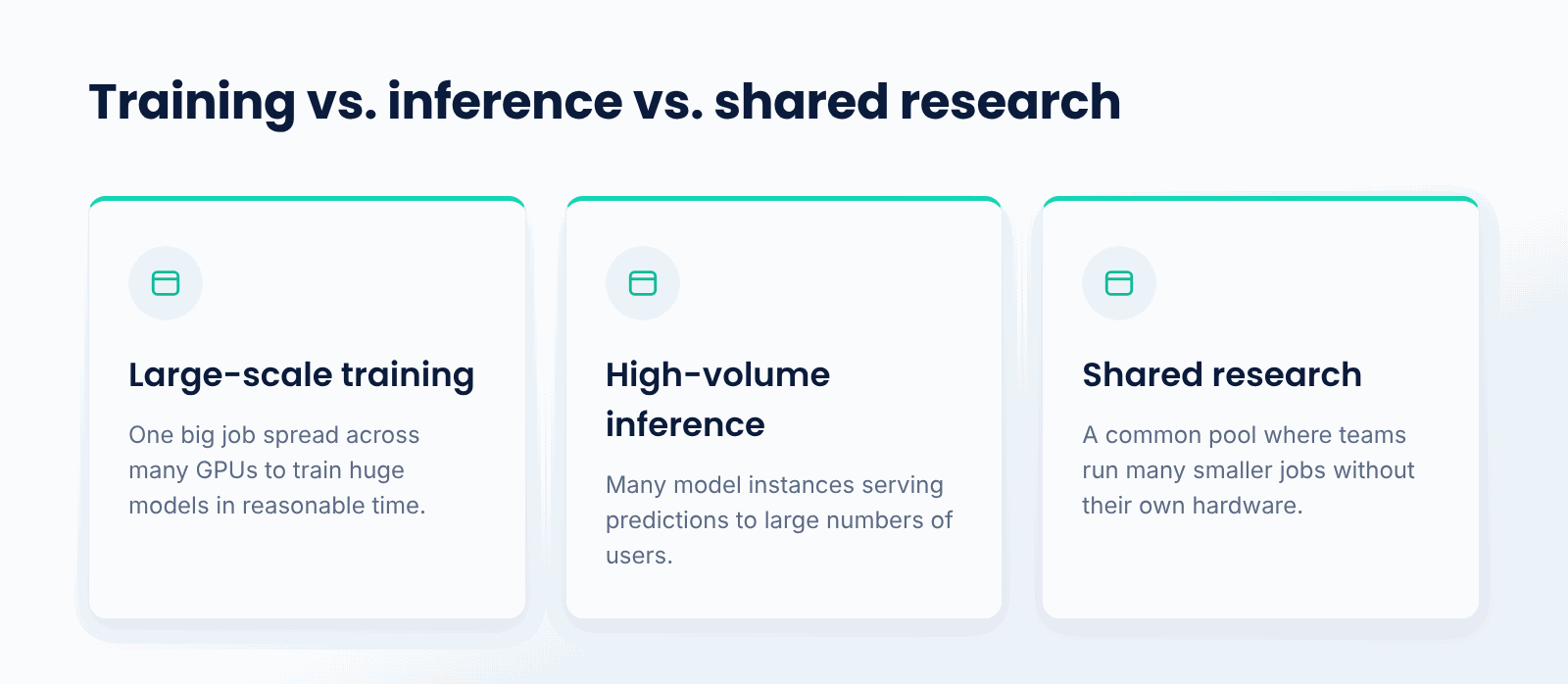
Clusters serve a few main workloads. Large-scale training spreads a single big training job across many GPUs so huge models can be trained in reasonable time. High-volume inference runs many model instances to serve predictions to large numbers of users. Shared research and experimentation gives teams a common pool to run many smaller jobs without each buying their own hardware.
What these share is the need for more GPU power than one machine holds, applied either to one enormous job or to many jobs at once. The cluster and its scheduler make either possible from the same pool.
Why does efficient GPU cluster use matter?
- High cost. GPUs are expensive, so idle ones waste significant money.
- Scarcity. GPU supply is limited, making efficient sharing important.
- Throughput. Good scheduling means more work done per GPU.
- Fairness. Sharing the pool well keeps many teams productive.
- Scalability. An efficient cluster can take on more work without more hardware.
What are the challenges?
- Utilization. Keeping GPUs busy rather than idle is surprisingly hard.
- Scheduling. Allocating GPUs fairly and efficiently across jobs is complex.
- Networking. Interconnect bottlenecks can limit large distributed jobs.
- Cost management. Without controls, cluster spend grows quickly.
When do you need a GPU cluster?
You need one when your AI work outgrows a single GPU or machine, whether training large models, serving high inference volume, or supporting many users who each need GPUs. The larger and more concurrent the workloads, the more a cluster is required.
A single experiment or light inference can run on one GPU. But scaling training or serving, or sharing GPUs across a team, is what makes a cluster, with its networking and scheduling, necessary.
Best practices for GPU clusters
- Use a scheduler to share GPUs across jobs and teams rather than fixed allocation.
- Monitor utilization so you can find and reclaim idle GPUs.
- Match interconnect to workload so large distributed jobs are not network-bound.
- Right-size jobs to the GPUs they need rather than over-reserving.
- Track cost per team and job to keep spending visible.
- Automate scaling so capacity follows demand instead of sitting idle.
Conclusion
A GPU cluster is a pool of networked GPU machines that act as one large accelerated-compute resource, making large-scale training and high-volume inference possible. Its power comes not just from the GPUs but from the fast interconnect that lets them cooperate and the scheduler that shares them. Because GPUs are costly and scarce, using a cluster efficiently is as important as having one.
TrueFoundry helps teams run AI workloads on their own GPU clusters, with scheduling, utilization monitoring, and autoscaling so expensive GPUs are shared efficiently. As AI compute needs grow, getting the most from a GPU cluster is central to running AI affordably at scale.

Govern, Deploy and Trace AI in Your Own Infrastructure
Frequently Asked Questions
What is a GPU cluster in simple terms?
It is many computers, each with GPUs, networked and coordinated to work as a single large pool of computing power. It lets you train large models or serve AI at scale beyond what a single GPU could handle.
Why connect GPUs into a cluster instead of using them separately?
Because large jobs need more GPU power than one machine holds, and the GPUs must share data quickly to work on one job together. Fast interconnects and a scheduler turn separate GPUs into a single coordinated resource.
What is a GPU cluster used for?
Large-scale model training spread across many GPUs, high-volume inference serving many users, and shared pools where teams run many smaller jobs. All need more GPU power than a single machine provides.
Why does GPU cluster efficiency matter so much?
Because GPUs are expensive and in short supply, so idle GPUs waste significant money. Good scheduling and high utilization mean more work per GPU, which directly controls the cost of running AI at scale.
What makes a GPU cluster different from just many servers?
The high-speed interconnect and the scheduler. The interconnect lets GPUs exchange data fast enough to cooperate on a single job, and the scheduler shares the pool across many jobs and users, which plain separate servers cannot do.


- © 2022 ENSEMBLE Technologies



Subscribe to our newsletter
The latest news, articles, and resources sent to your inbox


