


What Is FlashAttention and Why Does It Matter?

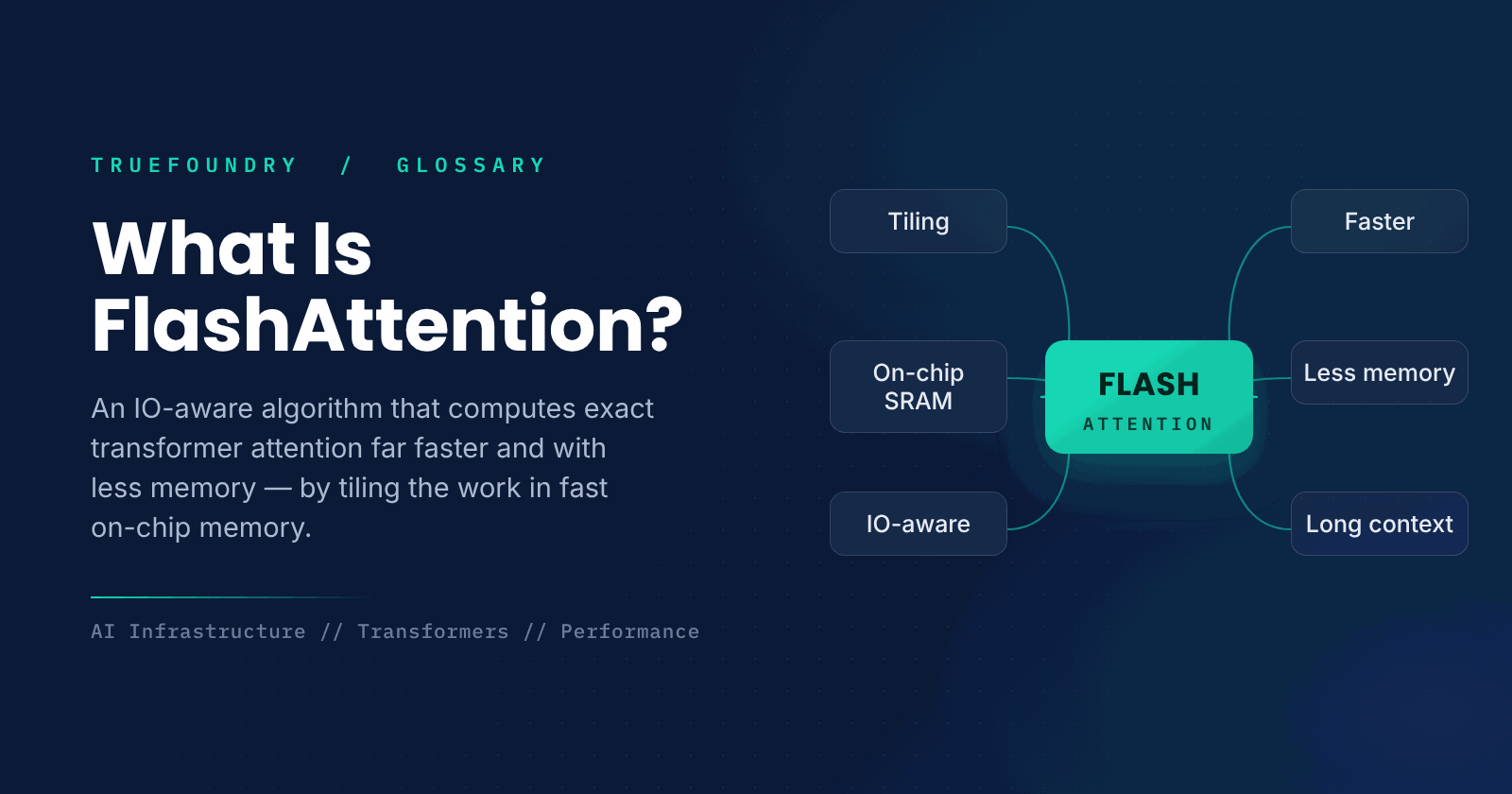
Attention is the heart of the transformer, but the standard way of computing it is wasteful on modern GPUs. It builds a large matrix of scores for every pair of tokens, writes it to GPU memory, reads it back, and repeats, spending most of its time moving data rather than doing math. FlashAttention rewrites this computation so the data barely moves, which makes it dramatically faster.
The key realization is that attention is bottlenecked not by arithmetic but by memory traffic between the GPU's slow high-bandwidth memory and its fast on-chip memory. By restructuring the computation to minimize that traffic, FlashAttention runs the exact same attention far more efficiently, which is why it has become a default building block in modern model training and serving.
This guide explains what FlashAttention is, how it works, how it differs from standard attention, and why it matters.
What is FlashAttention?
FlashAttention is an algorithm for computing the attention operation of a transformer that is optimized for how GPUs actually move data. It produces exactly the same result as standard attention but reorganizes the work so that the large intermediate attention matrix is never fully written to the GPU's main memory, which removes the dominant cost.
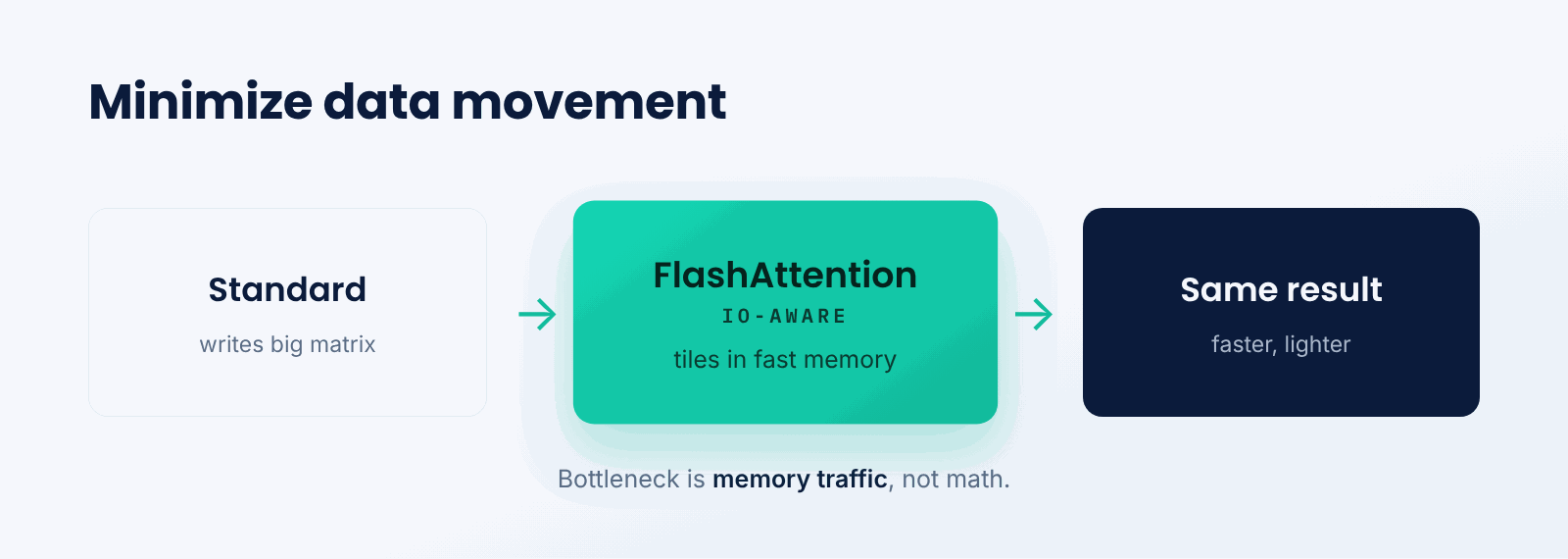
Think of it like doing a long calculation on a tiny desk next to a big filing cabinet. The slow way keeps fetching papers from the cabinet and putting them back for every step. FlashAttention instead keeps just the slice it needs on the desk, finishes everything it can with that slice, and only then moves on, so it visits the cabinet far fewer times.
The key idea is that it is IO-aware. It treats data movement, not arithmetic, as the thing to minimize, because on modern GPUs moving the attention matrix in and out of memory is what actually dominates the time.
How does FlashAttention work?
FlashAttention computes attention in tiles, keeping intermediate results in fast memory and combining them as it goes.
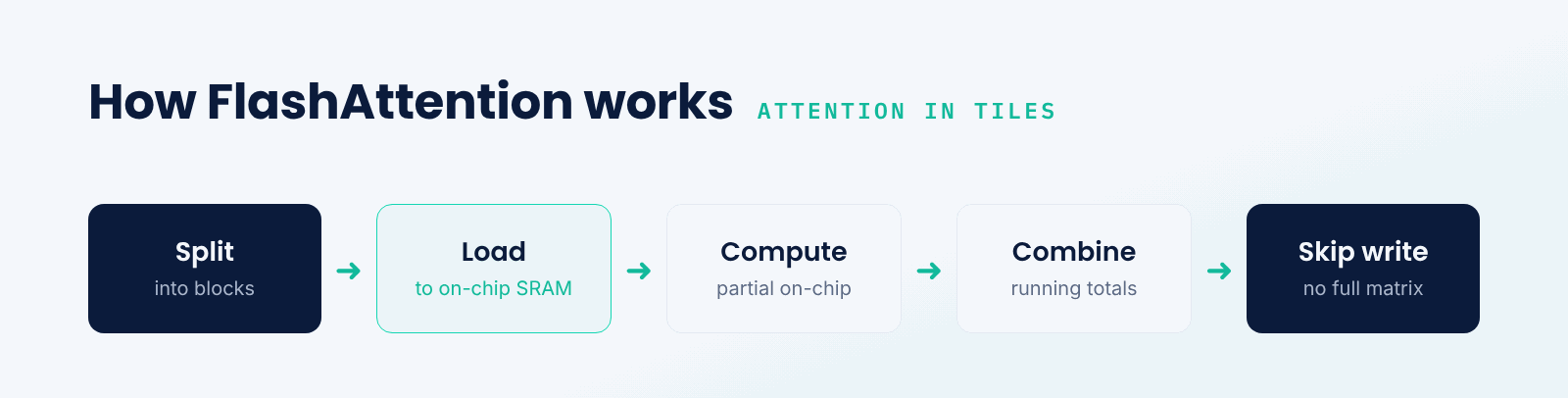
- Split into tiles. Break the queries, keys, and values into small blocks.
- Load to fast memory. Bring one block at a time into the GPU's on-chip SRAM.
- Compute on-chip. Calculate the partial attention for that block without writing the full matrix out.
- Combine running totals. Merge each block's result into a running output using a stable online update.
- Skip the big write. Never store the full attention matrix in main memory.
Because the full score matrix is never materialized, memory use grows linearly with sequence length instead of quadratically, and the computation spends its time on math rather than shuffling data. During training, FlashAttention also recomputes parts of the attention on the backward pass rather than storing them, trading a little extra math for a large memory saving.
FlashAttention vs. standard attention
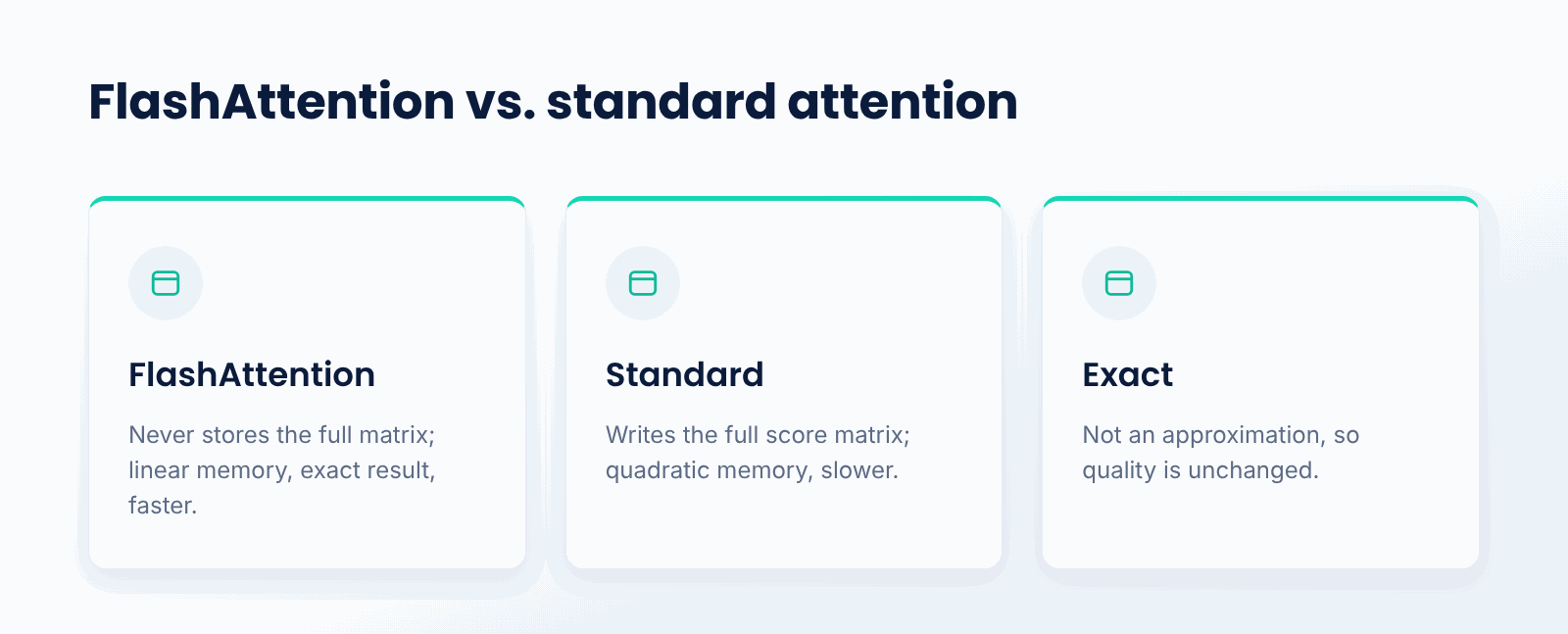
Standard attention computes the full matrix of scores for every pair of tokens, writes it to GPU memory, applies softmax, and reads it back to produce the output. That is simple but memory-heavy, and its memory use grows with the square of the sequence length. FlashAttention produces the identical result while never storing that full matrix, so it is both faster and far lighter on memory.
Crucially, FlashAttention is exact, not an approximation. Many earlier efficiency techniques sped up attention by approximating it and sacrificing some quality. FlashAttention gives the same numbers as standard attention, which is why it can be dropped in as a faster replacement with no change to model behavior.
Why does FlashAttention matter?
- Speed. It makes transformer training and inference significantly faster.
- Memory. It cuts attention's memory use from quadratic to linear in sequence length.
- Longer context. It makes long context windows practical to train and serve.
- Exactness. It is not an approximation, so quality is unchanged.
- Ubiquity. It has become a standard component in modern model stacks.
What are the tradeoffs?
- Hardware-specific. Its speedups depend on GPU architecture and tuned kernels.
- Implementation complexity. It relies on carefully written low-level kernels.
- Recomputation. It trades some extra computation on the backward pass for memory savings.
- Version sensitivity. Getting the best performance means matching the right version to your hardware.
When should you care about FlashAttention?
If you train or serve transformer models, FlashAttention is almost always worth using, because it speeds up the single most expensive operation without changing results. It matters most when working with long sequences or large models, where standard attention's memory cost becomes the limiting factor.
For most teams it is not something to implement by hand; it is built into modern frameworks and serving engines. The practical point is to ensure it is enabled and matched to your hardware, so you get the speed and memory benefits automatically.
Key points about FlashAttention
- It computes exact attention in an IO-aware way.
- It avoids writing the full attention matrix to GPU memory.
- It tiles the work and keeps it in fast on-chip SRAM.
- It makes memory grow linearly, not quadratically, with length.
- It speeds up training and inference without approximating.
- It is a standard part of modern transformer stacks.
Conclusion
FlashAttention computes the exact attention of a transformer in an IO-aware way, tiling the work in fast on-chip memory so the large attention matrix never has to be written to slow GPU memory. The result is a major speedup and a shift from quadratic to linear memory use, with no change to model quality, which is why it has become a default in modern training and serving and a key enabler of long context windows.
TrueFoundry helps teams train and serve transformer models efficiently on their own infrastructure, where optimizations like FlashAttention translate directly into lower GPU cost and faster responses. Understanding it explains much of why modern models are faster and can handle longer inputs than before.

Govern, Deploy and Trace AI in Your Own Infrastructure
Frequently Asked Questions
What is FlashAttention in simple terms?
It is a faster, more memory-efficient way to compute a transformer's attention. It gives exactly the same result as the usual method but avoids writing the big attention matrix to GPU memory, so it spends its time on math instead of moving data around.
How does FlashAttention save memory?
By never storing the full matrix of attention scores. It processes attention in small tiles kept in the GPU's fast on-chip memory and combines them with a running update, so memory use grows linearly with sequence length rather than with its square.
Is FlashAttention an approximation?
No. It computes exactly the same attention as the standard method, just far more efficiently. That exactness is why it can replace standard attention with no change to a model's behavior or quality, unlike approximate attention methods.
Why is FlashAttention faster if it does the same math?
Because attention is limited by memory traffic, not arithmetic. Standard attention spends most of its time moving the large score matrix between slow and fast GPU memory. FlashAttention minimizes that movement, so the same math runs much faster.
Do I need to implement FlashAttention myself?
Usually not. It is built into modern training frameworks and serving engines, so the main task is making sure it is enabled and matched to your GPU. When it is, you get the speed and memory benefits automatically.


- © 2022 ENSEMBLE Technologies



Subscribe to our newsletter
The latest news, articles, and resources sent to your inbox


