


What Is Few-Shot Learning and Why Does It Matter?

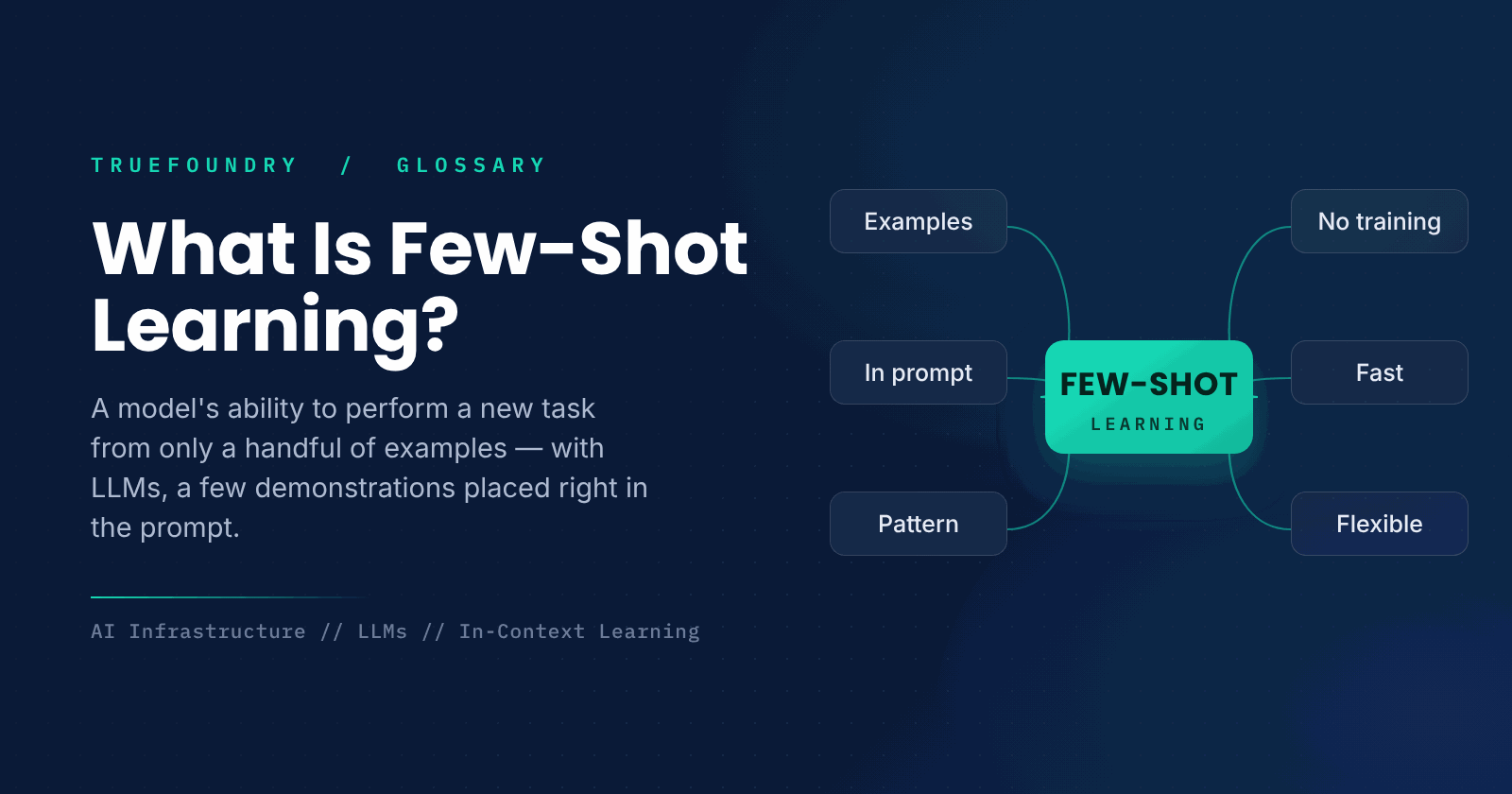
One of the most striking abilities of large language models is that you can teach them a new task just by showing a few examples. Paste three labeled samples into the prompt, add a fourth input, and the model often produces the right output, having never been trained on that specific task. This is few-shot learning, and it changed how people use AI.
The appeal is immediacy. Instead of collecting a dataset and running a training job, you demonstrate the task inline and get results right away. For a huge range of tasks, a few well-chosen examples are enough to get useful behavior, which makes experimentation and deployment dramatically faster.
This guide explains what few-shot learning is, how it works with language models, how it compares to zero-shot and fine-tuning, and when to use it.
What is few-shot learning?
Few-shot learning is the ability to learn a task from only a small number of examples. In the context of large language models, it most often refers to in-context learning: providing a few input-output demonstrations within the prompt so the model infers the pattern and applies it to a new input, all at inference time without changing the model's weights.
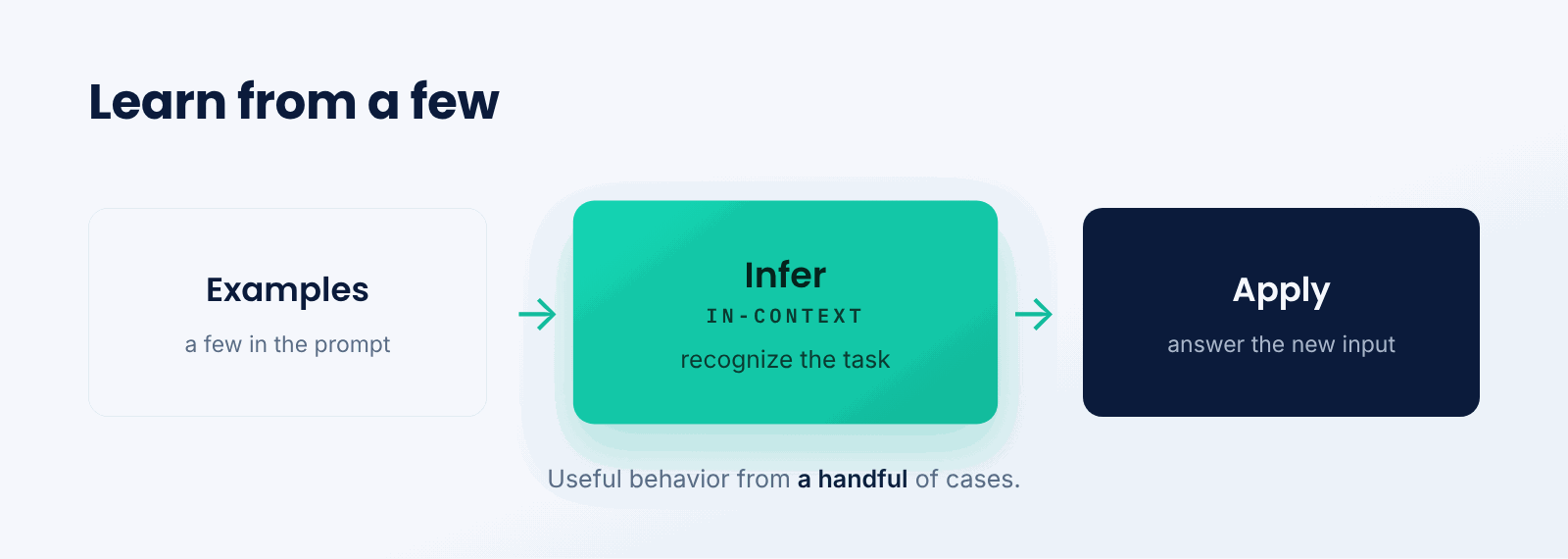
Think of it like showing a new colleague how to do a task by example. You do not write a manual; you just say, here are a few cases and how I handled them, now you try this one. A capable person picks up the pattern quickly. A large model does the same with the examples you place in the prompt.
The key idea is learning from very little. Where traditional training needs many labeled examples, few-shot learning gets useful behavior from a handful, relying on the broad knowledge the model already has to generalize from so few cases.
How does few-shot learning work with LLMs?
With language models, few-shot learning happens entirely in the prompt through in-context learning.
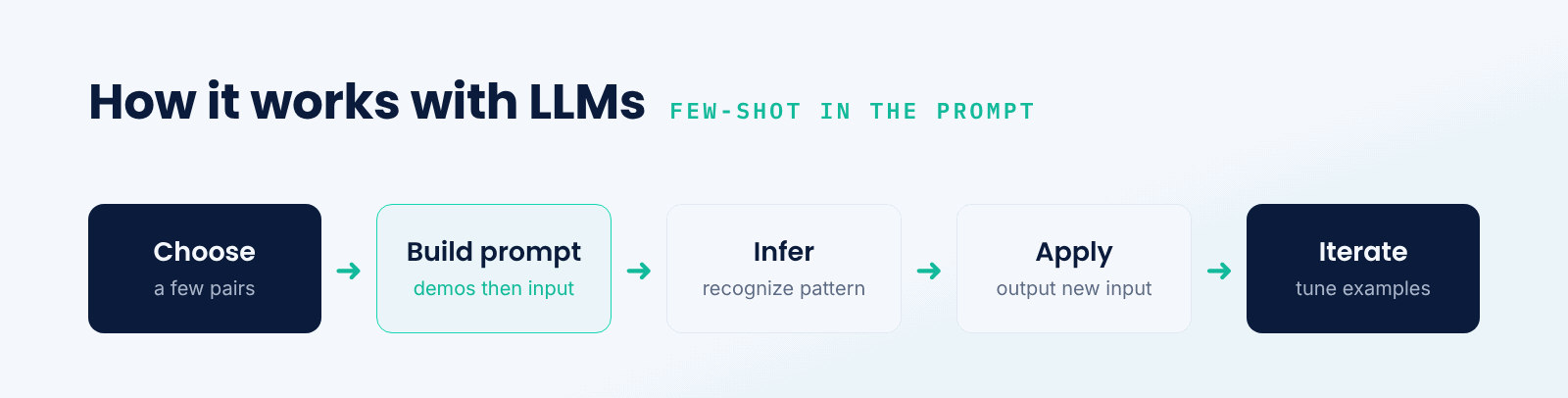
- Choose examples. Pick a few representative input-output pairs for the task.
- Build the prompt. Place those demonstrations before the new input.
- Infer the pattern. The model reads the examples and recognizes the task.
- Apply it. The model produces an output for the new input in the same style.
- Iterate. Adjust the examples to improve accuracy and consistency.
No training occurs; the model's weights are unchanged. The examples simply condition its response, guiding it toward the format and behavior you want. The quality and relevance of the chosen examples strongly affect the result, so picking good ones matters.
Few-shot vs. zero-shot vs. fine-tuning
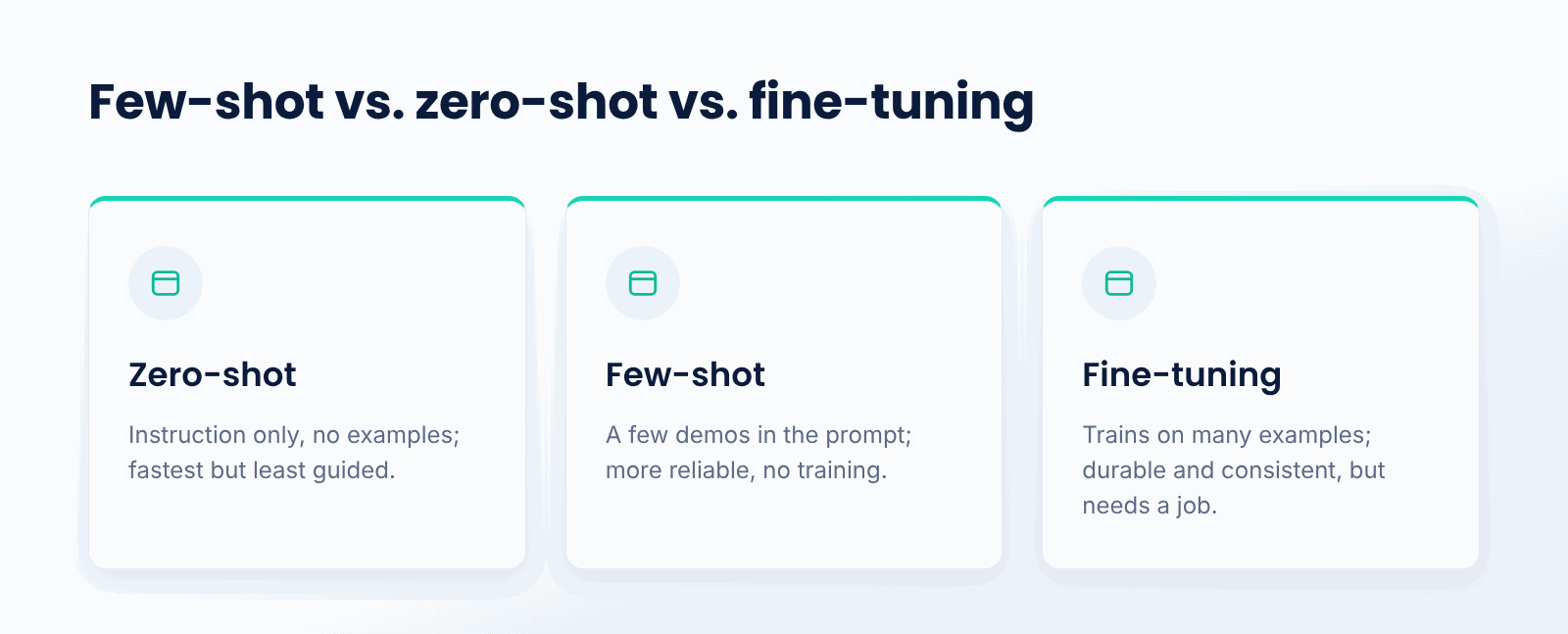
Zero-shot learning gives the model only an instruction and no examples. Few-shot learning adds a handful of demonstrations in the prompt. Fine-tuning goes further, actually training the model on many examples so the task is baked into its weights. They form a spectrum from no examples to many, with increasing effort and permanence.
Few-shot occupies a useful middle ground. It is more reliable than zero-shot on tasks that benefit from examples, yet far faster and cheaper than fine-tuning since it requires no training. The tradeoff is that the examples consume prompt space on every request and are less durable than a fine-tuned model.
Why does few-shot learning matter?
- Speed. You can teach a task in seconds, with no training job.
- Low cost. It needs only a few examples, not a labeled dataset.
- Flexibility. You can change the task by changing the examples.
- Accessibility. Anyone who can write a prompt can use it.
- Prototyping. It is ideal for quickly testing whether a task is feasible.
What are the tradeoffs?
- Prompt cost. Examples take up context on every request, adding tokens.
- Example sensitivity. Results depend heavily on which examples you pick.
- Limited capacity. Only so many examples fit in the context window.
- Less durable. A fine-tuned model is more consistent for high-volume use.
When should you use few-shot learning?
Use it when a task benefits from a few examples to clarify the format or behavior, and you want results immediately without training. It is excellent for prototyping, for tasks that change often, and for cases where you have only a handful of examples to work with.
When a task is simple enough, zero-shot may suffice and save prompt space. When it is run at high volume or needs maximum consistency, fine-tuning is often worth the investment. Few-shot shines in between, where a few examples give a big boost at almost no cost.
Key points about few-shot learning
- It teaches a task from only a few examples.
- With LLMs it works through examples placed in the prompt.
- No weights are updated; it is in-context learning.
- It sits between zero-shot and fine-tuning.
- Example choice strongly affects results.
- It is fast and cheap but uses prompt space each time.
Conclusion
Few-shot learning lets a model perform a new task from just a handful of examples, which with large language models means placing a few demonstrations in the prompt. It is faster and cheaper than fine-tuning and more reliable than zero-shot on many tasks, making it a go-to technique for prototyping and flexible deployment. Its costs are prompt space and sensitivity to which examples you choose.
TrueFoundry helps teams build and serve LLM applications, including prompt-based workflows that rely on few-shot examples, and fine-tuned models when a task graduates beyond them. Few-shot learning is often the fastest path from idea to a working AI feature.

Govern, Deploy and Trace AI in Your Own Infrastructure
Frequently Asked Questions
What is few-shot learning in simple terms?
It is where a model is taught how to do a certain task through very limited demonstration. In the case of a language model, you give a few pairs of input and output in the prompt, and the model learns the trick and applies it to a new input, with no extra training.
How is few-shot different from zero-shot learning?
Zero-shot provides only the instruction to the model, without any examples. In few-shot learning, we provide a few demonstrations. The examples give the model insight into the task's format and behavior, making few-shot more reliable on tasks that benefit from illustration.
Does few-shot learning train the model?
No. The weights of the model do not change. All that happens is the prompt gives context to the model at inference time, hence in-context learning. There is no persistence between requests, meaning the examples need to be included in every request.
How many examples should I use?
Generally just a handful to a dozen, depending on the task and how much context you can spare. Additional examples can prove beneficial up to a point, but they eat up prompt space and tokens on every request, so the aim is to include enough to convey the pattern clearly.
When should I fine-tune instead of using few-shot?
In cases where the task involves high throughput, needs maximum consistency, or simply has too many examples to fit in the prompt. Fine-tuning embeds the task within the model's weights, making it more resilient and token-efficient per query, but requiring a training step.


- © 2022 ENSEMBLE Technologies



Subscribe to our newsletter
The latest news, articles, and resources sent to your inbox


