


What Is an Embedding Model and How Does It Work?

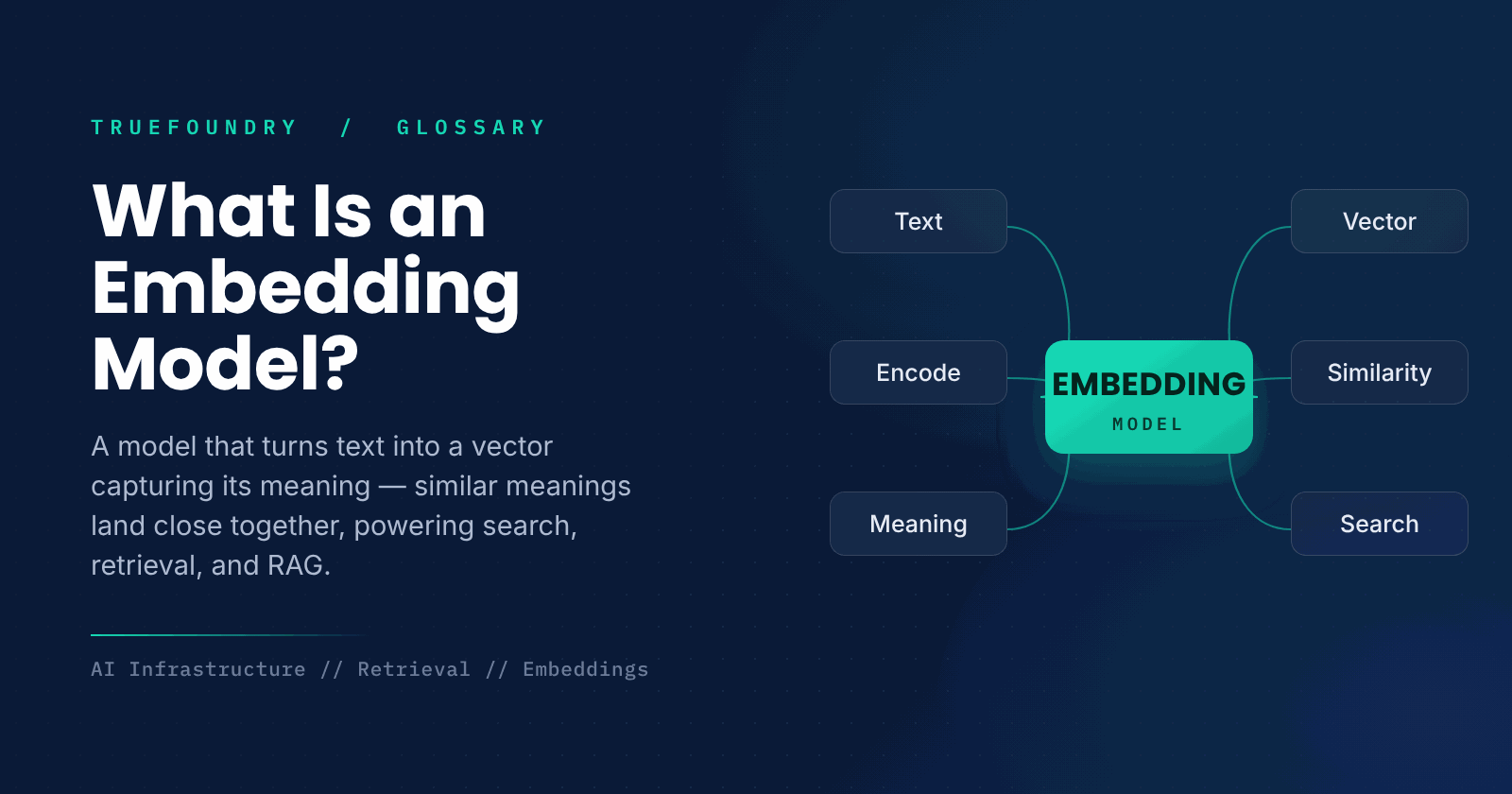
Computers compare numbers easily but struggle with meaning. The sentences how do I get a refund and what is your return policy share almost no words, yet they mean nearly the same thing. To let software recognize that, you need a way to turn meaning into numbers. That is what an embedding model does.
By converting text into vectors that place similar meanings close together, embedding models make it possible to search by meaning rather than keywords, to cluster related items, and to find the right passages to feed a language model. They are the quiet engine behind semantic search and retrieval-augmented generation.
This guide explains what an embedding model is, how it works, how it differs from keyword search and generation, and where it is used.
What is an embedding model?
An embedding model is a model that converts input, usually text, into a dense vector of numbers, called an embedding, that represents its meaning. The vector typically has hundreds or thousands of dimensions, and it is built so that inputs with similar meaning produce vectors that are close together in that space.
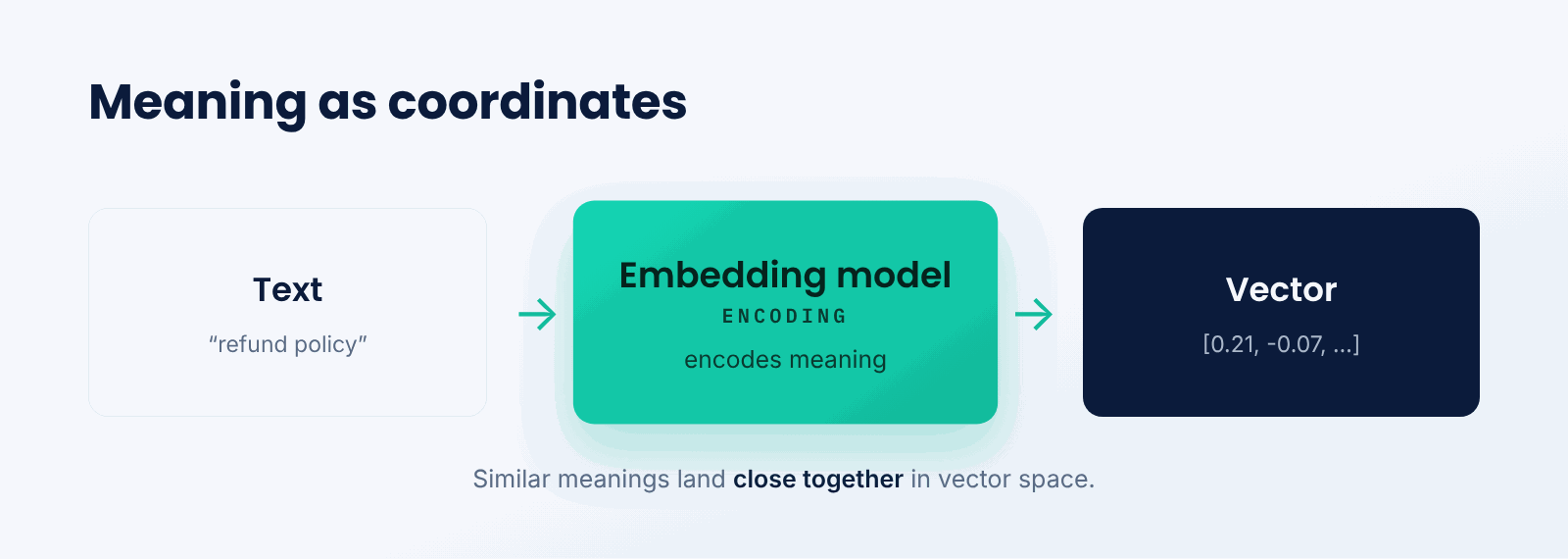
Think of placing every phrase on a giant map where location means meaning. Phrases about refunds cluster in one area, phrases about shipping in another. You can then find related phrases simply by looking at what is nearby, even if they share no words. An embedding model is what assigns each phrase its coordinates on that map.
The key idea is that distance equals similarity. Once text is embedded, measuring how close two vectors are tells you how similar their meanings are, which is the basis of semantic search.
How does an embedding model work?
An embedding model sits at the front of a search or retrieval pipeline.
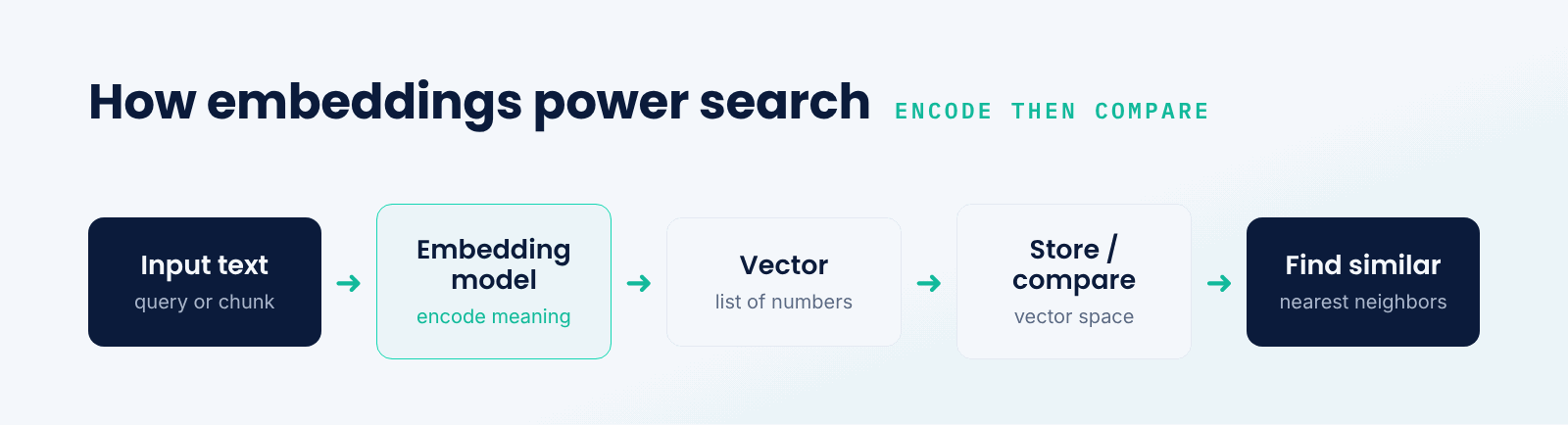
- Take the input. A piece of text, such as a query or a document chunk, is fed to the model.
- Encode the meaning. The model processes the text and outputs a vector that represents what it means.
- Store the vector. Document vectors are saved in a vector database, indexed for fast search.
- Compare by distance. At query time, the query is embedded and compared to stored vectors by similarity.
- Return nearest matches. The closest vectors, meaning the most semantically similar items, are returned.
Similarity is usually measured with cosine similarity or a related distance. Because the comparison is just math on vectors, searching millions of items by meaning becomes fast and practical.
Embeddings vs. keyword search and generation
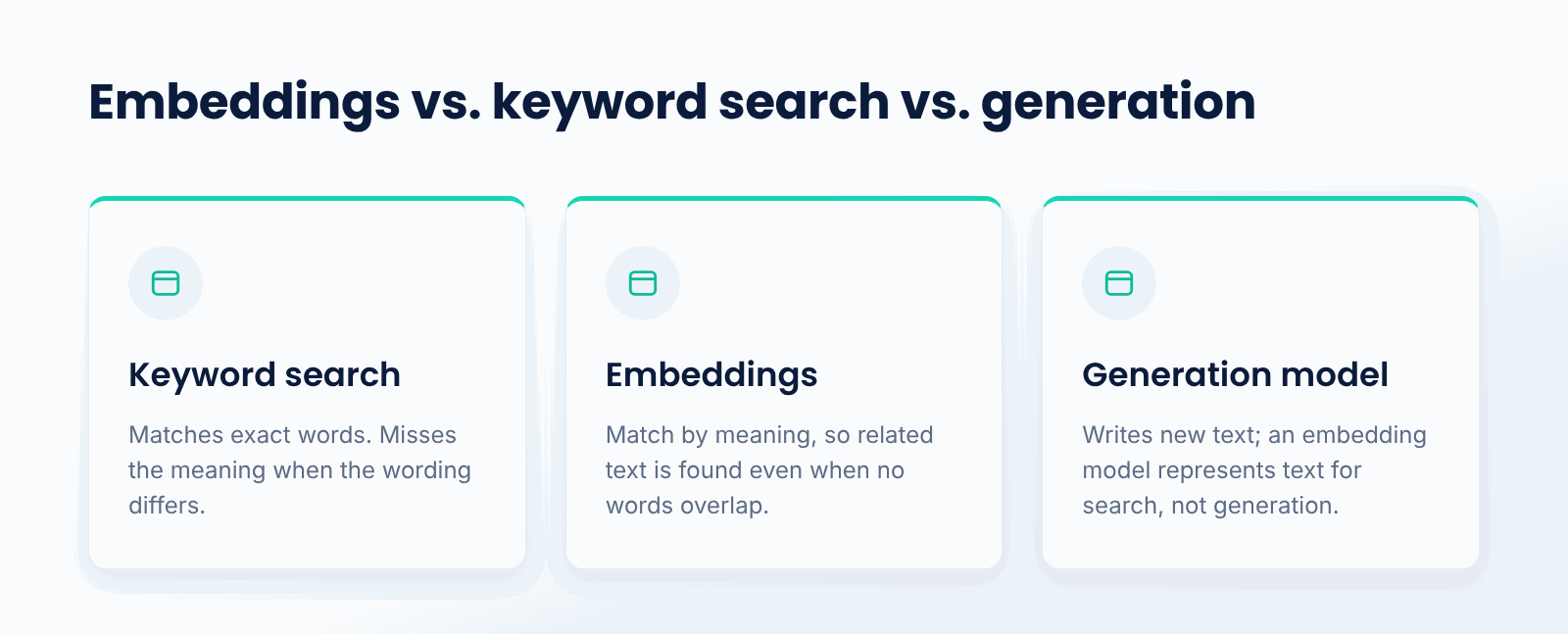
These do different jobs. Keyword search matches exact words, so it misses meaning when the wording differs, returning nothing for a reworded query. An embedding model matches by meaning, finding related text even when no words overlap, which makes search far more forgiving. A generation model is different again: it writes new text, whereas an embedding model represents existing text as vectors for search and comparison rather than generating anything.
In modern systems they work together. Embeddings find the relevant passages, and a generation model uses them to write an answer. Some systems also combine keyword and embedding search to get the strengths of both.
What are embedding models used for?
- Semantic search. Find documents by meaning rather than exact keywords.
- Retrieval-augmented generation. Fetch the relevant chunks to ground a language model's answer.
- Clustering and classification. Group or label items by the similarity of their embeddings.
- Recommendations. Suggest related items by finding nearby vectors.
- Deduplication. Spot near-duplicate content by how close its embeddings are.
What should you consider when choosing one?
- Quality. How well the model captures meaning for your kind of text and language.
- Dimension and cost. Larger vectors can be richer but cost more to store and compare.
- Domain fit. A general model may need fine-tuning for specialized or technical content.
- Latency and hosting. Whether you call an API or self-host affects speed, cost, and privacy.
When do you need an embedding model?
You need one whenever you want to search, match, or organize text by meaning rather than exact words. Any retrieval system, RAG pipeline, recommendation feature, or semantic search depends on an embedding model to turn text into comparable vectors.
If you only generate text and never need to find or compare it, you may not need embeddings. But the moment a system has to retrieve relevant information, an embedding model is usually at its core.
Best practices for using embedding models
- Use the same embedding model for indexing and querying so vectors are comparable.
- Chunk documents well before embedding, since chunk quality drives retrieval quality.
- Pick a model that fits your domain and language, and fine-tune if the content is specialized.
- Store embeddings in a proper vector database for fast similarity search at scale.
- Consider combining embedding and keyword search for the strengths of both.
- Serve embedding models behind a gateway so hosting, cost, and access are managed in one layer.
Conclusion
An embedding model turns text into vectors that capture meaning, placing similar meanings close together so software can compare them by distance. That simple idea powers semantic search, retrieval-augmented generation, clustering, and recommendations. Distinct from both keyword search and text generation, the embedding model is the component that lets systems work with meaning rather than exact words.
TrueFoundry lets teams serve embedding models alongside generation models on their own infrastructure, with retrieval pipelines managed behind one gateway and the same observability and cost control. Behind almost every retrieval or search feature is an embedding model quietly turning text into the vectors that make meaning searchable.

Govern, Deploy and Trace AI in Your Own Infrastructure
Frequently Asked Questions
What is an embedding model in simple terms?
It is a system that converts textual information into numerical representations called vectors, which carry the meaning of the information. The more closely two pieces of text are related in meaning, the more closely their vectors sit together.
What is an embedding?
An embedding is the vector an embedding model produces for a piece of text. It is a point in a multi-dimensional space where the proximity of two points indicates similarity in meaning, which is what makes semantic search and retrieval possible.
How is an embedding model different from a generation model?
A generation model generates text, whereas an embedding model creates a vector representation of text that already exists, for searching and comparing. In a RAG setting both collaborate: embeddings retrieve useful text, and the generation model writes the answer.
How is similarity measured between embeddings?
Normally with cosine similarity or a related distance measure. The smaller the distance between two vectors, the more similar the meaning of their texts, which is how a search retrieves the most relevant items.
Do I need the same embedding model for queries and documents?
Yes. You should embed both your documents and your queries using the same model, because their vectors then exist in the same space and the distances between them are meaningful.


- © 2022 ENSEMBLE Technologies



Subscribe to our newsletter
The latest news, articles, and resources sent to your inbox


