


What Is Direct Preference Optimization and Why Does It Matter?

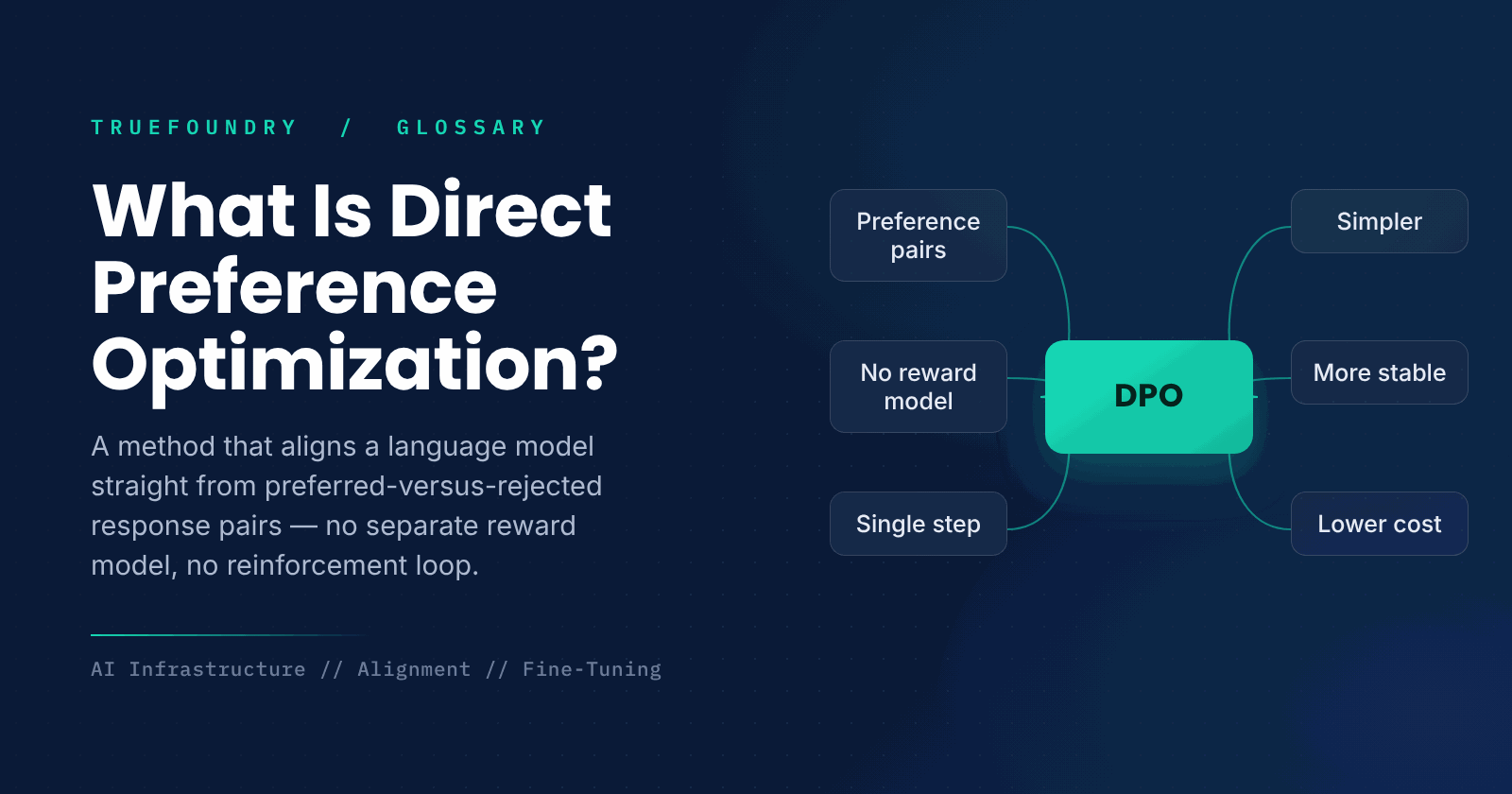
After a language model is fine-tuned to follow instructions, teams usually want to align it further with human preferences, so it is helpful, honest, and matches the tone they want. The established way to do this, reinforcement learning from human feedback, is powerful but complex: it trains a separate reward model and then uses reinforcement learning to optimize against it, which is finicky and expensive.
Direct Preference Optimization offers a simpler path. It trains the model directly on human preference data, pairs of a better and a worse response, without a separate reward model or a reinforcement loop. The result is alignment that is easier to run and more stable, which is why DPO has become a popular alternative. This guide explains what it is and how it works.
We will cover the definition, the training process, how it compares to RLHF, and when to use it.
What is Direct Preference Optimization?
Direct Preference Optimization, or DPO, is a technique for aligning a language model with human preferences by training it directly on pairs of responses where one is preferred over the other. The model is optimized to make the preferred response more likely and the rejected one less likely, learning human preferences straight from the data without an intermediate reward model.
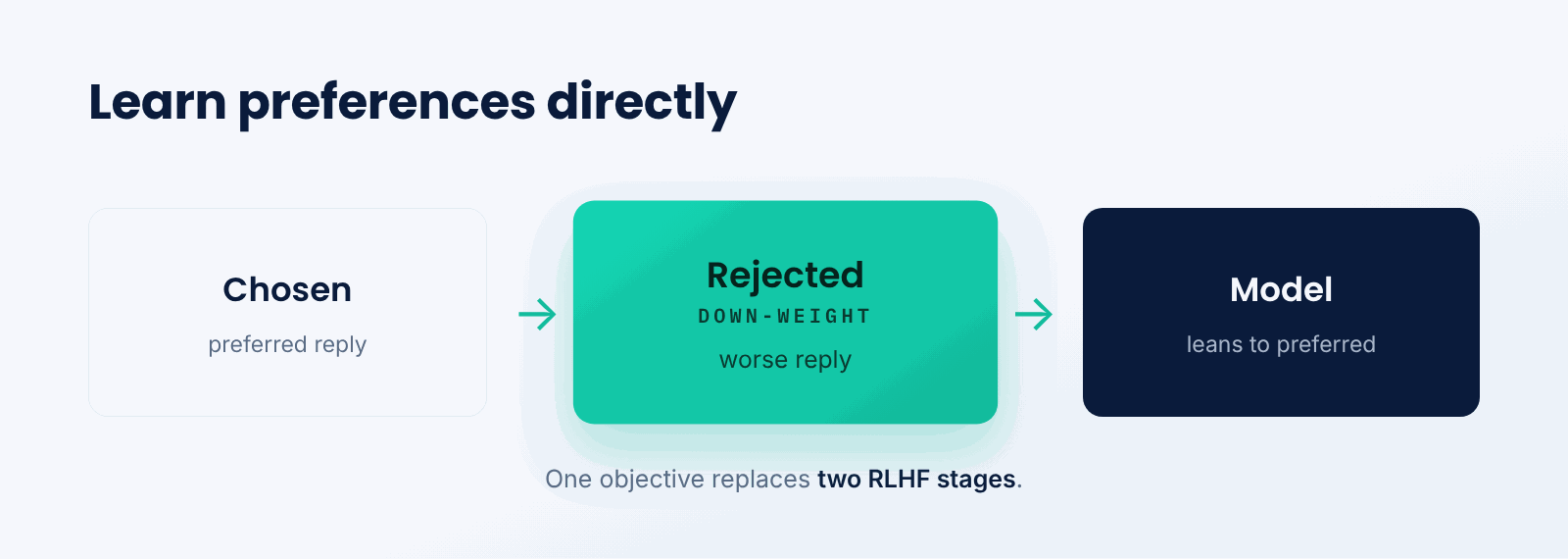
Think of it like teaching by direct comparison. Instead of first building a scoring rubric and then coaching to the rubric, you simply show the model many pairs and say which one people liked better, and it learns to lean toward the kind of answer people prefer.
The key idea is optimizing preferences directly. By folding what RLHF splits into two stages into a single training objective, DPO removes a whole layer of machinery while still teaching the model the same preferences.
How does DPO work?
DPO trains on preference pairs with a single objective that favors the chosen response.
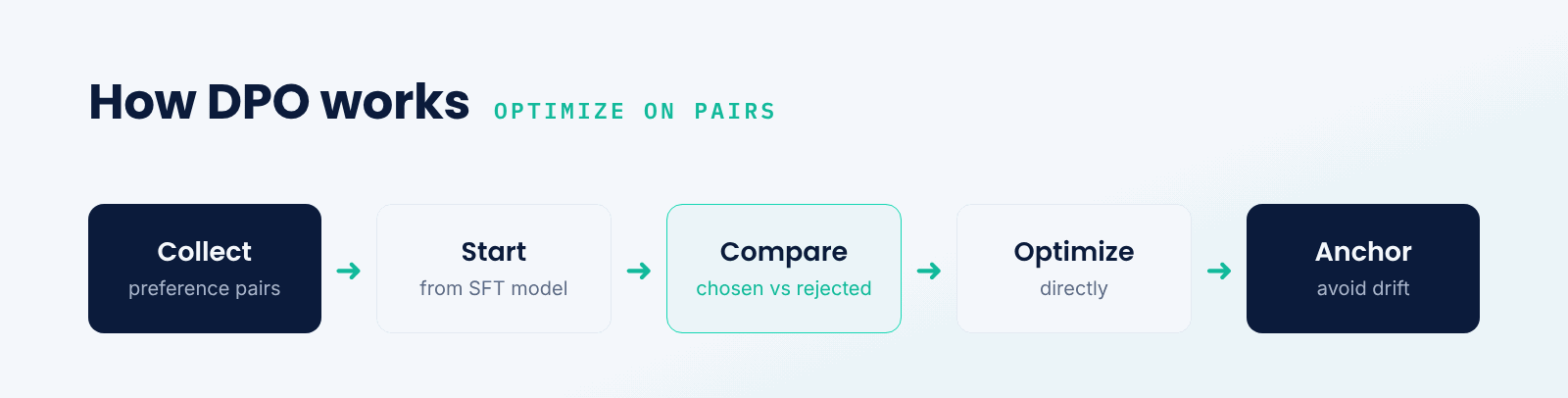
- Collect preferences. Gather pairs where humans marked one response better.
- Start from an SFT model. Begin with an instruction-tuned base.
- Compare pairs. For each pair, look at the preferred and rejected response.
- Optimize directly. Adjust the model to raise the preferred, lower the rejected.
- Keep it anchored. Stay close to the original model to avoid drift.
The training objective increases the model's relative preference for the chosen response over the rejected one, while a built-in term keeps it from straying too far from the starting model. This gives the alignment benefit of RLHF without training or querying a separate reward model.
DPO vs. RLHF
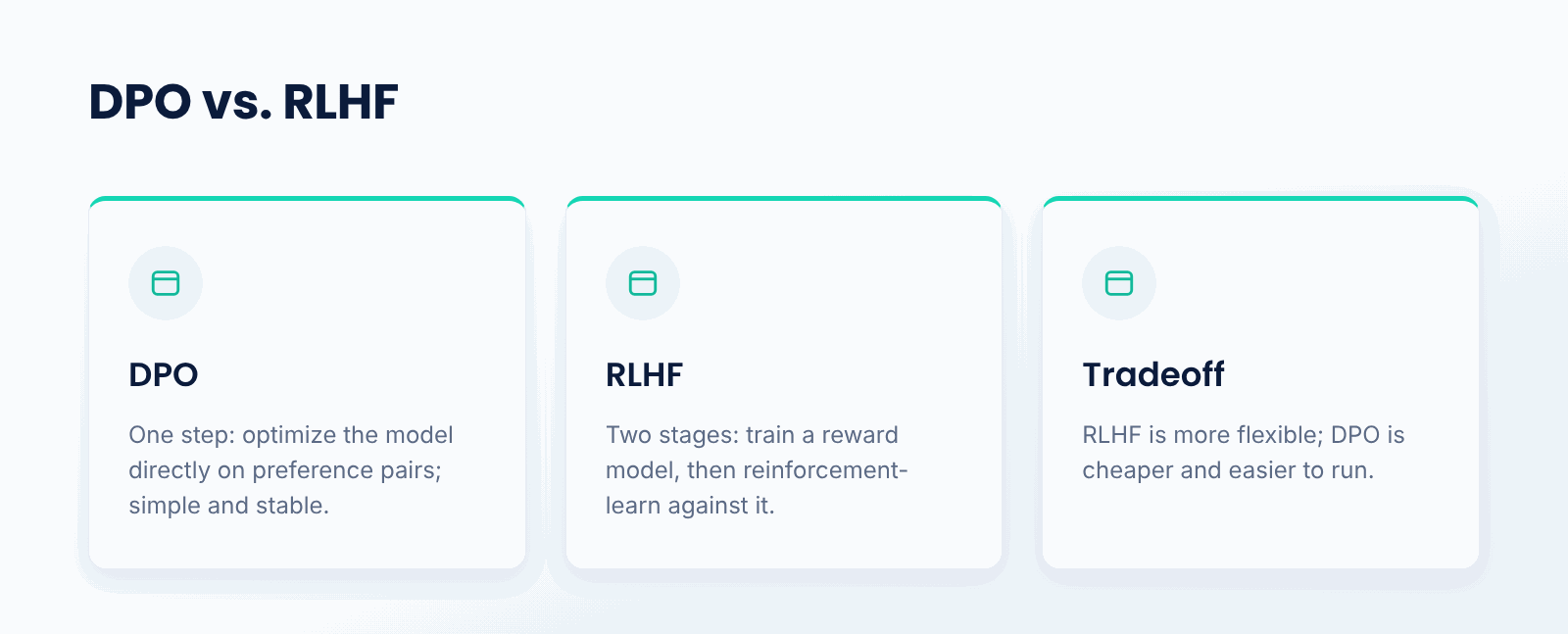
RLHF works in two stages: it first trains a reward model to predict human preferences, then uses reinforcement learning to optimize the language model against that reward. It is powerful and well-proven, but the reinforcement step is complex, sensitive to tuning, and computationally heavy.
DPO collapses this into one step, optimizing the model directly on the preference pairs with a simple loss. It is easier to implement, more stable to train, and cheaper to run, while reaching comparable alignment quality on many tasks. The tradeoff is less flexibility than a full reinforcement setup, which can matter for the most demanding alignment goals.
Why does DPO matter?
- Simplicity. It removes the reward model and reinforcement loop.
- Stability. It trains more reliably than reinforcement learning.
- Lower cost. It needs less compute and engineering effort.
- Accessibility. It brings preference alignment within reach of more teams.
- Comparable quality. It matches RLHF on many alignment tasks.
What are the tradeoffs?
- Data dependence. It still needs good preference pairs to learn from.
- Less flexibility. It is less expressive than a full RL setup.
- Anchor tuning. The term that limits drift needs to be set carefully.
- Not a cure-all. Hard alignment goals may still favor RLHF.
When should you use DPO?
Use DPO when you want to align a model with human preferences and value simplicity, stability, and lower cost. It is a strong default for teams that have preference data but do not want the complexity of a full reinforcement learning pipeline, which describes many practical alignment efforts.
If you need the maximum flexibility of a reward-model-based setup, or have alignment goals that call for it, RLHF may still be worth the extra complexity. But for most teams, DPO offers most of the benefit at a fraction of the effort.
Key points about DPO
- DPO aligns a model directly from preference pairs.
- It removes the reward model and reinforcement loop of RLHF.
- It is simpler, more stable, and cheaper to run.
- It raises the preferred response and lowers the rejected one.
- It stays anchored to the starting model to avoid drift.
- It matches RLHF quality on many tasks.
Conclusion
Direct Preference Optimization is a simpler way to align language models with human preferences, training directly on preferred-versus-rejected response pairs without the reward model and reinforcement loop that RLHF requires. It is easier to implement, more stable, and cheaper, while reaching comparable quality on many tasks, which is why it has become a popular alignment method.
TrueFoundry helps teams fine-tune and align models on their own infrastructure, including preference-based methods like DPO that keep alignment simple and cost-effective. When you need aligned behavior without the overhead of reinforcement learning, DPO is an excellent place to start.

Govern, Deploy and Trace AI in Your Own Infrastructure
Frequently Asked Questions
What is DPO in simple terms?
It is a method for training a model toward the type of answer people prefer, based on direct training on pairs of a better and a worse answer. In this approach, there is no need for an additional reward model or reinforcement learning, as RLHF uses.
How is DPO different from RLHF?
There are two phases in RLHF: it first trains a reward model to score responses, and then applies reinforcement learning based on it. DPO merges both phases into one, where the model is optimized directly on preference pairs using a simple loss function, which makes it simpler, more stable, and cheaper.
Does DPO still need human preference data?
Yes. Since DPO is trained on pairs of answers where people have ranked one as better, the quality of the preference data is very important. What it removes is the separate reward model and reinforcement loop, not the need for human preferences in the first place.
Is DPO as good as RLHF?
For many alignment tasks, DPO is equally good with far less overhead. While RLHF can still provide more flexibility for the toughest use cases, in practice DPO is sufficient in most cases while using far less in resources and effort.
When should I use DPO instead of RLHF?
Select DPO if you want preference alignment and value simplicity, stability, and reduced cost, and you have preference data for training. Select RLHF if you specifically require the added flexibility of a reward-model-based reinforcement setup.


- © 2022 ENSEMBLE Technologies



Subscribe to our newsletter
The latest news, articles, and resources sent to your inbox


