


What Is a Diffusion Model and Why Does It Matter?

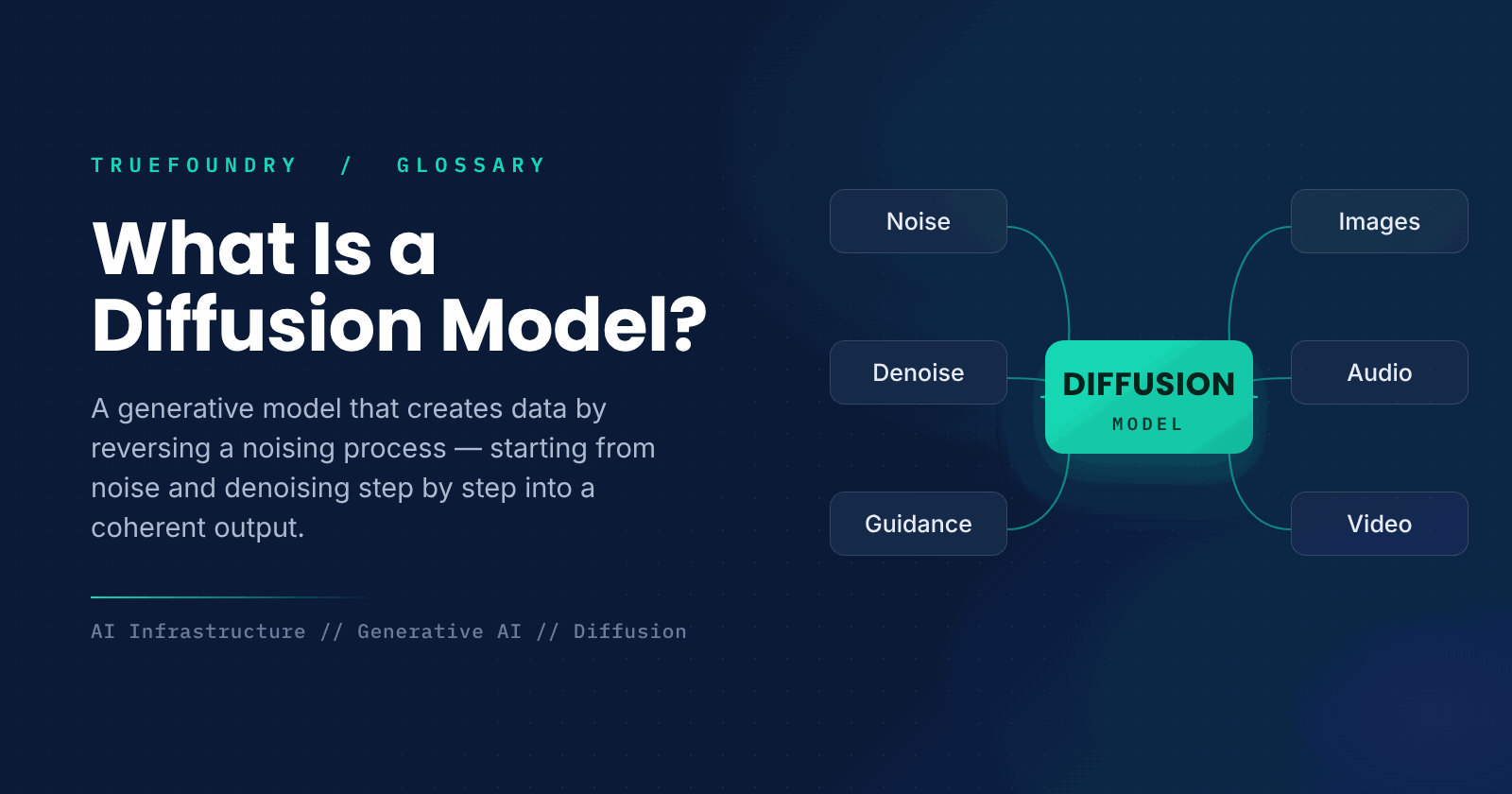
Diffusion models belong to the category of generative models where training enables the system to generate new data by reversing a continuous process of noising. This is achieved by removing noise from an entirely noisy input until a meaningful result emerges, such as an image or an audio clip. They power most modern AI image generation.
Diffusion model essentials
- A diffusion model generates data through gradual noise reduction.
- It learns through training on reversing a sequential noising process.
- Generation starts from random noise and is denoised into a clear output.
- It is used for making most modern AI images, audio, and videos.
- Direction like a text prompt guides what the model generates.
Much of the recent wave of AI image generation, from photorealistic pictures to stylized art, rests on a single idea: diffusion. Rather than drawing an image in one shot, a diffusion model sculpts it out of noise, removing a little randomness at a time until a clear picture appears. The approach has proven remarkably good at producing high-quality, varied outputs.
Diffusion models are a class of generative models, systems that learn the structure of data well enough to create new examples. What sets them apart is how they generate: through a gradual, iterative denoising process that turns random static into something meaningful. The same principle extends beyond images to audio, video, and other kinds of data.
This guide explains what a diffusion model is, how the denoising process works, how diffusion compares to other generative approaches, and where it is used.
What is a diffusion model?
A diffusion model is a generative model trained to reverse a process that gradually adds noise to data. During training, real examples are progressively corrupted with random noise until they become pure static, and the model learns to undo each step. Once trained, it can start from fresh noise and run the reverse process to generate a brand-new example.
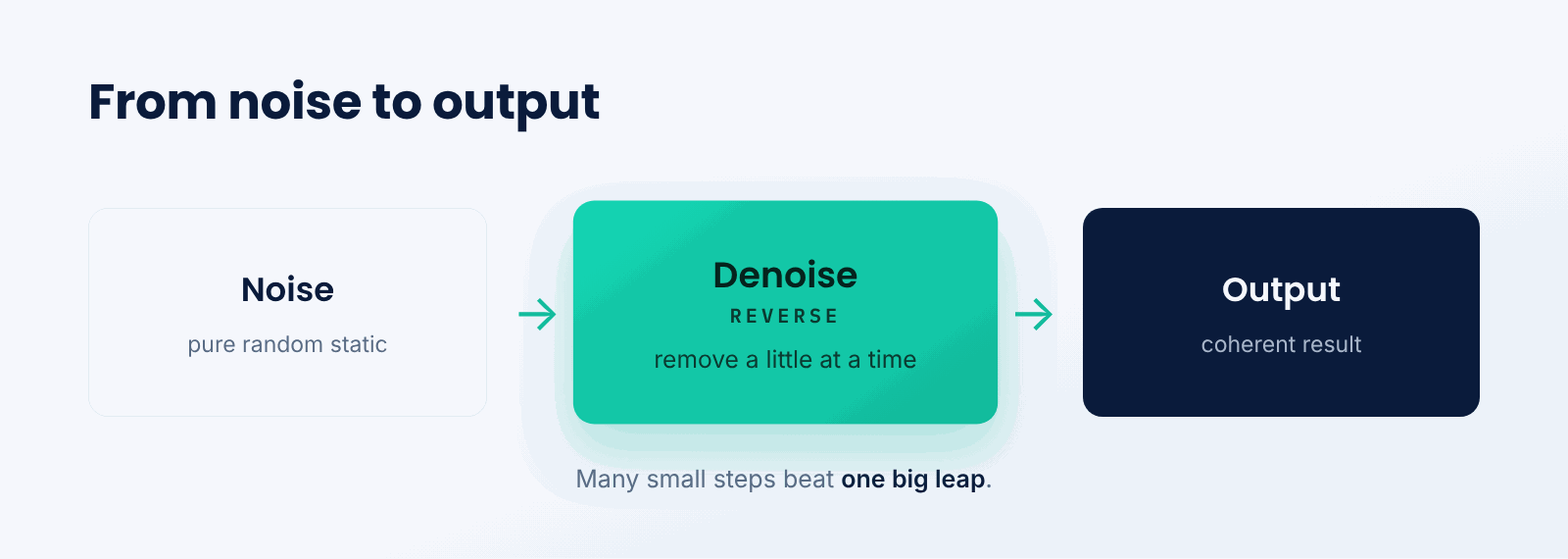
Think of it like a sculptor facing a block of marble. The finished statue is, in a sense, already inside the block; the sculptor's job is to remove everything that is not the statue. A diffusion model starts with a block of noise and removes the randomness that is not the image, revealing a coherent result one chip at a time.
The key idea is that generating in many small steps is easier than in one leap. Predicting a tiny amount of noise to remove is a tractable problem, and chaining many such steps together produces outputs of a quality that single-shot generation struggles to match.
How does a diffusion model work?
Generation runs the learned denoising process from noise to a finished output, often steered by a prompt.
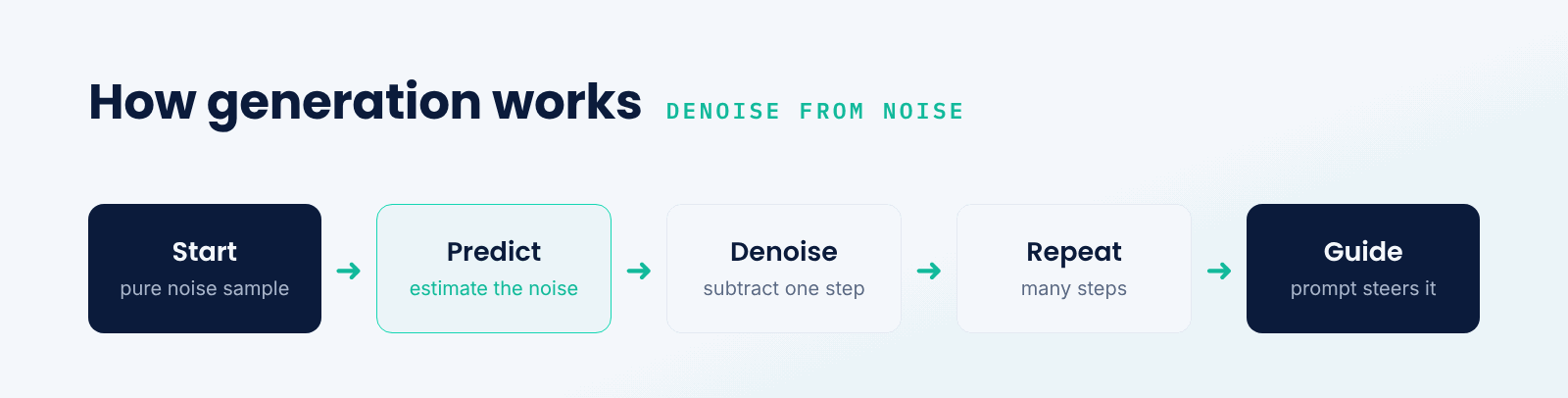
- Start from noise. Begin with a sample of pure random noise.
- Predict noise. The model estimates how to remove a small amount of noise.
- Denoise a step. Subtract that estimate to get a slightly cleaner sample.
- Repeat. Run many steps, each revealing more structure.
- Guide. A condition like a text prompt steers each step toward the desired output.
The number of steps trades quality against speed: more steps generally give cleaner results but take longer. Guidance is what makes the output controllable, aligning each denoising step with a text description or other condition so the final image matches what was asked for.
Diffusion vs. other generative models
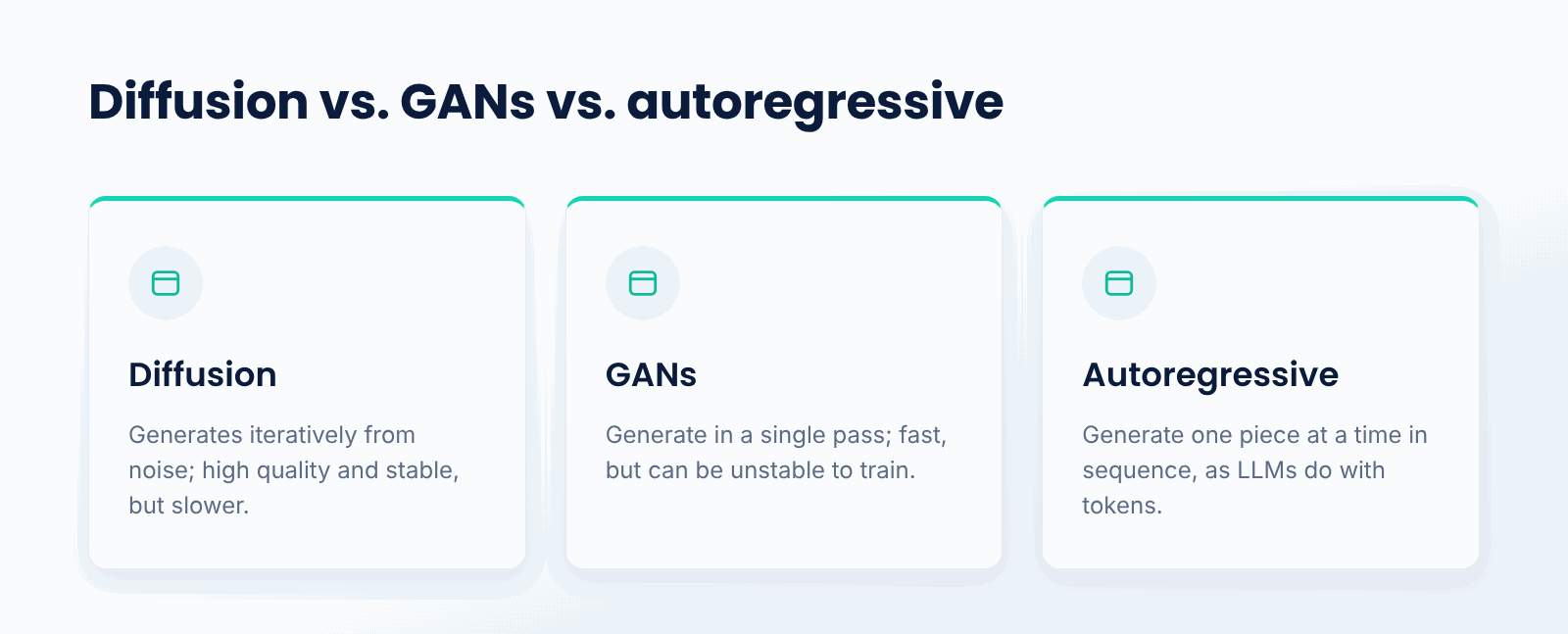
Diffusion is one of several ways to generate data. GANs pit a generator against a discriminator and produce outputs in a single pass, which is fast but can be unstable to train. Autoregressive models generate one piece at a time in sequence, as language models do with tokens. Diffusion generates iteratively from noise, trading more compute per sample for high quality and stable training.
Each approach has a niche. Diffusion has become dominant for images because it produces diverse, high-fidelity results and is comparatively stable to train. Autoregressive models dominate text, and hybrid approaches combine ideas. The main cost of diffusion is that its many steps make generation slower than single-pass methods.
Why do diffusion models matter?
- Image quality. They produce highly realistic and varied images.
- Controllability. Guidance lets prompts and conditions steer the output.
- Stability. They are more stable to train than earlier approaches like GANs.
- Versatility. The same idea works for images, audio, video, and more.
- Foundation. They underpin most modern text-to-image and generative media tools.
What are the tradeoffs?
- Slow generation. Many denoising steps make inference slower than single-pass models.
- Compute cost. Each step runs the model, so generation is compute-intensive.
- Step tuning. Fewer steps are faster but can reduce quality.
- Serving demands. Real-time use requires optimization to cut the step count or cost.
Where are diffusion models used?
Diffusion models are the engine behind most text-to-image systems, generating pictures from written descriptions. They also extend to image editing, inpainting, super-resolution, audio and music generation, and increasingly video, wherever high-quality generative output is needed.
In production, the main engineering challenge is speed. Because generation takes many steps, serving diffusion models efficiently involves reducing the number of steps, optimizing each one, and using accelerators well, so that high-quality generation stays fast and affordable at scale.
Key points about diffusion models
- They generate by reversing a gradual noising process.
- Generation starts from noise and denoises step by step.
- Guidance steers output toward a prompt or condition.
- They dominate AI image generation and extend to other media.
- Their main cost is slow, compute-heavy multi-step generation.
- Serving optimization focuses on reducing steps and cost per step.
Conclusion
A diffusion model generates data by learning to reverse a noising process, starting from random noise and denoising step by step into a coherent output. Steered by guidance such as a text prompt, this approach produces high-quality, varied results and has become the foundation of modern AI image generation. Its main tradeoff is the compute cost of running many generation steps.
TrueFoundry helps teams deploy and serve generative models, including diffusion models, efficiently on their own infrastructure, managing the GPU demands of multi-step generation. As generative media spreads, serving diffusion models well is key to using them at scale.

Govern, Deploy and Trace AI in Your Own Infrastructure
Frequently Asked Questions
What is a diffusion model in simple terms?
It is an algorithm that generates visual or any other kind of data starting with random noise and getting rid of that noise until some form appears. It learns to do that through training to undo the action of adding noise progressively to real examples.
How does a diffusion model generate an image?
It starts with raw noise and goes through numerous stages of denoising, whereby a tiny bit of noise is predicted and stripped away at each stage. A text prompt or other guidance steers each stage so that the final output reflects the description.
How is diffusion different from a GAN?
GANs generate outputs in one pass by training the generator against a discriminator, which is fast but prone to instability. On the other hand, diffusion models iteratively generate outputs starting from noise over multiple passes and take more time, but produce high-quality, diverse results and train more stably.
Why are diffusion models slow?
The reason is that the generation process performs several denoising steps sequentially, where each step makes use of the model. The more denoising steps, the better the quality, although the generation time becomes longer, so serving them in real time requires reducing or optimizing those steps.
What are diffusion models used for?
Most text-to-image, image manipulation, inpainting, upscaling, and now even audio and video. Diffusion can be found at work in any instance where high-quality generative media is required.


- © 2022 ENSEMBLE Technologies



Subscribe to our newsletter
The latest news, articles, and resources sent to your inbox


