


What Is Catastrophic Forgetting and Why Does It Matter?

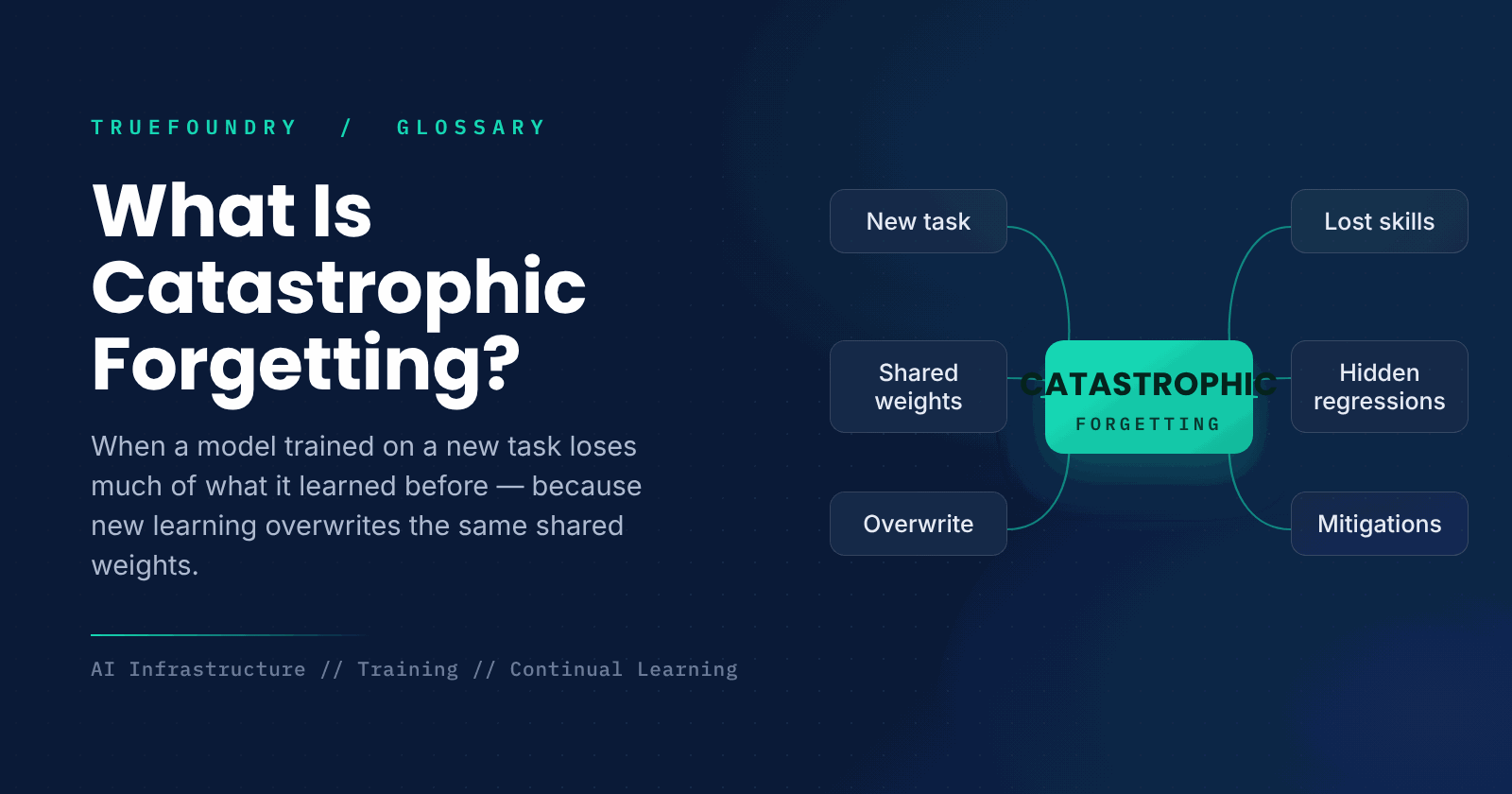
When you fine-tune a model on a new task, you hope it gains the new skill while keeping everything it already knew. Often it does not. As the model learns the new task, it can lose much of its earlier ability, sometimes dramatically. This is catastrophic forgetting, and it is one of the central challenges in adapting and continually training neural networks.
The cause is built into how these models learn: training adjusts the same shared weights, so updates for the new task can overwrite the patterns that encoded old knowledge. Understanding and controlling this effect is essential for fine-tuning safely and for building systems that learn over time. This guide explains what it is, why it happens, and how to reduce it.
We will cover the definition, the cause, how it is mitigated, and when it matters.
What is catastrophic forgetting?
Catastrophic forgetting is the tendency of a neural network to lose previously learned knowledge when it is trained on new data or a new task. The model's performance on earlier tasks drops, sometimes sharply, as it adapts to the new one, because the training process overwrites the weights that stored the old knowledge.
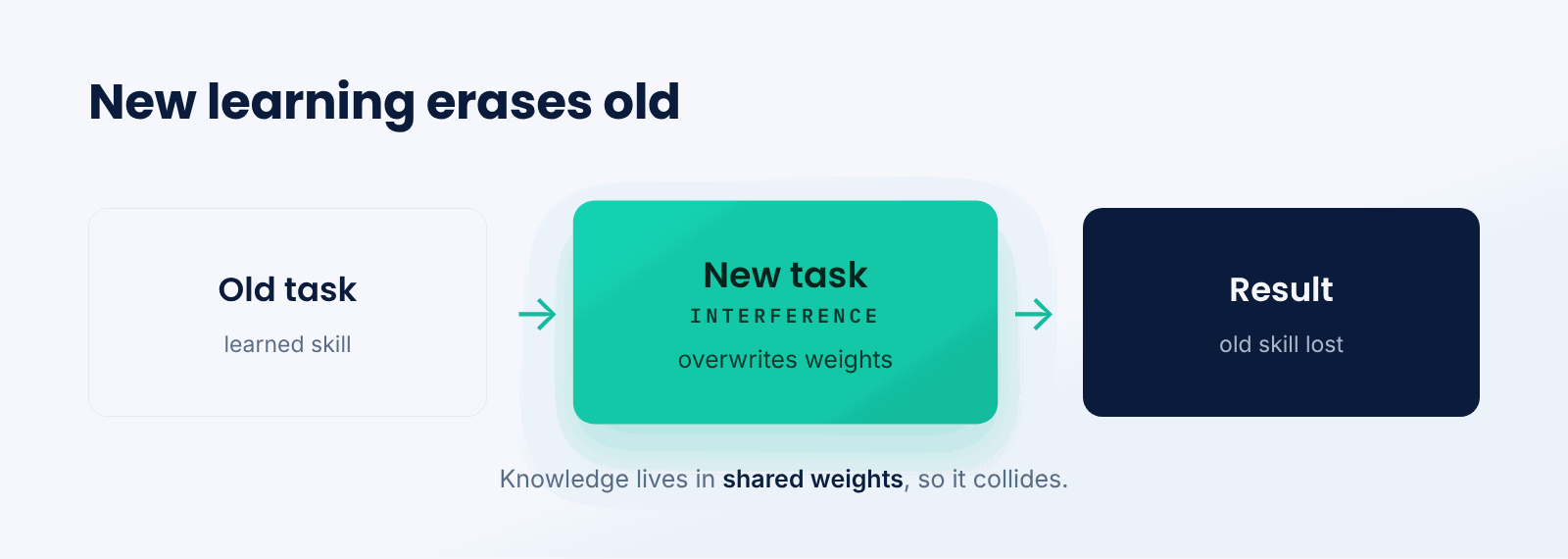
Think of it like writing on the same whiteboard. To add new notes, you erase part of what was there, and the old notes are lost. A neural network learns on a shared set of weights, so teaching it something new can rub out what it learned before unless you take care to protect it.
The key idea is interference between old and new learning. Because knowledge is spread across shared weights rather than stored in separate slots, new updates can disrupt old capabilities as a side effect.
Why does catastrophic forgetting happen?
It happens because learning a new task reuses and overwrites the same weights that held old knowledge.
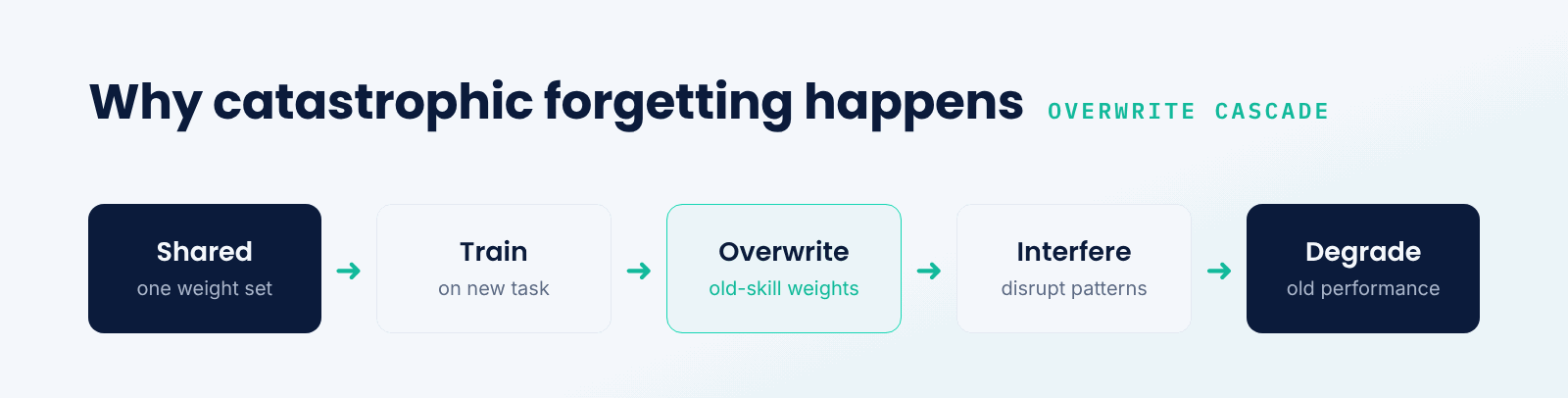
- Shared weights. The model stores all knowledge in one set of weights.
- New task training. Fine-tuning pushes those weights toward the new task.
- Overwrite. Updates change weights that encoded earlier skills.
- Interference. Old patterns are disrupted as a side effect.
- Degradation. Performance on earlier tasks falls.
The more the new task pulls the weights away from where they were, the more the old knowledge erodes. Training heavily on a narrow new task is especially prone to it, because the model optimizes hard for the new data with no pressure to preserve the old.
How is catastrophic forgetting reduced?
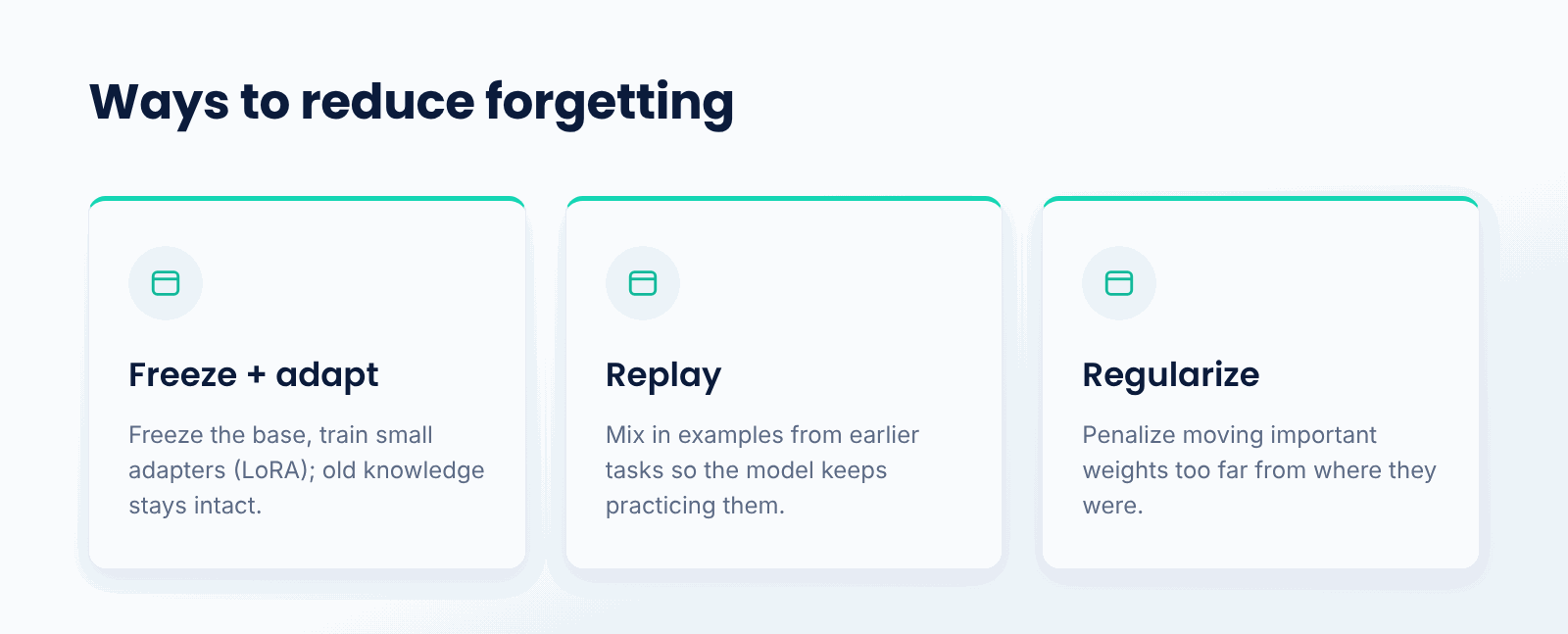
One family of methods protects or freezes important weights, so training changes the parts that matter least to old tasks. Parameter-efficient methods like adapters and LoRA take this further by freezing the base model entirely and training small added weights, which leaves the original knowledge intact.
Another family keeps old knowledge present during training. Replay mixes examples from earlier tasks into the new training data, so the model keeps practicing what it already knew. Regularization methods add a penalty for moving important weights too far. In practice, teams combine these approaches to balance new learning against retention.
Why does catastrophic forgetting matter?
- Fine-tuning risk. Adapting a model can silently degrade its general ability.
- Continual learning. It blocks models from learning tasks in sequence.
- Hidden regressions. Lost skills may not show up until later.
- Cost. Retraining from scratch to recover is expensive.
- Reliability. Preserving old behavior is key to trustworthy updates.
What are the challenges in addressing it?
- Tradeoff. Protecting old knowledge can limit new learning.
- Detection. Forgetting may be missed without testing old tasks.
- Data access. Replay needs access to earlier training data.
- Tuning. Mitigation methods add their own settings to balance.
When should you worry about it?
Worry about catastrophic forgetting whenever you fine-tune a model you still need to be good at its original abilities, or whenever you plan to train a model on tasks in sequence. It is especially a concern with heavy fine-tuning on narrow data, where the model can over-specialize and lose its general skills.
If you are training a fresh model for a single task and never need the prior knowledge, forgetting is not a problem. But any time retention matters, it pays to use parameter-efficient methods, replay, or regularization and to test old capabilities after training.
Key points about catastrophic forgetting
- It is losing old skills when learning new ones.
- It happens because new training overwrites shared weights.
- Heavy fine-tuning on narrow data makes it worse.
- Adapters and LoRA avoid it by freezing the base model.
- Replay and regularization help preserve old knowledge.
- It matters whenever earlier abilities must be retained.
Conclusion
Catastrophic forgetting is the loss of previously learned knowledge when a model is trained on something new, caused by new learning overwriting the shared weights that held the old. It is a central challenge in fine-tuning and continual learning, but techniques like parameter-efficient adapters, replay, and regularization can reduce it substantially.
TrueFoundry helps teams fine-tune models on their own infrastructure with methods that preserve what a model already knows, such as adapter-based tuning that leaves the base model intact. When adapting a model without losing its strengths matters, managing catastrophic forgetting is key.

Govern, Deploy and Trace AI in Your Own Infrastructure
Frequently Asked Questions
What is catastrophic forgetting in simple terms?
It happens when a model acquires a new skill but at the cost of forgetting a lot of what it had learned earlier. This is because training modifies the same weights that were associated with the previous knowledge, so the model's performance on earlier tasks drops.
Why does catastrophic forgetting happen?
Because a neural network stores its knowledge in one common set of weights. The training done for a new task drives those weights toward the new task, and this process overwrites the weight patterns that were responsible for earlier skills, disrupting them as a side effect.
How can catastrophic forgetting be reduced?
Various methods: freezing the base model and training small added weights, as adapters and LoRA do; replaying examples from previous tasks during new training; or adding a penalty so important weights don't move too far. Teams often combine these to balance new learning with retention.
Does fine-tuning always cause forgetting?
Not always, but heavy fine-tuning on narrow data is especially prone to it, because the model optimizes hard for the new task with no pressure to keep the old. Parameter-efficient methods and testing old capabilities afterward help keep it in check.
When should I worry about catastrophic forgetting?
Whenever you need to refine a model that still requires its original abilities, or when you will train it on tasks in sequence. If you are building a fresh model for only one task and never need the prior knowledge, it is not a concern.


- © 2022 ENSEMBLE Technologies



Subscribe to our newsletter
The latest news, articles, and resources sent to your inbox


