


What Is an Attention Mechanism and Why Does It Matter?

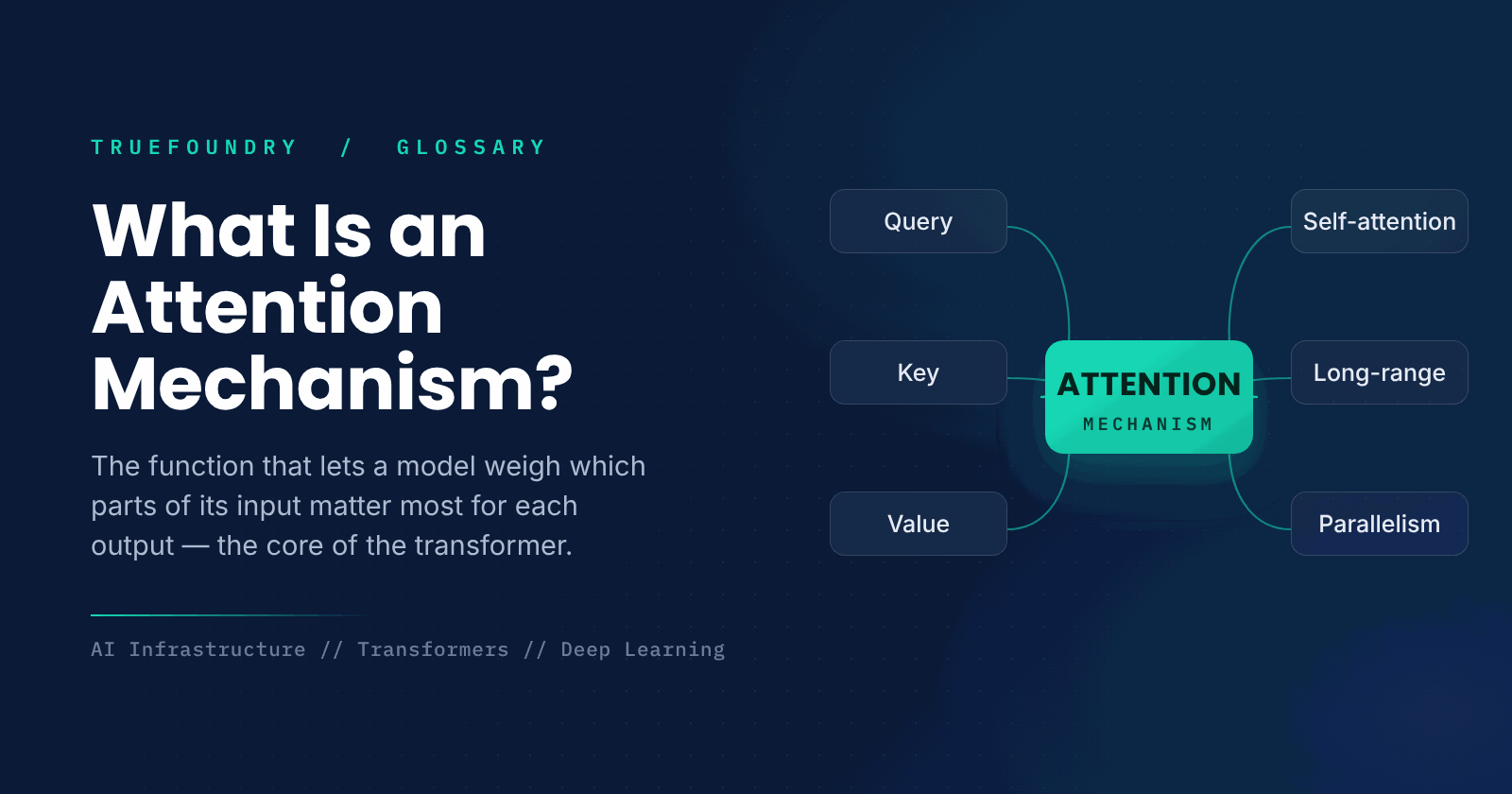
When you read a sentence, you do not give every word equal weight. To understand a pronoun, you look back at the noun it refers to; to interpret a verb, you focus on its subject and object. Attention mechanisms give neural networks a version of that ability: a way to decide, for each piece of output, which parts of the input are most relevant.
Attention is the idea at the heart of the transformer, the architecture behind virtually every modern large language model. It replaced older approaches that processed sequences strictly in order and struggled to connect distant words. By letting every token look directly at every other token, attention made it possible to model language at a scale and quality that was not previously achievable.
This guide explains what an attention mechanism is, how it works, how self-attention differs from earlier methods, and why it matters so much.
What is an attention mechanism?
An attention mechanism is a function that computes a weighted combination of values, where the weights reflect how relevant each value is to a given query. Each input element produces a query, a key, and a value. The query is compared against all keys to produce attention scores, and those scores decide how much each value contributes to the output.
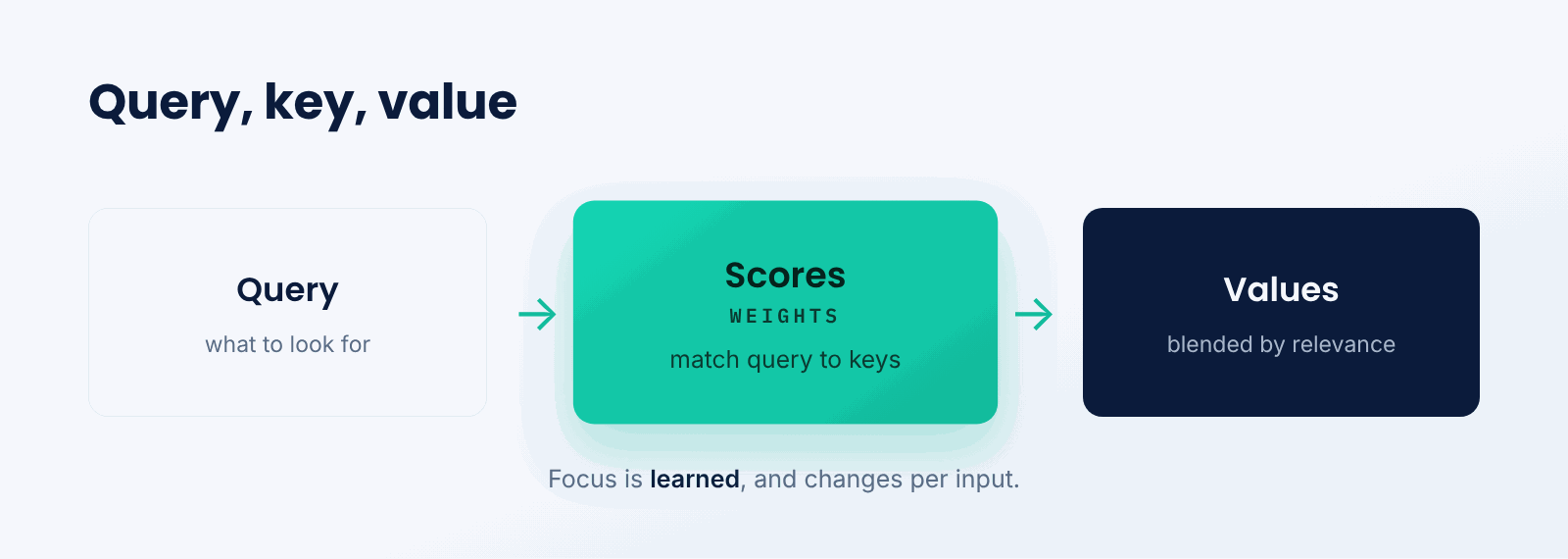
Think of it like looking something up in a library. Your question is the query, the labels on the shelves are the keys, and the books themselves are the values. You compare your question to the labels to find the most relevant shelves, then draw most heavily on those books. Attention does the same with numbers, blending information in proportion to relevance.
The key idea is that attention is learned and dynamic. The model is not told which inputs matter; it learns to produce queries and keys so that relevant pairs score highly. This lets it focus differently for every input it sees.
How does self-attention work?
In a transformer, self-attention lets each token in a sequence attend to all the others, including itself.
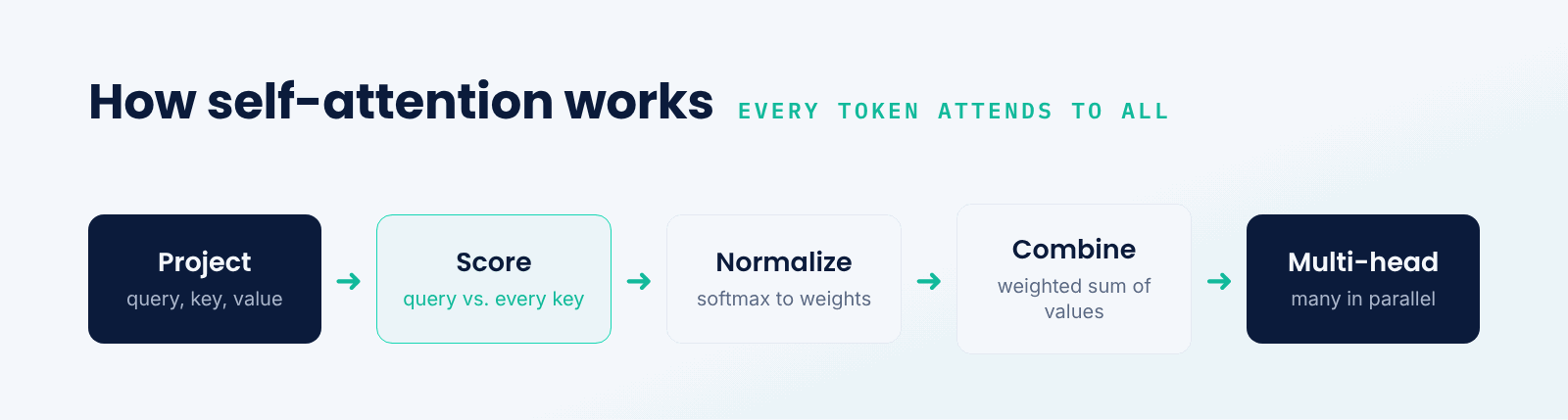
- Project. Each token is turned into a query, a key, and a value vector.
- Score. Each query is compared against every key to get relevance scores.
- Normalize. The scores are turned into weights that sum to one, via softmax.
- Combine. Each token's output is a weighted sum of all values, using those weights.
- Repeat in parallel. Multiple attention heads do this at once, capturing different relationships.
Because every token attends to every other, self-attention captures relationships regardless of distance, connecting a word to another far earlier in the text just as easily as to its neighbor. Multiple heads let the model track several kinds of relationship at the same time, such as grammar and meaning.
Attention vs. older sequence models
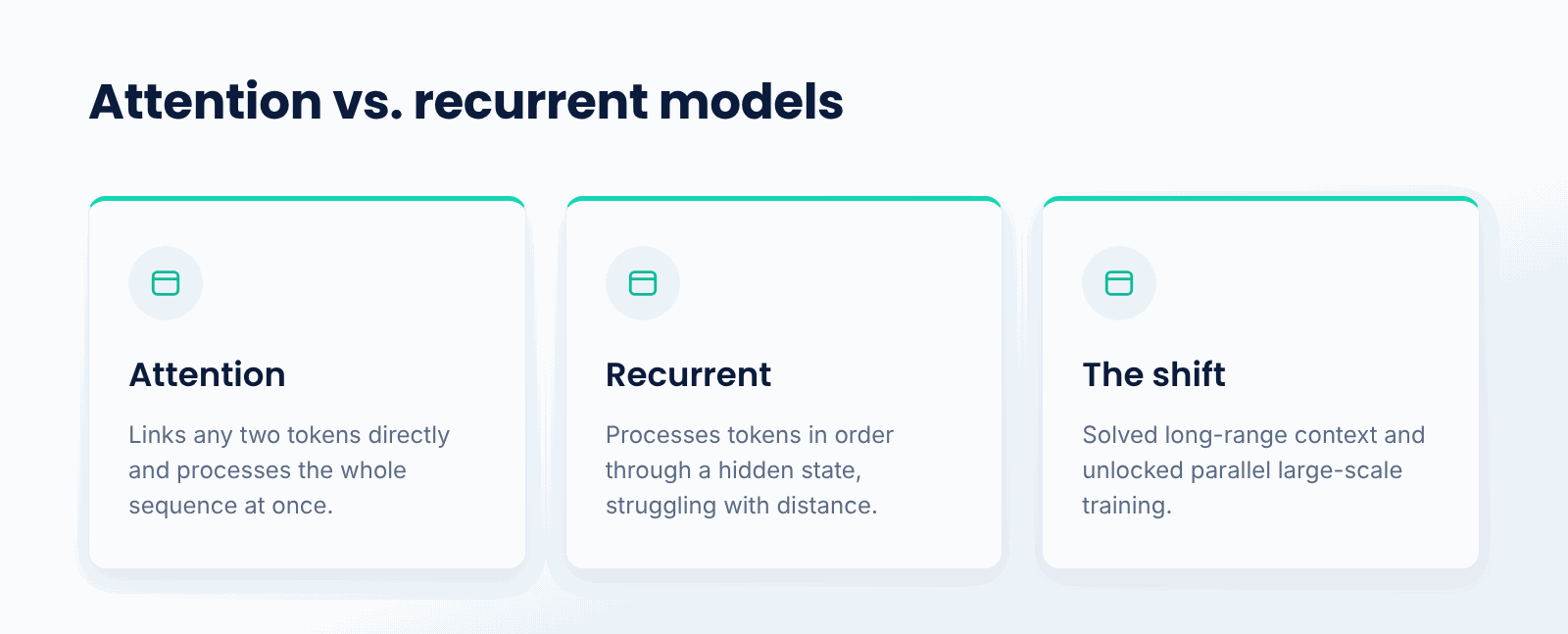
Before attention, sequences were handled mainly by recurrent networks that processed tokens one at a time, carrying a hidden state forward. This made it hard to connect distant tokens, since information had to survive many steps, and it forced sequential computation that was slow to train. Attention processes the whole sequence at once and links any two positions directly.
That shift had two big consequences. It solved the long-range dependency problem, letting models relate distant parts of a text, and it unlocked parallel training on modern hardware, which made training on massive datasets practical. Together these are why the transformer displaced earlier architectures.
Why does attention matter?
- Long-range context. It connects distant tokens directly, not through many steps.
- Parallelism. The whole sequence is processed at once, enabling fast training.
- Scale. It made training very large models on huge datasets practical.
- Flexibility. The same mechanism works for text, images, audio, and more.
- Quality. It is the core reason transformers handle language so well.
What are the tradeoffs?
- Quadratic cost. Comparing every token to every other grows with the square of length.
- Memory use. Long sequences require large attention computations and KV caches.
- Context limits. The cost of attention bounds how long a context can practically be.
- Efficiency research. Many variants exist to approximate attention more cheaply.
When should you care about attention?
If you use or build on large language models, attention is the mechanism underneath almost everything they do, so understanding it helps explain their strengths and limits. The quadratic cost of attention, in particular, is why context length and long-input processing are such important and actively optimized parts of serving.
For most application developers, you do not implement attention yourself, but knowing that it drives both the capability and the cost of these models helps you reason about latency, context windows, and why longer prompts are more expensive to process.
Key points about attention
- Attention weighs input relevance using queries, keys, and values.
- Self-attention lets every token attend to every other token.
- It is the core building block of the transformer architecture.
- It captures long-range relationships older models missed.
- Its quadratic cost drives context-length limits and serving optimizations.
- Multiple heads let a model track several relationships at once.
Conclusion
An attention mechanism lets a model decide which parts of its input matter most for each part of its output, using queries, keys, and values. Self-attention, where every token attends to every other, is the foundation of the transformer and the main reason modern language models handle long-range context so well. Its one major cost, scaling with the square of sequence length, is why efficient attention and context management are central to serving.
TrueFoundry helps teams serve transformer models efficiently, managing the memory and compute that attention demands so long contexts stay fast and affordable. Understanding attention is the first step to understanding why these models behave and cost as they do.

Govern, Deploy and Trace AI in Your Own Infrastructure
Frequently Asked Questions
What is an attention mechanism in simple terms?
It is a process through which the model establishes what is more important in the input for generating a certain output. The same way you focus on important words while making sense of a sentence, the model assigns higher weight to the inputs that are most relevant and blends them accordingly.
What is self-attention?
This is attention performed on one sequence alone, with each token attending to all others, including itself. In this way, the model can relate any two positions directly, allowing transformers to capture the context of an entire piece of text.
What are queries, keys, and values?
They are three vectors each token produces. The comparison of the query with all the keys gives relevance scores, which in turn assign weights to the values to form the output. It is similar to matching a question (query) to labels (keys) to retrieve content (values).
Why is attention expensive for long inputs?
Since each token needs to be compared against all the other tokens, the complexity is proportional to the square of the sequence length. When the sequence length is doubled, the computation and memory for attention become roughly four times more, which is why very long contexts are costly to process.
Why did attention replace recurrent networks?
This approach tackled two issues at the same time: it provides a direct connection between far-apart tokens, bypassing multiple sequential steps, and allows parallel processing of the entire sequence. That made both long-range context and large-scale training practical, which recurrent models could not do well.


- © 2022 ENSEMBLE Technologies



Subscribe to our newsletter
The latest news, articles, and resources sent to your inbox


